The consortium that is bidding the INEOS Grenadier as the common base platform for the UK MoD’s Light Mobility Vehicle requirement has strengthened its team and brought its Enhanced Protection Vehicle out into the open.
Team Grenadier introduces new team members, unveils Enhanced Protection Vehicle
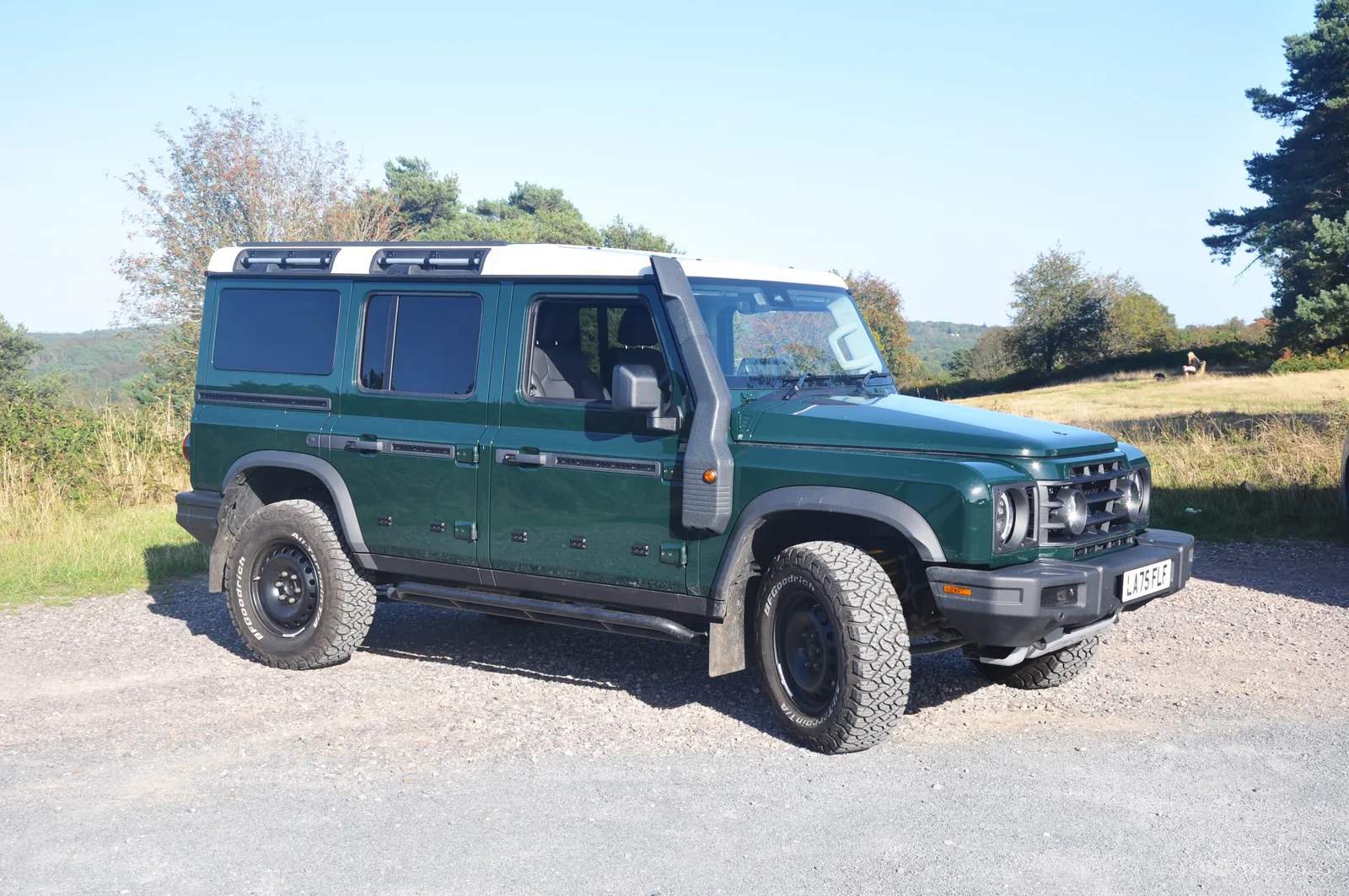
The INEOS Grenadier was specifically designed as a successor to the original Land Rover Defender, the production of which ended in January 2016. (Pete Felstead)
Team Grenadier – the consortium comprising INEOS Automotive, SMT Defence and NMS UK that is bidding solutions based on the INEOS Grenadier 4×4 for the UK Ministry of Defence’s (MoD’s) Light Mobility Vehicle (LMV) requirement – announced on 7 September 2026 it has added Hobson Industries and TVS Supply Chain Solutions to the team.
Hobson Industries is a specialist with 40 years of experience in worldwide vehicle reconditioning and fleet renovation as well as end-of-life vehicle support, while TVS Supply Chain Solutions (TVS SCS) brings decades of experience in parts global supply chain management. Both companies already operate extensively in the defence market.
The new team members join INEOS Automotive as the design authority and manufacturer of the Grenadier 4×4; SMT Defence as the partner applying its expertise in the design, integration and delivery of the Grenadier as a military vehicle; and NMS UK, which as the UK arm of Nurol Makina brings its expertise in armoured and protected mobility solutions while also underpinning Team Grenadier’s in-service support capability and ability to deliver the LMV programme at scale, on time and with long-term resilience.
Enter the Grenadier EPV
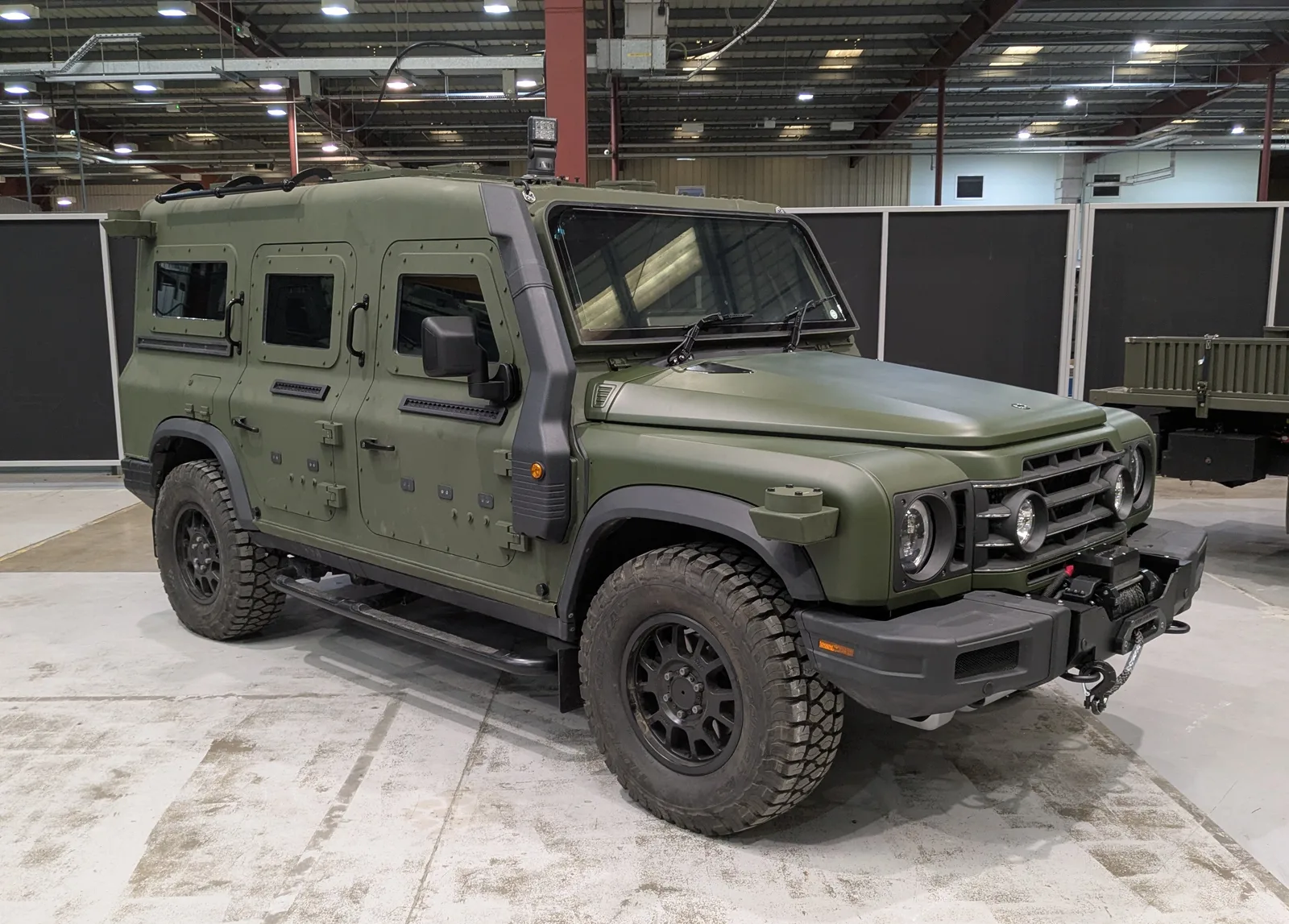
Meanwhile, during an advance briefing to select journalists at NMS UK’s facilities in Leamington Spa on 2 September, Team Grenadier not only introduced the new team members but also unveiled the first example of the Enhanced Protection Vehicle (EPV) Grenadier variant.
Offering armoured protection to NATO STANAG 4569 Level 2, the Grenadier EPV is produced by NMS UK after receiving the base rolling chassis with enhanced suspension from the INEOS Automotive production line in Hambach, France. While the EPV is obviously not an MRAP, mine blast mitigation measures have nevertheless been implemented, such as suspended flooring.
The Grenadier EPV will be displayed on the NMS stand at the upcoming DVD2026 show at UTAC Millbrook in Bedfordshire from 16 – 17 September, while examples of the General-Purpose Vehicle (GPV) and Multi-Role Light Vehicle (MRLV) versions of the Grenadier will be exhibited at the show on the Hobsons stand.
The LMV contest and how it will play out
As part of the UK MoD’s overall Land Mobility Programme (LMP), the LMV requirement is intended to directly replace the UK’s legacy light, mobile tactical platforms, most specifically the Land Rover- and Pinzgauer-based fleets that are due to be retired by 2030. In all nine LMV variants, all to be derived from a common base platform (CBP), have been specified under the MOD’s tender notice, which was formally issued in early August 2026: a General Purpose Vehicle (GPV); a Battlefield Ambulance (BFA); a Tactical Mobility Vehicle (TMV); a Utility Vehicle (UV); an Enhanced Protection Vehicle (EPV); a Command and Control Vehicle (C2V); an Equipment Support Vehicle (ESV); a Troop Carrying Vehicle (TCV); and a Mission Systems Vehicle (MSV).
Somewhat strangely for fleets of vehicles that are expected to serve for 40 years or so, the UK MoD has placed no stipulations with regard to the introduction of electric drive into the LMV requirement, despite its experimentation into such technology in recent years.
Apart from Team Grenadier, numerous other consortia have announced their intention to bid for the LMV requirement, including: Team LionStrike, comprising GM Defense, BAE Systems and NP Aerospace, pitching vehicles derived from the Chevrolet Colorado and GM Infantry Squad Vehicle; Babcock and Supacat, offering the General Logistics Vehicle family built upon the Toyota Land Cruiser 70 Series platform; Ford, GDLS-UK and Ricardo, with a bid leveraging the Ford Ranger commercial pick-up architecture for a scalable, military-grade platform; and Jaguar Land Rover, bidding a range of vehicles based on its current Defender Wolf Series II.
By 19 October 2026 at the earliest the MoD will give three weeks’ notice of the deadline for the competitors to deliver examples of three LMV variants: a General Purpose Vehicle, a Tactical Mobility Vehicle and a Battlefield Ambulance.
The bidders who have successfully delivered these three examples will then see their vehicles competitively trialled, with a final downselect and initial rollout contract then issued, most likely in the spring of 2027. An initial operational capability with the selected vehicles is expected to come in the 2029-2030 timeframe.
The genesis of the Grenadier
The INEOS Grenadier 4×4 is already a commercial success. Since the vehicle went into production in October 2022, around 40,00 vehicles have been sold, primarily to retail customers (the United States is the vehicle’s biggest market) but also to numerous military and blue-light customers, including the Italian military; the French RAID counter-terrorism forces; the German GSG 9 counter-terrorism forces; the Estonian Border Guard; the Czech, German, Polish, Serb, Slovakian, Spanish and UK police forces; Polish mountain rescue units; and multiple UK fire and rescue services.
However, as Lynn Caulder, CEO of INEOS Automotive, noted on 2 September with regard to the UK’s LMV requirement, “Our vehicle was engineered precisely for this purpose; that was the original vision in mind.”
The genesis of the Grenadier, in fact, came as direct result of the end of production of the original Land Rover Defender in January 2016 after a 67-year manufacturing run.
That end of production was especially lamented by Sir Jim Ratcliffe: the billionaire chairman and CEO of the INEOS chemicals group, who was a major Defender fan and who owns the very first production Land Rover (registration JUE 477), which rolled off the assembly line in 1948.
After Jaguar Land Rover declined Ratcliffe’s approach to buy the tooling for the Defender, he sat down with associates in The Grenadier pub in London’s Belgravia district to sketch out a plan to design a successor to the Defender. Subsequent to that, Ratcliffe and his designers convened in a cow shed in the New Forest, southern England, where they assembled a range of legendary 4×4s – including an original Toyota FJ Cruiser, a Willys Jeep ,a Jeep Wrangler, old Defenders, an old Mercedes-Benz G-Wagon and others – and sought to determine what made those vehicles what they were and how they could encapsulate all of those qualities in a new vehicle.
While the Grenadier was being developed it was originally intended that the vehicle would be manufactured in Bridgend, Wales, but in mid-2020 Mercedes-Benz offered up its newly built Hambach factory in Moselle, France, which it had originally intended to use to build 4×4s but ultimately decided was surplus to the company’s requirements. INEOS thus moved the production of Grenadiers to France.
Caulder additionally noted that the UK government at the time declined to offer INEOS Automotive any financial assistance in setting up a UK production line.
Nevertheless, INEOS Automotive asserts that its LMV vehicles would have at least 70% UK content in components alone, while the EPV variant, with NMS UK taking rolling chassis from France and producing the vehicle in Leamington Spa, would certainly exceed this.
The ethos behind the Grenadier
As Warsight spoke to numerous members of Team Grenadier in Leamington Spa on 2 September, it was clear that the company has a clear passion in pursuing the LMV requirement.
Global head of fleet for INEOS Automotive Tony Lewis, a former officer in the Royal Corps of Transport, laid out the company’s ethos in that respect.
“For generations, British and allied forces have relied upon lightweight, highly capable 4×4 vehicles to provide mobility at the tactical edge,” said. “A military vehicle has to work when conditions are difficult, nearly impossible. It has to carry people and equipment. It has to operate away from infrastructure and also meet all the on-road regulations, which for the MoD means you have to turn them on and you have to be able to turn them off. It has to be easy to understand, easy to maintain. It’s got to be resilient to demanding use, and it has to do that repeatedly, reliably, and over years.
“The previous generation of Land Rover Defender actually became almost synonymous with that role,” Lewis continued. “Replacing such a vehicle is therefore not simply about replacing four wheels and an engine; it’s about replacing a philosophy of mobility. The Grenadier is exceptionally well aligned with that philosophy.”
For Lewis it is clearly a personal issue, having founded a trust in honour of his son Conrad Lewis, who served in the British Army’s Parachute Regiment and was the 353rd British serviceman to lose his life in the Afghanistan conflict, where fit-for-purpose protected mobility was certainly lacking for a number of years.
“The Grenadier is the only car on sale today, or indeed in this competition, that I’d walk into a showroom, buy, and take into a theatre at war,” said Lewis.
It is clear that securing the LMV requirement means very much to Team Grenadier: the ultimate affirmation of the ethos on which the Grenadier was conceived and produced.
The Grenadier: a personal view
After attending the Team Grenadier event in Leamington Spa on 2 September, Warsight was kindly offered the chance to take away a Grenadier for a few days to get to know the vehicle first hand.
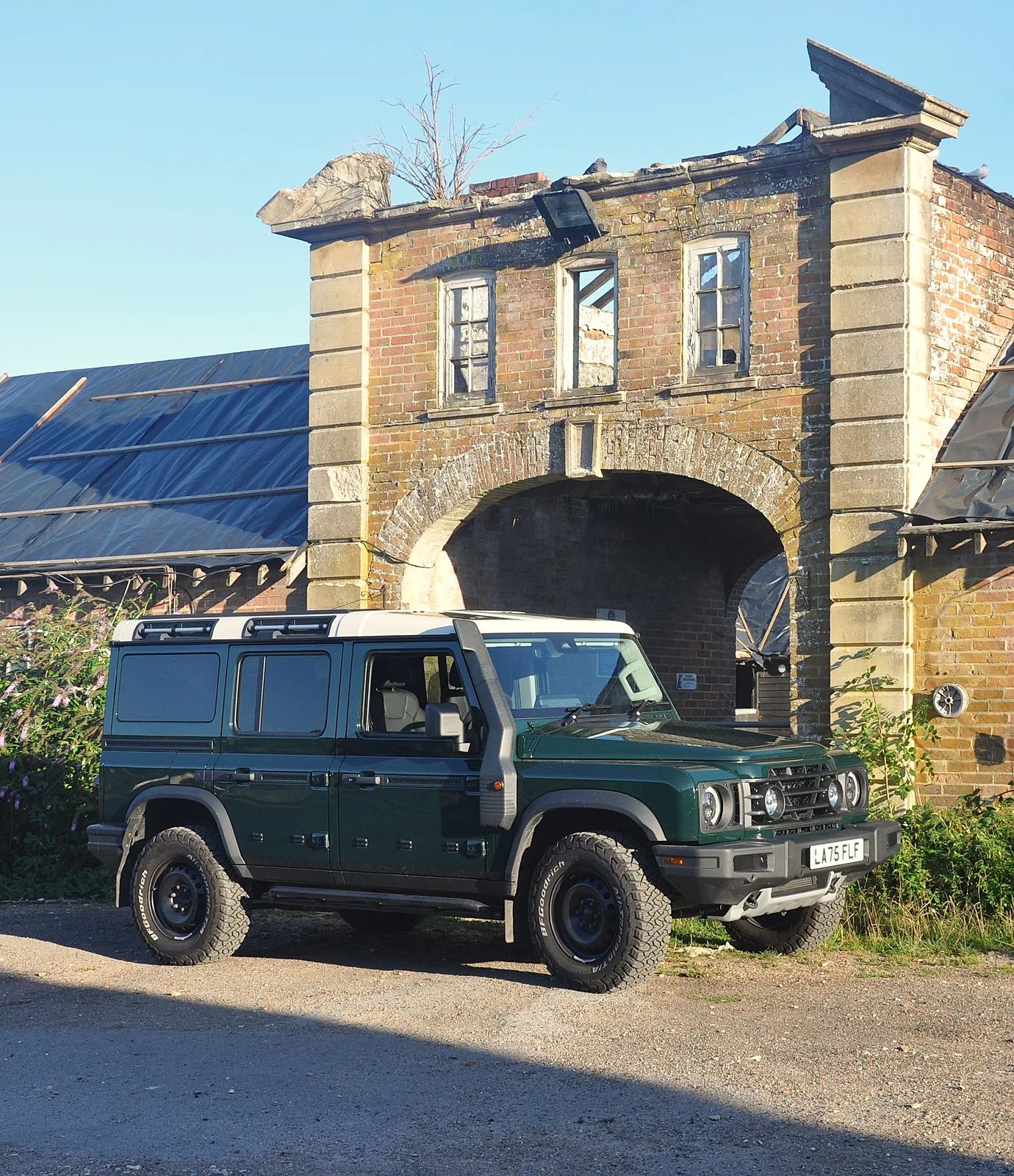
The first stage of this process was to take a Grenadier back to the technical woodland offroad course that journalists had traversed earlier in the day as passengers and to drive it first hand. While this author is clearly not a professional reviewer of offroad vehicles, I have owned and operated multiple 4×4s capable of offroad performance and have driven numerous others. That being the case, I can say that the Grenadier performs at least as well as any other comparably-sized offroader I’ve driven. The choice of tyre, of course, can significantly affect offroad performance – regardless of the vehicle in question – but the versatile BF Goodrich All-Terrain T/A tyres fitted to my Grenadier certainly allowed the vehicle to show its competence.
Then it was a 200 km motorway trip back home to Horley, Surrey, via the M40 and M25: a journey that was certainly comfortable and felt pretty effortless. After that I pretty much used the Grenadier as a family utility vehicle, taking my daughter and the family dog to the Ashdown Forest (undulating B-road terrain) and to the horseyard where my daughter keeps her pony (pretty much all horseyards are degraded semi-offroad terrain). Suffice to say that, after that, I didn’t really want to give it back.
In appearance the Grenadier very much presents itself – very deliberately, of course, given its origins – as a new-generation Land Rover, yet despite having all the mods cons expected of a modern 4×4 the Grenadier is far from being a 21st Century ‘Gucci’ facsimile of a Defender. In fact, significant measures have been taken to make the vehicle as analogue – and thus as squaddie-proof and field reparable – as possible. The Grenadier has a full box-section steel ladder-frame chassis designed for extreme off-road durability and strength, with a traditional suspension system featuring heavy-duty solid-beam axles and Eibach progressive coil springs.
While the new Defender now produced by Jaguar Land Rover has well over 100 electronic control units throughout the vehicle, the Grenadier has just 35, thus minimising any chances of an electronic failure hampering operation.
Numerous other features attest to analogue priorities: the hand brake line, for example, can be accessed simply by unscrewing the cover to the gear selector console, while the lever to raise and lower the driver’s seat is purely mechanical.
Grenadier performance
Performance-wise, the engine and transmission components selected by the Grenadier’s designers are those deemed to be best in class. There are two BMW 3.0-litre turbo-charged inline six-cylinder engines as options, the B57 diesel and B58 petrol powertrains, which offer a maximum power of 183 kW and 210 kW and maximum torque of 550 and 450 Nm respectively. The engine is paired with a ZF eight-speed automatic gearbox (the ZF8HP76 for diesel-powered vehicles and the ZF8HP51 for petrol models). For their deployment in the Grenadier, Magna-Steyr recalibrated and fine-tuned these gearboxes and added a heavy-duty torque converter specifically for offroad work.
Torque and power are sent to the front and rear axles via an INEOS-designed two-speed transfer case built by Tremec. The manually operated two-speed transfer case features a built-in centre differential that is lockable in both high and low range.
Regarding offroad performance, the Grenadier (Station Wagon) has a ground clearance of 264 mm, a wading depth of 800 mm, a maximum departure angle of 36.1°, a maximum approach angle of 35.5° and a maximum side angle limit of 45°.
Payload-wise, the Grenadier has a 3.5-tonne towing capacity, with payload ranges from 689 kg for a fully optioned diesel Trialmaster Station Wagon, 835 kg for a Quartermaster version, through to 871 kg for a base two-seat petrol Utility Wagon. Both the two-seat Utility Wagon and Quartermaster can accommodate a standard Euro-pallet that measures 1200×800 mm.
A cockpit-styled cab
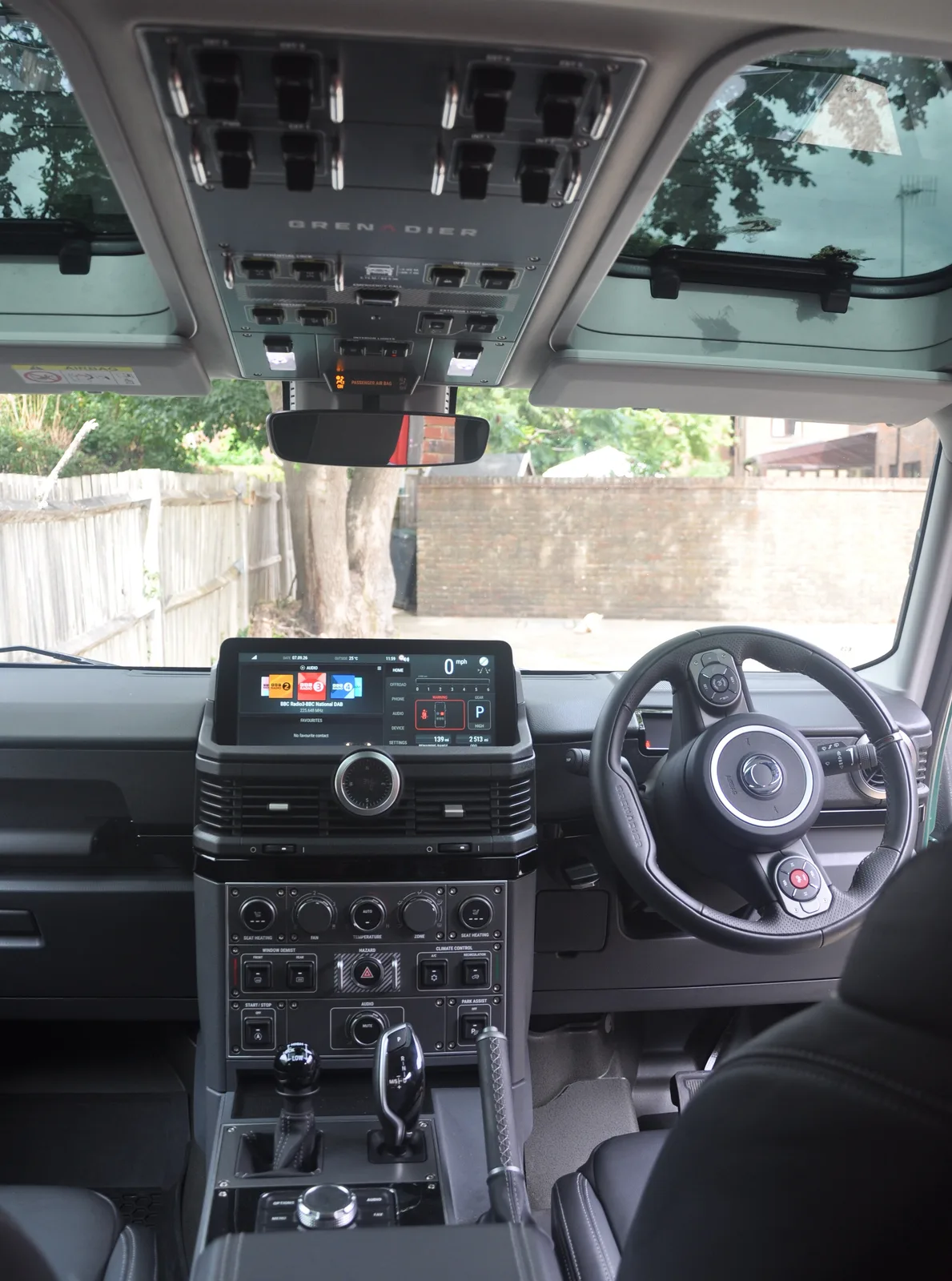
Internally the cab of the Grenadier partially resembles an aircraft cockpit with its roof mounted controls. These include some of the offroad controls, such as multiple differential-lock options and the hill descent function (selectable via the cruise control from 3 to 20 mph), but also include the power switches to four external sockets pre-installed on the edge of the roof (two either side). This means that the installation of, for example, an external lighting rig can be accomplished in around 15 minutes with no drilling into the cab superstructure required.
The main vehicle displays and controls are featured on a central touchscreen display above the dashboard, but crucially these features can also be controlled from a central console behind the gear selectors that features a toggleable selector wheel and push buttons, allowing the features to be selected by a soldier wearing gloves.
Conclusion
In the final analysis the INEOS Grenadier, conceived as it was to replace and considerably surpass the capabilities of the Land Rover Defender of old, appears to be an extensively flexible and capable, British-designed and substantially British-produced solution to the LMV requirement.
A vehicle so clearly over-engineered, moreover, would be very well set to cope with all the additional equipment the British Army would load onto it while remaining a vehicle that is capable, reliable and substantially squaddie proof.
But will that commendable over-engineering come at a cost? Team Grenadier are keenly aware that their vehicle will be more expensive in unit cost terms than certain other LMV contenders vying for the requirement. An INEOS Grenadier Station Wagon can be bought for ‘From GBP 63,495’ (EUR 73,893) from a UK dealership, whereas some other LMV contenders are likely to come in lower than that.
Costs over the life of the LMV programme, of course, would be another matter, especially given the numerous testimonials from blue light/military clients who have reportedly told INEOS that they simply can’t break the vehicle, but will the MoD have the initial budget outlay to take advantage of that? For the answer, we’ll have to wait until the spring.

Share post






You may be interested in
Categories
Used tags
Ad