The UK Ministry of Defence has at long last published its Defence Investment Plan. Notably, the UK’s spending plans lean fairly heavily into uncrewed capabilities. While many of the headline figures are positive, anticipated cost-saving measures also came as part of the package.
UK DIP finally published: It’s a mixed bag
The UK Ministry of Defence (MoD) has finally published its long-awaited Defence Investment Plan (DIP): Equipping our forces, defending our future, on 30 June 2026, more than a year after the 2025 Strategic Defence Review (SDR): Making Britain Safer: secure at home, strong abroad was released.
The headline figure of the DIP is an additional GBP 15 billion for defence over the next four years, bringing the MoD’s total budget to GBP 298 billion out to 2030. Put in context, the GBP 15 billion figure is slightly less dire than initially expected (see below), but nonetheless remains shy of the reported GBP 18 billion aimed for by former Defence Secretary John Healey, and well shy of filling the reported GBP 28 billion budgetary shortfall (known as the budgetary ‘black hole’) out to 2028.
Beyond the top-level summary presented in this article, Warsight will be also performing more granular analyses of the impact of the DIP on each of the main service branches and select domains. These will be linked below as they become available.
The Cyber and Electromagnetic domain
What are the key areas of investment?
Unless stated otherwise, all spending figures refer to the fiscal period running to April 2030.
- UK Defence Nuclear Enterprise (DNE) – GBP 63.6 billion. The MoD stated that this includes four Dreadnought nuclear-powered ballistic missile submarines (SSBNs), 12 SSN-AUKUS nuclear-powered attack submarines (SSNs), and 12 F-35A fighters for the NATO Dual-Capable Aircraft nuclear mission.
- UK naval base refurbishment – GBP 26 billion through 2036 for Project Royal Oak, including upgrades to Faslane, Portsmouth, and Davenport naval bases.
- UK munitions stockpiles and production – GBP 11.1 billion to increase UK stockpiles. The DIP stated that this includes “Deep Precision Strike, low-cost cruise missiles and one-way effectors,” adding, “by 2030, we will have built at least six new energetics factories and increased our national munitions production capacity”.
- Global Combat Air Programme (GCAP) – GBP 8.6 billion.
- Type 26 frigates – GBP 4.1 billion.
- Digital Backbone and Digital Targeting Web – GBP 5.5 billion for the Digital Backbone, and GBP 1.8 billion for the Digital Targeting Web. The latter includes the British Army’s Project Asgard, the Royal Navy’s Maritime Fighting Web, and the Royal Ait Force’s (RAF’s) NEXUS programmes. The DIP also envisions spending a further GBP 17 billion on both the backbone and targeting web between 2030 and 2035, to reach full operating capability.
- Drone procurement – GBP 5 billion. Of this, the MoD stated GBP 650 million will be spent on “inexpensive expendable autonomous systems including drones and uncrewed ground vehicles [UGVs]” for the army, Royal Marines Commandos, and special forces. A further MoD release added that this would include “attack drones flying alongside army helicopters, RAF jets made invisible from enemy detection with new drones, and a hybrid Royal Navy made up of crewed and uncrewed vessels.” This stream will also be used to fund the new Uncrewed Systems Centre in Swindon, and a new Uncrewed Systems Taskforce.
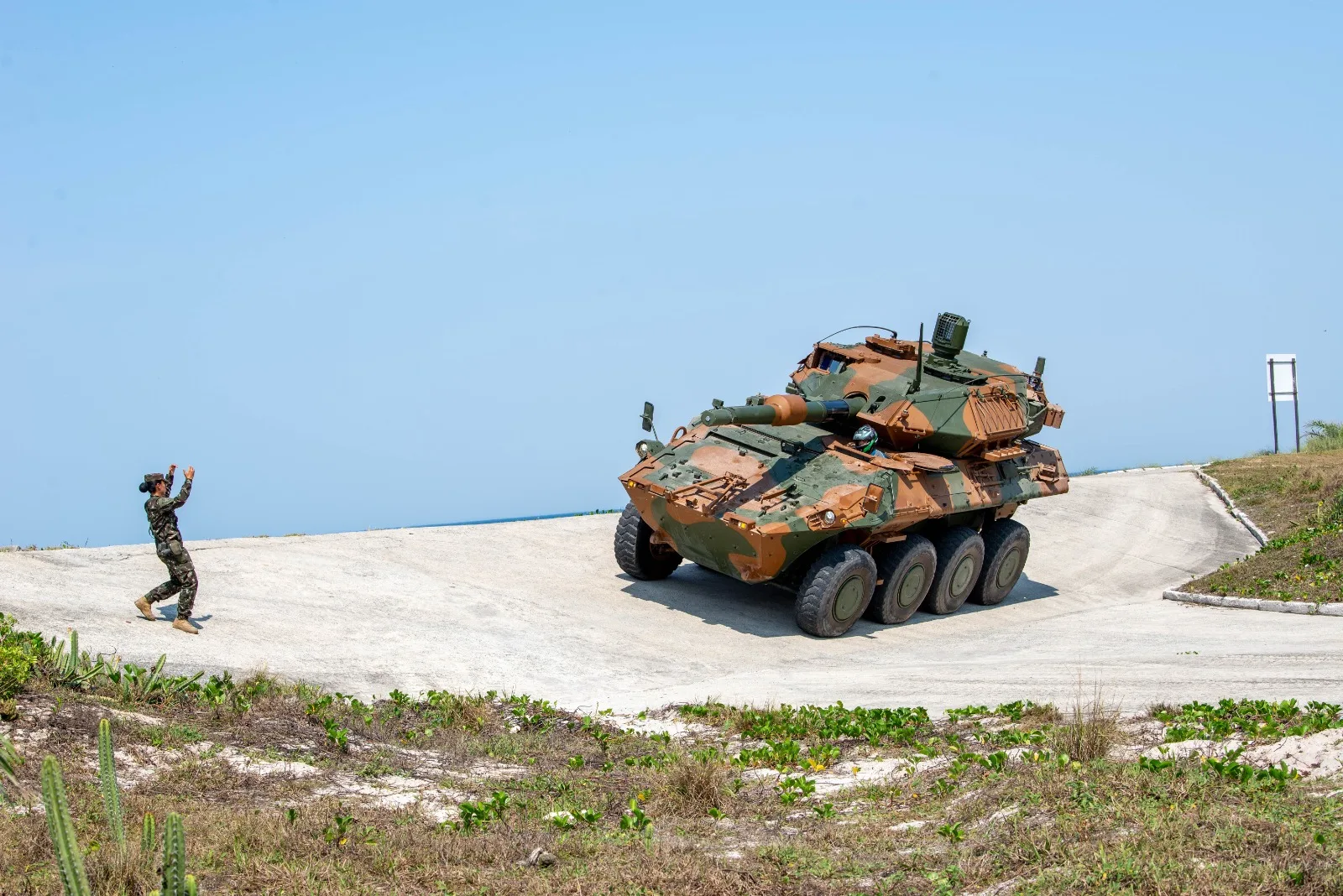
- Boxer 8×8 – GBP 2.2 billion.
- Type 31 frigates – GBP 1.6 billion.
- Common Combat Vessels (CCVs) and Hybrid fleet – GBP 1.3 billion, to be spent on six new CCVs to replace the current six Type 45 destroyers. These are pitched as “the Royal Navy’s first ‘Hybrid’ warship, coordinating uncrewed systems in the air, on the surface and under the sea to deliver more resilient air defence.” These also replace earlier plans for the Type 83 (see below). Alongside the CCVs, the Royal Navy will operate at least four new unmanned platform types:
- Type 91 – Uncrewed missile platforms. Due to enter service by 2030.
- Type 92 – Uncrewed sensing platforms, designed to assist with submarine hunting, and operating alongside the CCVs.
- Type 93 – Extra-large uncrewed underwater vessels (XLUUVs) to work alongside the UK’s SSNs (presumably SSN-AUKUS), to hunt and engage submarines. Due to enter service by 2030.
- Type 94 – Uncrewed sensing platforms, designed to scan for aerial threats.
- Eurofighter Typhoon sustainment – GBP 1.1 billion to sustain the Typhoon force into the 2040s. An MoD official noted, “We’re also going to commit to the long-term evolution of Typhoon, so that will sustain and upgrade the aircraft into the 2040s, and I think it’s true to say that Typhoon will remain the backbone of UK air defence for many years to come.”
- Challenger 3 – GBP 1.1 billion.
- Ajax – GBP 1.1 billion. As Warsight predicted back in March 2026, the programme has not been cancelled.
- Investment in efficiency and procurement reform – GBP 900 million. According to the MoD, this includes “a [GBP] 500 million Transformation Fund to deliver productivity improving investments in AI and workforce transformation, as well as an initial [GBP] 400 [million] contribution to setting up the Multilateral Defence Mechanism.”
- Air and missile defence – GBP 790 million through 2030 for “new homeland Integrated Air and Missile Defence systems,” according to the DIP, “to enhance protection of the UK homeland and overseas bases from air, drone and missile threats.” An MoD official said of this would include “upgrading C2 and connectivity of homeland air defence,” and “homeland counter-drone capabilities for a significant number of fixed sites across the UK.”
- Land Mobility Programme – GBP 500 million for the Light Mobility Vehicle (LMV) programme to succeed the Land Rover and Pinzgauer vehicles, and the Heavy Protected Mobility (HPM) programme to field a 6×6, in which the Patria 6×6 (CAVS) is the overwhelmingly likely candidate.
- Future Commando Force – GBP 450-500 million for the Royal Marines Commandos to be transformed into the Future Commando Force. This includes equipping the force with the Joint Commando Craft (JCC) being jointly procured with Norway. [Note: There was a discrepancy between the original press release which said “over [GBP] 500 million”, and the DIP, which gave a lower figure of GBP 450 million.]
- Collaborative Combat Aircraft (CCA) – GBP 300 million, with a demonstrator slated to fly by 2030. An MoD official explained “We’re going to be starting a collaborative combat air programme with an initial investment of [GBP] 300 million, which we’ll build on, and that will likely, I think, result in some form of international partnership, but we’ll see.”
- Hybrid Carrier Air Wing – Close to GBP 240 million. Under Project Pantheon, the UK aims to develop and trial jet-powered drones to eventually operate as part of a hybrid carrier air wing alongside the UK’s F-35Bs.
- Rapid AI Delivery (RAID) taskforce – GBP 100 million to “accelerate the deployment of AI-enabled capabilities” to the armed forces, according to the MoD, adding that “on top of this, the government is investing [GBP] 115 million to raise the UK’s defences against the threats from AI,” with the latter understood to come via a separate funding stream.
As expected, the DIP also included cost-saving measures, with GBP 7 billion to be cut from resource departmental expenditure limit (RDEL) and a further GBP 3.7 billion to be cut from capital departmental expenditure limit (CDEL). This totals GBP 10.7 in cuts the MoD must make by April 2030. Some of the areas to be cut were highlighted by the DIP, or by MoD officials during a briefing attended by Warsight, while in other areas, the cuts are likely identifiable through omission.
What are the headline cuts and savings?
- Shadow R1 – At an MoD briefing, an official told journalists “we will be retiring some of our older surveillance platforms, and we will be looking at the retirement of the Shadow aircraft from service.” Another official added, “more broadly, we’ll be looking, as part of the investment in autonomy, where ISR [intelligence, surveillance, and reconnaissance] assets can perform functions that are currently performed by manned craft.”
- Type 83 destroyer – The MoD stated that the Common Combat Vessels “will replace earlier plans for a Type 83 destroyer. Rather than concentrating capability in a small number of large, expensive ships, the Royal Navy’s shift to a hybrid navy will mix crewed and uncrewed capabilities and be more suited to the pace and nature of modern warfare.”
- Helicopters – At the MoD briefing, an official said the spending plan “will require us to delay some of our ambition around helicopters, including the phased retirement of some of our older Chinooks, as they reach maintenance milestones, and the Wildcat battlefield reconnaissance helicopter, which we will start to retire from 2027. I think the Wildcat’s a good example of the changing balance between crewed and uncrewed in the DIP. The idea of sending a crewed helicopter forward over any enemy lines to visually search for targets doesn’t feel like it makes any sense in a modern battlefield. So we will invest in new uncrewed technology to do that job in the future.”
- Infantry fighting vehicles (IFVs) – Quite notably, the DIP made absolutely zero mention of the UK’s Warrior IFV, nor of any envisioned replacement for it. The UK’s Warrior fleet was initially intended to be retired from service by 2025, but its service life was quietly extended. Given that there is very little time to begin fielding a replacement by its retirement date, it is likely that either Warrior’s service life will be extended yet again, or that the IFV will simply be retired without a direct replacement. Another possibility is that the MoD will procure a turreted Boxer 8×8 to fill this role, albeit at the expense of tracked mobility.
[UPDATE 02/07/2026: Since this piece was published, the MoD responded to a Warsight query on Warrior, confirming that it would begin being retired from 2027, “with all vehicles scheduled to be withdrawn from service by the end of the decade.” No mention was made of a forthcoming replacement]
The DIP that finished off an ailing government
To say this DIP had a long and torturous journey to publication would be an understatement. The DIP was originally expected to emerge around 1-2 months after the SDR in late summer 2025, but the deadline repeatedly slipped. Initially, the rumours suggested it would be published in September to coincide with DSEI 2025, then this moved to November, then December.
At this point, it became clear that the DIP would need to do more than was originally envisioned, with Air Chief Marshall Richard Knighton, the Chief of Defence Staff, reported to have briefed Prime Minister Kier Starmer that the MoD faced a GBP 28 billion funding shortfall out to 2028.
By January 2026, the rumours said the DIP would emerge in March, but still nothing came, and the rumours began to state that the DIP might not be released publicly at all. By this point it became clear that the delay was the result of fundamental divisions between the Ministry of Defence (MoD) and the Treasury on the level of funding the latter was willing to apportion to the defence of the realm.
According to a 7 May Financial Times report, two DIP funding proposals existed at the time, a GBP 12 billion package favoured by the Treasury, and a GBP 18 billion package favoured by the Cabinet Office. According to an official quoted by the FT report, “[GBP 12 billion] will mean cuts, [GBP 18 billion] means deferrals or delay”. By June, the former package was reported by The Times to have been raised to GBP 13.5 billion over four years, but this was seen as inadequate by the MoD.
By June, the MoD’s divisions with the Treasury boiled over, resulting in the resignation of three MoD ministers, including Defence Secretary John Healey, Armed Forces Minister Al Carns, and Defence Parliamentary Private Secretary (PPS) Pamela Nash. In their resignation letters, all three squarely panned the inadequate level of funding the Treasury was willing to provide for the DIP.
Prior to these resignations, many hoped that the Prime Minister would be able to step in to resolve the impasse between the MoD and the Treasury, but Starmer, already weakened by several of his key allies resigning, and amid his party’s mood souring on his leadership, was evidently either unwilling or unable to resolve the issue. Despite the PM reacting quickly to appoint Dan Jarvis as the new Defence Secretary, the damage, it seemed, had been done.
Consequently, just 11 days after the MoD resignations, on 22 June, Starmer himself announced he would be stepping down as PM in July. While Starmer had been facing mounting pressure to resign prior to Healey, Carns, and Nash’s resignations, the latter appeared to have been the final nail in the coffin for Starmer’s government. The former mayor of Manchester and newly-elected Makerfield MP Andy Burnham is widely expected to replace Starmer as PM before the end of July. Despite this, Starmer was reported to have given Jarvis a deadline to publish the DIP before the 7 July NATO summit in Ankara.
Prior to the DIP’s publication, Warsight assessed that Jarvis had relatively little scope for manoeuvre. His two choices seemed to be:
- Push through a slimmed-down ‘diet’ DIP the Treasury would be willing to fund, after three resigning ministers had panned it.
- Attempt to fight the Treasury and likely be held up by the same impasse Healey faced.
To be fair to Jarvis, he was indeed able to secure some additional concessions from the Treasury, with The Telegraph reporting on 26 June that the sum apportioned to the DIP had now increased GBP 14.5 billion. By the day of the DIP’s publication, this figure reached GBP 15 billion. While a positive step, this nonetheless still fell shy of the GBP 18 billion sought by Healey, which, lest we forget, was itself shy of covering the MoD’s GBP 28 billion budget shortfall to 2028.
Providing some explanation of where the additional money had come from, in a briefing prior to the DIP publication, an MoD official explained to journalists, “The plan is built on the department having an additional GBP 15 billion of spending power against its previous plans agreed in the last spending review. That comprises an additional GBP 11.6 billion of new cash from the Exchequer for the department, and GBP 3.4 billion of increased spending power, by transferring risk for spending lines, like the burden of Ukraine security guarantees, from MoD to the Exchequer. That releases GBP 15 billion in total.”
In terms of the impact this would have on the annual defence budget figure, during a speech given by Prime Minister Keir Starmer just hours before the DIP’s publication, the PM stated, “[In 2024], this country spent GBP 54 billion on defence. We are taking this to almost GBP 80 billion per year by 2029. That is a real-term increase of 27%. From spending 2.3% of GDP on defence in 2024, we are raising it to 2.7%, putting us on a trajectory to reach 3% in the next parliament.”
So after its long journey to publication, where does the DIP leave the UK’s armed forces? Broadly speaking, the DIP sees the UK making some serious investments it should have made long ago, such as in uncrewed systems, air defence, long-range fires, and digital targeting networks. These investments are broadly positive and if these programmes proceed on schedule, should put the UK armed forces of 2030 into a better position to face the threats of the modern battlefield than they are today. Having said that, the MoD is no stranger to procurement problems, so it remains to be seen if the spending plans outlined will be fully realised.

Share post