The UK Royal Navy (RN) has developed a new capability designed to build capacity to deploy anti-submarine warfare (ASW) sensing more widely across its crewed and uncrewed platform fleets. It demonstrated this capability at the recent Robotic Experimentation and Prototyping with Maritime Unmanned Systems (REPMUS) 2026 exercise, which takes place each September around Portugal’s Tróia peninsula.
The core of the capability is the Sonix VHF receiver and processor hardware and software package; developed by the Australia-based defence supplier TKMS Sonartech Atlas, the package receives and processes sonobuoy transmissions. The Sonix system is already deployed on German Navy vessels. The RN’s broad concept is to deploy it on board crewed platforms (including those not originally designed for ASW operations) and especially on uncrewed surface and airborne platforms to expand the navy’s autonomous sonar sensing capacity.
The package’s unique selling point is being platform- and sonobuoy-agnostic, a military adviser to the UK Ministry of Defence’s Defence Science and Technology Laboratory (Dstl) told a media briefing at REPMUS.
“What we’ve been doing over the last four years is developing a low-cost, platform-agnostic sonar sensing capability that can be scaled and deployed at pace to support the growth in autonomous platforms,” the military adviser said.
ASW capability development
The RN has been developing the capability, including through REPMUS, since 2022-23. The navy has been focused on finding an affordable system that also could be developed relatively quickly. Sonobuoys met the affordability requirement, are interoperable and are ideally sized to be deployed by relatively smaller platforms like uncrewed aerial vehicles (UAVs) and uncrewed surface vessels (USVs).
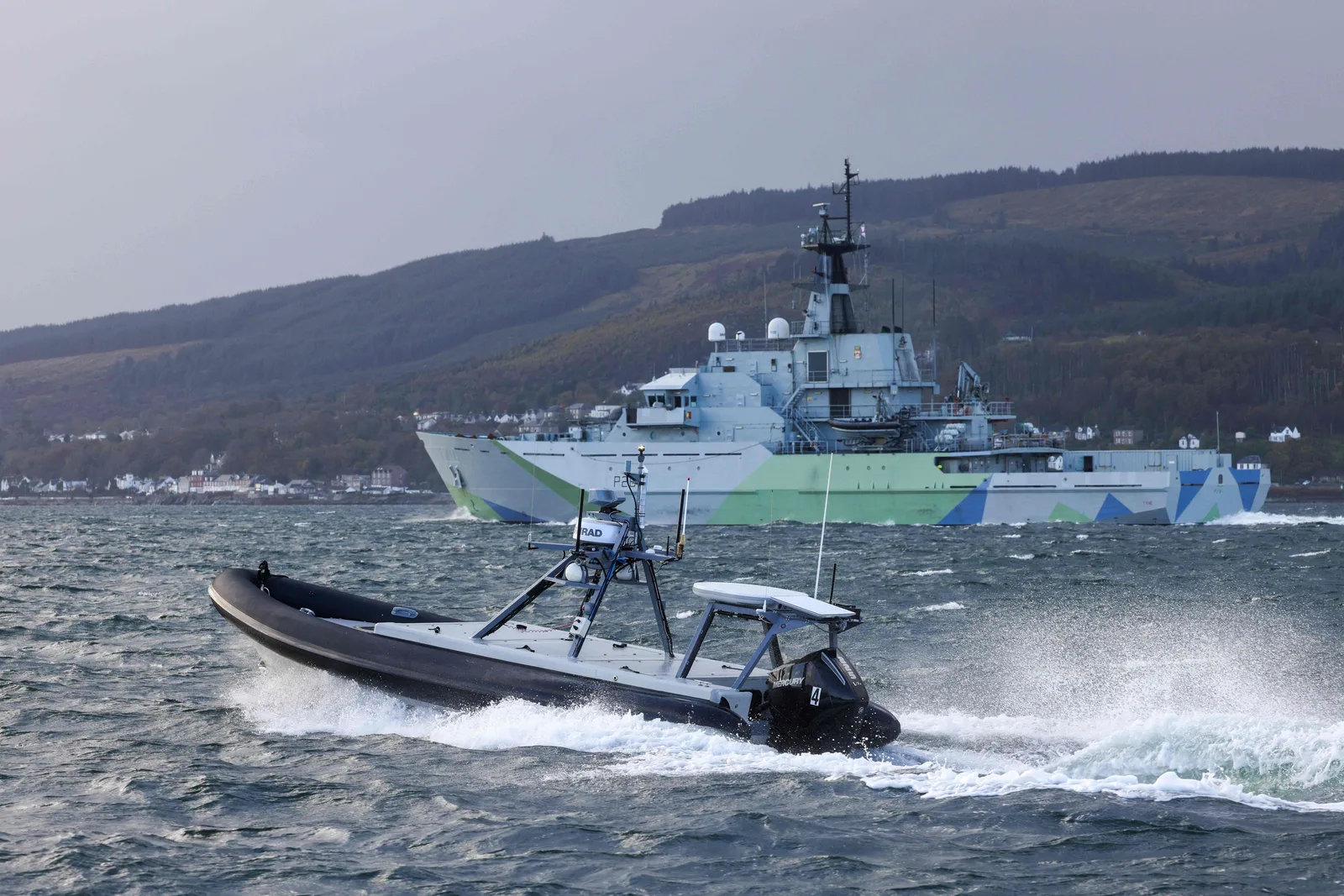
At REPMUS the system was deployed on UAVs including the Tekever AR5 and USVs like ZeroUSV’s Oceanus17.
Also present at REPMUS was Finnish company Kelluu’s airship, which is designed to deliver forward-deployed, persistent intelligence, surveillance and reconnaissance (ISR). Able to patrol for up to 12 hours, the airship can generate on-station sensing for much longer periods than maritime patrol aircraft (MPAs) or organic helicopters. Kelluu plans to increase the airship’s persistence even further with an improved version.
The RN’s Sonix system was not fitted to the airship for REPMUS 26, but the navy’s intent over the next year is to implement this integration, the military adviser said. “If we’ve got the sonobuoys being deployed by autonomous systems, we’ve got the ability … to put a persistent air vehicle out there that increases the [sensing] range, as the VHF transmissions from the sonobuoys are line of sight,” he added.
Sonobuoy spread
“[The various launching options] give us the ability to get sonobuoys out there,” the military adviser continued. “We can also exploit sonobuoys that have been dropped by MPAs and helicopters.”
Sonobuoys are usually paired with larger ASW platforms like frigate/helicopter packages or MPAs. Work the RN has conducted since establishing its project, including collaborating closely with the supplier on science and technology aspects, has addressed the requirement to modify the Sonix package for hardware and software compatibility with smaller autonomous platforms. Such modifications have encompassed component miniaturisation and developing a smaller form factor for fitting on board UAVs, for example.
Another development underway has been layering artificial intelligence (AI) onto the sonar processing part to enable autonomous (rather than human) processing of the acoustic data, including contact and track information. Processing is currently done ashore, but the aim over the next 12 months is to build capacity for ‘edge processing’ on the platforms themselves, the military adviser said. This development would reduce bandwidth requirements and data latency while offering real-time processing capacity.
To support effective command and control (C2) and information sharing in a NATO operational context on board any host platforms, the RN has also developed the package to comply with Standardisation Agreement (STANAG) 4817: the alliance’s common architectural framework for enabling maritime uncrewed systems operations. STANAG 4817 compliance allows all vessels to automatically report their positional data and share C2 and other information.