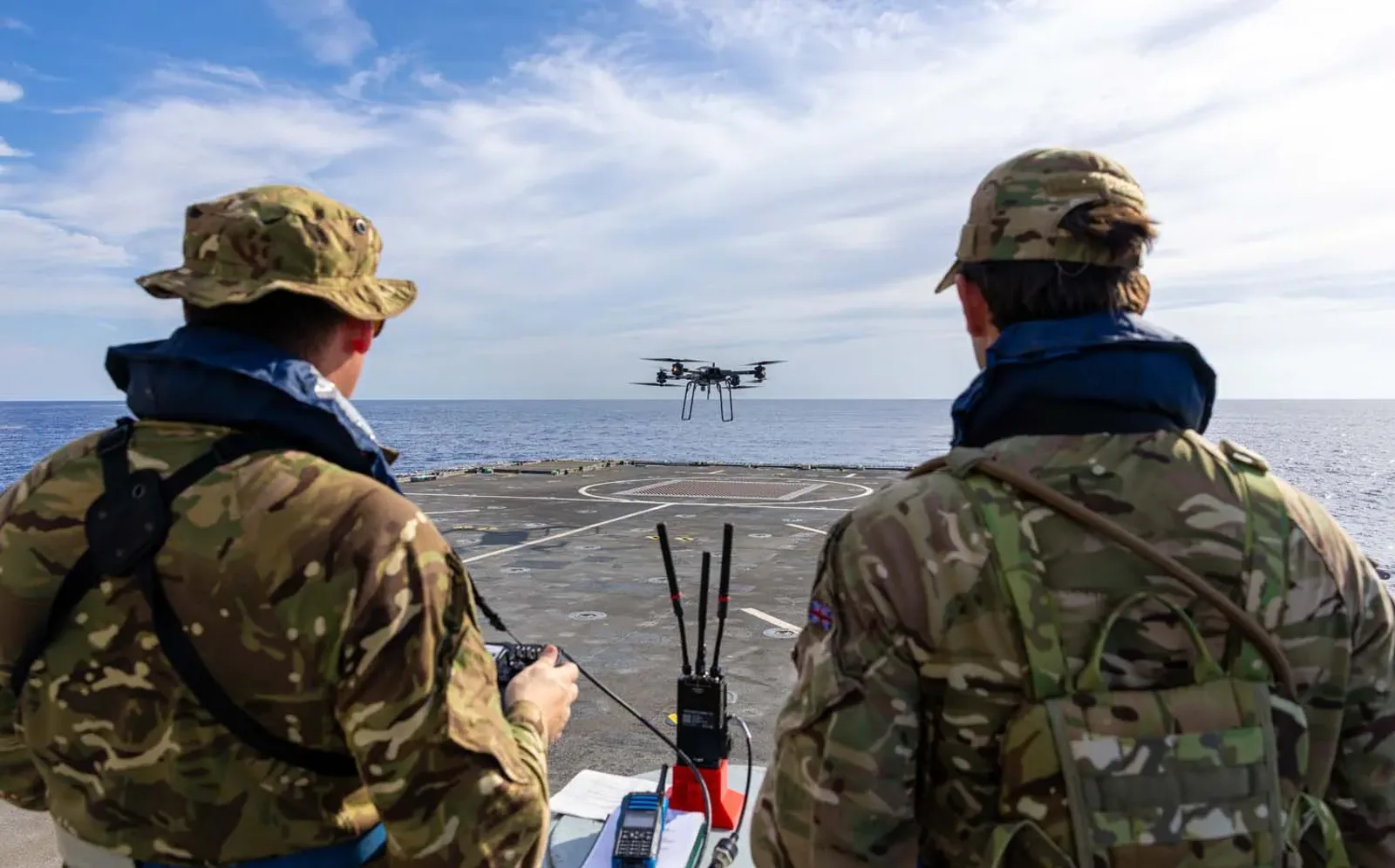
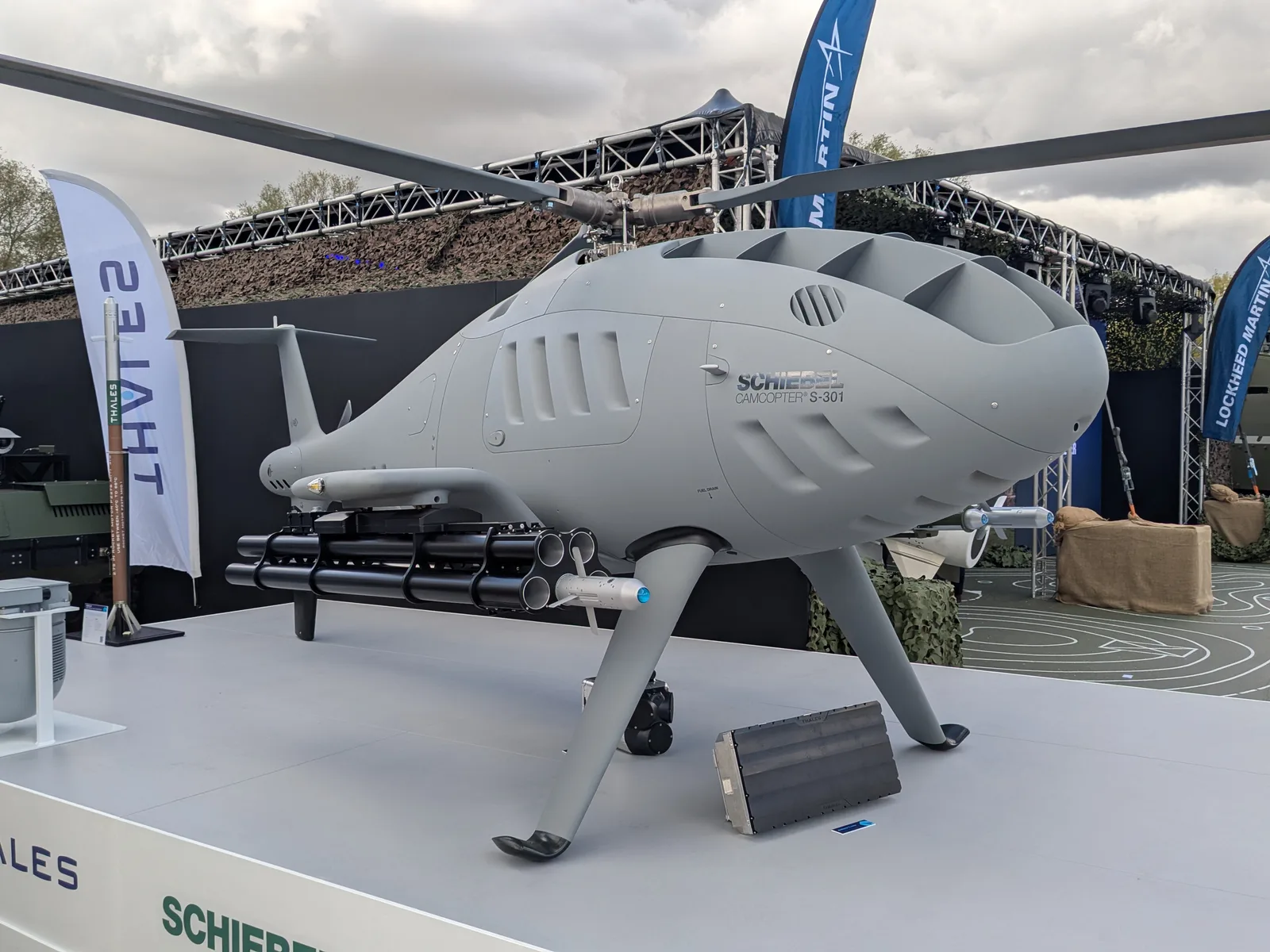
Thales UK displayed a Camcopter S-301 rotary-wing unmanned aerial vehicle (UAV) produced by Austrian manufacturer Schiebel at its stand at the DVD 2026 event, held at held at the UTAC Millbrook Proving Ground in Bedfordshire from 16-17 September. Configured with dual pods armed with Thales FZ275 70 mm laser-guided rockets, the S-301 was a representation of the company’s ongoing work in developing autonomous UAV capabilities for both the Royal Navy and British Army.
Under Project Peregrine Thales (as prime contractor) and Schiebel successfully integrated and operationalised a pair of Peregrine rotary-wing UAVs, based on the smaller Camcopter S-100, under a GBP 20 million (EUR 23.3 million) urgent capability requirement for the Royal Navy initiated in 2023. Operating as intelligence, surveillance and reconnaissance (ISR) assets featuring the Thales I-Master radar, the Peregrine UAVs made their debut aboard the Type 23 frigate HMS Lancaster in the Gulf of Oman and Persian Gulf in early 2025. The capability was formally declared ready for frontline operations by the Royal Navy on 11 September 2025.
Meanwhile, under the British Army’s Project Nyx concept demonstrator programme, Thales UK was one four companies selected in May 2026 to develop autonomous UAV wingmen for the army’s fleet of AH-64E V6 Apache Guardian attack helicopters (the other companies being Anduril Industries (UK), BAE Systems and Tekever). The Project Nyx UAVs are designed to act as a forward screen of autonomous collaborative platforms (ACPs) that would extend the reach of the British Army’s attack aviation assets while enhancing the survivability of the manned Apaches.
As laid out in the UK Defence Investment Plan (DIP), under Project Nyx the British Army aims to spend GBP 220 million on procuring 24 armed autonomous UAVs to operate alongside its AH-64E Apache helicopters by 2030.
Speaking to Warsight at DVD 2026 on 16 September, Matt Moore, deputy sales director for ISR at Thales UK, explained that under Stage 2 of Project Nyx an invitation to tender will soon be released, probably by the end of September/beginning of October. Under this one or perhaps two competitors will move forward, said Moore, in an effort that will culminate at NATO’s Exercise ‘Steadfast Defender 2027’, which “is expected to see collaborative aircraft working together in an autonomy-led, commanded not controlled environment”.
“We’ve just done our demonstration last week to the Nyx assessment team,” said Moore. “The other three [contenders] over the next couple of weeks will be doing the same.”
Thales, the S-301 and Project Nyx
Speaking of the capabilities of the S-301, Moore said, “This aircraft can carry up to 300 kilogrammes. It has a flight envelope up to 15,000 feet, a speed of around 120 knots at dash and, depending on the system configuration, it’s a mix of payloads and endurance. If we take the Peregrine payload at the moment, so an I-Master radar, an EO/IR payload and an AIS capability, this system will carry that sensing ISR capability for 20 to 24 hours, so it’s quite considerable in terms of its persistence and range protection.
“When we arm it, what we’re proposing here is the FZ275 made by Thales,” Moore added, noting that this weapon is a direct equivalent to the Advanced Precision Kill Weapon System (APKWS) produced by BAE Systems. The FZ275, which has a range out to 7 km, is currently made by Thales in Belgium, but the company is looking to produce the weapon at its facilities in Belfast, thus obviating any supply problems with the APKWS, which is currently very much in demand. Thales is also equipping the FZ275 with a proximity fuse for the counter-drone mission.
Moore noted that the S-301 can be armed with 14 FZ275s and still have a double the endurance of an Apache helicopter.
The S-301 can also be armed with Thales 8 km-range Light Multirole Missiles (LMMs) for increased lethality, of which Moore said it could carry around 10, as well as Thales Toutatis loitering munitions, which feature a 30 km range, a 30-minute endurance and a one 1 kg blast-fragmentation warhead.
A Schiebel Camcopter S-300 made its first flight in the UK in the first half of September 2026 as part of a capability demonstration for the British Army and Royal Navy.
Moore additionally noted that “the big journey in Nyx is the autonomy journey” – and most specifically providing a sovereign UK capability in that respect. Regarding this Thales has an entity called cortAIx: an AI autonomy incubator and accelerator that the company is using to feed into its effort under Project Nyx.