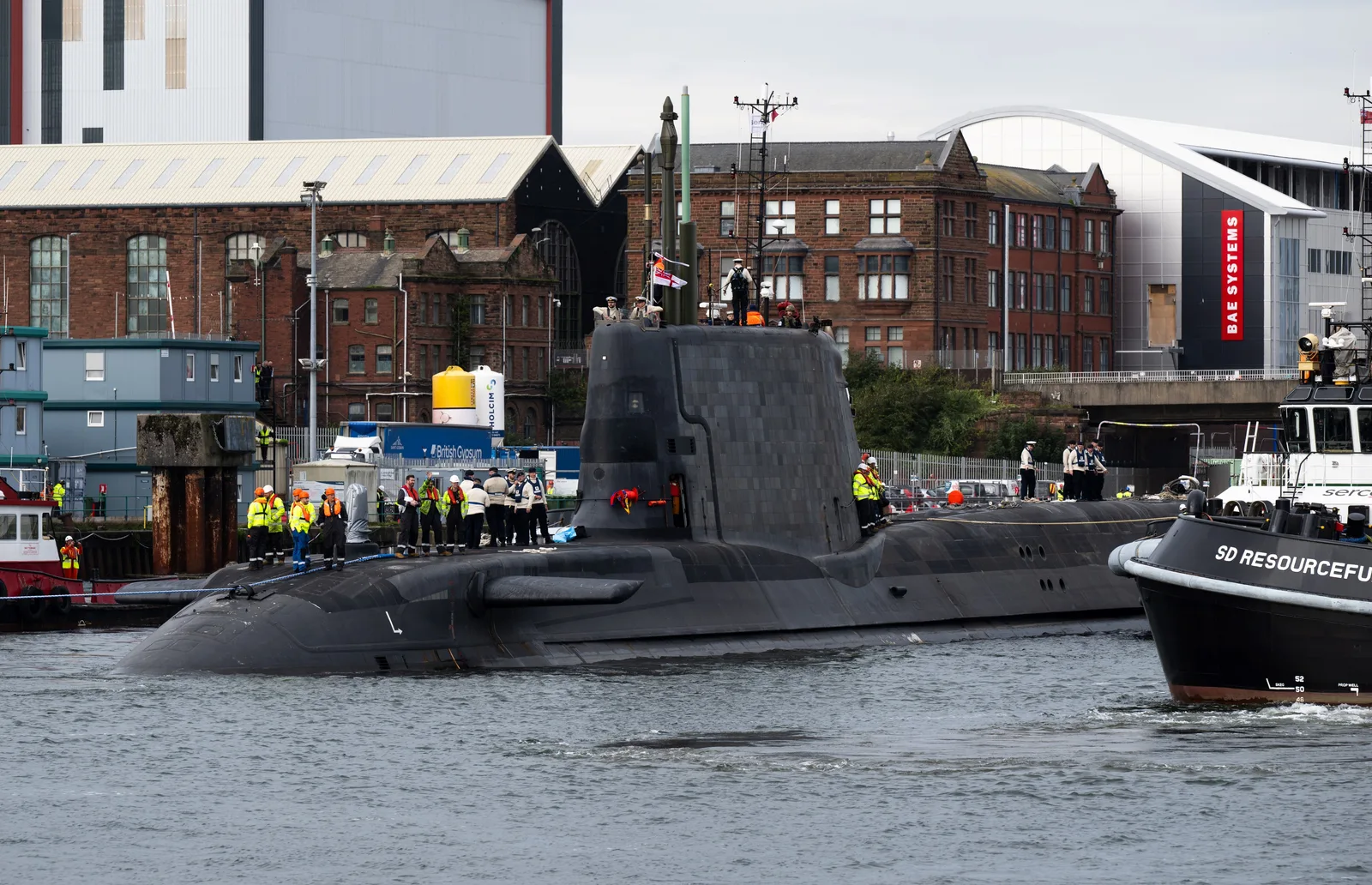
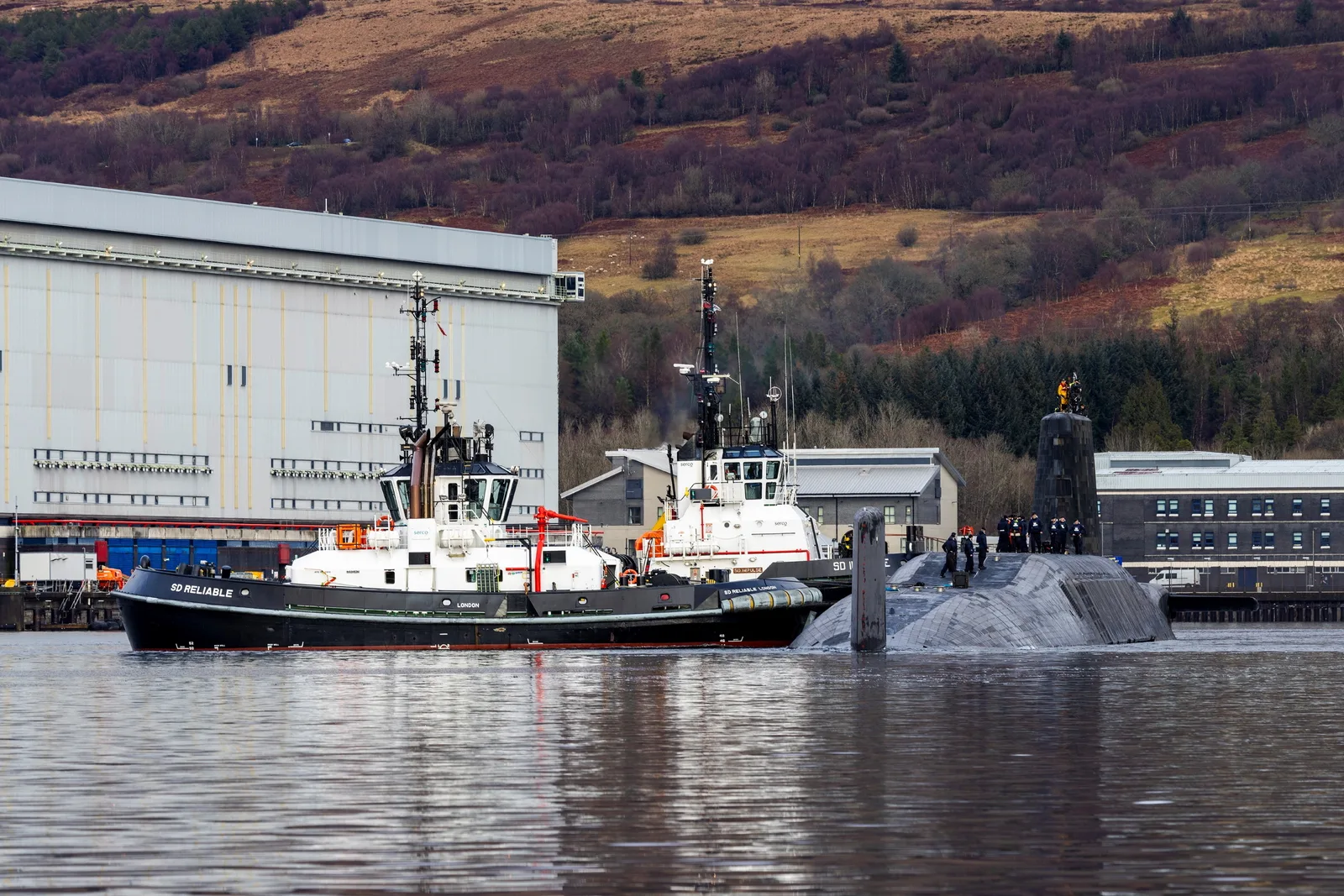
The UK Ministry of Defence (MoD) announced on 25 September 2026 that the sixth of seven Astute-class nuclear-powered attack submarines (SSNs) to be operated by the Royal Navy (RN), HMS Agamemnon, had departed the BAE Systems shipyard in Barrow-in-Furness and was headed for His Majesty’s Naval Base (HMNB) Clyde in Faslane, Scotland. The boat will now begin sea trials ahead of joining active service with the RN.
In the MoD press release there was much applauding of this event. UK Defence Secretary Wes Streeting, for example, was quoted as stating, “Deterrence is the bedrock of our national security. Another formidable attack submarine going to sea strengthens that deterrence and demonstrates how we are stepping up to meet the threats of a more dangerous world.”
The First Sea Lord, General Sir Gwyn Jenkins, added, “In an increasingly dangerous world, sea power remains fundamental to keeping our country and people safe. Our submarine fleet is essential to that effort, which is why I am delighted that HMS Agamemnon, the sixth of our Astute-class submarines, has now begun sea trials and will soon arrive at HMNB Clyde to join the fleet.”
The Astute class: an invisible fleet
However, there is no getting around the fact that the RN’s SSN fleet is pretty invisible – and not for the right reasons. For one thing it has been over 13 years since the keel of Agamemnon was laid at Barrow on 18 July 2013 and more than a year since the boat was officially commissioned on 22 September 2025, which navylookout.com remarked was “an exceptionally protracted construction and commissioning period”.
Moreover, HMS Agamemnon leaving Barrow-in-Furness for its journey to HMNB Clyde made it the only Astute-class SNN at sea. The current status of the RN’s other six Astute-class SSNs is believed by Warsight to be as follows:
- HMS Anson, having deployed to Australia in February 2026, was then deployed to the Arabian Sea in March 2026 amid US/Israeli hostilities with Iran, but arrived back in Devonport on 27 May and is currently alongside awaiting maintenance;
- HMS Audacious arrived at HMNB Devonport in April 2023, possibly having sustained damage during a Mediterranean patrol in late 2022, and is in the process of returning to service after a period of extended maintenance;
- HMS Astute arrived at HMNB Devonport in June 2025 for a Mid-Life Re-Validation Period (MLRP), which is a process that is expected to take multiple years;
- Both HMS Ambush and HMS Artful are non-operational at HMNB Clyde, having last put to sea in August 2022 and mid-2023 respectively;
- Achilles, the last boat of the Astute class, is still in build at the BAE Systems shipyard at Barrow-in-Furness.
When approached by Warsight with a view to verifying the status of the RN’s submarine fleets, the UK MoD has always declined to comment, citing sensitivities regarding the operations of RN submarines.
Addressing the infrastructure issue
The RN’s fleet of nuclear-powered ballistic missile submarines (SSBNs) has suffered a similarly low availability rate, and the reason for that is the same: there is simply not enough onshore infrastructure to maintain and overhaul the UK’s SSN and SSBN fleets at anything other than a minimal pace.
HMNB Clyde, for example, currently has just one shiplift that can be used to raise a submarine out of the water for maintenance work.
The UK MoD’s Defence Investment Plan (DIP), published on 30 June 2026, defined measures to address this situation, including: upgrading submarine maintenance docks at HMNB Devonport within a wider process of enhancing support capacity there for RN operations; and improving infrastructure at HMNB Clyde to boost support for in-service and future submarines. Notably, the DIP specified acquisition of three floating dry docks and other infrastructure at Faslane to enable “resilient out-of-water engineering for all submarine classes”.
On 28 September 2026 the UK chancellor, John Healey, announced that the orders for the three floating dry docks at Faslane, worth GBP 6 billion (EUR 6.99 billion) and part of a wider GBP 15 billion upgrade to the facilities at Faslane, will go to a UK-based shipbuilder. Strangely, that could end up being Spanish shipbuilder Navantia through its UK arm, Navantia UK, which owns the Harland & Wolff shipyard in Belfast, along with related production sites at Appledore in Devon, Arnish on the Isle of Lewis, and Methil in Fife.
Another option is Babcock International, whose Port Babcock Rosyth facility in Fife features three dry docks that can accommodate ships and submarines. In a move that now appears very short-sighted, the active RN submarine maintenance facilities at Port Babcock Rosyth were phased out in 2003 in favour of consolidating the work at Devonport and Faslane.