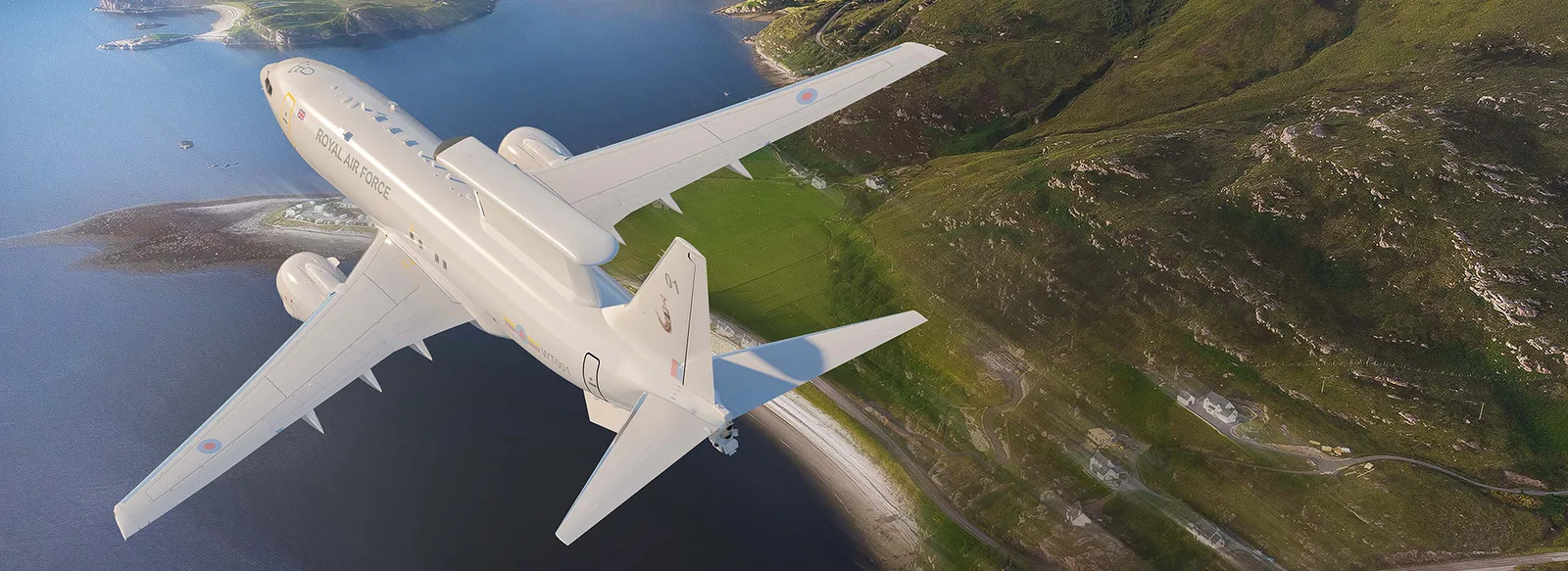
Baulkwill noted that confirmation in the DIP that the Typhoon would remain in Royal Air Force (RAF) service “well into the 2040s and beyond” was “a major, major piece of news … that is great for ourselves in the UK, but also our customers and partners around the globe”, cementing as it does the importance of the aircraft’s Long Term Evolution (LTE) programme.
“That extension of Typhoon, coupled with Long-Term Evolution, will allow us to do something really very exciting and that is the control and the teaming with collaborative combat aircraft: these uncrewed capabilities that everybody is talking about. And be under no illusions: they are the future,” he said.
Delivering at pace
Baulkwill noted, however, that the UK Chief of the Air Staff, Air Chief Marshal Sir Harv Smyth, has asserted that air capability is not about what generations of aircraft you have. “And he’s right,” he said. “It’s about what you can do and when you can do it.”
Baulkwill signed off by noting that the Typhoon had achieved “a million flying hours” and that there would be “many more millions to come on this aircraft”.
Next up, Chris Moon, the Director for Future Capabilities on Typhoon at BAE Systems, said that, while the Typhoon is a great platform because it has excess power and extensive, proven weapon capabilities, a key current and future necessity for combat air is the ability to deliver new capabilities at pace. He noted, though, that the RAF’s Typhoon fleet has been doing this ever since its first operational deployment, in March 2011 during Operation ‘Ellamy’ over Libya.
“There was capability delivered at pace there,” said Moon. “Then, Project Centurion delivered new weapons onto Typhoon at pace, and again a few years ago some of us were involved when we delivered even more capability at pace to our customers when Russia invaded Ukraine.”
More recently, in response to the threat in the Middle East and elsewhere from one-way attack drones, BAE Systems’ Advanced Precision Kill Weapon System (APKWS) kit, which converts unguided 70 mm rockets into low-cost laser-guided missiles, was integrated onto the Typhoon in a matter of months and deployed on Typhoon operations out of Cyprus in May 2026.
The APKWS-on-Typhoon challenge
Briefing on the challenges of that APKWS integration, Andrew ‘Blyty’ Mallery-Blythe, BAE’s Typhoon Operational Requirements Manager and test pilot, noted that, as far back as September 2025, the company was originally looking at a feasibility study focused on integrating APKWS that didn’t work. The company then moved to what Mallery-Blythe termed an “austere integration” of APKWS onto Typhoon under a revised 18-month plan.
“From there we started brainstorming, concepting and tried to figure out how we were going to integrate this rocket into the aircraft. From my point of view, I was really focused on where the pilot’s attention would be and the pilot’s workload,” he said.
“Unlike some of the more modern weapons, some of the beyond-visual-range weapons, this was most definitely a short-range weapon inside of five miles. And that creates a different way of thinking: intercepts inside of five miles and very dynamic geometry changes,” Mallery-Blythe explained. “If your attention’s in the wrong place for a few seconds, you find yourself rolling out 10 miles behind your target instead of two miles behind your target where you want to be.
“Added to that was the complexity of guiding the weapon,” he continued. “The weapon’s laser guided, so that requires the pilot’s attention to be on the targeting. The pilot has to find the target with the radar. Some of these targets are small and tricky to find with the radar; you’ve got to work with the radar to find some of these targets. You’ve then got to transition across to the targeting pod and put your attention into the targeting pod. Find the target in the pod, get it into a point track mode, and eventually fire the laser before employing the rocket. You’ve got to do all of that while you’re dynamically manoeuvring the aircraft into a position to conduct an intercept and get into a position so that you’re in range.”
“So this is a high workload activity,” Mallory-Blythe noted. “From that point of view, the pilots, myself included, recognised that we really wanted to take advantage of the extant displays and controls and the HOTAS [the hands on throttle and stick controls on the flight control column].”
He noted that the pilots ultimately won that argument, but added cryptically that the decision” would result later on in some extremely beneficial aspects and some that would later come back to cost us.
“So fast forward then to March of 2026, when I was lucky enough to find myself in a position to be employing the first of the APKWS rockets off the aircraft using that austere capability,” said Mallory-Blythe. “We did that as an air-to-surface firing. We were trying to prove safe carriage and separation of the rocket. If we can also prove guidance and hit the target, that is very much a bonus. And that went extremely well.”
The rocket, he said, hit a target barge on an offshore range just 40 cm from the aimpoint. “That ended up being on day three of the Iran campaign, and clearly the primary threat in that part of the world was the very target that this weapon in an air-to-air context was designed to counter,” he added.
At this point the APKWS trial almost became a victim of its own success.
“There was an unbelievable amount of focus on what we just achieved, and our customers were very much, ‘Well, you’ve just done this. We want that weapon on our aircraft now, now, now’,” Mallory-Blythe recalled. What wasn’t necessarily obvious was that, although we were on this 18-month programme, we were less than halfway through it, so what we had because of that decision to use the aircraft extended HOTAS was a single-shot capability. We could fire one rocket and we had no ability at that stage to fire the laser in an air-to-air capacity, so we didn’t really have the capability that our customer thought we had at that stage. And this was really where the overwhelming effort and the incredible collaborative effort between ourselves and the RAF – and incredibly innovative engineering – we saw take place over the next few weeks was really seen ….
“The result of that incredibly intense period of work was that the aircraft entered service with a full 14-shot capability and the ability to designate air-to-air targets with the targeting pod laser and successful trials on the part of 41 TES [the RAF’s No 41 Test and Evaluation Squadron] with engagement of air-to-air drones.
“So the capability is out there,” Mallory-Blythe concluded. “Reflecting upon that, we now have a template to do things rapidly.”