During exercise Freedom Shield 26-II, Germany’s 45th armoured brigade practised contested river crossing Lithuania. Dutch engineers, Norwegian infantry and Lithuanians trained alongside the Bundeswehr. Here, the brigade’s commander, Brigadier General Christoph Huber, explained how he pictures the battle of the future, and how his troops are already using FPV drones and loitering munitions. This article originally appeared on Defence-Network.
Tanks test the waters: Germany’s 45th armoured brigade trains in Lithuania
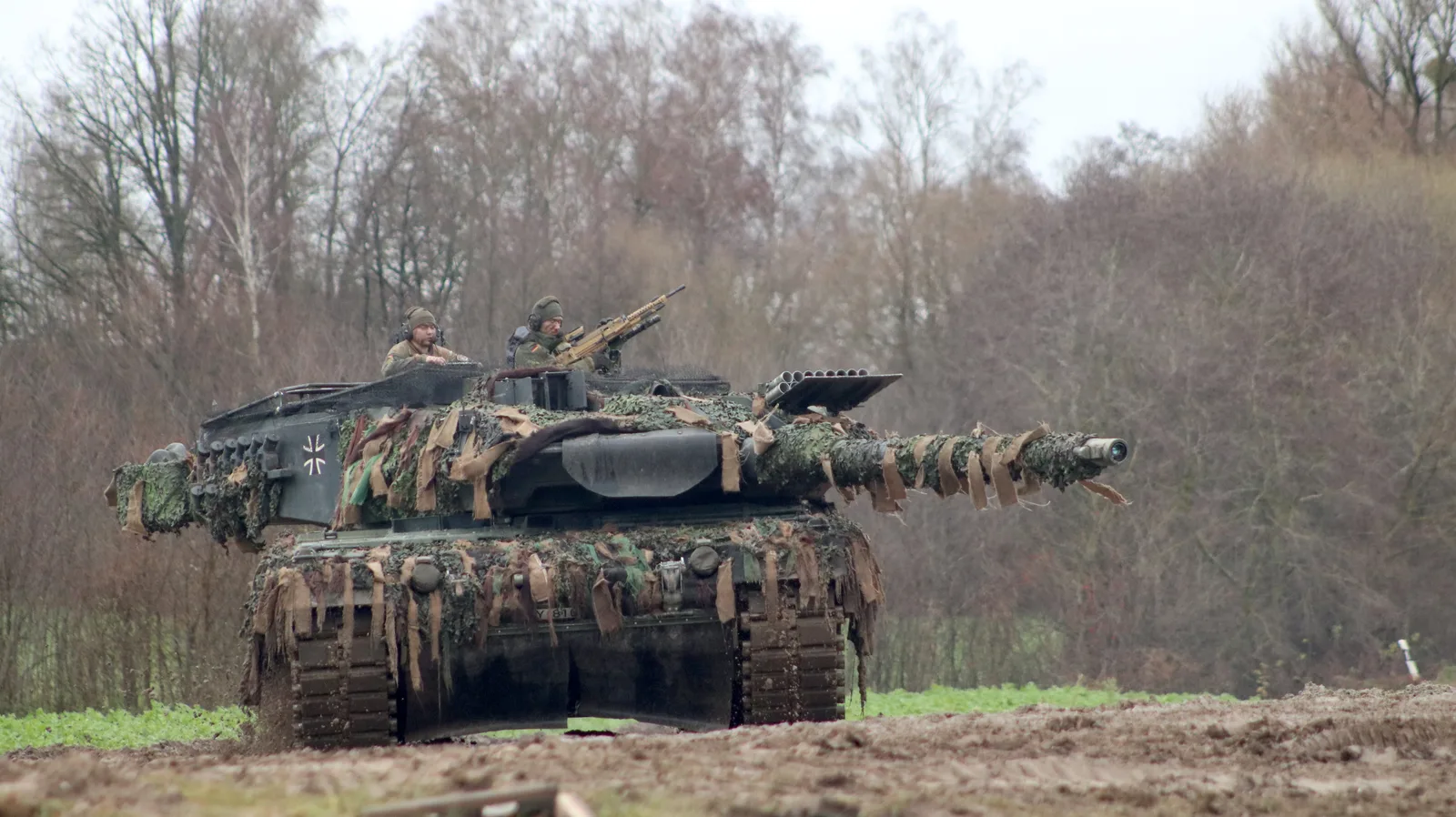
A Leopard 2A6 draped in camouflage netting. This one lacks the cage-style mesh that other tanks had stretched over their turrets as overhead protection against drones. (CPM/Navid Linnemann)
The rain falling on the trees, meadows and riverbanks about 40 km south of Kaunas on the morning of 20 November 2026 seemed to have followed Brigadier General Christoph Huber from Munster. The day before, Lieutenant General Christian Freuding, Germany’s Army Chief, had formally stood up the remaining elements of the 45th Armoured Brigade there, and Huber had then handed over command of two battalions and two companies to their new commanders.
By the end of 2027, a total of 4,800 soldiers and 200 civilian Bundeswehr employees are to be permanently stationed in the country; about 2,800 are already there. While the missing units are built up in Germany, ready to deploy to the Baltics in 2027, their commander flew ahead, bringing along the kind of weather infantrymen know well.
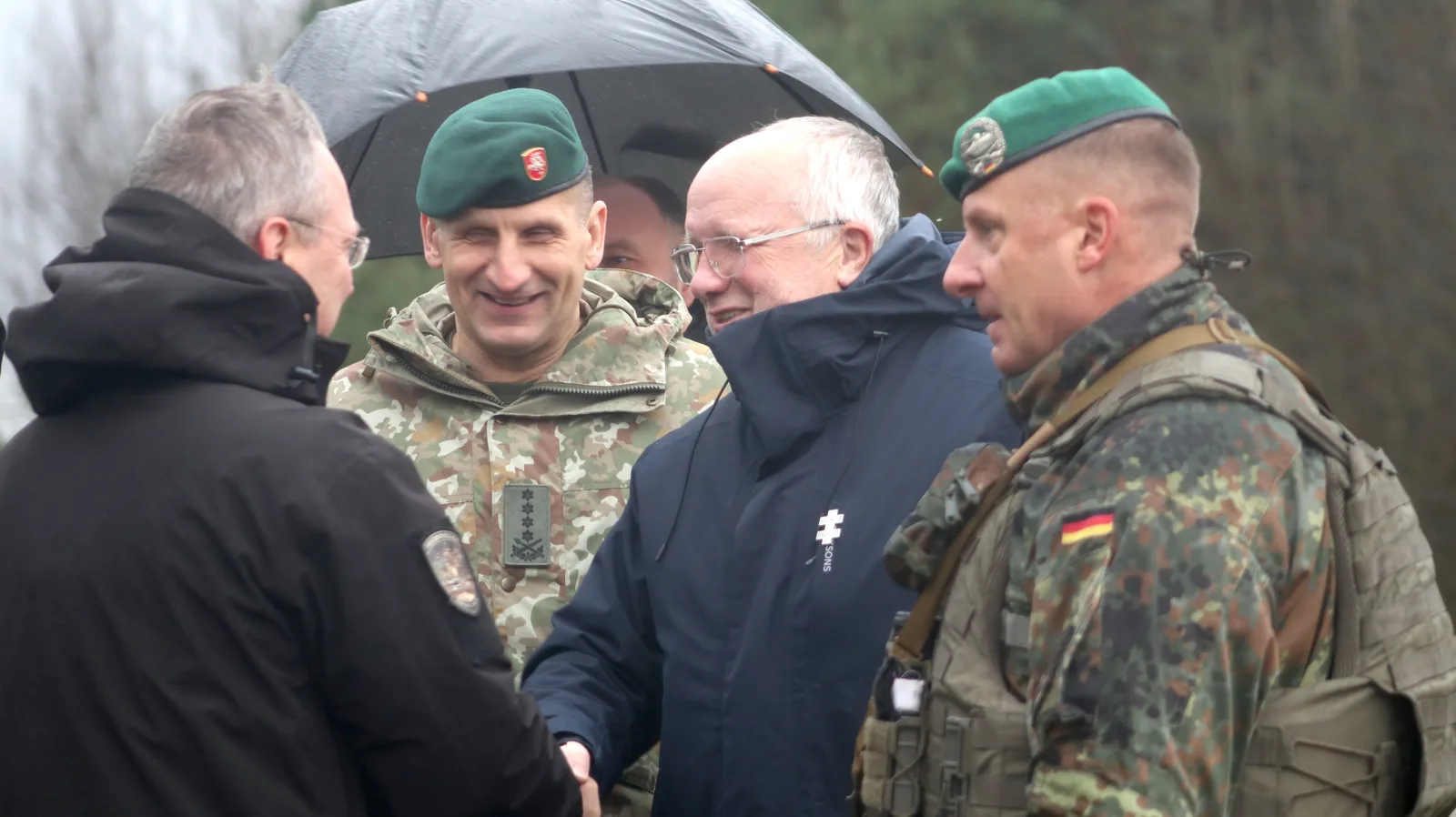
Now Huber stood in the mud in a protective vest, his MP7 slung across his chest, between the Speaker of the Lithuanian parliament, the German ambassador and the commander of the Lithuanian armed forces. The ground was churned up by tank tracks, with a few islands of lush green grass left. Then came the signal to start.
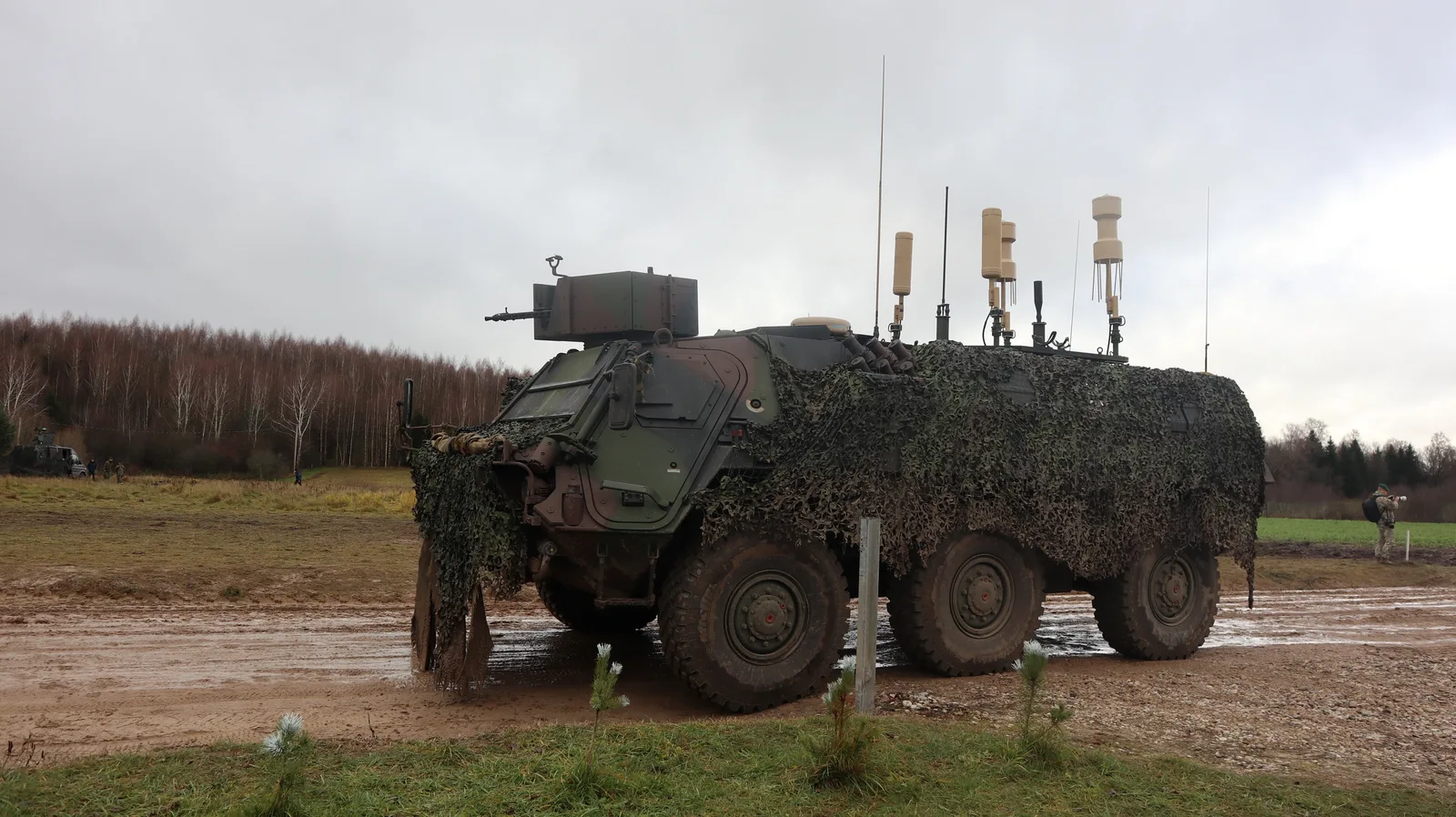
A red flare sinks to the ground on the far bank of the Nemunas river. A roar follows. Two Leopard 2A6 tanks sprint out of the nearby woods, fire across the river and take up position. A Gereon unmanned ground vehicle (UGV) sends a tethered surveillance drone hovering overhead while a Sonobot 5 surveys the water. A Fuchs A1 ‘Hummel’ jamming vehicle moves up, a diver slips into the water, and two CV90 infantry fighting vehicles (IFVs) pull up close to the bank behind low scrub. Somewhere in the forest, a Wiesel 2 Ozelot very short-range air defence (VSHORAD) vehicle is still waiting.
Freedom Shield 26-II: The brigade at work
“Here at the river, we’re first carrying out extensive combat and crossing operations under realistic conditions,” Huber tells his guests. In all, 3,800 soldiers are taking part in the two-week exercise. They include the troops already stationed there and Germany’s 203rd Tank Battalion, which sailed over with 274 vehicles. That is 900 more than took part in Freedom Shield 26-I in early summer 2026. The brigade had spent the prior two days training with 122nd Mechanised Infantry Battalion from Oberviechtach in Bavaria.
Now it is the turn of the Multinational Battlegroup. This formation is also part of the 45th Armoured Brigade. Aside from Germans, it includes soldiers from Belgium, Croatia, the Czech Republic, Luxembourg, the Netherlands, and Norway – the latter of which brought the CV90s. “We’ve also integrated a Lithuanian company from the ‘Iron Wolf’ Brigade into our battalions, and they’re truly outstanding warriors,” Huber said.
While the focus here is on establishing a bridgehead and getting a whole battalion across, elsewhere in Lithuania troops are practising a capability the Bundeswehr barely has yet: loitering munitions. The brigade has already received 100 of them, the first Bundeswehr unit to do so.
Only on 19 November 2026, the OWE-V Virtus from Stark and the HX-2 from Helsing, both designed for combat ranges of 100 to 130 kilometres, completed their Hot Strike campaign. In it, the Bundeswehr’s WTD 91 test centre tested the entire kill chain, from approach to target through to the warhead’s effect. The 45th Armoured Brigade now gets to find out whether the systems deliver beyond the firing range, in realistic tactical situations, as their manufacturers promise. A video shared on social media shows the first footage.
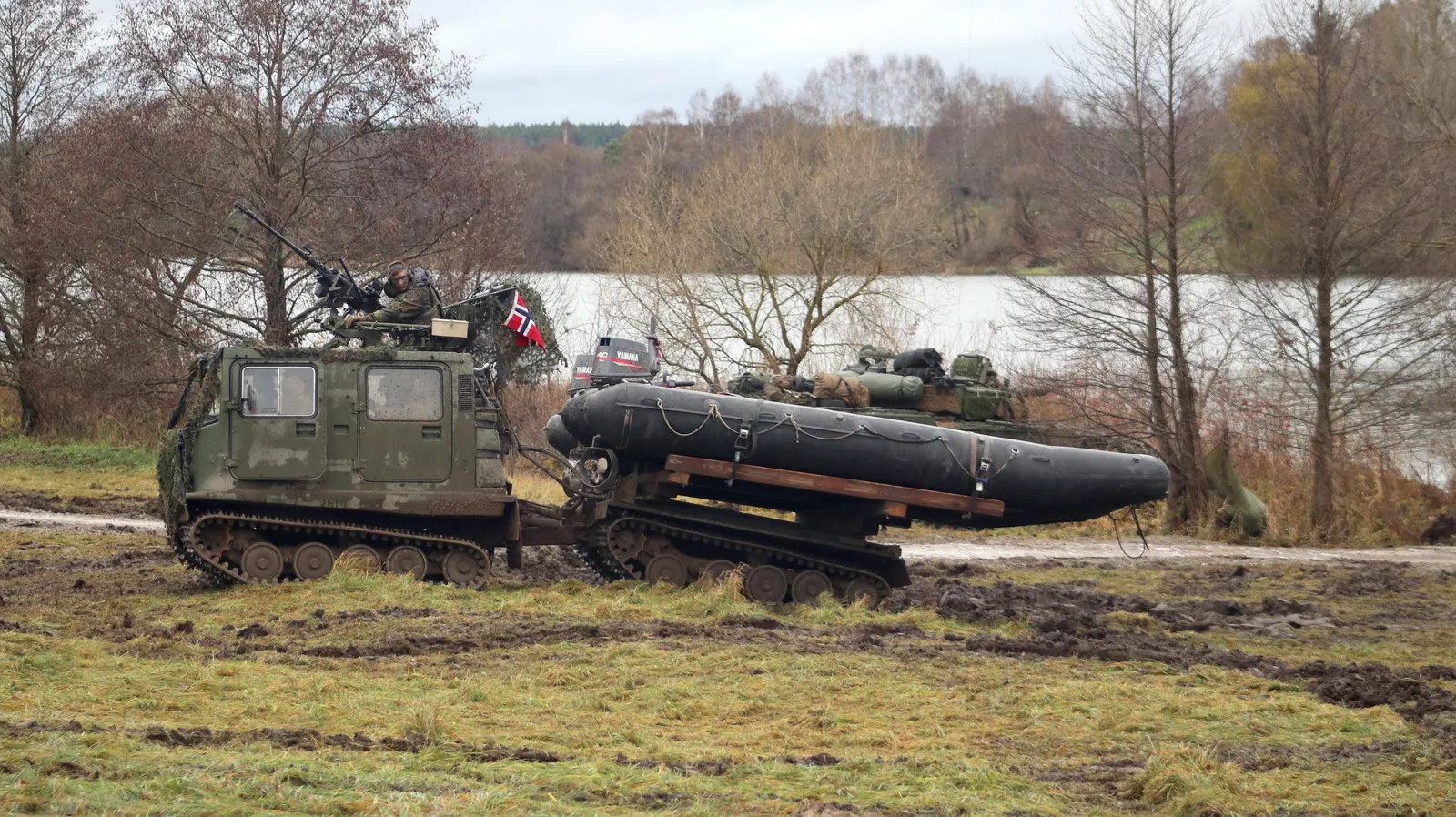
Back on the bank of the Nemunas, the rear ramps of the CV90s open. A dozen Norwegian and German soldiers jump out and run toward a Bv 206 tracked personnel carrier that has just arrived, flying a Norwegian flag. This Bv206 has brought two inflatable boats. The soldiers lift them off, carry them at a run to the water and cross to the far bank under covering fire.
Halfway across, three drone swarms buzz after them. These are Q-X quadcopters from Munich-based Twentyfour Industries, and the 45th Armoured Brigade is already being supplied with these short-range FPV drones. As they reach the far bank, the panzergrenadiers go ashore to attack the enemy positions spotted there.
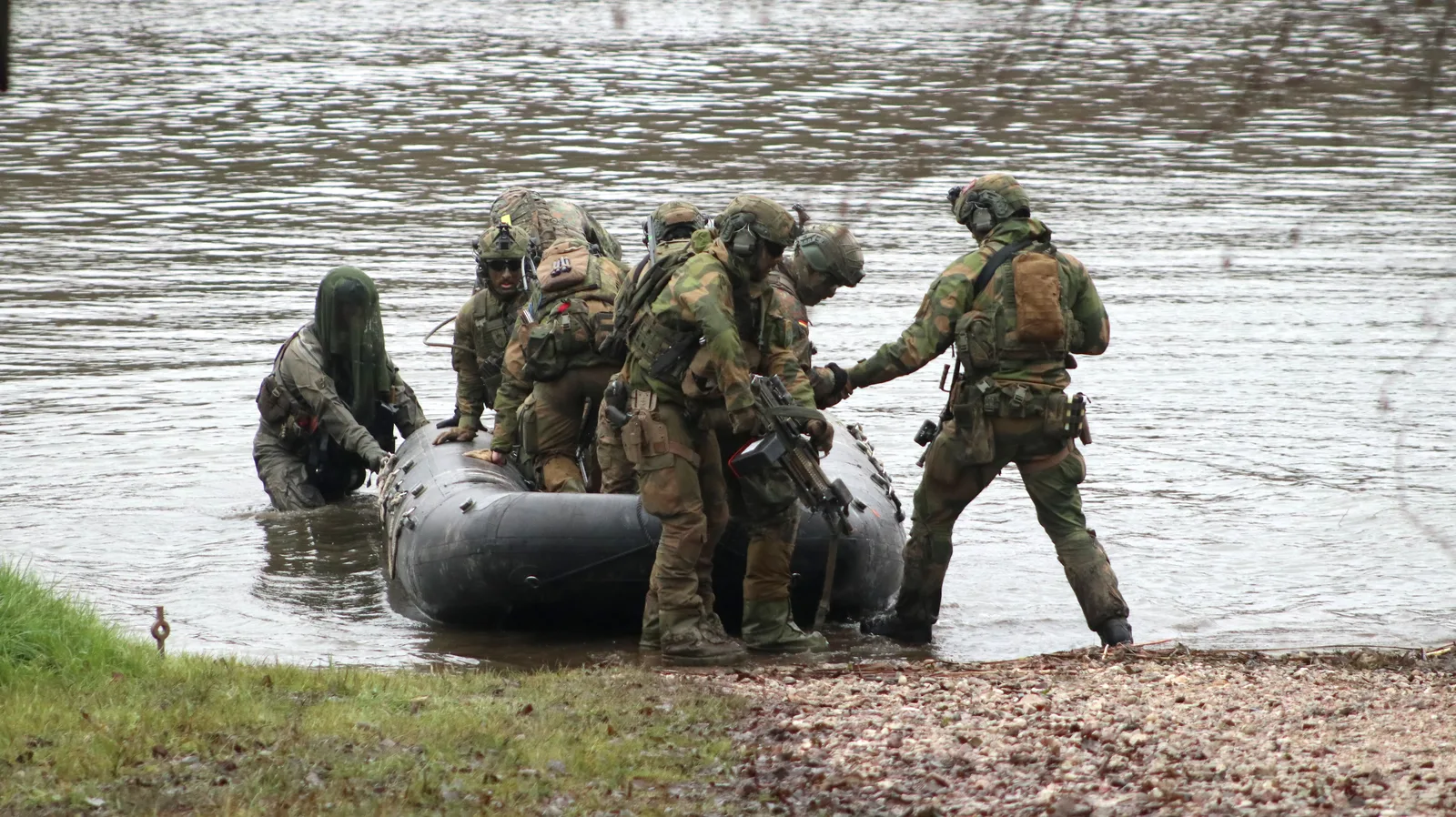
The brigade is emphatically not training for the kind of warfare seen in the past, nor for what is currently happening in Ukraine, according to its commander. To prepare for future battles, the 45th Armoured Brigade follows a three-part approach, Huber said: “First, we need a protective shield over our own forces. That’s done by means of electronic warfare [EW].” Air defence is part of that shield too. For now, an Ozelot provides the latter, since the troops no longer have any Gepards and the Skyranger has not yet been delivered.
“Second,” Huber continued, “we destroy or weaken the enemy’s shield, which creates the conditions for manoeuvre warfare.” Depending on the type and range of the enemy’s air defences, that is a job for FPV drones, loitering munitions or tube artillery. But manoeuvre warfare with tanks has changed too, the commander explains.
Today, battle begins with unmanned combat: unmanned reconnaissance and unmanned effectors in the air or on the ground. Only then do crewed systems or infantry come into play. “Most of the destruction of enemy forces is already being done by our unmanned systems,” Huber says. That is exactly what Freedom Shield is practising. In this second iteration second round of the exercise, ‘26-II’ held in November 2026, the soldiers had more than 700 drones of every description at their disposal.
The third element is tanks and armoured infantry, who carry out the decisive manoeuvre operations. Meanwhile, armchair generals online are convinced that “the war of the future will be fought exclusively with unmanned systems. What use are armed forces for multi-million-euro tanks when 500-euro drones can destroy them?”
Bundeswehrübung in Litauen der Panzerbrigade 45, Gewässerüberquerung (Schnitt)
Huber has an answer for them: “I think it’s very important to have the right mix of capabilities. In the end, it’s the Leopards, the Pumas and other infantry fighting vehicles. It’s soldiers who secure the terrain, who defend it and so protect the people who live there.”
Aluminium carries steel: Floating pontoons in Lithuania
The panzergrenadiers have secured the far bank, and the mist is starting to lift as the next phase begins. At two points along the bank, Scania trucks of the Dutch 105th Engineer Company roll up. Their hook-lift beds carry foldable bridge sections about seven metres long, which are joined together in the water using pusher boats. The system is called the Improved Ribbon Bridge (IRB), from General Dynamics European Land Systems (GDELS). The long aluminium sections can be linked into ferries or into continuous pontoon bridges.
Within minutes, a ferry of three centre sections and two ramp sections takes shape in the Lithuanian river, followed by a second. The advantage of using the ferry configuration is that ferries make a harder target than bridges. The drawback is that once a bridge is complete, the whole battalion can get across faster. Another Leopard 2 thunders out of the woods, rolls cautiously aboard the Dutch ferry and crosses. The next tank follows. Vehicle by vehicle the battalion crosses, and tank by tank the bridgehead on enemy territory grows.
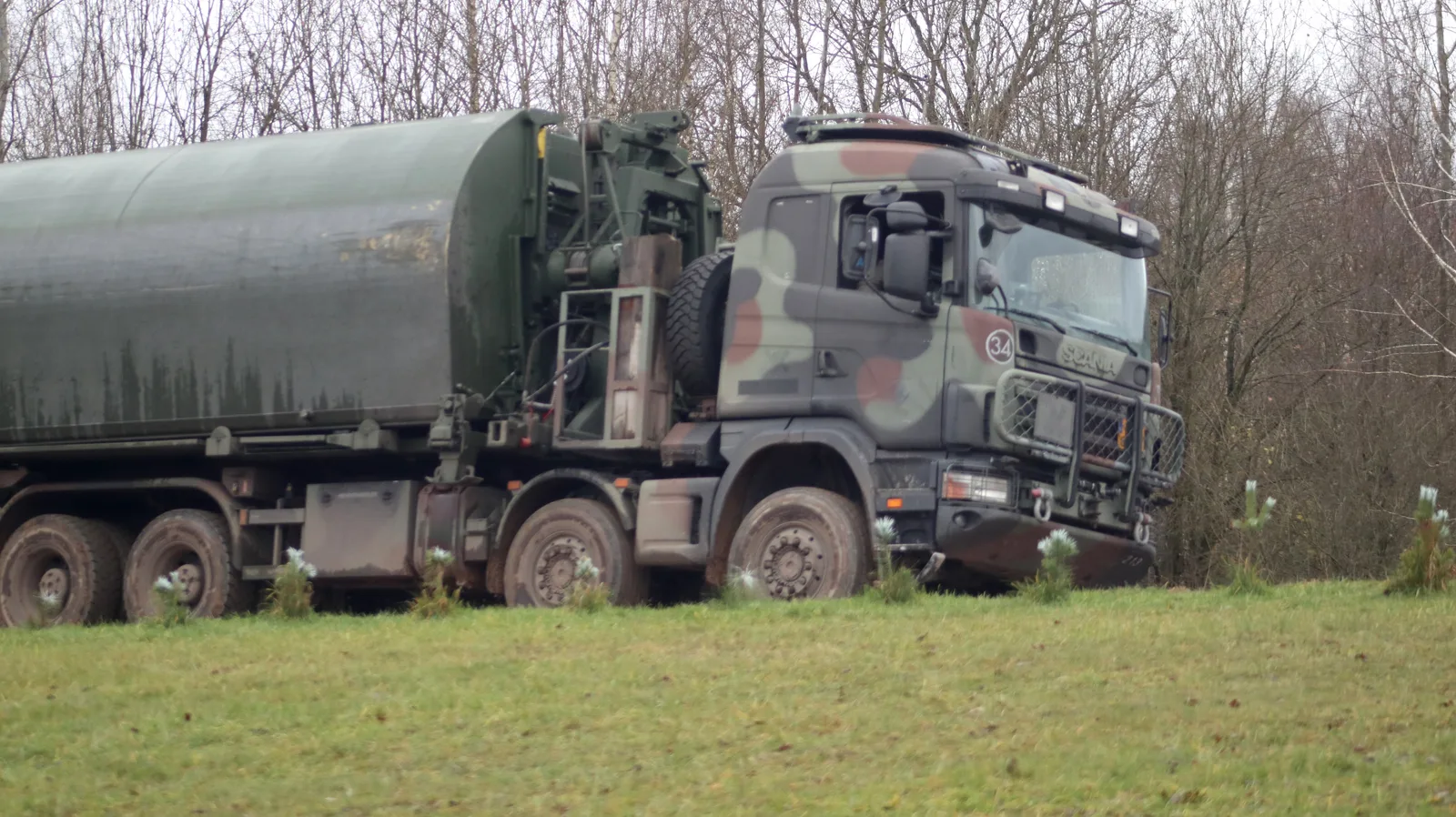
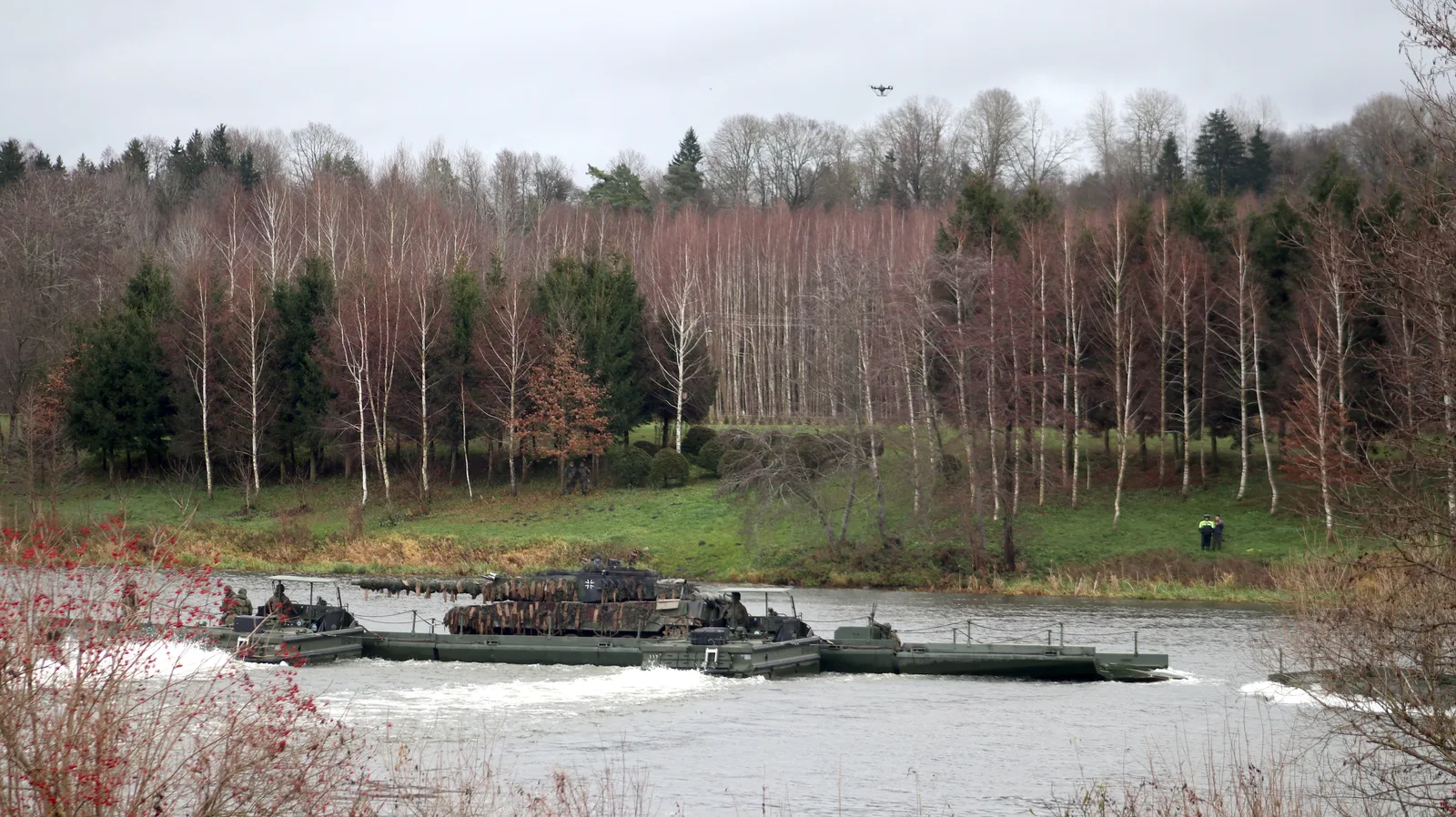
The Dutch are doing “outstanding work,” Huber stresses, and are ferrying soldiers and combat vehicles “across the river with great professionalism.” Bridges are vital to military mobility, all the more so when enemy attacks destroy civilian ones, as is currently happening in Ukraine. “And when bridges are destroyed,” says General Raimundas Vaikšnoras, commander of the Lithuanian armed forces, “we still have to keep moving our troops and equipment. This exercise shows that we must have the capabilities to carry out not only a retreat but also a counterattack.”
Lithuania puts its trust in its partners
Vaikšnoras came to Freedom Shield alone because his soldiers are part of the exercise too. He also wanted to see for himself that Germany’s promise is sound. Will Germany keep its word and defend Lithuania, with its roughly 20,000 active soldiers? Lithuania is itself racing to build barracks and supporting infrastructure, due to be ready by the end of next year. Will it make it? Here on the banks of the Nemunas, nobody doubts it.
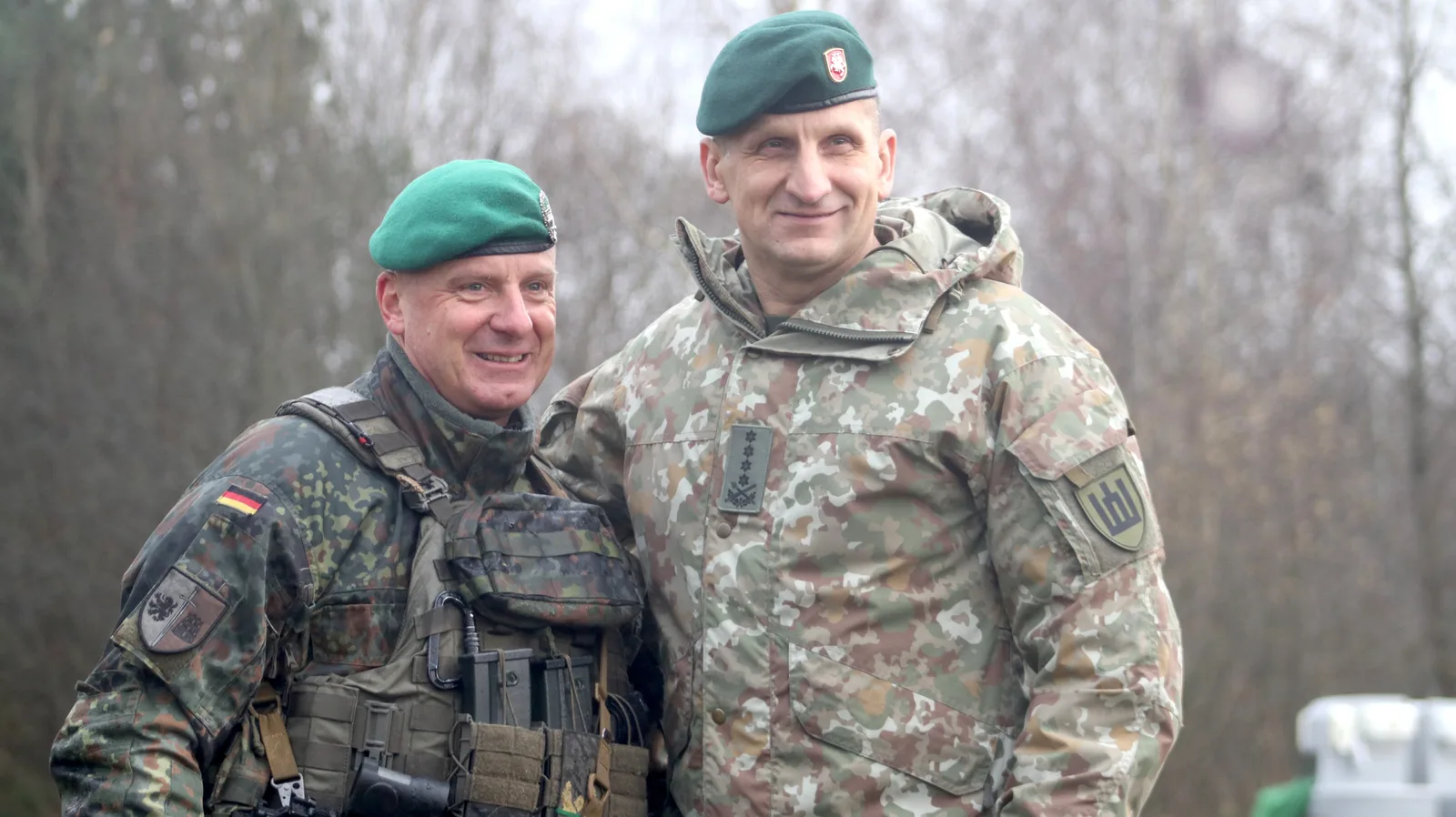
That is exactly why the exercise matters, the Lithuanian Speaker of Parliament said. Freedom Shield 26-II shows the Allies’ readiness to stand by Lithuania. “We trust in our collective defence and deterrence, and so we can once again create as safe an environment as possible for our citizens and businesses in Lithuania,” said Juozas Olekas.
In Lithuania, where solidarity with Ukraine is visible on every street corner, outside every public building, and on buses and billboards, people remember all too well what Russian occupation meant. As General Huber described in his interview, and as one hears again and again here, the population is deeply grateful to the Bundeswehr.
That shows in everyday contact. Parts of Freedom Shield 26-II, such as the river crossing under way, are taking place not on training areas but practically in Lithuanians’ front gardens. Curious locals watch the tanks cross. Complaints when the Leopards fire? Protests because tank tracks have torn up the muddy riverbank? A demonstration because the military is training right where it would have to fight if the worst happened, instead of hiding in barracks? Not in Lithuania.
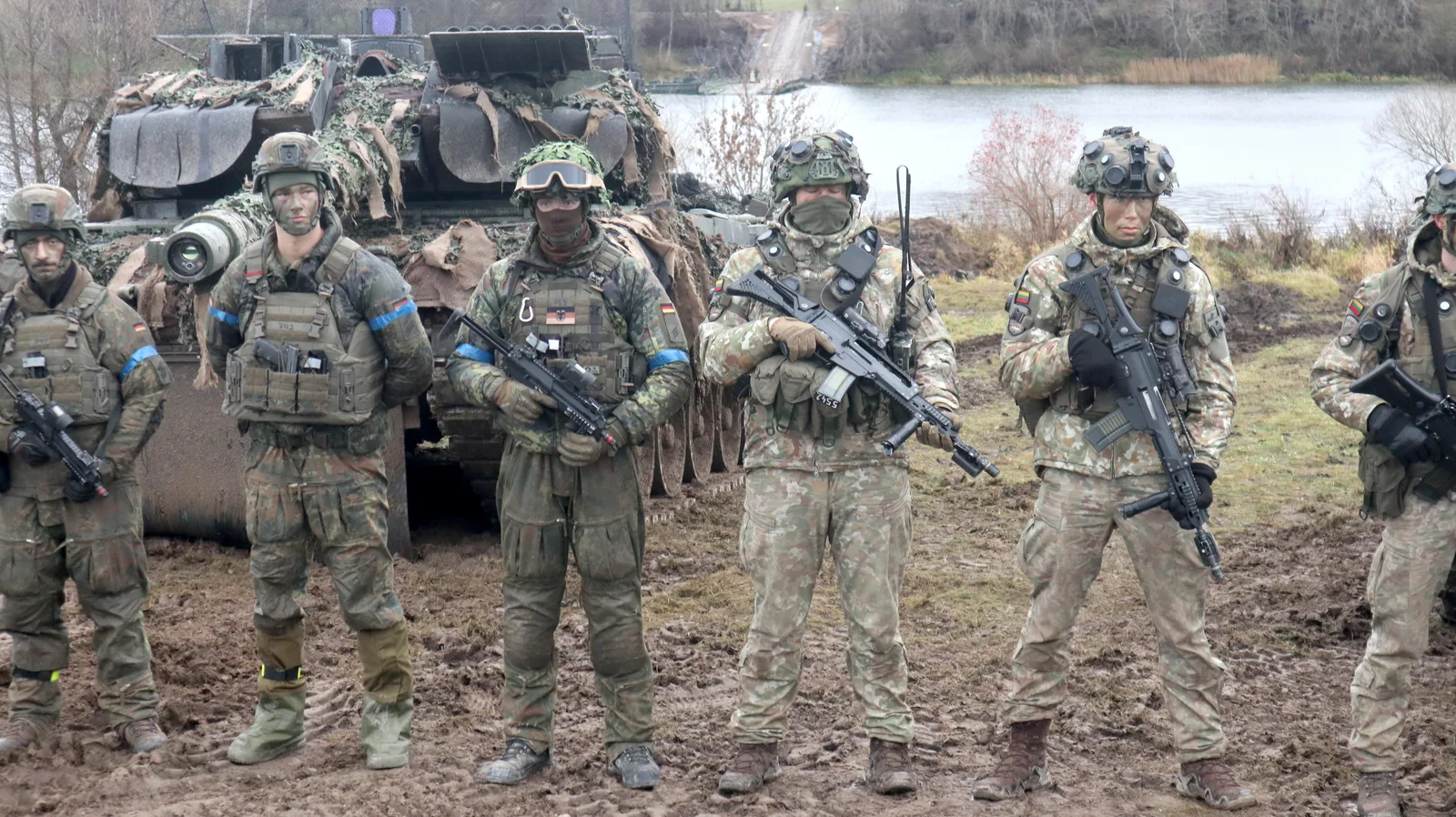
“What this exercise shows, though,” says Vaikšnoras, bringing the military perspective back in, “is that we can all work together, all nations. It shows how good our interoperability is. I’m glad we’ve reached this point.”
Major strides toward readiness
Then things get tense again. While the ferry service across the Nemunas is still running, an enemy drone is detected. To intercept it, the brigade again turns to an interceptor drone. It climbs in seconds, races across the river and neutralises the threat. Huber is satisfied: the technology works and every move is smooth.
The river crossings practised over the past few days have always taken only half as long as originally planned. The troops have long since been ready for combat. Freedom Shield 26-II is meant to show that too, to the Germans back home, to the Lithuanians on the ground, and to the Kremlin. Military training raises the soldiers’ skills and the credibility of deterrence alike.
“There should be no doubt,” Huber said as the day’s exercise ended, “that the soldiers of the 45th Armoured Brigade Lithuania […] side by side with the outstanding soldiers of the Lithuanian armed forces, will be able to defend every centimetre of Lithuania and every centimetre of NATO territory.” The Bundeswehr in Lithuania emphasises its readiness to ‘fight tonight,’ though the commanding general on site hopes that will not come to pass.

Share post