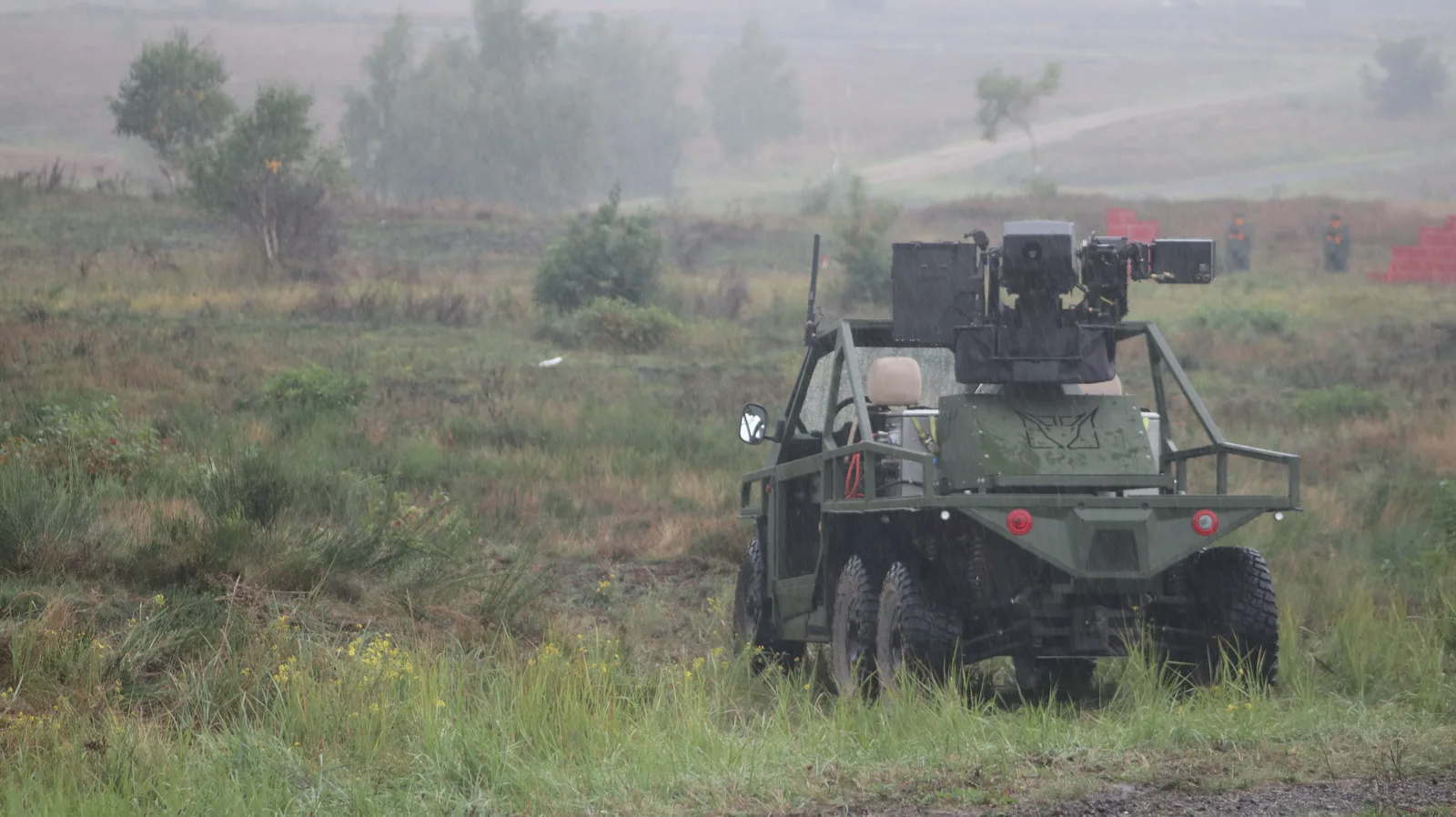
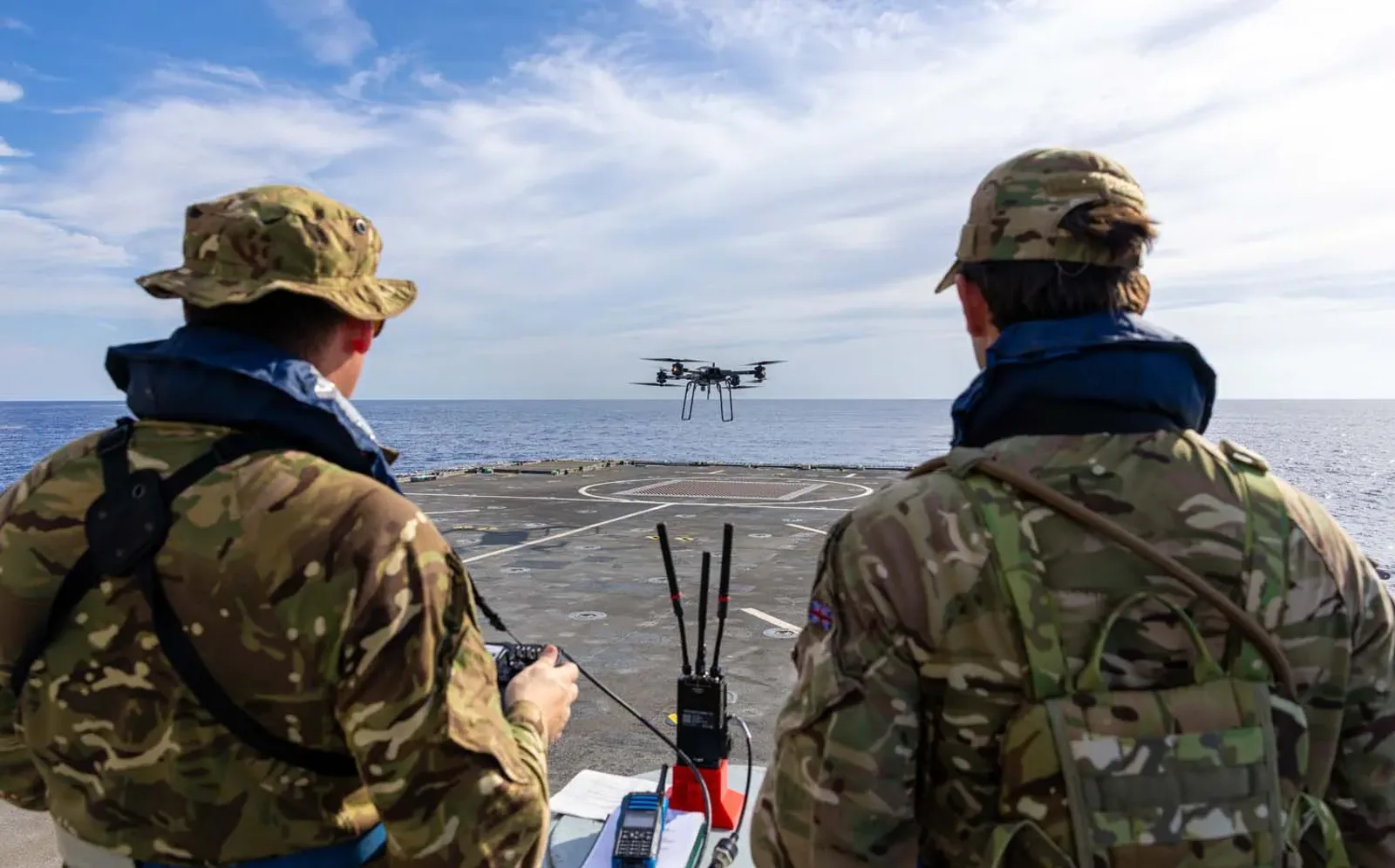
Very slowly, like sycamore seeds, the electronic warfare (EW) sensors drifted to the ground, dropped from a drone at an altitude of around 1,000 metres. A Gereon tracked unmanned ground vehicle (UGV) from ARX Robotics and an optionally-manned Ermine 6×6 vehicle from Rheinmetall – both equipped with remote weapon stations (RWSs) – move into their positions in staggered file. Seven first-person view (FPV) drones take off simultaneously from behind a hill, controlled by a single soldier. Further back, loitering munitions awaited the go-ahead to launch.
There is a hive of activity on and above the rain-soaked Bergen military training area north of Hanover. Plenty of equipment and technology was on show visible, but Soldiers were hardly to be seen. Unmanned systems took centre stage in the ‘Land’ experimental series.
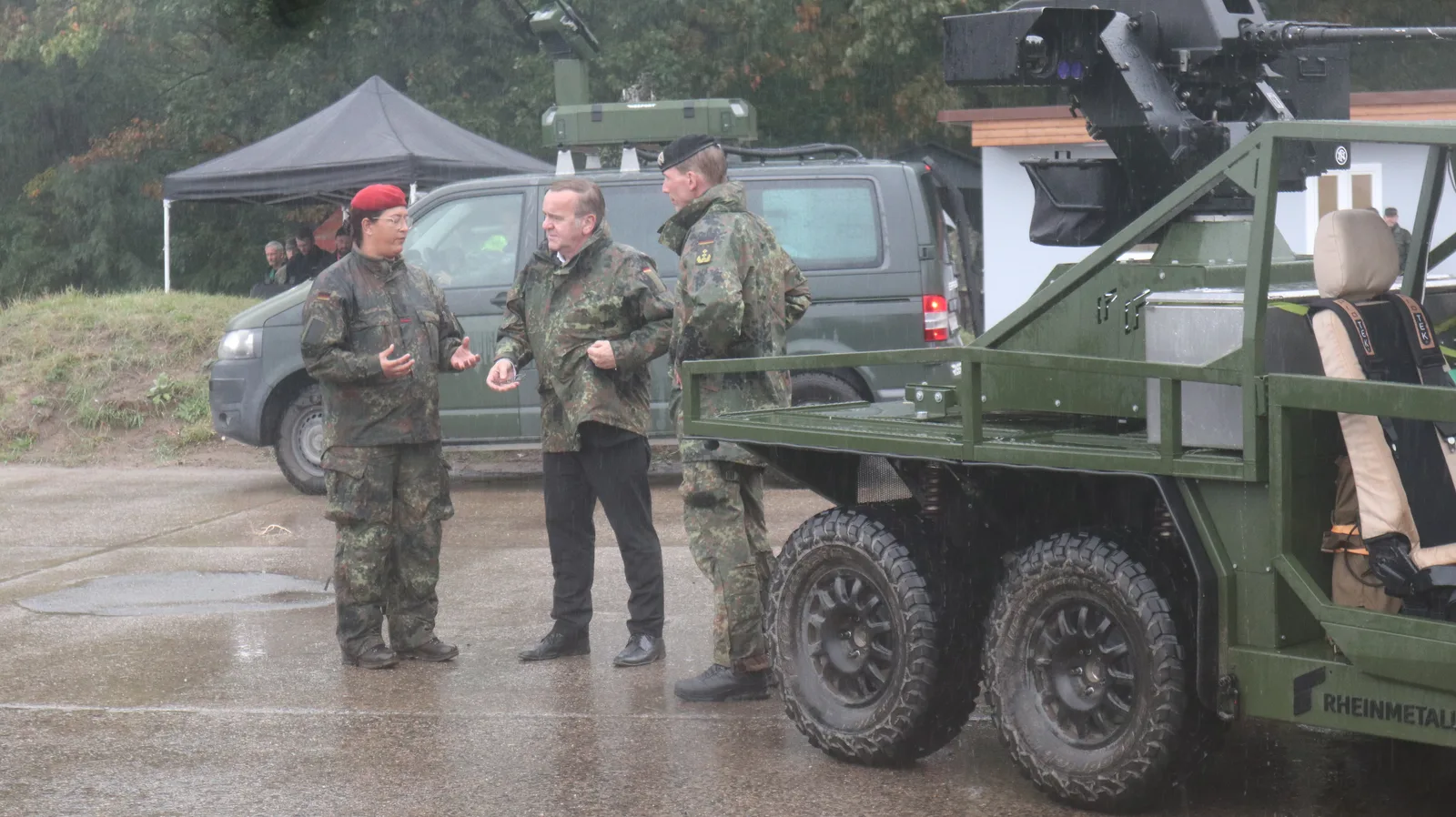
Defence Minister Pistorius, who had travelled to Bergen together with the Inspector of the Army, Lt Gen Dr Christian Freuding, and his deputy, Lt Gen Heico Hübner, was shown the latest technology that the industry had made available to the troops. “The Army is proving once again,” said Pistorius, “that it is committed to living up to its reputation as a laboratory of innovation.” Shortly afterwards, he announced that the first drone regiment would be established next year (as previously reported by Defence-Network).
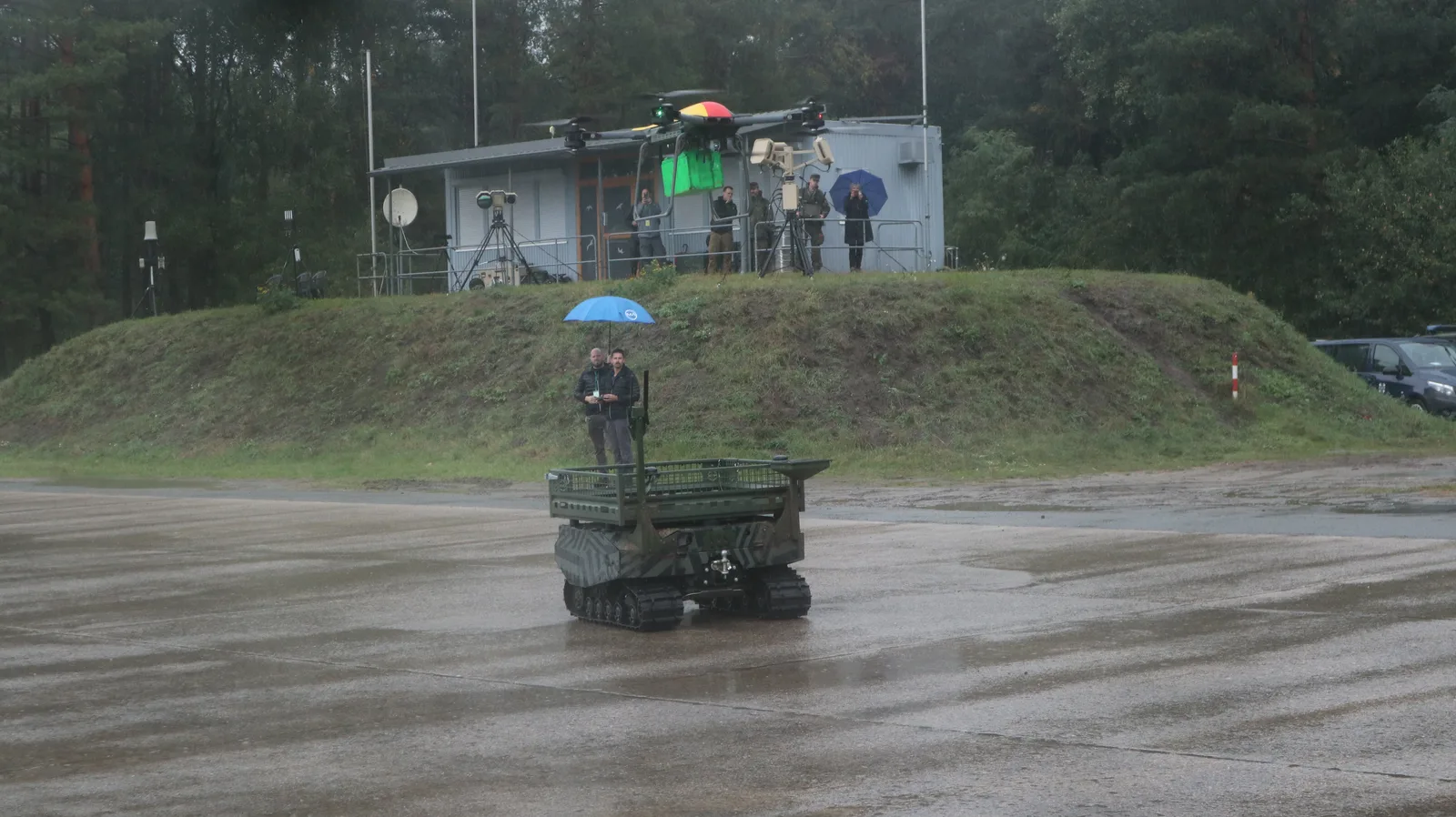
Will it work? Much of it has already made an impression: a medium-sized multicopter drone approached at high speed, dropped a green box with pinpoint accuracy onto a waiting UGV, and disappeared. The UGV then set off immediately. The test showcased a successful integration of unmanned logistics.
But not all the systems in Bergen were so immediately convincing. Another, larger transport drone took off briefly, making a lot of noise and emitting a strong smell. A few seconds later, it touched down again. “At least it can take off and land,” commented one observer.
In another case, a small interceptor drone took off at high speed towards a target drone, but then turned back. It remained unclear whether the high-explosive fragmentation (HE-FRAG) warhead was supposed to have exploded next to the target drone or whether this was to be tested on another occasion.
Since 2022, the Army has been using the experimental series ‘Land’ to test new ideas, weapons and components for their compatibility with the troops, in collaboration with researchers, developers and industry. In 2026, of the approximately 680 people taking part in the three-week tests, around half were in uniform.
“Soldiers must be able to speak directly to the engineer,” explained Colonel Mario Brux, project manager for the Land Experimental Series at the Army Development Office. This requirement was met in Bergen.
The Army takes a step-by-step approach to testing: first, new systems are tested individually within the troops throughout the year. At the ‘Land’ event in Bergen, integration then takes place within the context of a tactical scenario. Here, the systems must prove themselves and demonstrate added value for the troops.
‘Land’ experimental series: Innovations put to the test
There were over 40 systems being tested in the 2026 iteration of the ‘Land’ experimental series. These included drone detection sensors, interceptor drones, UGVs ranging in size from a beer crate to a 6×6 wheeled all-terrain vehicle, FPV drones deployed in swarms, and transport multicopter drones such as the ‘Grille’.
AHEntwg, the German Army Development Agency, aims to gain a comprehensive understanding before considering any potential introduction into the armed forces. Procurement projects, which are traditionally preceded by a call for tenders setting out user requirements in precise detail, have a decisive disadvantage: the Bundeswehr can only put out to tender for what it knows it needs.
The ‘Land’ experimental series therefore offers industry the opportunity to present its solutions, even if the armed forces may not yet realise they need them.
Robots in the field
Some of the requirements are based around familiar everyday tasks for a soldier: guard duty, patrols, and reconnaissance. Today’s rapidly-advancing technology offers possibilities that can drastically reduce the risks faced by troops in such tasks.
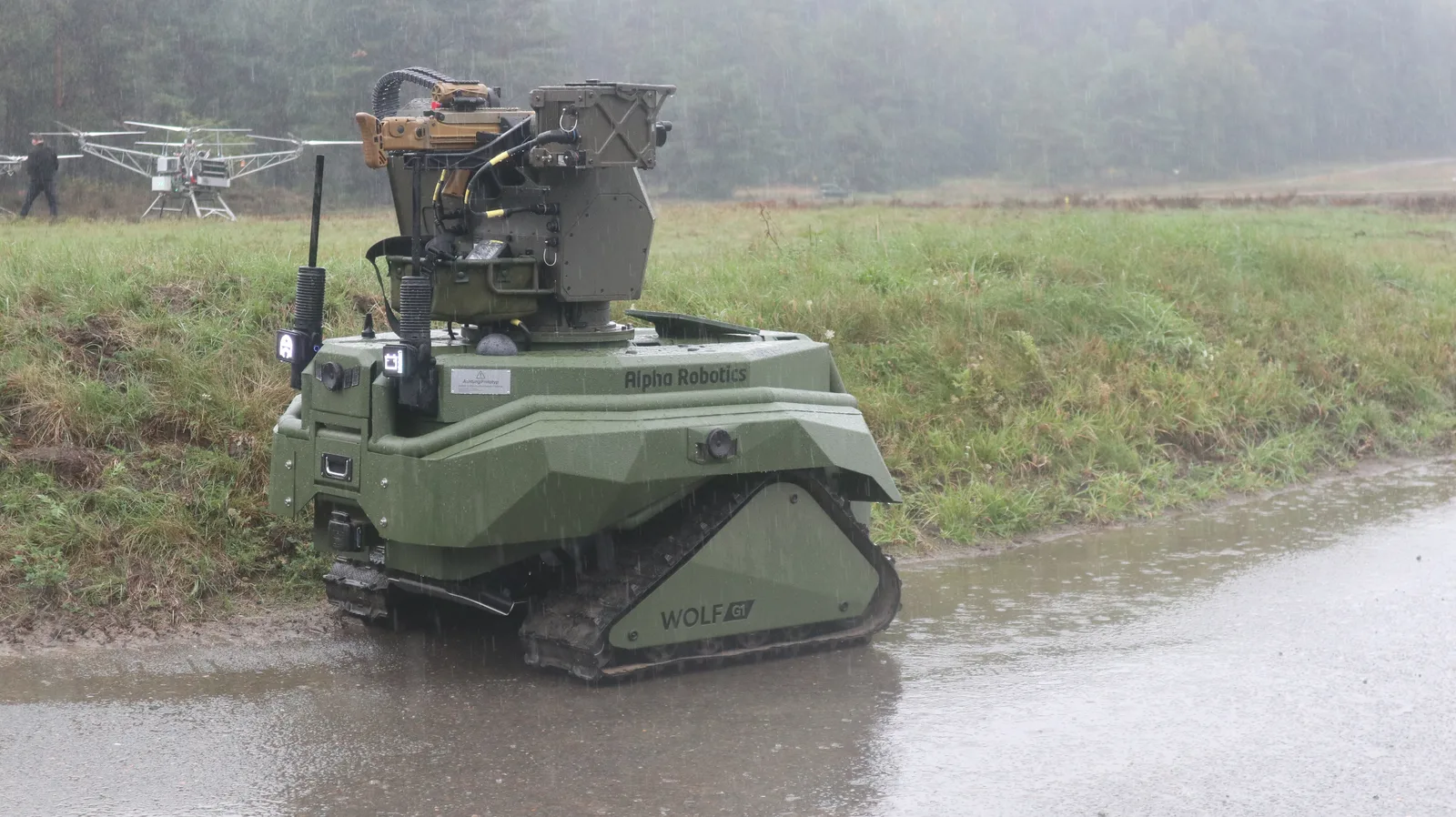
Boris Pistorius formed his own impression of this during the ‘Land’ experimental series. At the edge of the forest in Bergen, a Wolf G1 from Alpha Robotics rolled into position before the minister’s eyes. Equipped with sensors and Valhalla’s Loki RWS, the concept is intended, for example, to take over or enhance the protection of military infrastructure.
Soldiers control several of these UGVs simultaneously from a protected Eagle 6×6 vehicle parked nearby. Should hostiles approach, initial contact is made via the ‘Wolves’ in their positions – not via the soldiers in the Eagle. The manned-unmanned teaming (MUM-T) concept was unveiled for the first time at Eurosatory 2026 (as reported by Defence Network).
However, there is no talk in Bergen of the kind of autonomy recently observed in the Russian war against Ukraine. Anything unmanned here is under the control of a human operator – at the very least when it comes taking an action. Should the army ever adopt a different approach, this is likely to reignite an ethical debate in Germany.
Suddenly, drones are whirring overhead. Are they our own or simulated enemy drones? It is an important distinction – and not just for tactical exercises. In recent years, there have been real-life attempts at reconnaissance. The situational picture provided by sensors – both those deployed on the ground and those dropped from the sky – is, all of a sudden, no longer important merely for testing purposes, but extends far beyond that.
The field laboratory
“We want innovative solutions – faster than was previously possible or intended,” said Pistorius, summarising the basic idea behind the ‘Land’ experimental series. The aim is to develop solutions that are tested with and amongst the troops right from the start.
“To put it another way: this is about a field laboratory, and that is exactly what is taking place here,” said the Minister. Much of what was happening in Bergen did indeed resemble a laboratory. Things are being tested, tinkered with and ‘just given a go’. Very few observers at the ‘Land’ experimental series will have realised what will actually enhance the troops’ combat effectiveness in the end. Certainly not if they were rushed through the prepared stations in the space of two hours.
However, the data and insights gathered are likely to prove helpful to the German Army Development Agency. Towards the end of the 1 October event, there was already talk of one or two systems that would be seen again fairly soon.