The UK’s new space strategy: One small step for Britain

The UK’s new Space Strategy outlines a whole-of-government approach to support increased space capabilities for defence, security, and industry. However, available funding may make some medium- and long-term ambitions difficult to realise.

The UK's new Space Strategy will focus on delivering defence and security technology.
The new UK Space Strategy will focus on delivering defence and security technology, through a whole-of government approach. (USAF/SSgt J.T. Armstrong)
Charles Forrester

The British government released the UK Space Strategy on 9 September 2026, unlocking a total of GBP 7.8 billion in investment to be disbursed through to 2029/30. The policy is adopting a more interventionist stance compared to previous space strategies, putting defence and national security as the number one priority for the policy, and a commitment to delivering a co-ordinated cross-government civil-military collaboration.

As part of the government investment, the UK Ministry of Defence (MoD) will commit to spending “at least 10% of its annual Equipment Programme budget on novel technologies”. Of the categories identified in the Defence Investment Plan, GBP 420 million is to be spent on space technologies – the lowest proportion of the GBP 11 billion made available in the novel technology category. A broader GBP 3.2 billion was, however, allocated to space technology in the DIP, largely focusses on satellite communications.

National industrial direction

The foundation of the Space Strategy is based on four pillars to support industry, namely: an industrialisation of the space sector; building partnerships and leadership in multinational collaborative organisations; delivering regulations that support UK growth in the sector; and strengthening security, sustainability, and resilience.

The new policy builds on the UK’s 2025 Modern Industrial Strategy, which also placed an emphasis on space technology as part of the country’s advanced manufacturing strategy. This was designed to build on the country’s “leadership as a spacefaring nation” to secure “advantages in areas critical to defence and growth.” This itself was preceded by the Advanced Manufacturing Sector Plan, which committed a total of GBP 80 million to the space priority sectors.

Four sectors have been earmarked for priority development: satellite communications, Space Domain Awareness (SDA), in-orbit servicing assembly and manufacturing and access to space. Longer-term areas for focus include positioning, navigation, and timing (PNT), earth observation, and space discovery.

As part of the approach, the UK government will be moving towards fewer, higher value contracts, the alignment of civil funding to include defence and security applications, acting as an anchor customer for government projects, and enabling exports of UK space technology.

UK SatCom capabilities continue to represent the largest single-project component of the space sector strategy.
UK SatCom capabilities continue to represent the largest single-project component of the space sector strategy. (Crown Copyright/Sgt Paul Shaw)

Near-term targets

Within the Space Strategy is confirmation of investments for defence capabilities to be delivered out to 2030. These include:

  • Establishment of an integrated national satellite communications architecture with clarified interoperability standards, commercial structures, and spectrum management.
  • A National Space Operations Centre, valued at GBP 80 million.
  • Investments of GBP 880 million in space-based intelligence, surveillance, and reconnaissance (ISR), deep space advanced radar capabilities, and space control.
  • A GBP 2.3 billion investment for military satellite communications, alongside a GBP 75 million for civilian-use low-earth orbit communications.
  • The development of a PNT interference warning capability valued at GBP 13 million for a UK-wide system to monitor, locate, and react to threats from the ground and space, and protect against jamming and spoofing.
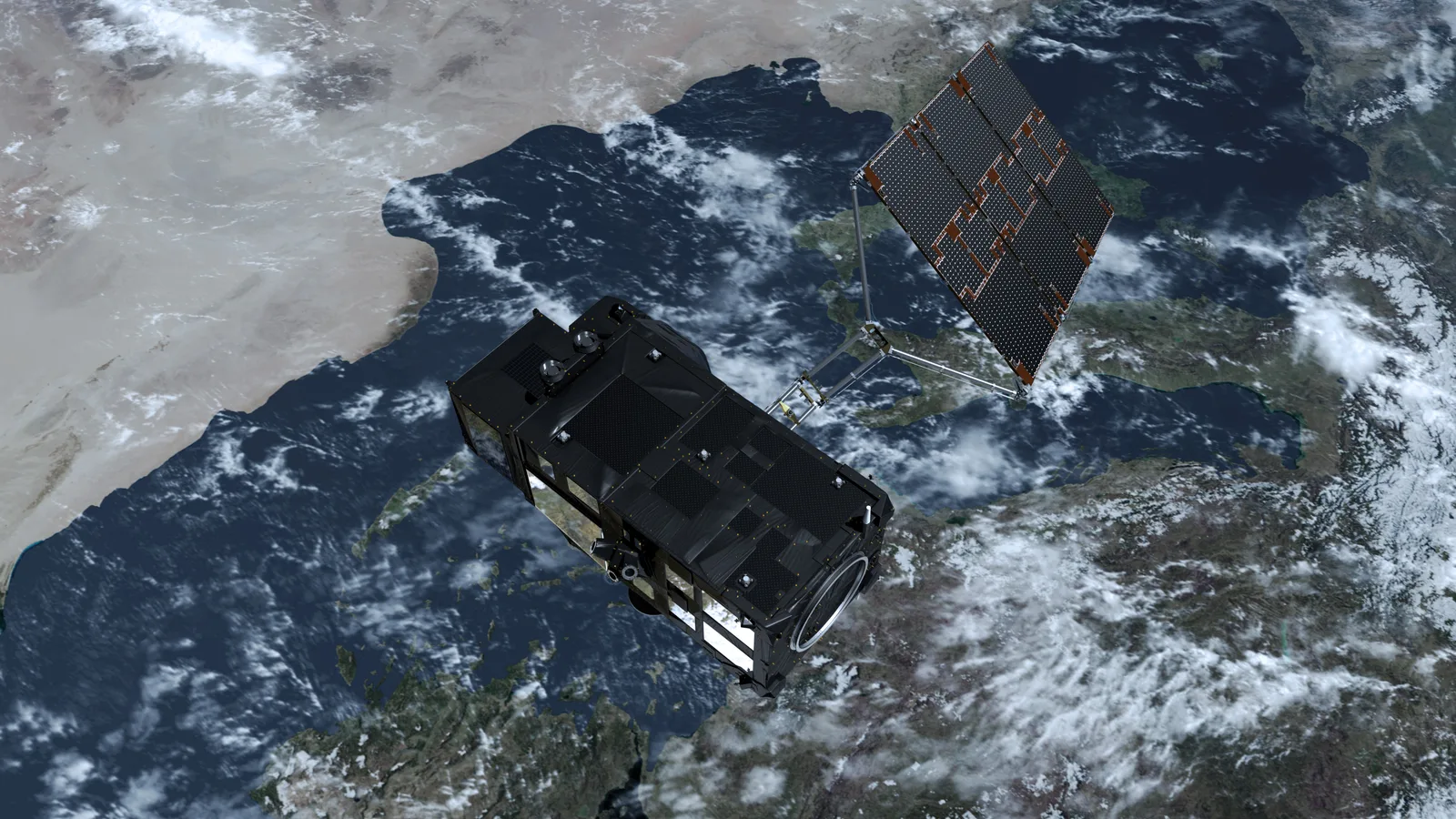
The UK will continue contributing to the ESA’s Copernicus programme, but a commitment to funding beyond 2027 is uncertain.
The UK will continue contributing to the ESA’s Copernicus programme, but a commitment to funding beyond 2027 is uncertain. (ESA)

Earth observation and surveillance

Broad investments in earth observation technologies, valued at GBP 990 million out to 2030, are to be focused on collaborative European programmes as well as MoD-funded defence projects.

Continued investment, at GBP 8 million per year, will be made in the UK’s Earth Observation Data Hub (EODH) that was launched by the Department for Science, Innovation and Technology (DSIT) in 2023 as a pathfinder project. The organisation is to act as a ‘single source of truth’ for geospatial data for UK users across the defence, security, and civil sectors that helps to unlock advanced geospatial data across the UK’s economy. A broader plan for collective UK government procurement of earth observation (EO) data will be developed to support greater access to services and analytical support, while helping to reduce the costs incurred by multiple procurements of the same data.

Collaboration with European partners on earth observation will be continued through a funding commitment valued at GBP 332 million out to 2030. The funding will be used for European Space Agency programmes such as FutureEO, ESA Copernicus funding, Aeolus-2, and the European Resilience in Space programme. While the UK rejoined the EU’s Copernicus programme in 2024 and will continue to pay GBP135 million per year to be part of the programme, funding is currently only committed to 2027. The Space Policy noted that “no decision has been made” on the future participation in the programme.

GNSS jamming and spoofing is being experienced across Europe and the Middle East to deter military operations by hostile actors. The technology does, however, have implications for the civilian sphere.
GNSS jamming and spoofing is being experienced across Europe and the Middle East to deter military operations by hostile actors. The technology does, however, have implications for the civilian sphere. (GPSJam.org / CC0)

PNT partnerships

The importance of reliable PNT data is increasingly apparent over the past decade, as GNSS spoofing and interference has become heavier in areas such as the Middle East, the Baltic Sea, High Arctic, and Ukraine. Ensuring that redundancies, such as inertial navigation systems, can deliver accurate position and timing data helps to reduce the reliance on space-based position data, but can be improved by access to multiple data streams.

The Space Strategy noted that the UK is investing GBP 248 million in a National Timing Centre (NTC) and GBP 71 million in an Enhanced Long-Range Navigation (eLoran) network to deliver sovereign timing data for civilian and military uses of PNT data. By 2030, the Space Strategy has outlined that it will be delivering concept studies for GNSS independent time transfer and hybrid PNT, as well as a national capability to identify and monitor PNT interference. A further GBP 52 million will be allocated to the ESA’s Navigation Innovation and Support Program (NAVISP) to “increase the competitiveness of the UK PNT sector and fund the development of resilient PNT solution.”

Further funds to support quantum PNT systems will be invested in technology that supports military space-based satellite time and frequency transfer through the NTC and eLoran transmitters. The project, known as TOUCAN, was launched by the UK Space Agency in February 2026 in collaboration with the ESA’s NAVISP. Quantum navigation technology has already been tested by the Royal Navy, with the first quantum sensors for navigation being demonstrated in 2018 ahead of an initial deployment on the navy’s XV Patrick Blackett test and experimentation vessel in 2023. Further integration tests using Infleqtion’s Tiqker optical quantum navigation system on the uncrewed testbed submarine XV Excalibur in the Arctic took place in October 2025.

The SaxaVord Spaceport on the island of Unst is currently supporting the RFA testing programme. Additional launchpads are being constructed.
The SaxaVord Spaceport on the island of Unst is currently supporting the RFA testing programme. Additional launchpads are being constructed. (SaxaVord)

Spaceport infrastructure investment

The GBP 30 million investment in SaxaVord Spaceport will help to increase the launch availability of the facility, and is being further complemented by a GBP 30 million in planned private investment. The sole launchpad at the facility is currently being used by RFA for their rocket tests, which have faced delays due to technical malfunctions that included one of their rockets exploding on a launchpad in August 2024. Two more launchpads at the site are in development, with the second nearing completion. The additional capacity will help with rocket launches from other companies, notably Germany’s HyImpulse, that have had to delay or relocate their launch and testing activities in addition to meeting goals around annual rocket launches.

The investment will come as a welcome lifeline to SaxaVord’s operators, Shetland Space Centre Limited, which reported continuing losses in 2022, 2023, and 2024 of GBP 5 million to Companies House. A UK government loan of GBP 10 million was secured in May 2024, and other investments have come from the Scottish government’s Highlands and Islands Enterprise. However, as previously reported by Warsight, the options for UK space launches are limited. The Cornwall Spaceport project was tied to horizontal launch technology, and the proposed Sutherland Spaceport project in northern Scotland collapsed after parent company Orbex went into liquidation in 2026.

Outlook

While the effective mobilisation of a cross-governmental approach to supporting the nation’s military space capabilities demonstrates that there is a drive to enhance the country’s space capabilities, but broader ambition and funding may hamper wider technological deployment. Continued support via European institutions will support regional drives for non-US sovereign control, as well as pooling and sharing of costs. The drive for UK leadership in these programmes could be met with resistance as other European states seek to assert their own dominance in the sector and work to enable their own industries and sovereign capabilities.

The initial focus on military satellite communications capabilities is fulfilling a long-standing requirement for defence operations that has been in place for many years – ultimately meaning that there is ‘more of the same’ for investment. Increasing the number of satellites that can support sovereign military communications is a step in the right direction for data sovereignty, but also one that requires improved control of the nose-to-tail elements of satellite manufacturing and payload development, launch, ground-based control, and data processing. The industry’s move from large, single satellites to constellations of smaller ones represents a need for greater scale and delivery in manufacturing, launch, and capability integration.

There are, however, some brakes and safeguards being put in place by the Space Strategy document. The policy explicitly notes that investments in private companies will be subject to due diligence checks – an attempt to assure the public that funds will be invested appropriately and reduce the chances of the investments turning into boondoggles for established firms and new market entrants.

Funding for space has been dwarfed by the money being made available to other novel technologies outlined in the Defence Investment Plan. As a result, there may be a lack of funds to realise medium- and long-term ambitions as end-users chase more visible and impactful technologies such as artificial intelligence (AI) and automation, weapons, and unmanned systems.


Share post

You may be interested in

Categories

All NewsSpace

Used tags

GNSSJammingNATOPNTSatellitesSpaceSpace launchUK

Similar posts