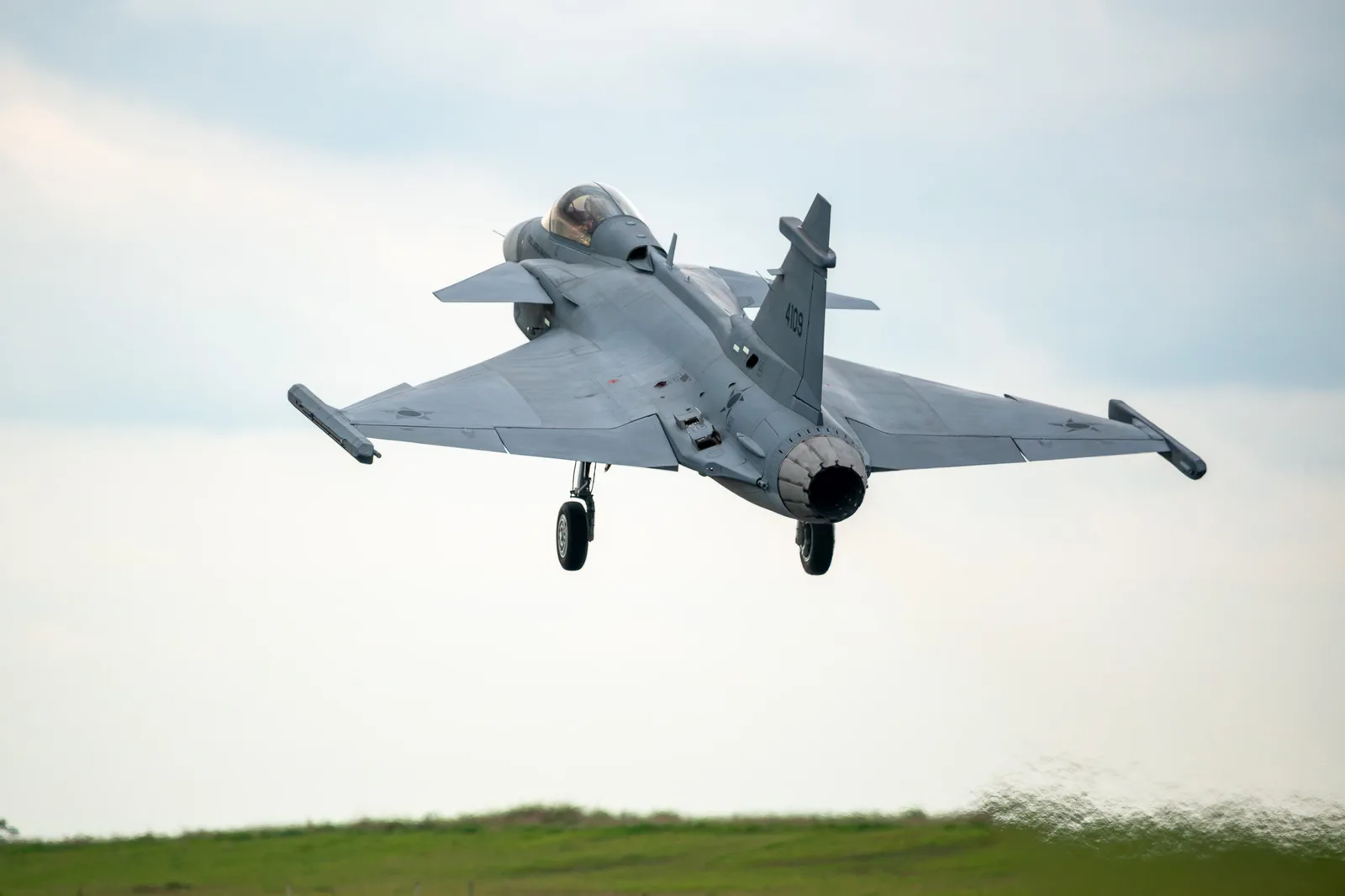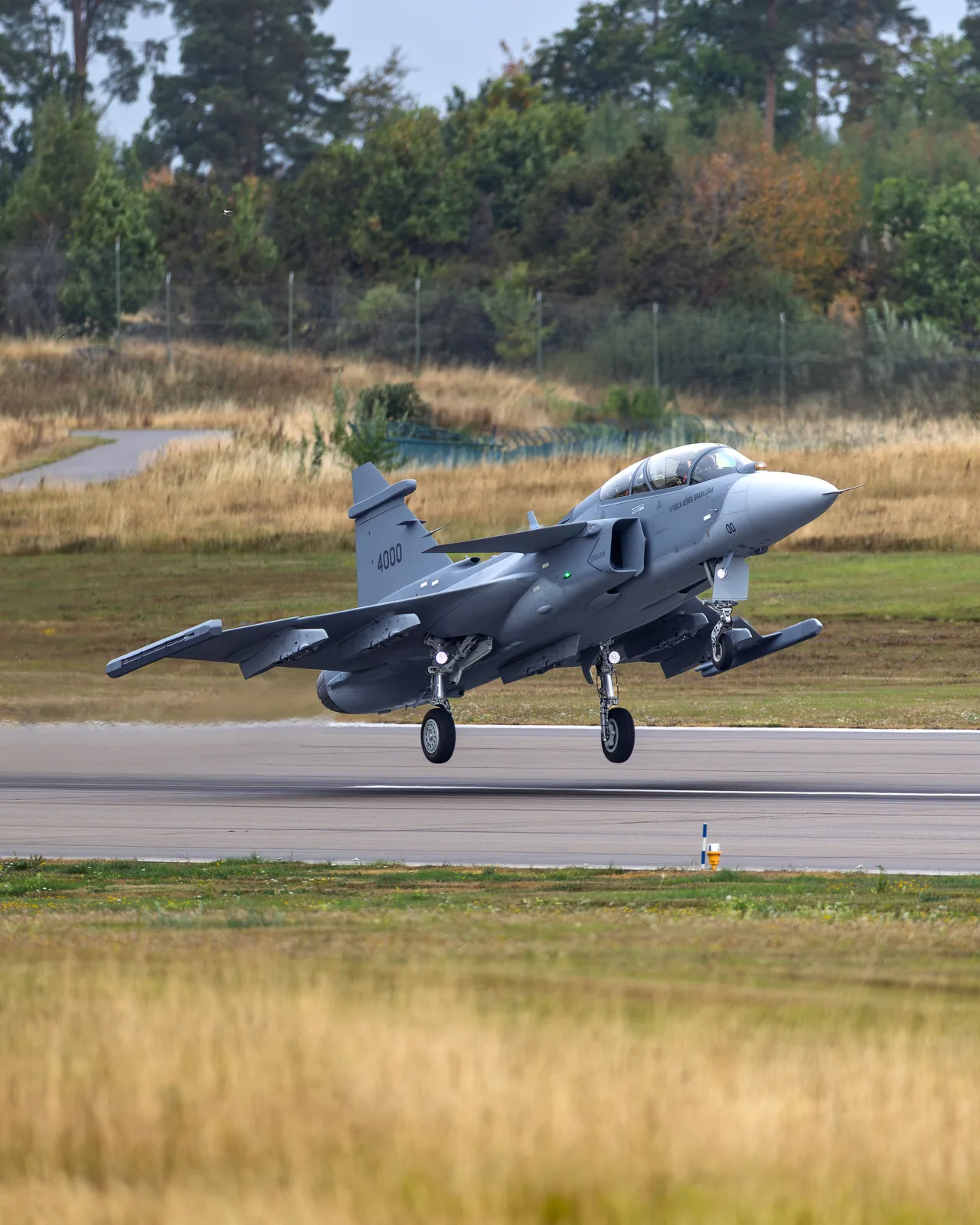
A maiden flight with a Gripen F fighter, the twin-seat variant of the Gripen E, has been successfully conducted by Saab. The aircraft took off from Saab’s airfield in Linköping, Sweden, at 09:40 local time on 28 August 2026 and remained airborne for 40 minutes, the company announced.
The inaugural sortie, which successfully verified the functionality of the aircraft’s core systems and its initial flight performance, was conducted by Saab chief test pilot Jakob Högberg and Brazilian Air Force test pilot Lieutenant Colonel Aviator Abdon de Rezende Vasconcelos.
“This first flight represents an important step forward for both Saab and the Brazilian Air Force,” Lars Tossman, head of Saab’s Aeronautics business area, was quoted as saying in a company press release. “Seeing Gripen F take to the skies is particularly significant for all the Swedish and Brazilian teams whose years of engineering work have helped turn this aircraft into a reality. It is designed to accelerate pilot training while enhancing operational performance in advanced combat missions.”
The Gripen F will now enter the airborne phase of its test campaign. Following initial production acceptance flights, the programme will move into a progressive envelope expansion phase in which the aircraft’s full performance limits — including speed, altitude, g load and angle of attack — will be cleared step by step. In parallel, tactical capabilities and rear cockpit functions specific to the two-seat Gripen will also be evaluated.
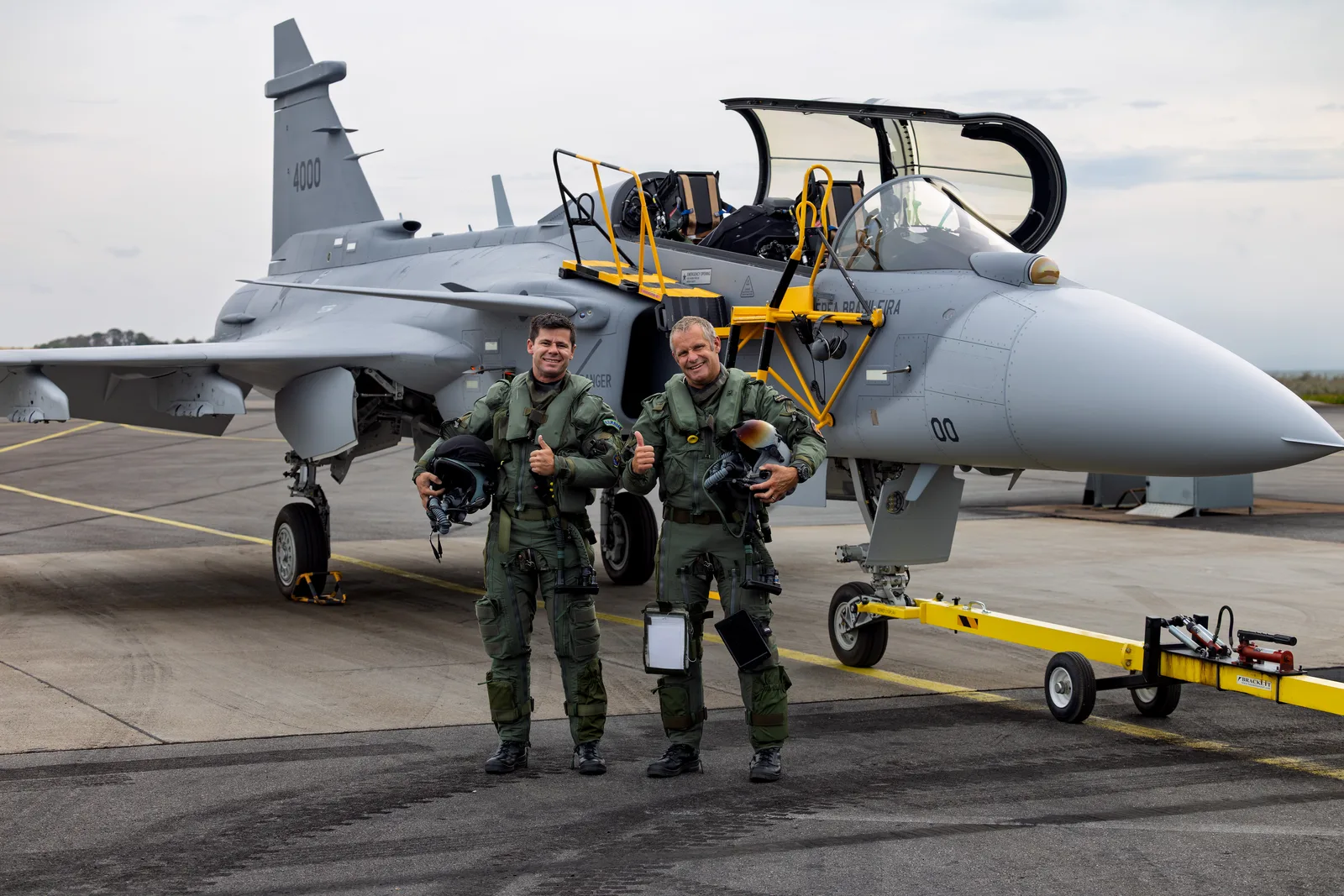
The Gripen F is the result of the strategic partnership between Sweden and Brazil, which in October 2014 placed a contract with Saab for 28 single‑seat Gripen Es and eight twin‑seat Gripen Fs. While a technology transfer agreement under this contract saw the establishment by Brazil’s Embraer of a final assembly and manufacturing line for the Gripen E, it was decided that the Gripen Fs would be manufactured in Linköping to optimise production efficiency, despite the Swedish Air Force not having ordered any Gripen Fs of its own.
The Gripen F was nevertheless developed in partnership with Brazilian industry according to the requirements of the Brazilian Air Force and the first Gripen F was formally rolled out at Linköping on 2 June 2026.
Saab noted in its press release that more than 350 Brazilian engineers, technicians and pilots have participated in training activities related to the development, production, flight testing and maintenance of the aircraft.
The Saab Gripen E (designated the F-39E in Brazil) officially entered operational service with the Brazilian Air Force on 19 December 2022 and with the Swedish Air Force on 20 October 2025.
Beyond the eight Gripen Fs ordered for the Brazilian Air Force, Thailand has one on order alongside three Gripen Es under a contract placed in August 2025, while Colombia has two on order as part of a 17-aircraft Gripen E/F contract placed in October 2025.
While Saab signed a contract with the Swedish Defence Materiel Administration (FMV) on 30 June 2026 under which 16 Gripen Es are being procured for Ukraine, there are as yet no plans for Ukraine to acquire Gripen Fs.
Gripen F characteristics
Compared to the single-seat Gripen E, the twin-seat Gripen F has broadly similar characteristics, although it has a length of 15.9 m compared to 15.2 m for the Gripen E and the space required for the second seat means that it does not carry the internal 27 mm Mauser BK27 cannon that arms the Gripen E.
Powered by a single General Electric F414-GE-39E (RM16) afterburning turbofan, the Gripen E/F series has a maximum speed of 2,100 km/h, a service ceiling of 16,000 m, a combat range of 1,500 km, a maximum take-off weight of 16,500 kg, g limits of +9/−3, and a combat endurance of greater than two hours in a typical air-to-air configuration.
Both aircraft feature the Leonardo Raven ES-05 active electronically scanned array (AESA) radar, the Leonardo Skyward-G advanced, passive infrared search and track (IRST) sensor, the Saab Arexis electronic warfare/self-protection suite, and have 10 hardpoints that can carry a variety of weapons, including the Meteor and AIM-120 AMRAAM beyond-visual-range air-to-air missiles; the IRIS-T, AIM-9X Sidewinder and A-Darter short-range air-to-air missiles; the AGM-65 Maverick air-ground-missile; the RBS-15F anti-ship missile; and freefall bombs, including the GBU-12 Paveway II/III/E series, SPICE 250, GBU-10 and GBU-39 Small Diameter Bomb.
On 21 August 2026 a Swedish Air Force Gripen C released a live Taurus KEPD 350 cruise missile over the Vidsel Test Range in northern Sweden. This German-Swedish missile, which has a range exceeding 500 km, will further enhance the weapon suite of the Gripen E/F.