The UK and Europe have been making concerted efforts to develop localised sovereign space launch facilities, but the journey has been harder than expected.
Failing to launch: UK and Europe strive to enter the sovereign space launch game

Ambitions to increase European space launch capabilities have been dampened by launcher test issues and launchpad availability as new technologies are brought to the fore. (SSC)
The ability to utilise space technology for civil and military purposes has increased exponentially since commercial launch providers, such as SpaceX, have been able to deliver more frequent launches for customers. This has opened up a range of opportunities for military users in particular, as payload capacity has grown and more satellites can be deployed to support operations.
However, the reliance on US launch companies and facilities has come with a growing desire for sovereign launch facilities located in Europe to ensure that satellites can be launched according to schedule and not be subject to the demands or restrictions of US-based providers. Europe has a long history in developing and manufacturing satellites for use in the commercial and military sectors, but has been limited by the launch facilities that are under sovereign European control.
Establishing an end-to-end space capability – from payloads to launch, deployment and tracking – is now a requirement for ensuring sovereign control of space-based systems. When factoring in the expansion of security and defence space-based projects from Europe, the need for more launch capacity is critical to supporting the high demand for satellites to support secure communications and surveillance.
Key to this is the development of spaceports in sovereign European territory to facilitate launches and support governmental priorities. However, European spaceport plans have faced challenges in their development – not helped by airspace restrictions and a population density that makes space launches a challenge.

Increasing demand for sovereign space assets
In the United Kingdom recent defence policy initiatives have underlined the need for increased operations in the space domain. The need for sovereign control, despite a tilt towards interoperability and intelligence sharing with foreign partners, will continue to leverage the country’s significant and lengthy capabilities in the satellite and rocket domain. However, launching capabilities remain hamstrung for financial and technical reasons, meaning that true space independence has yet to be achieved.
The UK’s 2025 Strategic Defence Review (SDR) emphasised the role of the space domain was, stating that “Defence must urgently develop the resilience of its military space systems.” As part of this enhanced capability, the UK outlined plans for space control, including “Space Domain Awareness (such as Earth-based sensors), command-and-control systems, and counter-space systems (both co-orbital and Earth-based).” Intelligence, surveillance, and reconnaissance (ISR) and position, navigation, and timing (PNT) were also highlighted as force enablers. Collaboration across alliances such as NATO, as well as bilateral and multilateral government-to-government agreements, were earmarked as cornerstones for the success of the UK’s space capabilities, particularly in support of missions such as integrated air and missile defence. The dual-use nature of the space industry was also discussed, with the investments also helping to enable the UK’s commercial space industry and potentially deliver exportable technology and services.
Following on from the SDR, the UK government’s 2026 Defence Investment Plan outlined GBP3.2 billion (EUR 3.74 billion) for space capabilities, with the joint UK Space Command to “enhance space control, including developing capabilities to increase our awareness of space activities and protect critical national assets in orbit”. The bulk of the funding, GBP2.3 billion, between 2027 and 2030 has been earmarked for satellite communications technology, with a further GBP9 billion between 2030 and 2035 to support sovereign space-based ISR capabilities, space control and communications.

UK spaceports face difficulties
Localising launch facilities is a crucial part of enabling a space capability, particularly with sovereign control at the heart of the acquisition. In the UK, there have been some attempts to develop one.
The first onshore UK launch site was Spaceport Cornwall, receiving its licence from the UK’s Civil Aviation Authority in November 2022. The horizontal launch facility, located at Cornwall Airport Newquay, is owned by Cornwall Council through its ownership of the airport. The site supports the launch of rockets from aircraft, with the first and only such launch from the spaceport taking place in January 2023. While the launch marked the first orbital space launch from the UK, it ultimately ended in failure.
Undertaken by Richard Branson’s Virgin Orbit company, the company used a modified Boeing 747 aircraft as the launch vehicle, which released its LauncherOne rocket over the Atlantic Ocean. Following ignition and its first-strage flight, however, the rocket’s upper stage failed, meaning it was unable to reach the required orbit to deploy the nine satellites on board. The all-liquid-fuelled LauncherOne and the air launching concept had previously been successfully proven, with commercial launches in 2021 and 2022 delivering cubesats and small payloads into orbit from the Mojave Air and Space Port in California. Virgin Orbit ultimately filed for bankruptcy in April 2023, permanently closing a month later.

The horizontal launch concept is relatively rare, with the majority of rocket launches being vertically launched from land to take advantage of pre-launch support and infrastructure, while also mitigating technical issues that can lead to the cancellation of rocket launches and payloads remaining Earthbound. As a result, the tying of Spaceport Cornwall to this technology has ultimately led to financial and operational challenges due to the lack of horizontal launch companies.
The UK’s second site, SaxaVord Spaceport on the island of Unst in the Shetland Isles, is a traditional vertical launch facility. It currently has just one launchpad, with a further two under construction at the same location. Associated integration hangars and support infrastructure are also being built, with SaxaVord claiming it will support up to 30 launches a year from the three launchpads, which would amount to 60% of Europe’s orbital launches.
Under the UK Pathfinder Launch project Lockheed Martin partnered with US rocket manufacturer ABL Space Systems to begin the manufacture and delivery of space launch systems to the SaxaVord site. Announced in February 2021, the companies were targeting a first launch from SaxaVord in 2022 with the new ABL Space Systems RS1 rocket using the company’s GS0 containerised launch system. However, following a fire during a test in January 2022 at the Mojave Spaceport and the failure of the RS1’s maiden flight in 2023, ABL Space Systems decided in 2024 to change its focus; it has now exited the commercial space market to focus instead on ballistic missile defence systems, rebranding itself as Long Wall.
A Lockheed Martin spokesperson told Warsight, “ABL Space Systems, which had been selected to provide launch services for the programme, announced that it was exiting the commercial launch market to focus on missile defence. Following that decision, Lockheed Martin and the UK Space Agency conducted an extensive assessment of alternative launch providers. However, none of the options available met the existing grant requirements in terms of programme objectives, benefits and value for money. We are looking at further launch partnership opportunities throughout Europe.”
A third vertical launch site, Sutherland Spaceport, was set to be built in the far northwest of Scotland near the village of Tongue in Sutherland. Announced in 2018 and backed by the UK Space Agency and Scottish Highlands and Islands Enterprise, the facility was to support up to 12 launches a year from a single launchpad. However, the selection of the site came with objections from the local community over the environmental impact of the site as well as land rights and supporting infrastructure buildout. The project collapsed into liquidation in June 2026, following the failure of Scottish parent company and launch vehicle manufacturer Orbex in February. Reports in early 2026 indicated that Glasgow-based launch vehicle manufacturer Skyrora was interested in acquiring the assets, including the Sutherland Spaceport site.

European spaceport development and launch availability
There are some developing options for use within Europe. Development and testing of new rockets manufactured by European industry is currently occupying much of continent’s existing spaceport launch capacity, but without launch vehicles that are certified for operation from European bases the demand for launch windows is limited.
Aside from the SaxaVord site in Scotland, there are currently vertical rocket launchpads at Andøya in Norway and Esrange in Sweden, in addition to the Kourou Spaceport located in French Guiana. An additional spaceport is being established in the Azores by the Atlantic Spaceport Consortium (ASC) to deliver polar- and sun-synchronous orbit launches, as well as, lower inclination launches, due to its proximity to the equator.
Andøya Spaceport was established in 2018 as a location for launching communication and Earth observation satellites. Expanding on the Andøya Rocket Range that was established in 1962, the facility has one launchpad for orbital launches that is currently secured by ISAR Aerospace under a 20-year exclusivity contract. The facility is expanding to support the launch of more sounding rockets and suborbital systems, and is expected to expand the number of orbital launchpads.
Esrange Space Centre, based in northern Sweden, is owned and operated by SSC Space. The facility has focused on sounding rockets and high-altitude balloon launches but has expanded to include a rocket engine test facility and will also accommodate orbital launches using small rockets for polar orbit satellites. The test facility has recently hosted the ArianeGroup’s Themis reusable launcher first-stage prototype. This project will bring technology seen in the SpaceX programme to Europe, with the potential launch sites from Esrange and other spaceports providing greater opportunity for launching European payloads from European sites.
The ASC site on the island of Santa Maria in the Azores received its licence to operate as a spaceport in August 2025. The site’s capability had been validated the previous year, when an atmospheric rocket was launched in September 2024. The organisation was inducted into the European Space Agency’s Business Incubation Centre and has signed agreements with organisations from Portugal, Poland and South Korea.
Funded by the French government and European Space Agency, Kourou Spaceport has been active since the early 1970s, supporting launches for satellites to geostationary Earth orbit (GEO), low Earth orbit and sun-synchronous orbits. The site has supported rockets including the Russian Soyuz and European-made Vega and Ariane rockets, supporting payloads for a wide variety of government, military and commercial customers. The larger size and capacity of the Vega and Ariane rockets necessitates a larger launch facility that is clear from major population centres. Additionally, the facility’s location near the equator enables the launching of GEO satellites, which provide benefits for communications and observation satellites.

Developing new spaceport technology
The population density of Europe and the flight restrictions that rocket launches entail have meant that the locations for spaceports have been limited to the northern reaches of the region. While this provides a benefit for launching polar orbit satellites, it has a corresponding impact on launch availability. As a result, new technologies for rocket launches have been underway, with maritime platforms under development to take advantage of the open spaces of the North Sea to allow for greater flexibility in launching.
A new spaceport initiative was announced in November 2025 by German satellite manufacturer OHB, combined with a restricting of its business operations. The new European Spaceport Company will bring together OHB’s existing capabilities in launch site infrastructure and will develop launch capabilities from fixed and mobile sites, both on land and at sea. The maritime launch project, known as OSLIOS (Offshore Spaceport Solution and Infrastructure Development for Orbital Launches), has already attracted EUR900,000 in funding from the German government.
A similar maritime launch platform has been developed by Danish firm EuroSpaceport. Utilising retired offshore windfarm support vessels, the Esbjerg-based company has established an integration facility and control centre, with launches to take place in the North Sea 50-100 km west of the company’s home port. The company’s first launch, of the Polish Perun suborbital sounding rocket to support microgravity research, is to take place in the second half of 2026. Small satellite launch services are also planned for later in 2026, with a general payload launch service expected by 2028.
Launcher testing and failures reducing capacity
There is, however, a wider issue around launcher development and availability. With rockets from companies such as SpaceX, Blue Origin, and the United Launch Alliance remaining solidly in the US, sovereign space launch capabilities are still some distance away. The collapse of the Lockheed Martin – ABL Space Systems collaboration meant that launch capacity was delayed in coming to market as European capabilities lagged in development. Three key European companies – Rocket Factory Augsberg (RFA), ISAR Aerospace and HyImpulse – are still developing and testing their launchers, which has a corresponding impact on spaceport availability in mainland Europe, while ArianeGroup’s Themis system is still under development.
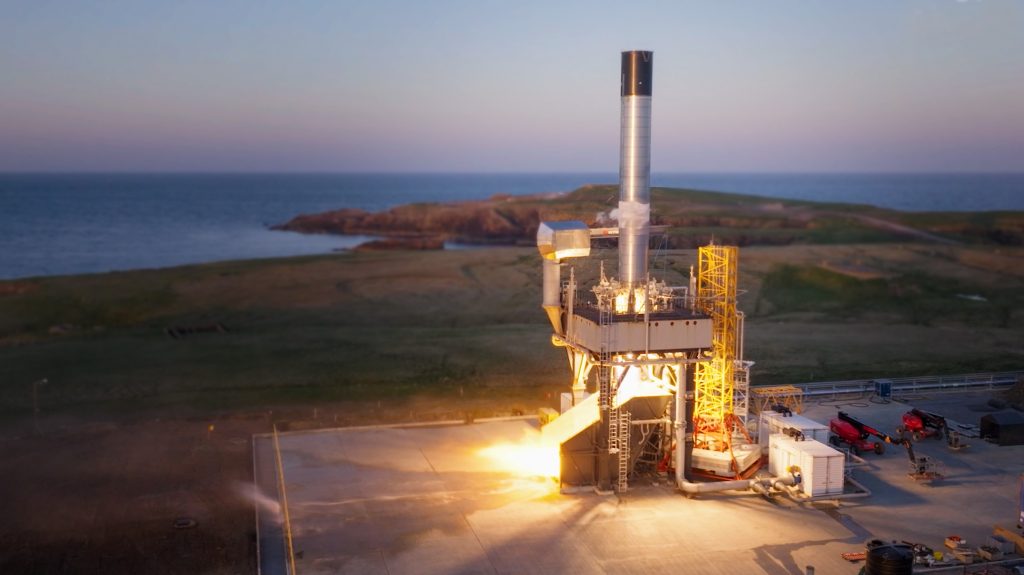
Testing of RFA’s RFA One launcher has taken place at SaxaVord, with the company occupying the sole launchpad for test firings and potential launches. A fire in 2024 during a test delayed development progress, with a further test in July 2026 being postponed. This led to a potential launch window in August-September being cancelled while investigations are carried out. The long-term testing of the RFA One at SaxaVord’s sole launch pad led to HyImpulse moving the test launch of its SR75 suborbital launch vehicle to Australia, as construction of the second launchpad at the SaxaVord site is still in progress.
ISAR Aerospace has also faced challenges in its testing at Andøya Spaceport. The first launch of its Spectrum two-stage orbital launch vehicle in March 2025 exploded shortly after take-off, while a second launch attempt in June 2026 was scrubbed due to “off nominal behaviour in the vehicle’s fluid systems” being detected. ISAR Aerospace’s exclusive occupation of Andøya Spaceport’s sole orbital launchpad means that other companies are unable to take advantage of the launch facility to facilitate satellite launches.
Similarly, the Esrange facility in Sweden is also supporting testing alongside its sounding rocket and balloon operations. In July 2026 Esrange hosted the ArianeGroup’s Themis reusable launcher first-stage prototype. This project brings promise for European reusable rocket technology that promises to support greater launcher availability and payload delivery.
These ongoing tests mean that more capacity is required from launches in Kourou and is dependent on the availability of larger systems such as the Ariane 6 and upcoming Vega rockets. Expansion of the site at Kourou is underway, with the European Space Agency, French National Space Agency (CNE) and industry partners all contributing investments to both maintain and expand operations there.

Outlook
As UK and European demand for space-based systems remains strong, there is a corresponding need for launch vehicle and launch site organisations to deliver. Increasing launch availability through European spaceports will be key to developing and expanding European space systems, as well as delivering end-to-end sovereign control of those systems.
For the spaceports themselves, ensuring that there is the financial support from governments and industry will be crucial as they move from supporting technology tests and into regular launches from their sites. The latter will provide a steady stream of revenue, particularly when combined with wider ground support services such as mission control for satellites. The progression of new commercial rocket providers such as RFA and ISAR Technologies will ensure that there is a diverse supplier base and remove the bottlenecks around launching from Kourou Spaceport when full sovereign control is needed.
As noted in the UK SDR, the potential for cross-pollination of technology and launch capacity will have positive effects for the economies of Europe. Expanding space launch availability to non-European partners from the Middle East and Asia will also serve to support the financial viability of the European space sector.

Share post






You may be interested in
Categories
Used tags
Ad