Despite the Ajax programme’s well documented issues with excessive noise and vibration, Rupert Pearce, National Armaments Director for the UK MoD, is confident that all six Ajax variants will be fully operable and fielded within the next 18 months.


Despite the Ajax programme’s well documented issues with excessive noise and vibration, Rupert Pearce, National Armaments Director for the UK MoD, is confident that all six Ajax variants will be fully operable and fielded within the next 18 months.

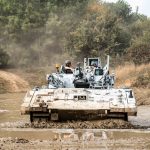
Within the next 12 to 18 months the British Army will have fielded all six fully operable variants of the Ajax tracked reconnaissance vehicle, according to Rupert Pearce, National Armaments Director at the UK Ministry of Defence (MoD).
Pearce delivered this positive outlook for the previously troubled Ajax programme during an oral evidence session of the House of Commons Public Account Committee (PAC) on 16 July 2026 focused on the affordability of the UK MoD’s Defence Investment Plan (DIP).
Prime contractor General Dynamics UK (GDUK) has been trying to fix issues with excessive vibration and noise on the Ajax since they first emerged in late 2020. The issues were largely assumed to be fixed by 6 November 2025, when the MoD declared an initial operating capability (IOC) with the Ajax family, having delivered around 165 Ajax vehicles by that point. However, the MoD later confirmed that 31 personnel showed noise and vibration symptoms following Exercise ‘Titan Storm’, which took place on Salisbury Plain from the beginning of November 2025 and involved both the Household Cavalry and the Royal Lancers.
In response to questions from the PAC chair, Sir Geoffrey Clifton-Brown, Pearce pointed out that ‘Titan Storm’ took place amid a ‘capability drop’ for Ajax, meaning that the Ajax vehicles being trialled and tested under operational conditions were not the final iterations of the vehicle.
“Capability Drop 4 is in the process of dropping right now,” he said. “There is a whole series of changes and fittings, such as improved air conditioning and so on. We will implement automatic track tensioning, which is a big step in terms of both ride comfort and ‘operationalisability’ because it means the users will not have to keep getting out to adjust track tensioning.”
Pearce added, “We are going to be running trials on composite rubber tracks (CRT), which could be another big step change. One of the things that has happened with CRT is that it has become available for heavier and heavier vehicles. GD’s view, and our view, is that that could be an appropriate step for Ajax. That does two things: it will make the ride more comfortable and allow variants for Ajax that improve its exportability.”
Pearce then detailed additional steps that are being taken with regard to both training and user feedback for Ajax.
“We are also looking at upgrading the onboarding process in two important ways,” he said. “First, GD run a programme for the US Department of War that involves much more holistic, detailed onboarding and training for the army when it takes delivery of a vehicle. We are taking that as the gold standard. … We are professionalising and taking further that process so that our warfighters are better trained to the vehicle in hand.
Secondly, we are improving the feedback loops,” he added. “What we found, to our chagrin, was that there was nowhere for troopers’ comments to drop. They gave us comments that dropped into the ether. We need a proper feedback loop where stuff gets picked up. When people say, ‘This isn’t working, that’s not working, or it would be better if we did this’, that needed somewhere to go. There is now somewhere [for it] to go, and we will iterate through that with GD. We can put Ajax into a programme where we are continually improving it based on real-world experience.
“In other words, it is a very holistic approach,” said Pearce. “There is not one problem that we fix and we are done; it is a whole series of things that need to be taken together and got after. I am confident that over the next 12 to 18 months all those things will be dropped and implemented, and we will have a fundamentally better armoured vehicle.
“We still believe that this is among the best recce-strike vehicles of its type in the world and that there is a very large export market for GD and Merthyr Tydfil [location of GDUK’s Ajax manufacturing site in Wales] to get after. In our experience, there is huge interest. Once we can get the army behind it in an unqualified way, it will be a very successful vehicle.”
The PAC chair then asked Pearce, “Who will pay for all of the modification, delays and everything else? It does not seem reasonable that the UK taxpayer should be paying for all that, so where have we got to with the negotiations?”
“We are in the process of reigniting those because it was DIP dependent,” Pearce replied. “We have a position in principle agreed with GD, and now we need to nail that down and sign up to the new terms. That will include a long-term service and support arrangement, which was not in place before these problems. We are killing a number of birds with the same stone. We will emerge with all that work having been agreed and a long-term support contract alongside it. We will be in a much stronger position in terms of supporting this vehicle in the field as well.
“There will be costs for us,” Pearce added, “but I have to say publicly that we have been very happy with the way that GD has leaned into this. It has invested very significantly out of its own pocket to get this vehicle to where it needs to go. It is not all costs on the UK taxpayer. I cannot say what the exact number will be yet, but where we are in principle is a very good overall outcome for MoD and for the taxpayer.”
When Clifton-Brown asked Pearce to specify what the GBP 1.1 billion (EUR 1.28 billion) mentioned in the DIP alongside the Ajax programme actually covers, he confirmed that it includes “all the capability drops, all the changes and the long-term support agreement”.
The UK has ordered 589 Ajax vehicles in six main variants: 245 turreted reconnaissance, surveillance and joint fire control vehicles (with these three types known as Ajax variants); 93 Ares armoured personnel carrier variants to provide protected mobility and overwatch support for reconnaissance and strike teams; 112 Athena command-and-control variants; 51 Argus engineer reconnaissance variants; 38 Atlas armoured recovery vehicles; and 50 Apollo repair vehicles.

In the autumn of 2025 this author was told by a highly placed source with intimate knowledge of the Ajax programme that there were three main issues that caused problems with the vehicles’ development. Firstly, a significant issue resulted from the quality of ASCOD-based platforms being delivered from General Dynamics European Land Systems’ manufacturing site in Spain, which gave the GDUK engineers in Merthyr Tydfil a number of engineering issues.
Secondly, there was excessive tinkering with the vehicles’ requirements as the project was passed from one desk to another within the British Army/MoD, leading to additional and often unnecessary engineering issues to meet the resulting design revisions.
Lastly, there was an unhelpful reticence from the overarching GD management to concede there were issues to be addressed and to grasp the nettle of addressing them.
Despite all of these issues, however, Warsight has previously concluded that the Ajax programme was ‘condemned to succeed’ as a result of already sunk costs, lack of available funding or time to source an alternative and the impact that cancelling Ajax would have on critical British Army capabilities and programmes.