The DIP promises the Army a mix of continuity with conventional programmes, along with smaller quantities of new capabilities. In some cases the outlook is quite positive, while others look set to rely on future budgets to come to fruition.


The DIP promises the Army a mix of continuity with conventional programmes, along with smaller quantities of new capabilities. In some cases the outlook is quite positive, while others look set to rely on future budgets to come to fruition.

Going through the UK Land Forces entry in the Ministry of Defence’s (MoD’s) Defence Investment Plan (DIP), the British Army is broadly investing in three primary capability sets.
Of the DIP’s circa GBP 14.5 billion in spending on army programmes out to April 2030, a majority of GBP 8.29 billion (around 57%) is to be spent on core land warfare systems, with GBP 3.48 billion (around 24%) on rotary-wing aviation, and the remaining GBP 2.71 billion (nearly 19%) on more forward-looking capabilities such as uncrewed systems and implementing the land portion of the Digital Targeting Web.
There’s a lot to discuss here, so Table 1 provides a summary of the key areas of army capability funding, and what they are expected to go toward, ordered by funding level.
| Table 1: British Army capability funding summary out to April 2030 | ||
| Capability | Comment | Funding from FY26/27-FY29/30 (GBP) |
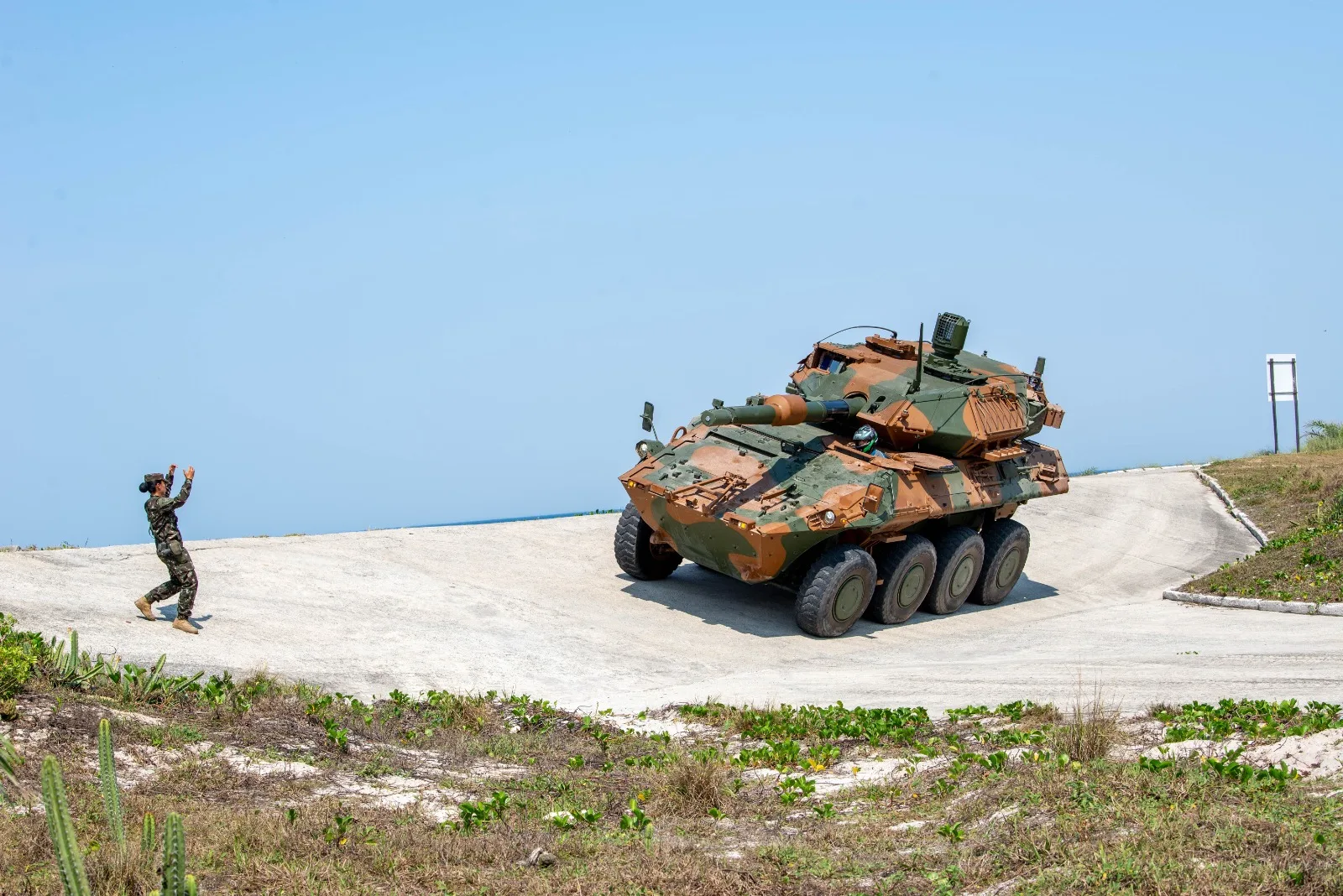
| Boxer 8×8 | 2.2 billion | |
| Chinook helicopters | To replace older Chinooks (Mk 6A) approaching retirement. | 1.7 billion |
| Ground-Based Air Defence (GBAD) | 1.5 billion | |
| Close Support Artillery | Mostly comprises 72 RCH-155 self-propelled howitzers (SPHs). | 1.3 billion |
| Challenger 3 main battle tanks (MBTs) | Due from 2029 | 1.1 billion |
| Ajax family of vehicles | 1.1 billion | |
| Apache helicopters | 1.1 billion | |
| New Medium Helicopter (NMH) | Comprises 23 Leonardo AW149 multi-role helicopters. | 680 million |
| Long Range Rocket Artillery | Likely refers to the MLRS A2 Upgrade, with GMLRS and ER GMLRS missiles. Unclear if this also includes the PrSM procurement or if that is separate. | 590 million |
| Army ISTAR | 570 million | |
| Land Mobility Programme | The Light Mobility Vehicle (LMV) seeks a replacement for Land Rover and Pinzgauers;
While the Heavy Protected Mobility (HPM) seeks a 6×6, likely to be the Patria 6×6 (CAVS). |
500 million |
| Project Corvus | Mostly comprises 24 new intelligence, surveillance and reconnaissance (ISR) drones to replace Watchkeeper. | 450 million |
| Land Lethality Pipeline | Includes drones – likely Anduril Ghost and Bolt-M; plus UGVs – likely ARX Gereon. Unclear if also includes the medium and heavy UGV procurement, or if that is separate. | 400 million |
| Project Asgard | Involves developing the Army’s reconnaissance-strike capabilities, of which Ajax is a key component. | 370 million |
| Project Nyx | Aims to procure 24 armed autonomous drones to operate alongside the Army’s AH-64E Apache helicopters. | 220 million |
| Deployable counter-drone technology | Unclear if part of GBAD funding or separate. | 200 million |
| Short-range ballistic missiles (SRBMs) | This will likely involve acquiring PrSM. Unclear whether part of the Long-range rocket artillery funding or separate. | 190 million |
| Personal weapons and equipment | 160 million | |
| Medium and Heavy unmanned ground vehicles (UGVs) | Unclear if part of Land Lethality Pipeline funding or separate. | 150 million |
| Note 1: It should be emphasised that this table only includes funding over the specified period. The total cost of many of these programmes is much higher than appears here.
Note 2: The Army funding section contained some discrepancies, such as the cost of Project Corvus, wherein the table stated 450 million, while the explainer directly below stated 310 million. Elsewhere, some entries are missing from the DIP’s table, but mentioned below it, making it unclear if they are part of table items (and hence double-counted) or not. Items such as the Land Mobility Programme do not fit line items in the DIP table, but some others might. In places, the document is fairly unclear. |
||
As the table shows, around GBP 8.3 billion (57%) of the GBP 14.5 army programme spending detailed in the DIP is dedicated to continuity or upgrades to the army’s core land warfare systems. This includes Boxer 8×8s, Challenger 3 main battle tanks (MBTs), and the Ajax family of vehicles. Alongside this are efforts to modernise the army’s artillery through bringing the UK’s M270 Multiple Launch Rocket Systems (MLRSs) to the M270 A2 standard, and the procurement of RCH-155 self-propelled howitzers (SPHs), as well as new vehicles under the Land Mobility Programme (LMP). On top of this is new investment in ground-based air defence (GBAD).

The second main component, comprising GBP 3.48 billion (24%) involves continuity and additions to the army’s rotary-wing aviation, namely continuity for the Apache attack helicopter fleet, along with the purchase of new Chinooks to replace older Mk 6A models slated for retirement as they reach end of service life, and procuring 23 Leonardo AW149 multi-role helicopters under the New Medium Helicopter (NMH) programme.
The third main component outlined in the DIP concerns GBP 2.71 billion (nearly 19%) for forward-looking capabilities, such as Project Asgard (representing the army component of the Digital Targeting Web), or the Land Lethality Pipeline (to deliver drones and UGVs to the army), and Project Corvus (to replace the army’s Watchkeeper ISR drones).
Can the army funding outlined in the DIP credibly be said to result in “a British Army that is ten times more lethal,” as the DIP claims? In short, no. The news is not all bad, but at the same time it’s difficult to hide the fact that some hard choices seem to have been made by virtue of omission, and some of the more forward-looking capabilities the lethality boost claim rests upon will require substantial additional investment in future budgets. Here, Warsight examines the good, the moderate, and the bad.
GBAD/C2/Counter-drone capabilities
A positive development was the uptick (GBP 1.5 billion) in GBAD funding, which hopefully indicates that the army may be changing course from its long tradition of investing minimally into GBAD compared to many of its peers and opponents. However, the level of funding allotted did not indicate that the army will be fielding a multi-layered GBAD capability, as the cost would be expected to run to several billions at minimum. If the figures have been interpreted correctly, the GBP 1.5 billion comprises:
Of these, the former two are positive steps. Drone protection in particular represents a much-needed capability for the UK, and most of the allotted sum seems to be going to ground forces, judging by the DIP’s statement that “this includes Project Presagium, which builds on the recent success of Rapid Sentry [a semi-mobile missile launcher armed with the Thales UK LMM] and a suite of low-cost ground-based effectors such as Skyhammer [an interceptor drone].”
While the GBP 750 million is unlikely to get the UK all the way with having a strong counter-drone capability, it nonetheless represents a reasonable starting point.
New rocket and tube artillery
The UK’s procurement of 72 RCH-155 SPHs and upgrading/procuring 61 M270 A2 MLRSs, alongside procurement of GMLRS and GMLRS ER guided rockets are all positive moves. When coupled with the 14 Archer SPHs the UK already operates, the artillery is shaping up to be one of the army’s areas of greatest improvement.
NMH
Under the UK’s New Medium Helicopter (NMH) programme, 23 Leonardo AW149 medium multi-role helicopters were ordered on 2 March 2026, the DIP specifies that GBP 680 million will be spent on this project over the next four years. This move for now secures the future of Leonardo’s production site at Yeovil in Somerset, traditionally known as the ‘home of British helicopters’, preserving UK sovereign helicopter production.

Digital Backbone/Digital Targeting Web
While not strictly speaking an army programme alone, the Digital Backbone and Digital Targeting Web deserve mention here. Both are good initiatives, and vital for the UK armed forces’ continuing relevance. So what’s the problem? It appears that the DIP heavily relies on much higher spending in future budgets to make the figures work.
Out to April 2030, the DIP gives figures of GBP 1.8 billion for the Digital Targeting Web, and GBP 5.5 billion for the Digital Backbone, representing a combined GBP 7.3. However, it then notes that “at least [GBP] 17 billion” will need to be invested between 2030 and 2035 “to meet the vision set out in the SDR” and that these investments would include “raising the Digital Targeting Web to its full operating capability.”
This suggests that in practice, the Digital Targeting Web is likely to have only reached a fairly nascent initial operating capability (IOC) in 2030. While this in itself is not necessarily unrealistic, the concern here is that if the cost over the next funding cycle is likely to more than double (as suggested), future budgetary battles could in turn push some of this cost to the right again, delaying its implementation. This should have been one for the MoD to ring-fence and really commit to right out of the gate.
Uncrewed system programmes
Many of the army’s programmes involving uncrewed systems outlined in the DIP are commendable. Having said that, the level of funding apportioned to these efforts in total suggests procurement will be of modest scale until 2030, with more meaningful procurement a problem for future budgets.
Additionally, some uncrewed procurements raise questions. For instance, under Project Nyx the army aims to spend GBP 220 million on procuring 24 armed autonomous drones to operate alongside the Army’s AH-64E Apache helicopters. If hard decisions must me made, might it not have been more efficient to spend this sum on simply increasing the numbers of ISR drones (currently 24) to be procured under the GBP 310 million Project Corvus, or upping somewhat slim GBP 210 million budget for low-cost one-way effectors?
SRBMs
While the fact that the army is set to receive PrSM SRBMs represents a positive sign, the apportioned sum of GBP 190 million suggests a small initial tranche being sought, and supplementing this will be a matter for later budgets.

Challenger 3
While the army badly needed an upgrade to its ageing Challenger 2 tanks, and the Challenger 3 certainly represents a major capability uplift over its predecessor, the overall package appears likely to face issues when it enters service.
To put things into context, it is important to understand that Challenger 3 is not a new-build tank. It essentially mates a Challenger 2 tracked platform with a new turret armed with a 120 mm smoothbore gun and fitted with a new appliqué armour package.
This means key automotive parts, such as the engine, transmission, and running gear remain the same. The UK’s Challenger 2 fleet is undergoing the Heavy Armour Automotive Improvement Programme (HAAIP) as part of its transition to the Challenger 3 standard. This modifies the Perkins (now Caterpillar) CV12-6A diesel engine to the 9A standard, but the process does not uprate the engine beyond its current 1,200 hp (895 kW) power rating.
This becomes problematic because the upgrade sees a weight increase from the Challenger 2’s 62.5 tonnes to Challenger 3’s 66 tonnes, at least on paper. In practice, the combat ready weight of Challenger 2 Theatre Entry Standard (TES) sits at around 74.8 tonnes. Some sources have stated that the combat ready weight of Challenger 3 sits slightly above this, closer to 80 tonnes. Vehicle weight increases typically correlate with more frequent maintenance requirements, as the added weight imposes a toll on automotive components.
Next comes the numerical problem, the army is set to receive 148 Challenger 3 tanks, representing a roughly 35% decrease from the fleet of 227 Challenger 2s it operated in 2021, and a smaller fleet than many European allies. Yet this quantity is probably all the UK could realistically get, since the UK lost the ability to produce new-build Challenger 2 hulls after the Vickers Armstrong Works factory (now belonging to Pearson Engineering) closed in 2012, and with it, the UK’s ability to build tanks at all.
This situation ties into the maintainability question, since with no new-build option, the UK’s fleet more dependent on cannibalising existing platforms in whole-fleet management for spares. Complicating matters, the UK’s supply of serviceable vehicles further dwindled with the donation of 14 Challenger 2s to Ukraine in 2023.
On paper, Challenger 3 would also be able to rely on the Trophy hard-kill active protection system (APS), but in a cost compromise, the vehicle was ordered fitted ‘for-but-not-with’ APS, and with only 60 Trophy sets ordered, a majority of the fleet would not be able to make use of it. Consequently, the fleet’s ability to operate amid a persistent drone threat will depend much upon what counter-drone systems it is paired with.
Overall to its predecessor, Challenger 3 represents a better-protected tank with better optics, networking, and ammunition interoperability with NATO. But this comes at the cost of being less numerous, slower, with worse weight distribution, and likely requiring more frequent maintenance for some subsystems than its predecessor.
While officially, the MoD is still targeting an IOC date in 2027, some reports suggest the schedule has slipped to delivery in 2029. By this point, Challenger 3 is unlikely to look particularly remarkable alongside some of the tanks being procured by allies, such as the Leopard 2A8, and potentially CAPINT beginning to arrive not long after Challenger 3 deliveries are completed. The risk here is that it will then prove difficult for the MoD to convince the Treasury the tanks need an upgrade after they have just been delivered.
No mention of Warrior or successor IFV
As mentioned in the Warsight top-level overview, one glaring omission from the DIP was the fact that Warrior was not mentioned at all. Originally slated for upgrade, under the Warrior Capability Sustainment Programme (WCSP), the programme represented another procurement fiasco, and culminated in WCSP’s cancellation in 2021. The ultimate fate of the army’s IFV capability remained uncertain after this, with Warrior slated for retirement in 2025.
Things changed in 2023, as the MoD quietly extended Warrior’s service life to 2030 after signing a contract with Rheinmetall to upgrade the platform with front and rear cameras for the driver. But since that point, no news has emerged regarding either an upgrade programme or a replacement.
Warrior is one of the only IFVs in the entirety of NATO to still use an unstabilised main armament, with perhaps only the BMP-1 retained in service by some allies sharing this unenviable description. As things stand, unless a decision is made on Warrior either way, the approximately 388 in service IFVs will be retired with no replacement from 2030. This may have been one of those “hard but necessary decisions” alluded to in the DIP.
[UPDATE 02/07/2026: Since this piece was published, the MoD responded to a Warsight query on Warrior, confirming that it would begin being retired from 2027, “with all vehicles scheduled to be withdrawn from service by the end of the decade.” No mention was made of a forthcoming replacement]
In a similar vein, zero mention appeared to have been made to the proposed Ajax 2 upgrade.
Medium-range air defence
The DIP noted that GBP 350 million was earmarked to “double the number of the Sky Sabre air defence missile systems operated by the Army”.
While may sound impressive, to be brutally honest, doubling Sky Sabre quantities represents a fairly low bar. The army is understood to operate just seven or eight launchers at present, notionally split into four batteries with two launchers each. These are being supplemented by an August 2025 GBP 118 million order for a further six launchers. Referring to this contract in response to a written question, Minister for Defence Procurement Luke Pollard said “A doubling of the number of deployable Sky Sabre systems operated by the Armed Forces is already on contract and due to deliver by 2027”.
Taken at face value, Pollard’s statement suggests 12 ‘deployable’ launchers. To account for the discrepancy of the 7-8 understood to be in service, it is plausible that two are not be considered ‘deployable’, for instance, if permanently assigned to protect a fixed site. Depending on the reading, the army could end up with around 12 to 14 launchers in total. Either way, neither figure is particularly ambitious.
By way of comparison, Poland also fields the CAMM missile used by Sky Sabre with its Mała Narew and Pilica+ systems, and is in the process of acquiring 56 CAMM launchers to form just one part of its GBAD network, which will also include 138 launchers for the longer-range CAMM-ER missile, 64 launchers for PATRIOT PAC-3 MSE, along with numerous other components at the shorter-range end of the GBAD spectrum.

On paper, when looking at Ministry of Defence’s (MoD’s) Defence Investment Plan (DIP) breakdown of funding by domain out to 2030, the British Army, at GBP 19.2 billion, appears to sit between the RAF at GBP 27.8 billion, and the Royal Navy at GBP 18 billion. This is misleading. In reality, the army is slated to operate on a leaner procurement budget than its compatriot service branches.
This can be most easily demonstrated by looking at where much of the remaining funding is going. The lion’s share of the GBP 63.6 billion allocated for the Defence Nuclear Enterprise (DNE) will go to the navy to fund 4 Dreadnought-class nuclear-powered ballistic missile submarines (SSBNs), 12 SNN-AUKUS nuclear-powered attack submarines (SSNs), together valued at GBP 47 billion. Some of the remaining portion will be used to fund the RAF’s F-35A fighters for the NATO Dual-Capable Aircraft nuclear mission. The RAF is also likely to absorb a significant portion of the Space domain funding.
The way things stand, whether by design or budgetary inertia, the centre of gravity of the UK armed forces appears to be shifting away from the army, and more in the direction of the navy and air force. There are those who would agree with that balance.
In past conversations with serving personnel and others in the UK defence space, the discussion has often turned to whether the UK is trying to do too much with a limited budget. Few saw the British Army as being better than many allies in land warfare scenarios against the Russians in eastern Poland or the Baltics. One common attitude was that the Finns, Poles, and Germans were better prepared to conduct the fight in the land domain, so why copy them? Why not do something the UK is uniquely better suited to instead?
While there are some merits to this approach, personally, this argument has never seemed entirely convincing. In part, this is because many of the likely high-intensity warfare scenarios in Europe would involve fighting inland.
Using the navy and RAF to play a supporting role to allied ground forces can sound like a tempting route. However, the War in Ukraine has often demonstrated the enduring importance of sufficient infantry numbers, and how even having a small force plugging a key part of the front line can be enough to prevent an opponent from making critical and potentially decisive advances.
While naturally no NATO member wants to fight the same kind of war as Ukraine, it is worth remembering that the opponent always has a vote.