US President Donald Trump has backed off a threat to attack Iran’s energy infrastructure and claimed talks are in progress with Tehran. Meanwhile, two US Marine Expeditionary Units are on their way to the Gulf.


US President Donald Trump has backed off a threat to attack Iran’s energy infrastructure and claimed talks are in progress with Tehran. Meanwhile, two US Marine Expeditionary Units are on their way to the Gulf.

As the US/Israeli war with Iran moved into its fourth week, the sight of a path toward resolving the conflict remained opaque.
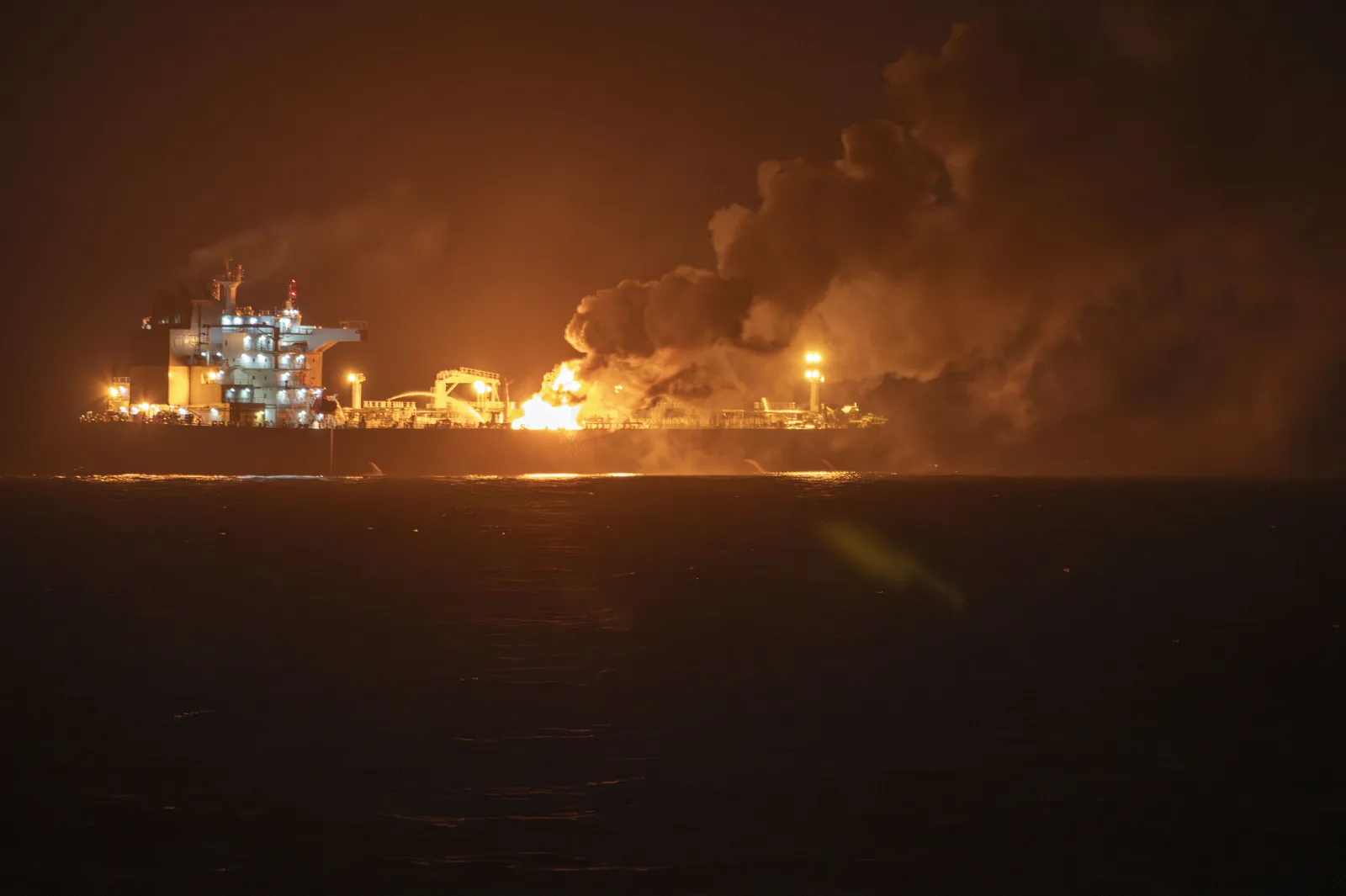
With the price of Brent Crude having peaked at USD 111.61 per barrel on 19 March due to Iran’s choking of the Strait of Hormuz, US President Donald Trump issued a 48-hour ultimatum on 21 March, threatening to “obliterate” Iran’s energy infrastructure if the strait was not re-opened to shipping.
To this the Iranians responded with typical defiance via several official and military channels, asserting that any US strike on its energy infrastructure would mean the Strait of Hormuz would be “completely closed”. Iranian parliament speaker Mohammad Bagher Qalibaf further warned on X that, following any such US attack, vital infrastructure across the Gulf region – including energy and desalination facilities critical to Gulf nations – would be considered legitimate targets by Iran and “irreversibly destroyed”.
By 23 March, however, Trump had apparently changed tack, posting on his Truth Social media channel in the usual capital letters that the US and Iran “HAVE HAD, OVER THE LAST TWO DAYS, VERY GOOD AND PRODUCTIVE CONVERSATIONS REGARDING A COMPLETE AND TOTAL RESOLUTION OF OUR HOSTILITIES IN THE MIDDLE EAST”.
Trump asserted that, as a result of this development, he had instructed the US military to postpone any strikes on Iranian power plants and energy infrastructure for a five-day period, “SUBJECT TO THE SUCCESS OF THE ONGOING MEETINGS AND DISCUSSIONS”.
While this news certainly had a positive effect on the markets, for example bringing the price of Bent Crude back down to less than USD 100 per barrel, as of mid-23 March Iran’s Fars news agency was denying there was any direct communication between Iran and the United States.
It remains to be seen whether any meaningful dialogue between the two sides has, indeed, taken place, or whether Trump is simply buying time, either to manufacture an acceptable off-ramp to the conflict or to widen his military options.
On 18 March the US Marine Corps’ 11th Marine Expeditionary Unit (MEU), consisting of at least 2,200 marines, was ordered the Middle East from San Diego aboard the Wasp-class amphibious assault ship USS Boxer (LHD-4). This force will join a force from the 31st MEU, led by the Japan-based America-class amphibious assault ship USS Tripoli (LHA-7) and including up to 2,500 marines, that was ordered to the Gulf region on 13 March.
A few thousand marines, of course, does not constitute an invasion force – and putting US boots on the ground in a foreign country would be fraught with political danger for Trump – but US news outlet Axios has reported that the Trump administration is considering occupying Kharg Island off Iran’s northern Gulf coast. The island, which was the subject of an extensive air strike by US forces on 13 March, is the location of Iran’s most important oil terminal.
Trump has vacillated several times over whether the war with Iran is nearing a conclusion or not. This is hardly a surprise, given that the US rationale for joining Israel in attacking Iran in the first place has been wildly inconsistent, ranging from destroying Iran’s nuclear capabilities (which Trump had already claimed on 25 June 2025 were subjected to “Obliteration” by Operation ‘Midnight Hammer’), to regime change, and also to vague, confidential objectives and timelines that US ‘Secretary of War’ Pete Hegseth maintained would not be disclosed, lest the ‘liberal media’ hold the Trump Administration to account over them.
On 13 March Hegseth put in what was described as a particularly unhinged appearance at a Pentagon press briefing in which he stated that the Strait of Hormuz was actually open and that military leaders “don’t need to worry about it”.
“The only thing prohibiting transit in the straits right now is Iran shooting at shipping. It is open for transit should Iran not do that,” said Hegseth, who went on to criticise press accounts suggesting that Iran’s choking of the strait was not anticipated by the Trump administration.
By 17 March Trump himself was claiming, without offering any evidence, that the US/Israeli offensive was initiated due to evidence that Iran was about to attack first.
On the afternoon of 20 March in Washington, DC, Trumptold reporters, “I don’t want to do a ceasefire. You don’t do a ceasefire when you’re literally obliterating the other side.”
A day later he was talking about resolving hostilities.

In the wake of erstwhile US allies refusing to join a war on which they were not consulted and did not sanction, Trump has attempted to play down the significance to the US of Iran choking the Strait of Hormuz of shipping. On 20 March Trump posted on Truth Social that the strait “will have to be guarded and policed, as necessary, by other Nations who use it – The United States does not!”
He claimed that reopening the strait would be a “simple” military manoeuvre – which calls into question why the US Navy hasn’t done it – and referred to the US’ NATO allies as “Cowards” for not committing their forces.
Yet there have already been significant consequences for those US allies – and not just at the gas pump. The US Gulf allies have had their cities and infrastructure attacked and now live in the vicinity of a vengeful Iran regime that, while battered, shows no sign of collapsing.
The UK, meanwhile, has seen bases beyond the immediate Gulf region attacked. On 1 March a UK base on Cyprus, RAF Akrotiri, was struck by an Iranian drone, with additional such attacks intercepted over the following days.
Then, on the night of 19/20 March, the UK base on Diego Garcia in the Indian Ocean was targeted by a couple of Iranian intermediate-range ballistic missiles (IRBMs). One of these was intercepted by an air defence missile fired from a US destroyer, while the other failed in mid-flight around 640 km from Diego Garcia, but more disturbing was the fact that Diego Garcia was targeted in the first place, given that it is around 3,800 km away from the southern coast of Iran.
It was previously believed that Iran’s Khorramshahr-4 medium-range ballistic missile had a range of around 2,000 km. It is suspected, however, that by reducing its 1.5-tonne payload to around 450-550 kg the Iranians have produced an IRBM with around double the range. While such a missile would have a reduced effect on impact and likely a large circular error probable (CEP), meaning that single examples could not be used for precision strikes, its potential as a terror weapon would remain.
On 21 March the Israel Defense Forces, with an interest in taking up the Iranian threat, stated that Iran has a ballistic missile capability “that can reach London, Paris or Berlin”.
This consideration must now be added to the potential for Iran to reconstitute its nuclear weapon programme should the Iranian regime survive its pummelling by the US and Israel.
Should the Iranian regime emerge from the current conflict as even more hardline and vengeful, there would theoretically be a more pressing incentive to effect regime change in Tehran, yet neither the Trump administration nor that of Israeli Prime Minister Benjamin Netanyahu have ever given any firm indication of how that might be achieved.