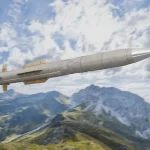
Running low: addressing the US shortage in missile stocks

It is fair to say that the current conflict in the Gulf is not going as planned for the United States. The Trump Administration is facing a number of political, economic and military hurdles that all need to be cleared before an elusive peace deal can be obtained with a tenacious and obdurate Iran. The situation is not being helped by diminishing US munitions stocks.

Tomahawk firing
The Arleigh Burke-class guided-missile destroyer USS Delbert D Black (DDG 119) fires a Tomahawk Land Attack Missile (TLAM) in support of Operation ‘Epic Fury’ in February 2026. The TLAM inventory is not expected to reach pre-war levels until late 2030 or early 2031, according to the CSIS. (US Navy)
Dr Trevor Nash

The war now being conducted by the United States and Israel against Iran and its proxies is not playing out as expected due to poor pre-deployment mission planning combined with a belief that sophisticated military hardware will always result in strategic superiority.

The US is also facing other obstacles. Its plan to transform the current tentative ceasefire into a permanent ‘deal’ that will see the Strait of Hormuz opened to shipping and restrictions placed on Iran’s nuclear enrichment capabilities is being thwarted by Israel. Prime Minister Benjamin Netanyahu’s priority is to neuter threats from Hezbollah in Lebanon and Hamas in Gaza, as well as to destroy Iran’s ability to militarily support both groups. In short, US and Israeli war aims are mutually exclusive.

Economically, both at home and abroad, US President Donald Trump is also feeling the heat. US gasoline prices are well over USD 4/gallon and with the cost of living rising there is a growing tide of resentment in the country. With around 20% of the world’s oil and gas passing through the Strait of Hormuz, many nations around the world are also suffering economically. Along with Israel retarding the potential peace process between the US and Iran for its own war aims, the conflict is set to drag on. It is little wonder that Secretary of War Pete Hegseth, in his testimony before the US Congress on 1 May 2026, said that “any deal will be a good deal”. Despite the Trump Administration’s hubris, there seems a growing sense of desperation to end the war.

Militarily, the US remains at the top of the global military power index. In terms of the complexity and sophistication of US weapon systems, it is second to none, but such weapons come at a high price. On 27 May the Washington DC-based Center for Strategic and International Studies (CSIS) published a report entitled Rebuilding US Missile Inventory: A Multiyear Project. The report states that during the 39 days from the start of the war on 28 February 2026 to the ceasefire on 8 April, US inventories of “key … munitions stockpiles” were significantly depleted such that their replenishment “has become a major concern”.

An SM-3 Block 1B missile is launched from the guided-missile cruiser USS Lake Erie during a test in the mid-Pacific in November 2017. Only a small number of SM-3s have been fired during Operation ‘Epic Fury’ and therefore replenishment is expected to be achieved in a matter of months. (US Navy)

Shortages spotlighted

In terms of the timeframe required to replenish stocks, these vary from three or more years for the BGM-109 Tomahawk Land Attack Missile (TLAM) and missiles for the Terminal High Altitude Air Defense (THAAD) and MIM-104 Patriot air defence systems. For rounds such as the ship-launched RIM-161 SM-3 and RIM-174 SM-6 air defence missiles, the lead stands at two to two-and-a-half years, as fewer of these missiles were expended due to the location of US ships in the Eastern Mediterranean and Arabian Sea.

Not all missiles have been expended against enemy aerial targets. According to the BBC, missile holdings received another blow in in late May when Iran struck Al Ruwais and Al Sader air bases in the United Arab Emirates (UAE), along with Muwaffaq Salti air base in Jordan, in attacks that are understood to have damaged a number of THAAD batteries.

The CSIS report says that the smallest impact will be on the US Army’s ground-launched Precision Strike Missile (PrSM), which can be fired from the M142 High Mobility Artillery Rocket System or M270 Multiple Launch Rocket System launchers and variants of the US Air Force’s AGM-158 Joint Air-to-Surface Standoff Missile (JASSM). Both have been used infrequently in the conflict so far.

Weapon stocks are sufficient to prosecute a continuing war in Iran, says the report, but referring to China it states that these depleted inventories “have created a window of vulnerability for a potential Western Pacific conflict” for several years. Although touching on the exports of weapons such as Patriot, THAAD, SM-3, and JASSM, it is clear that overseas customers might also face a shortage as the US prioritises rebuilding its domestic weapon stocks, although it is highly likely that Saudi Arabia and the UAE will receive replacement THAAD missiles.

Not everyone agrees that the current reduced stocks of missiles for systems such as Patriot and THAAD are sufficient to extend the war with Iran. Dr Kelly Greico, an analyst with the Washington DC-based Stimson Center, argues that “the current conflict has consumed US and partner air defence stocks at a significant rate” and that “there is no rapid path to replenishment, meaning any renewed Iranian assault would be met with a fraction of the interceptors available when the conflict started”.

Problem identified

The US Department of War (DoW) and industry players such as Lockheed Martin and Raytheon identified the need to ramp-up missile production long before Operation ‘Epic Fury’. During the Association of the US Army (AUSA) 2025 event, Lockheed Martin executives spoke about increasing production of Patriot PAC-3 and THAAD missiles. Jason Reynolds, the company’s vice president and general manager for integrated air and missile defence, raised the issue of the importance of subcontractor support.

“Concerning our global supply chain, most but not all of our products for the PAC-3 have second [supplier] sources,” said Reynolds. “THAAD, on the other hand, doesn’t have a lot of second sources. It was designed by the US Missile Defense Agency and it basically has limited second sources, but we’re now partnering with them to look at what we can do to increase supply.”

In late March Lockheed Martin signed a Framework Agreement with the DoW to quadruple PrSM production and that followed a similar agreement signed in January to increase Patriot PAC-3 Missile Segment Enhanced (MSE) production from 600 to 2,000 per year over the next seven years and THAAD production from 96 to 400 a year.

A US Army M142 HIMARS launches a Precision Strike Missile (PrSM) during a flight test at Vandenberg Space Force Base, California, on 19 March 2025. The PrSM was used for the first time in combat on 4 March 2026 and is manufactured by Lockheed Martin at its factory in Camden, Arkansas, as a replacement for the original rounds used by the Army Tactical Missile System (ATACMS). Usage has been limited during Operation ‘Epic Fury’ so far. (US Space Force)

“We are working closely with the Department of War and US Army to scale production to meet operational demand and ensure the joint force has the capabilities needed to deter and defeat emerging threats,” said Lockheed Martin’s chairman, president and CEO, Jim Taiclet, in a press statement in March.

The company says that it is investing USD 8-9 billion through the next three years in advanced manufacturing techniques and new production lines to meet the DoW’s “urgent production demand”.

As Taiclet says, the company is working closely with the DoW and that organisation’s position was clearly set out in its Acquisition Transformation Strategy document that was published in November 2025. With clear aims to expand the defence-industrial base, stabilise demand, accelerate investment and speed up the acquisition process, the Acquisition Transformation Strategy is providing clear leadership. It also has the secondary benefit of increasing employment and therefore the national tax intake for the US to partially offset defence spending: strategy that many other NATO members might consider, perhaps.

Lockheed Martin’s first Munitions Acceleration Supplier Conference was held in Dallas on 14 May 2026 and drew delegates from 150 suppliers. The conferences will be held every month and alternate between physical and virtual meetings. (Lockheed Martin)

Share post

You may be interested in

Categories

All NewsOperations

Used tags

BGM-109 TomahawkLockheed MartinOperation ‘Epic Fury’PatriotPrSMRaytheonSM-3SM-6THAADUS Department of War (DoW)
Ad

Similar posts