Underscoring growing NATO needs to enhance sensing capabilities more rapidly to counter underwater threats, Saab has developed a new, layered sub-surface sensor network. The company has already tested it in an operational experimentation environment at ‘REPMUS’.
Saab reveals, and demonstrates, new Ocean Barrier underwater surveillance concept
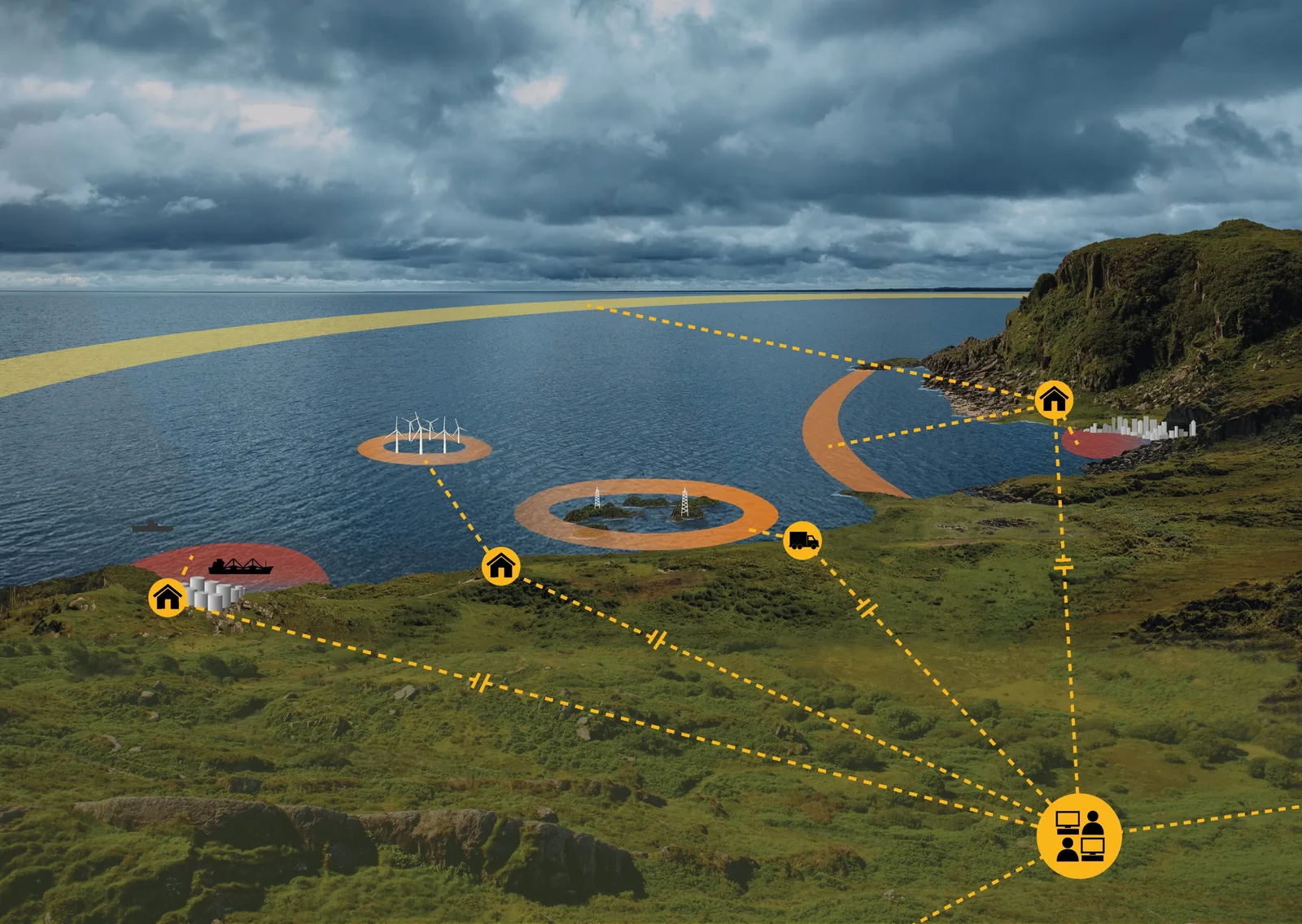
Saab’s Ocean Barrier integrated underwater sensing construct encompasses three sensor layers, plus shore-based data collation, processing and analysis facilities, to help secure coastal infrastructure and access points. (Saab)
Swedish defence and security company Saab has launched its new, layered underwater surveillance concept, Ocean Barrier, revealing that the concept has already been successfully tested at a high-level NATO operational experimentation (OPEX) activity.
That activity was ‘REPMUS 26’: the latest iteration of the Portuguese Navy/NATO co-hosted Robotic Experimentation and Prototyping with Maritime Unmanned Systems event, held each September at Tróia in southern Portugal. ‘REPMUS’ has become one of the alliance’s most significant naval activities for demonstrating new technologies and accelerating their development.
In a 28 October press release Saab stated, “At REPMUS 2026 … Ocean Barrier successfully demonstrated the ability to integrate data from diverse sensor systems and autonomously hand off tracked objects, [using] a NATO-standard protocol, to the exercise’s central command system.”
Capability construct
As a scalable, sensor-agnostic construct underpinned by modular architecture, Ocean Barrier can integrate diverse sensor capabilities and connect itself to other national and NATO underwater sensing networks.
Its broad construct is built around three underwater sensing layers and draws in multi-domain sensing data (subsurface, surface and air) to provide – working in, from its outer perimeter – detect, prevent and protect functions.
Ocean Barrier’s aim, Saab explained in its statement, is to meet naval requirements for reliable underwater surveillance capacity that connects and networks different systems and capabilities to create a more comprehensive operational picture and a more co-ordinated response against continuing challenges in the underwater environment. It does this by harnessing sensors, data and operators to detect, track, and analyse underwater activity to build persistent surveillance covering maritime chokepoints, coastal areas, territorial waters and other access points with a view to securing critical undersea infrastructure (CUI), naval bases, ports and harbours, plus other infrastructure sites. The network integrates data and converts it into information to support real-time situational awareness, enhance operator understanding of the underwater environment and augment threat response, Saab explained.
Operating each layer individually, as a pair, or as an integrated whole, Ocean Barrier is designed to secure everything from a single point to a wider maritime area, Saab said.
As described in a media briefing by Fredrik Danell, from the sales and marketing team in the Underwater Systems section of Saab’s Naval business area, the three layers generate an integrated sensing construct and output.
At the outer perimeter the ‘detect’ function is provided by a long-line passive sonar array fitted with numerous hydroacoustic sensors. It acts as a first-point-of-contact ‘tripwire’ to detect the full range of underwater target types, including submarines, uncrewed underwater vehicles (UUVs) and diver delivery vehicles.
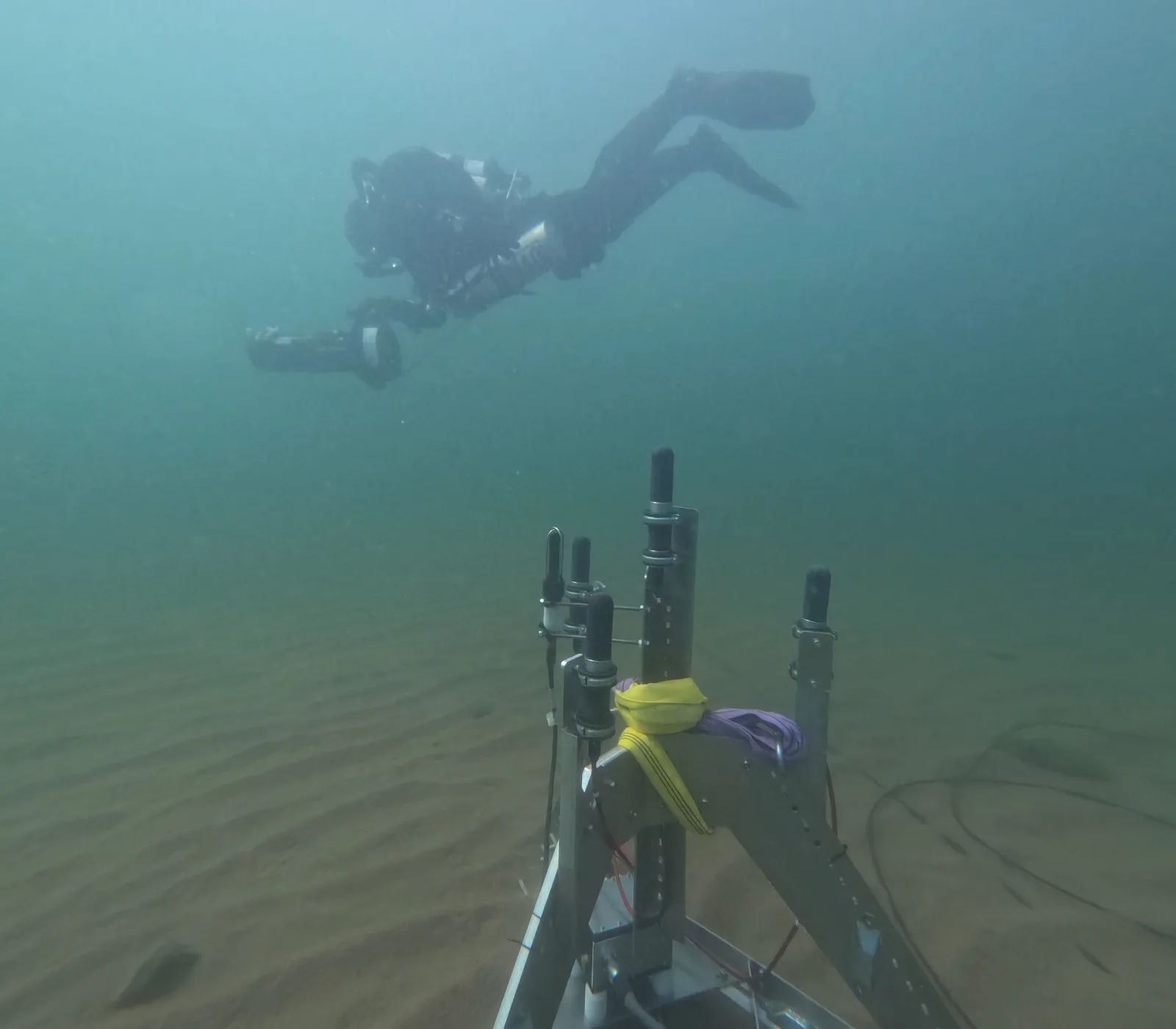
Closer in, the ‘prevent’ function is based around sets of tripod-mounted passive acoustic fibre-optic sensor ‘pods’ monitoring near-shore waters, including archipelagos, bays, coastal channels and fjords. This aims to not only detect contacts but to continuously track them and collect data on, for example, their classification, bearing and speed, helping to improve accuracy in positioning and tracking.
Closest in, the ‘protect’ function uses active sonar to provide close-range security for coastal installations like naval bases, ports and harbours, with multiple systems deployable to cover larger areas but also to support detection of smaller targets like individual divers.
Data from the sensor layers is fed directly, by cable, into a shore installation co-located, for example, at a naval base, maritime agency facility or port/harbour. Data from any surface sensors, such as radars, is also fed in here.
The collected data is then transferred to a surveillance centre, which acts as the network’s command-and-control (C2) node. That facility fuses the data into a common operational picture, providing information operators can use to detect, track and evaluate incoming risks and determine prospective responses.
Surface data sources like radar and AIS are used to help determine if a risk is subsurface. If no surface contacts are detected at the contact co-ordinates and a subsurface contact is confirmed, an alarm is triggered.
As shore installation and surveillance centre can both be container-based, Ocean Barrier thus offers a standalone, fully integrated capability that can be deployed when and where needed.
REPMUS reference point
One such location was ‘REPMUS’. There, an Ocean Barrier set-up based around two layers (‘prevent’ and ‘protect’) was assembled to test – and demonstrate – the ability to secure the naval facility at Tróia against access threats from several different UUVs.
The ‘prevent’ layer included two passive sensor ‘pods’; the ‘protect’ layer included a diver detection active sensor system.
Ocean Barrier’s sensor-agnostic concept was underlined by the fact that sensors from other companies were integrated for the test. This included Optics 11, which provided a two-pod configuration of its OptiBarrier passive fibre-optic sensing system for the ‘prevent’ layer.
At ‘REPMUS’ Saab achieved its aims with Ocean Barrier. “[We] successfully demonstrated the ability to integrate data from different sensor systems and autonomously send tracked object data up to the central [C2] system used by exercise command, all while following the requested NATO standards for data transfer,” Danell said.
Central to Ocean Barrier’s adherence to the ‘REPMUS’ data transfer standards was its compliance with NATO Standardisation Agreement (STANAG) 4817. Developed to establish a common C2 and data architecture to support integrated multi-domain operations with maritime uncrewed systems, STANAG 4817 is now the entry-level integration requirement for participation in ‘REPMUS’ (and increasingly for other NATO maritime OPEX activities).
“At ‘REPMUS’ we did the data fusion and autonomously transferred the fused data, via the STANAG, [to the C2 cell]. The technology worked very well,” said Danell.
Alongside this success, Saab learned lessons for system development. These included continuing automation of the capability and developing its usability from the operators’ perspective.
Regarding automation, “What we learned, and what we actually showed, was that we [deployed] an autonomous sensor system that automatically provided fused tracks to a higher level of command,” Kjell Adolfsson, Saab’s director of business development and strategy for underwater systems, told the media briefing. “That is something we need to work more with, of course, and to develop into better capabilities as we [develop] this product because that is something that will be needed in the future.”
Regarding operator perspectives, Danell explained that having end-users sitting with the system for several weeks during ‘REPMUS’ had generated various elements Saab wants to incorporate into Ocean Barrier as the system matures.
Overall, Danell said, “‘REPMUS’ was very interesting with all the different activities [conducted] and all the different vehicles present and operating.”
“That is also a learning, when you have a live surveillance system in the water,” he added.
Next moves with Ocean Barrier
Returning to ‘REPMUS’ in 2027 may feature in Saab’s development roadmap for Ocean Barrier, along with prospectively participating in the SeaSEC ‘Baltic Archipelago Challenge 2027’, where Saab may demonstrate additional system capabilities (SeaSEC – the Seabed Security Experimentation Centre – is a collection of Northern European navies collaborating to accelerate delivery of uncrewed system capability).
Saab’s main priority with Ocean Barrier for 2027, though, is to productise the capability, Danell said.
Ocean Barrier’s concept and construct also fit neatly with other emerging NATO underwater sensing capability architecture developments.
For example, NATO’s Allied Under Water Battlespace – Mission Network (AUWB-MN) is an alliance-wide C2 and wider interoperability architecture being developed – by a multinational consortium, led by Saab’s ship and submarine builder Kockums – to provide architectural and technological capacity, shaped by the requisite standards, to harness underwater battlespace data into a comprehensive operational picture covering waters across NATO’s area of responsibility. Ocean Barrier fits neatly into this framework and requirement.
AUWB-MN’s own development is an integral part of ‘REPMUS’ C2 architecture testing activities.
Both constructs are designed to be sensor and system agnostic, supporting existing and emerging underwater domain technologies and networks. Ocean Barrier’s effective integration via STANAG 4817 into the ‘REPMUS’ C2 and overall command structure architecture illustrated its potential to provide a local part of – and to plug into – a wider AUWB-MN network. Development of integration with AUWB-MN is part of Ocean Barrier’s roadmap.

Share post