Why don’t Russian losses directly translate into lost combat power?

Russia’s bombardment of Kyiv turns it into a ‘frontline city’
Russia’s strategic bombardment of the…

Why don’t Russian losses directly translate into lost combat power?
Despite taking severe losses in Ukraine, Russia’s forces have continued to generate military effects. Explaining that persistence requires assessing how losses change military functions, how those functions are restored and what limitations remain. The ‘combat power floor’ concept offers a way to examine that relationship without mistaking continued fighting for unchanged effectiveness.
Russia’s losses since February 2022 have been immense. Personnel casualties, destroyed armoured vehicles, damaged command posts, disrupted logistics facilities and the expenditure of ammunition and missiles have imposed costs that would normally be expected to produce a steadily declining ability to conduct military operations. Yet Russian combat power has not declined in a simple proportion to those losses.
The problem is partly one of measurement. Physical destruction is relatively easy to observe and count, whereas combat power is a product of interacting functions: command, reconnaissance, fires, logistics, personnel, equipment, communications and the ability to organise them for a particular mission. Destroying part of that system does not necessarily remove the function it performed, and counting the destroyed component therefore tells us only part of the story.
A destroyed tank is certainly a loss, but the operational consequence depends on what happens afterward. Another vehicle may be issued, an older system may be substituted, the unit may change its tactics, or the mission may be conducted with less armour and greater reliance on infantry, drones and fires. The replacement may be markedly inferior, but inferior capability can still be sufficient capability.
The same principle applies to less visible parts of the force. Destroying a headquarters matters, but its operational significance depends on whether command stops, how rapidly authority transfers elsewhere and how effectively an alternative arrangement functions.
Disrupting a supply route matters, but the military effect depends on whether materiel can be rerouted and whether the resulting reduction in throughput is sufficient to constrain operations. This distinction separates physical attrition from functional attrition: the important analytical question is when accumulated losses translate into persistent reductions in the military functions required to continue an operation.
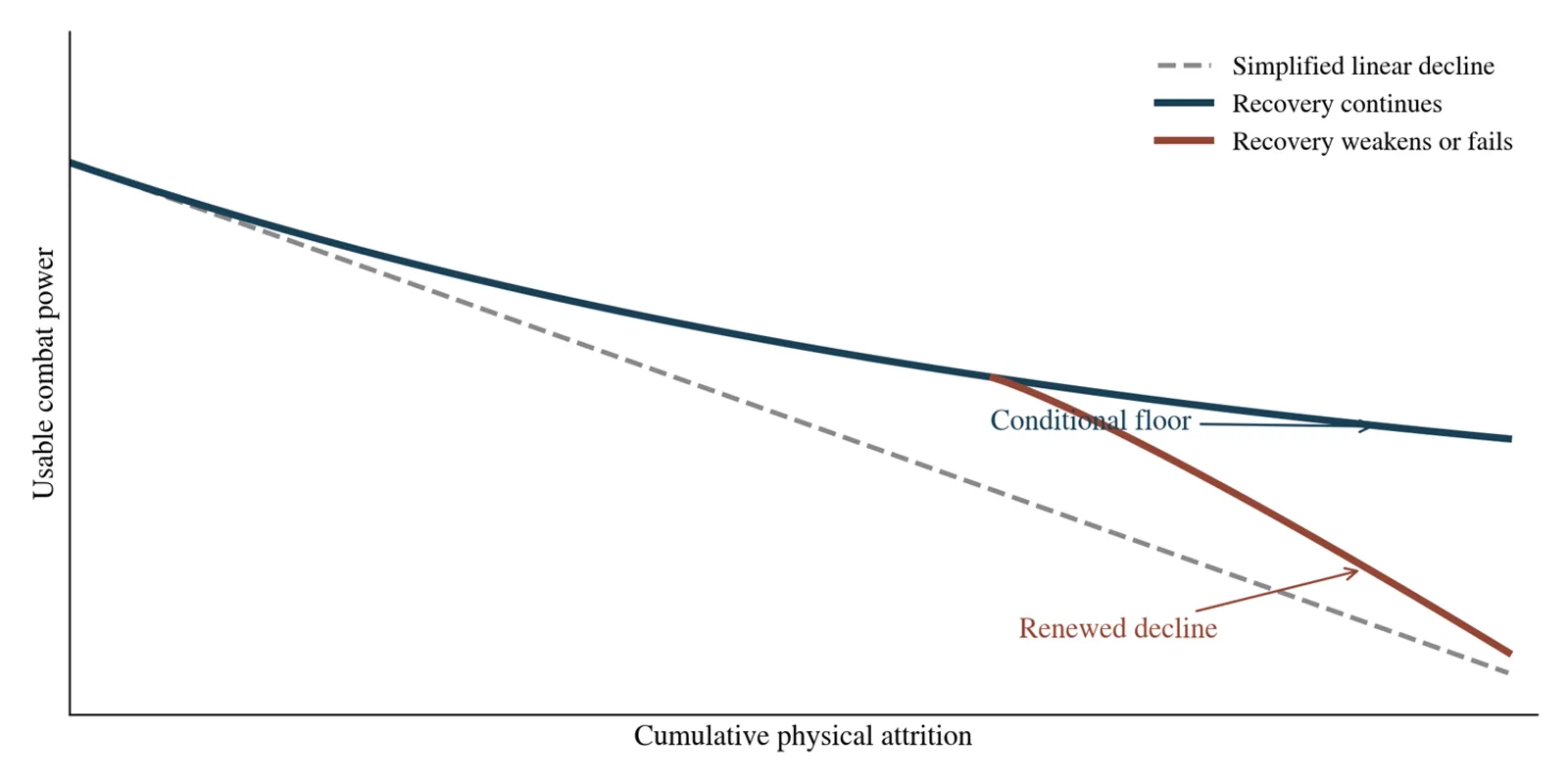
The term ‘combat power floor’ is used here to describe a temporary range of operational output sustained despite continuing losses, under specified mission demands and recovery conditions. It is an analytical concept, not a Russian doctrinal term or a measured minimum. The floor is conditional: repair, substitution, redistribution and replacement may cushion attrition, while exhausted reserves or failed dependencies can cause output to fall sharply.
Losses of experienced personnel, modern systems and established command or logistical relationships can sharply reduce effectiveness. The system may then reorganise around what remains. Damaged equipment returns from repair, older equipment is drawn from storage, personnel are replaced and depleted formations are recomposed. These responses change the capabilities available and the tasks a force can perform.
Russia does not have to recreate the force that existed before a loss to continue fighting. It may restore sufficient function for a narrower or simpler task. Replacing a modern system with an older one imposes a cost without necessarily eliminating its military effect. This can reduce the immediate operational return from attrition, but diminishing returns are a possibility, not a universal rule.
The relevant relationship is between degradation, recovery and mission requirements. A formation may retain enough capability to defend prepared positions while losing the ability to conduct a complex offensive. There is no single combat floor for the Russian military as a whole. The concept directs attention to an observable pattern: continued output despite losses, accompanied by changes in how that output is generated and what it costs.
Different functions recover at different rates. Their resilience depends on available reserves, industrial output, personnel replacement, tactical adaptation and the adversary’s ability to interfere with recovery. Figure 1 illustrates a possible relationship; it does not establish where a Russian capability will stabilise or how long that condition will last.
Russia’s most visible recovery mechanism is physical regeneration. Repair, refurbishment and new production allow the force to absorb destruction without shrinking at the same rate as battlefield losses. Soviet legacy stocks have provided replacements, although stored equipment varies in condition and requires work before deployment. Such resources cushion losses while consuming a finite reserve. The number remaining in storage matters less than how many serviceable replacements can reach units within the time required.
RUSI’s Stormbreak study describes a shift toward more precise fires as threats to Russian artillery logistics constrained the volume of less precise fire. Preserving an effect can therefore require changing the method, rather than restoring the previous level of ammunition expenditure.
Substitution provides another means of preserving function because lost capability does not necessarily need to be replaced like-for-like. A shortage of armoured vehicles may alter assault tactics rather than stop assaults; a missing reconnaissance asset may be partly replaced by another sensor; a damaged communications network may operate through less efficient channels. The replacement arrangement may deliver lower performance while preserving an essential military effect. The resulting cost, vulnerability and reduction in available options all matter even when the mission continues.
Personnel replacement also preserves numbers without restoring equivalent proficiency. Inexperienced replacements cannot immediately reproduce the judgment, cohesion and specialist skills of those lost. A force may accommodate some deficiencies by simplifying tasks and increasing fire support, but complex operations impose demands that numbers alone cannot meet. Preserving a formation’s headcount therefore says little about the range of missions it can perform.
Command resilience determines whether other functions can operate after disruption. In a 2025 study, G. B. Ryzhov and G. V. Vdovenko discuss restoring command-system integrity, interchangeable staff, trained personnel reserves, alternate command posts and duplicated communications. Their analysis also identifies unresolved theoretical and practical problems. These are proposed resilience measures, not proof that every Russian headquarters possesses them. A strike’s operational significance depends on how much command function survives, how rapidly control returns and whether the interruption constrains subordinate forces.
RUSI’s May 2023 report Meatgrinder: Russian Tactics in the Second Year of Its Invasion of Ukraine described Russian headquarters moving beyond GMLRS range and into hardened structures after command infrastructure was struck in July 2022. This illustrates a response to destruction, although relocation alone cannot establish the completeness or speed of functional recovery.
Industrial capacity performs the same function over a longer timeframe. New production cannot instantaneously replace battlefield losses, but it supplements refurbishment, repair and stored equipment while replenishing selected categories of weapons and ammunition. The system consequently operates across multiple recovery timescales, from hours for rerouting communications, to months or years for rebuilding formations and replenishing inventories.
The Russian army that continued fighting after its opening campaign was a changing force. Losses degraded some capabilities while adaptation developed others. Continued military activity, however, is not evidence of unchanged effectiveness. A force can sustain repeated assaults while losing tempo, flexibility and the capacity to exploit success.
Formation reconstitution provides a closer view of this process. In her 2024 study Russian Military Reconstitution: 2030 Pathways and Prospects, Dara Massicot described how Russia used piecemeal personnel replenishment in 2022 and early 2023 to stabilise depleted units, departing from its preference for withdrawing and regenerating formations. She reported improvements in rotation and regeneration from early 2023, while noting that some repeatedly reconstituted units had lost cohesion, experience and combat potential. This supports a distinction between restoring a formation and restoring its former capabilities. The mechanism can preserve a force’s presence and participation while leaving it less capable of demanding tasks.
Adaptation can also restore military effects through new methods. RUSI’s February 2025 field report Tactical Developments During the Third Year of the Russo–Ukrainian War, describes the expansion of glide-bomb employment as Ukrainian air defences restricted Russian aviation near the front. Aircraft could contribute firepower from greater distances without first securing air superiority. This illustrates adaptation to a constraint, rather than direct replacement of attrition losses. The two processes can interact, but should be distinguished when explaining persistence.
Recovery mechanisms interact and can fail together. Equipment shortages may increase reliance on infantry; heavier infantry losses then increase replacement and training demands. Command disruption can delay both resupply and repair. These dependencies allow cumulative damage to produce abrupt deterioration when remaining resources no longer meet the task. Continued operations during one period cannot establish that recovery will remain adequate in the next.
Signs that recovery is weakening include longer restoration times after comparable disruptions, lower operational output after replenishment, increasing reliance on inferior substitutes and repeated transfers from other formations. These are proposed analytical indicators, not findings that apply uniformly across Russian forces. They become meaningful when several converge within the same function and operational timeframe.
Interpreting those signs requires a baseline. Analysts should compare recovery after similar losses, under similar missions and enemy pressure. Yet reduced activity may reflect a planned pause, changed priorities or weather, rather than failed restoration. Conversely, maintained activity may conceal reduced effectiveness or resources diverted from another sector. Evidence of weakening recovery should connect observed delays and substitutions to actual constraints on the mission.
The combat power floor adds a temporal question to resilience assessment. Redundancy explains what may survive; regeneration explains what may return. Neither establishes whether the resulting function is sufficient before the opportunity to act has passed. A headquarters that eventually resumes work may still have failed its operational purpose during the interruption. Recovery must be judged against the task’s deadline, as well as its eventual completeness.
For NATO, battle-damage assessment should connect physical losses to military function and operational consequences. Four outcomes help clarify this relationship. Destruction records an asset’s physical loss; disruption describes a temporary interruption; degradation identifies reduced performance; and persistent functional loss occurs when the required capability cannot be restored within the operational timeframe. A single event may produce several of these outcomes.
These distinctions matter for distributed command networks, logistics, air defence and reconnaissance-strike systems. Individual losses may be absorbed through redundancy or substitution, or may expose a dependency that affects several functions. Assessment must establish which response occurred. A repaired vehicle, reoccupied headquarters or reopened route does not by itself demonstrate recovery of the previous operational output. Recovery also has costs beyond the immediate mission. Rerouting supplies can increase journey times and vehicle requirements; transferring personnel can weaken another formation; using reserves can preserve current output while reducing future options. Analysts should track these costs alongside recovery times. Otherwise, apparently successful restoration may conceal the progressive exhaustion of the mechanisms sustaining it.
The decisive condition is persistent functional loss relative to the mission. When restoration cannot keep pace with degradation, or a critical dependency fails, output can decline sharply rather than gradually. The combat power floor can move downward or cease to support the task altogether. NATO assessment should therefore answer three questions: What function was lost? How long did the loss persist? What operational constraint followed? Those answers establish whether attrition has narrowed Russian choices and reduced the force’s ability to accomplish its mission.