The Portuguese Navy’s latest ship is an unmanned systems platform

The Portuguese Navy’s latest vessel, Dom João Segundo (also known as D. João II), is noted for its maritime uncrewed systems capacity. Yet its impact is more layered. The ship will provide a platform for both developing and deploying maritime uncrewed systems across domains to support both scientific research and naval operational tasks.

Portuguese Navy ship NRP Dom João Segundo
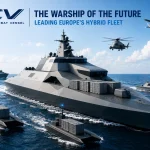
The Portuguese Navy’s latest ship, Dom João Segundo, is pictured during float out at the Damen Galati Shipyard, Romania. Focused on blending uncrewed systems in all domains and scientific research and naval operations, the ship is a new concept and capability for the navy. (Portuguese Navy)
Dr Lee Willett

The Portuguese Navy’s latest ship, the future NRP Dom João Segundo, has been floated out. The multifunctional naval platform, carrying the pennant number A5209, entered the water for the first time on 7 April 2026, at Damen Shipyards Galați, Romania where it has been in build since late 2024.

At the launch ceremony, the Portuguese Navy was represented by Superintendent of Materiel Vice Admiral Fernando Jorge Pires, plus other senior officers. In a statement, the navy said the float out was “an important step in the construction process of this ship and the modernisation of the fleet”.

Reflecting a pathway most NATO navies are starting to follow – but a pathway along which the Portuguese Navy is further than most – the ship has been nicknamed ‘the drone carrier’, but is known more formally as a maritime uncrewed systems (MUS) carrier.

Dom João Segundo is a new concept for the navy – and perhaps even a rare concept, compared to other navies – as it has been designed specifically as a platform for the development and operation of uncrewed systems across the maritime domain (air, surface, and sub-surface), and to support their use in both scientific research and naval operational tasks.

This output is enabled by a design based around a modular architecture, and an operational concept based around flexibility to support a wide range of missions. The multidomain focus for the MUS capability is illustrated too by the operational emphasis on scientific and environmental research, including environmental monitoring, seabed research and exploration, and collecting/processing oceanographic data.

Such research is supported by the ship’s at-sea endurance of 45 days, although this sustainment can be extended through use of an onboard re-supply at sea (RAS) rig. This endurance in turn enables the embarked MUS to conduct sustained research, supporting integration with the activities of Portugal’s academic and scientific communities.

The research focus at sea reflects a primary purpose for the ship – to support delivery of the country’s national and European responsibilities in the maritime domain, including to help generate marine resource and environment protection, maritime security, maritime surveillance, and humanitarian assistance and disaster relief operations. The ship’s build has been funded by the European Union’s (EU’s) Recovery and Resilience Facility within the NextGenerationEU programme.

In late 2023, Damen was contracted to build the ship. Steel cutting and keel laying took place in October 2024. Sea trials are set for later in 2026. The navy’s statement noted the ship will be ready to join the fleet by the first half of 2027.

In its own statement, Damen said that collaboration between the company, the navy, and other stakeholders on designing and building the ship took place within Damen’s development of a new multi-purpose support ship (MPSS) range. This concept provides ships spanning 7,000-9,000 tonnes in displacement, and combines military-grade technology with the use of proven, standardised solutions to support cost efficiency and rapid delivery.

A testbed platform for the Portuguese Navy

MUS capabilities that can be embarked onboard include air, surface, and sub-surface systems. Such systems will support both naval and wider marine scientific research and operations, especially including generation of data and environmental knowledge and understanding.

As well as being designed to carry a high number of autonomous systems, Dom João Segundo has been designed with a high degree of autonomy.

NRP D. João II
An artist’s rendering of Dom João Segundo showcases the spaces onboard the ship, from which the flexible range of MUS systems can be deployed in a flexible manner. (Portuguese Navy/Damen Shipyards)

The ship’s capacity to deliver task flexibility is enabled by its space. Measuring 107.6 m in length and 20 m in beam, and displacing 7,000 tonnes at full load, the ship has capacity for 650 m2 of deck space, including a 94 m × 11 m flight deck plus hangar and laboratory spaces. The deck spaces can accommodate up to 12 20-ft ISO shipping containers: such containerised capacity provides the opportunity to add further communications and support functionality, as well as embarking mission-specific MUS systems. The deck spaces can also accommodate up to 10 rigid-hull inflatable boats (RIBs) or landing craft.

A stern ramp, two ship’s cranes, an A-frame, and side davits can enable launch and recovery of embarked MUS systems into the water. Into the air, the flight deck has space for nine landing spots: eight for vertical take-off/landing (VTOL) uncrewed aerial vehicles (UAVs), and one for a medium helicopter. The ship’s contribution to underwater monitoring, for environmental or naval purposes, is supported by a drop-keel that can carry sensors.

Underlining its mix of naval operational and scientific research tasks, the vessel will carry 48 naval crew plus up to 42 scientists. Space onboard also permits another 100 people to be accommodated.

In naval operational terms, the design and concept for Dom João Segundo reflects the focus on the use of MUS from all domains to deliver MUS effect in all domains. In the air, the ship has design flexibility to accommodate larger UAVs as they are developed. Below the surface, the ship is designed to deploy uncrewed underwater vehicles (UUVs) than can support the full range of underwater warfare tasks – anti-submarine warfare (ASW), critical undersea infrastructure (CUI) protection, and mine-countermeasures (MCM) operations.

In between, as regards uncrewed surface vessels (USVs), the navy’s Barracuda USVs were developed with deployment from Dom João Segundo in mind. The USVs are a product of the navy’s Trator do Mar (Sea Tractor) programme, which is delivering surface-based underwater surveillance capability.

C2 link

The link between the scientific and naval operational communities is also evident in another key contribution the ship is already making for the Portuguese Navy.

Within the NATO context, the navy arguably has been leading the way amongst alliance navies in developing both MUS capabilities and the command-and-control (C2) architecture to enable their use – whether that be on environmental research or naval operational tasking. It has been developing and testing such systems and architectures extensively for some time now, especially at its annual ‘REPMUS’ exercise, held (in collaboration with NATO) in Troia, southern Portugal, each September. For the Portuguese Navy, the potential offered by the use of MUS capability includes the ability to conduct autonomous C2 of such systems.

As a naval operational platform, Dom João Segundo’s C2 architecture will be a central element of the network that connects and enables the autonomous use of MUS systems in the air, on the surface, and below the surface. Even before the ship was launched, the navy has been testing its role in this autonomous C2 architecture, in relation to MUS systems the navy will be using in operational service.

For example, at ‘REPMUS 2025’, a ‘virtual ship’ simulation of Dom João Segundo was established ashore at the Troia exercise headquarters. Here, testing was conducted of the ship’s C2 architecture in relation to Portuguese Navy MUS and other NATO naval MUS systems and C2 architectures. In the context of the navy’s own MUS capabilities, the establishment of the ‘virtual ship’ meant the navy could test all the MUS capabilities and C2 constructs the ship would employ, even before the physical ship was in its hands.

Moreover, the ‘virtual ship’ was also used at ‘REPMUS 25’ to demonstrate the network and process for using an ‘end-to-end’ digital tasking chain to conduct MUS missions autonomously. One key, successful demonstration, saw the establishment of a virtual chain linking the digital transfer of mission tasking orders from the Commander Task Group to two ‘virtual’ commander task units (CTUs) – including the Dom João Segundo ‘virtual ship’ CTU – and then on to MUS ground control stations (GCSs), and finally on to the MUS systems themselves, including a Portuguese Navy/UAVision Ogassa UAV. In sum, the effective use of this chain demonstrated the autonomous tasking and re-tasking of MUS by other MUS.

VIPs and UAVs at REPMUS 2025
VIPs and UAVs are gathered for a demonstration at ‘REPMUS 2025’. The exercise saw the Portuguese Navy demonstrate a digital, autonomous tasking chain that included UAVs and Dom João Segundo as C2 links. (US Navy)

Moreover, the effective demonstration of the autonomous C2 ‘chain’ means that navies can ‘hand over’ tasking of a MUS vehicle to each other, underlining the ability to generate interchangeability in crewed and uncrewed platforms and tasking that NATO is seeking. Using common C2 language – such as that developed as NATO’s Standardisation Agreement (STANAG) 4817, the NATO standard now being used to shape MUS C2 architecture – tasks in an activity like ‘REPMUS’ could be ‘handed over’ from one country’s ‘virtual ship’ to that of another country, and then on to that second country’s MUS systems.

These and other examples demonstrate clearly the concept, design, role, and capability of Dom João Segundo as an effective platform for MUS experimentation, validation, and operation.

With the ship now in the water and set to enter operational service in 2027, it will also be ready – having conducted exercise serials in ‘virtual’ mode – to fully support ‘REPMUS’ going forward as a platform designed from the start to help bridge the gap from MUS conceptual development to operational experimentation to naval and wider maritime operational output.

Share post

You may be interested in

Categories

All NewsSea

Used tags

MUSPortugalPortuguese NavyREPMUSUAVUSVUUVUxV
Ad

Similar posts