New Israeli company Skapion came to AUSA 2026 with a completely fresh approach to the challenge of providing an affordable air defence solution to counter the massed attack drone attacks witnessed in Ukraine and the Gulf.


New Israeli company Skapion came to AUSA 2026 with a completely fresh approach to the challenge of providing an affordable air defence solution to counter the massed attack drone attacks witnessed in Ukraine and the Gulf.
Founded only in late 2025, Israeli company Skapion attended the Association of the US Army (AUSA) 2026 show in to present a clean-sheet concept for low-cost air defences.
To that end, the company has gathered some of the leading figures in Israeli air defence technology to that end. Briefing gathered journalists in Washington, DC, on 13 October, Skapion CEO and founder Ido Bar-On noted that the company has “hundreds of operational development years in our team, both as operators and as builders” describing that team as the “best air defence team per capita in the world”.
“The basis for founding Skapion,” said Bar-On, “was that we think that the time has come to build a new generation of an air defence prime: one that’s not rooted back in the ’50s and ’60s with the high complexity and heavy DNA, and that’s able to at least match the adversary’s speed of development, but also pair it with advanced technology, advanced methodologies, infuse AI in every different department and every different development cycle: hardware, software, middleware, battle management system, advanced simulation, advanced iterations. That’s what we’re working at.”
Outlining the challenge that Skapion is addressing, Bar-On said, “If we’re looking at what’s happening globally, we can see that we have nights currently in the Ukrainian battlefront of hundreds of Gerans, the Russian version of the Shahed [attack drone], and if we’re talking 2025, a single night offensive of 800 Shaheds that cost the Russians about USD 16 million to launch. To intercept this kind of a threat with AMRAAM missiles, like some countries in the world are still doing, would have cost USD 810 million dollars; to intercept them with [Patriot] PAC-3 missiles would cost billions. This is obviously not reasonable at any stage. So this was 2025, when we started the company, and this is already 2026. Over the last three months we’ve seen a transition of more than 50 to 60% from piston- and propeller-based Gerans to jet engine Gerans … flying at 350 to 600 km/h, and we’re looking at multi-layered salvos.”
Noting the sophistication of these attacks, which incorporate decoys and mesh radio communications running all the way back to Moscow, Bar-On noted that the interception rate of Ukrainian air defences had consequently dropped from 85% to less than 50%.
“Now this is where we are today, but we’re building this company because we understand that this is where the world is going,” he said. “These threats will only get more smart, more synchronised, more connected, and just like in current air battles between combat jets, every manoeuvre will have a counter manoeuvre. Every measure will have a countermeasure, and we need to build the modern defence system to be able to cope with these rapid changes.”
Bar-On additionally noted that critical infrastructure is no longer in the rear but a prime target, both for state actors and for terrorist groups, and that the threat to that critical infrastructure is being fuelled by technology supplied by China.
“So we need to understand that the threat has changed,” said Bar-On. “I’m not disregarding ballistic missiles or hypersonic missiles; they’re still very dangerous and very aggressive, but the nature of the threat has changed and evolved.”
In terms of the solution to this dilemma, Bar-On said, “First, we have to win the cost equation. We can no longer build interceptors that cost millions of dollars, launchers that cost dozens of millions of dollars, and then ask the government to pay us USD 7 billion just to scale the production, like you hear on the news over the last couple of months.
“Second, we need to match the scale,” Bar-On continued. “If the enemy has simultaneous mass, the air defence has to have simultaneous mass. We cannot match salvos of 800, 600, 1,000, 2,000 unmanned aerial systems night in, night out, with the numbers that we currently have with the West and the alliance. Nothing even comes close to this production capacity. Nothing even comes close to these stockpiles.
“And the third thing – and this is one of the most interesting elements we need to look at – we need to outpace the evolving threat,” said Bar-On. “We need to build faster and we need to look forward and we need to build adaptable technology. And we can’t keep building technology that would cost the government hundreds of millions of dollars for each retrofit, for each line of code that you need to update and will also be outdated by the time it hits the field.”
Skapion’s solution, Bar-On explained, comprises three pillars.
“The first pillar is our interceptor,” he said. “It’s a small size, small-calibre interceptor based on a solid rocket motor that flies very fast. It’s very agile in its dynamic capabilities and the target price for this interceptor to the end customer, when we scale production – like if we plan tens of thousands a year, is USD 10,000 per interceptor. This is our target price.” He added that “The size is important because it allows us to stack dozens to hundreds of these interceptors on a single vehicle.”
The second Skapion pillar is a launcher that it calls Arsenal, which Bar-On described as “the enabling layer of our system”.
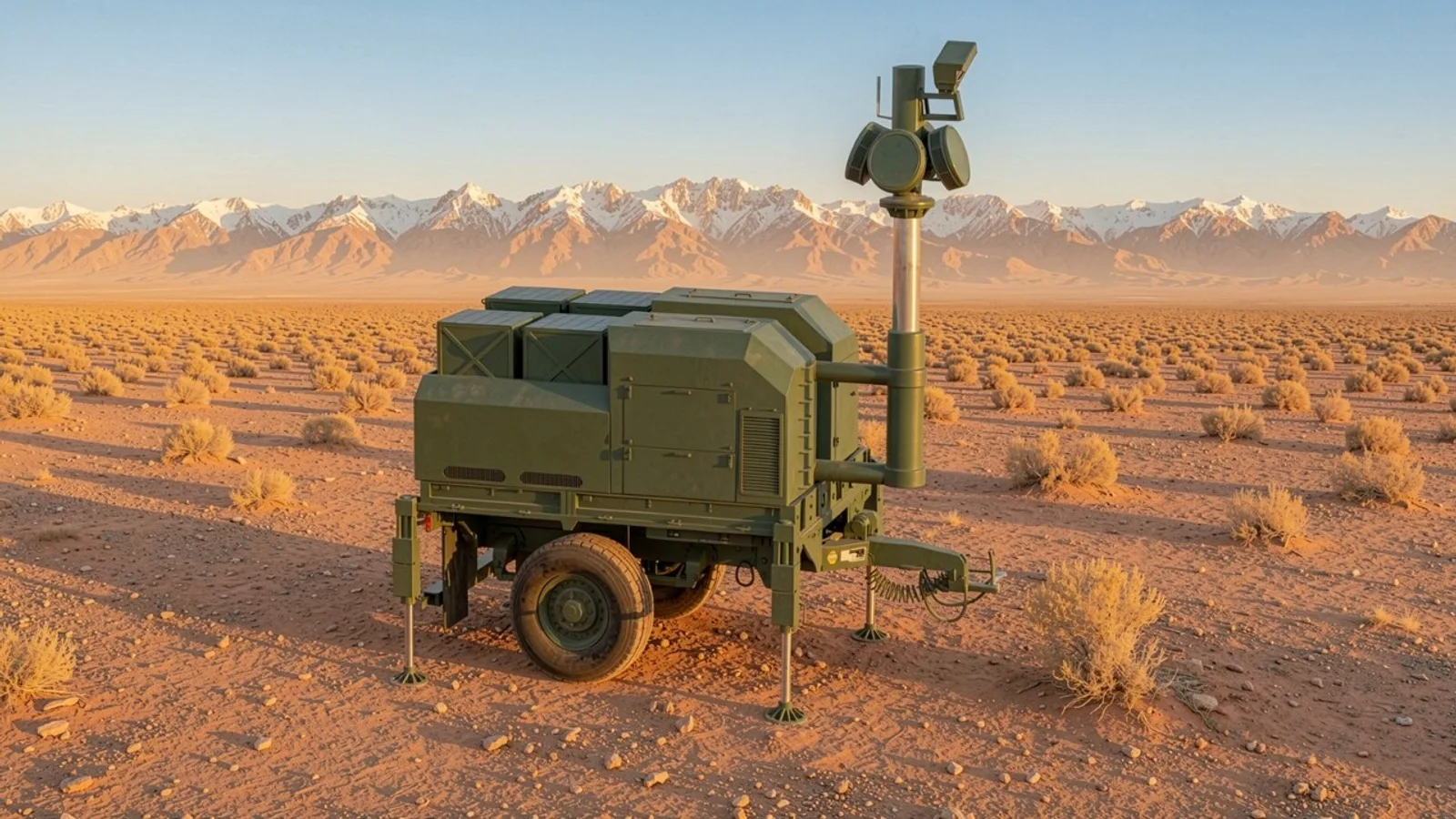
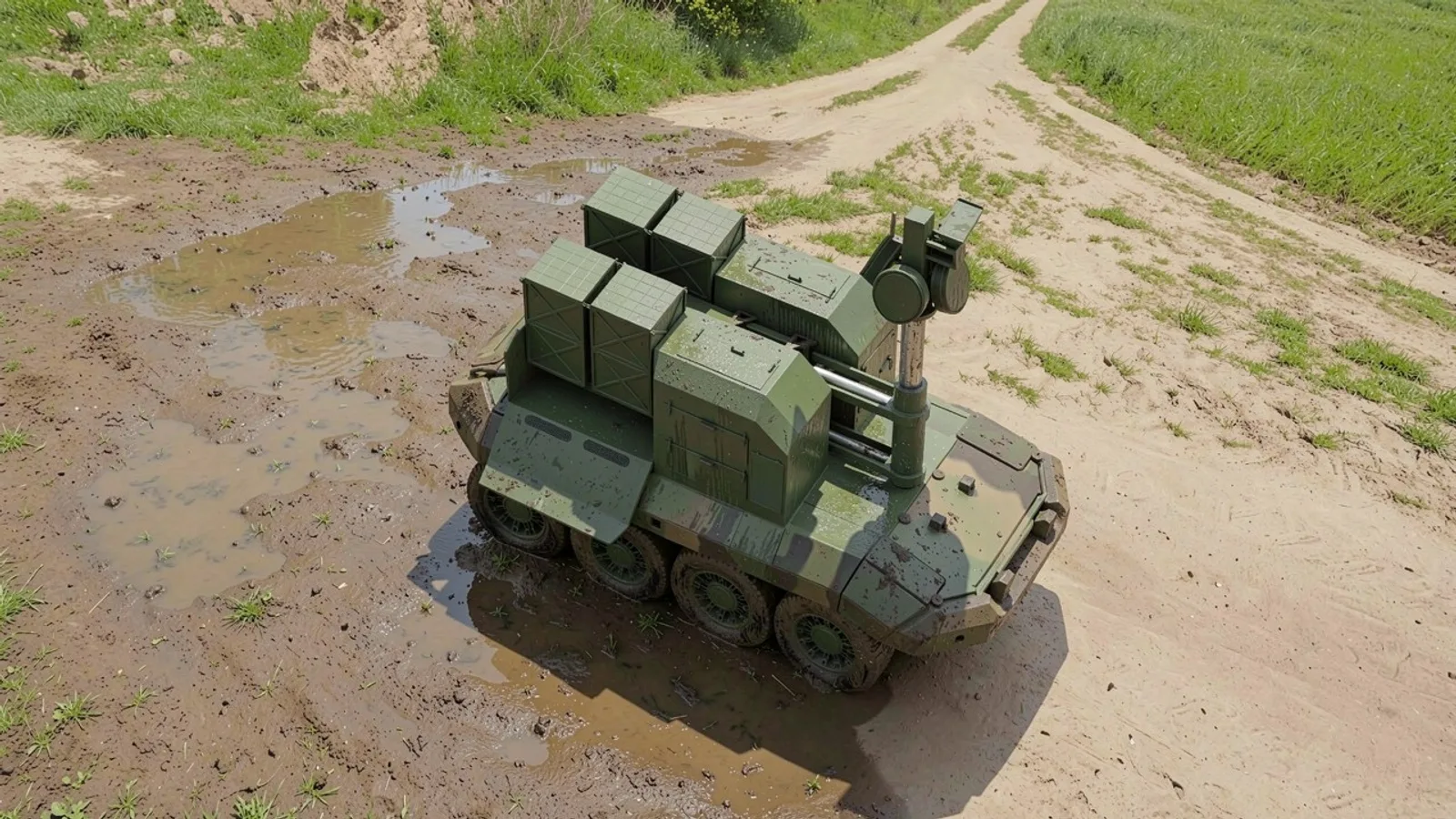
“This is a launcher that is scalable from 25 interceptors to 250 interceptors in a single fire unit,” he said. “It comes with a suite of ground sensors that allows it full autonomy and self-sustainment in the battlefield, and it comes with a full battle management system for the edge unit.”
Bar-On explained that, while a Joint Light Tactical Vehicle launch platform might only hold 25 interceptors, an unmanned ground vehicle or unmanned surface vessel could carry 200 interceptors.
The third pillar, said Bar-On, is a counter swarm battle management system (BMS). While he explained that Skapion is not trying to replace current Western-developed BMSs – noting that “This is an interoperable game; you have to play along with everyone” – he nevertheless noted that “There is no C2 [command-and-control system] today that is purposely built to track, detect, analyse, prioritise and allocate fire in these simultaneous masses of dozens versus dozens, hundreds versus hundreds, so this is something that we’re building from scratch, infused with AI in every different layer of it, from the detection, from the analysis, from the tracking.”
Bar-On noted that Skapion’s interceptor, which it calls the Hadar, has a range of up to 7 km, an interception altitude range of from 20 m to 6 km, uses a proximity fuze, has seeker variants covering day camera plus thermal opto-electronic to radio frequency in the Ka band, and can manoeuvre at up to 8 g.
Regarding overall cost, he noted, “In current financials, USD 400 million buys you one Patriot fire unit: one small battery without any missiles in it. USD 400 million buys you roughly 40 Skapion systems, and they come packed with interceptors.”
In terms of connectivity, Bar-On noted that Skapion’s concept is that its system always remains both standalone and interoperable. “If I have connectivity, I am plugged to the higher echelon, I talk to my commanders, I talk to the hosting country, I talk to my allies, I talk to other radars, I talk to other fire units,” he said. “If I don’t have connectivity, I have my rules of engagement. I’m fully autonomous and I can now, within the rules of engagement, within my given territory, intercept everything that gets my way and take it out of the game.”
Along with the need to provide an effective air defence solution, Bar-On also addressed the supply chain issue, explaining that Skapion’s model embraces distributed manufacturing.
“This is the kind of vision that we want to have for this company: build the technology, develop it, and then locally source it, manufacture it, maintain it, and deliver it for domestic markets by domestic markets,” he said. “So we’re engaging with multiple regions in Europe. We’re engaging with our neighbours from the Gulf. We’re engaging with multiple partners here in the US. And for each target market, that is the plan: to have domestic manufacturing capabilities, so there is never a chokehold on the supply chain; there is never a chokehold on sovereign defence capability.”
With regard to progress with the system’s development, Bar-On said that Skapion is currently at the advanced prototyping stage with the first firings due to take place “in a couple of weeks”.
“Basically, we’re planning to shoot multiple different interceptors: more than one, less than 50,” said. “And the target types that we’re matched against are Group 3 and 2 UASs. The reason that we’re already introducing customers to this test campaign that we’re doing is because we will not be the ones who build in the dark and then come up after five years and hope that we build something relevant. If there is a change in two months in the battlefield that we did not expect, we need to be aware of it and build our technology right. We don’t need to build according to the original plan one year ago; we need to always keep our eyes on the evolving threat.”
Asked when Skapion would have a fieldable solution, Bar-On replied that it would be next year.
“We’re getting unbelievable demand from many potential customers,” he said. “Obviously, the world is in an ‘I want this now’ mode, but we have customers that are even talking to us about paying just to be first in line. The system is not ready yet, but they’re saying ‘I want to buy the option to be first in line’. We’re looking at next year to start operational test and evaluation [OT&E]: the earliest you can put it in the field, the better for real-life learning. So we’re aiming to start OT&E next year. And we’re now working on a couple of different efforts to try and expedite our production readiness. So we don’t wait until we’re done with the development; we start working on supply-chain security across different regions and manufacturability for different regions. And by the time the system is operationally proven, we hope to be turnkey ready with the production.”
Bar-On added that “there’s more likelihood that we will be first deployed in either Europe, the US, or the Gulf, which he added included Israel, “which is a top priority for us on the personal level. When we have a working solution, it will not be held up for Israel.”