Saab showcases concept for future high-end autonomous collaborative platform

During the Swedish Air Force’s Jubilee Air Show at Malmen Air Base in Linköping from 21 to 23 August 2026, Saab unveiled its concept for a future Swedish high-end autonomous collaborative platform.

Saab A3 ACP demonstrator
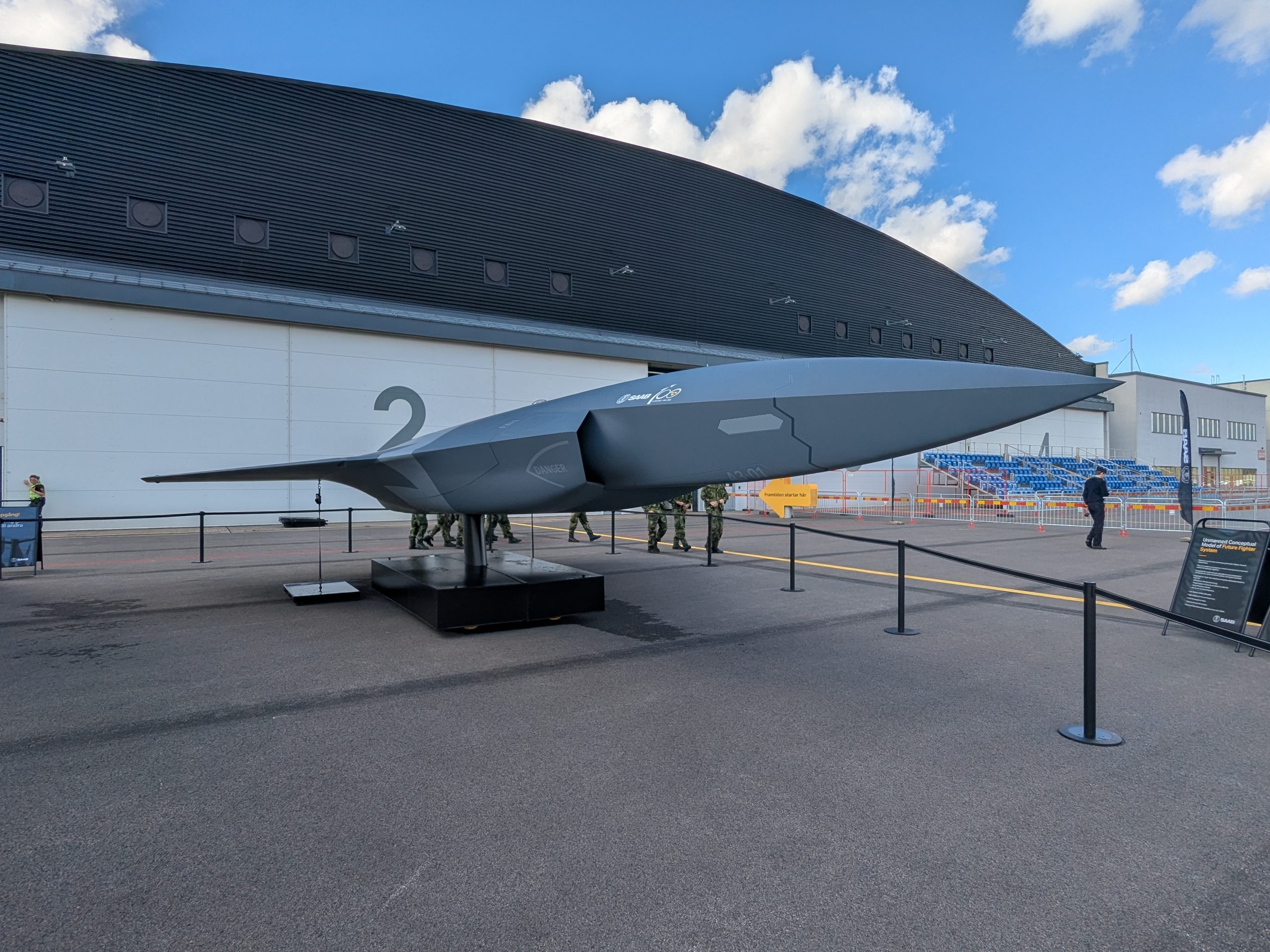
A full-scale mock-up of Saab’s proposed A3 high-end ACP on display at Malmen Air Base in Linköping, where the Swedish Air Force was celebrating its 100th anniversary. (P Felstead)
Pete Felstead

Saab has unveiled its concept for a future Swedish high-end autonomous collaborative platform (ACP). A full-scale concept model of the ACP, known as the A3-001, was showcased from 21 to 23 August 2026 during the Jubilee Air Show at Malmen Air Base in Linköping, where the Swedish Air Force (SwAF) was celebrating its 100th anniversary.

The A3 high-end ACP concept is envisioned as a future solution for high-risk operations, such as electronic warfare (EW), suppression of enemy air defences (SEAD) and precision strike operations in highly contested environments. A tailless, turbojet-powered air vehicle design, the A3 would feature low observability, a high degree of autonomy and the ability to operate across multiple domains.

In October 2025 the Swedish Defence Materiel Administration (FMV) awarded Saab a SEK 2.6 billion (EUR billion) follow-on contract under an initiative called the Future Combat Aviation Concept (Koncept för Framtida Stridsflyg – KFS), managed by the FMV and primarily led by Saab, to continue conceptual studies and technology development for Sweden’s next-generation combat air systems. A primary objective of these studies is to allow the Swedish government and its armed forces to decide how the country addresses what will come after the Swedish Air Force’s Gripen E manned fighter, which began entering SwAF squadron service in October 2025.

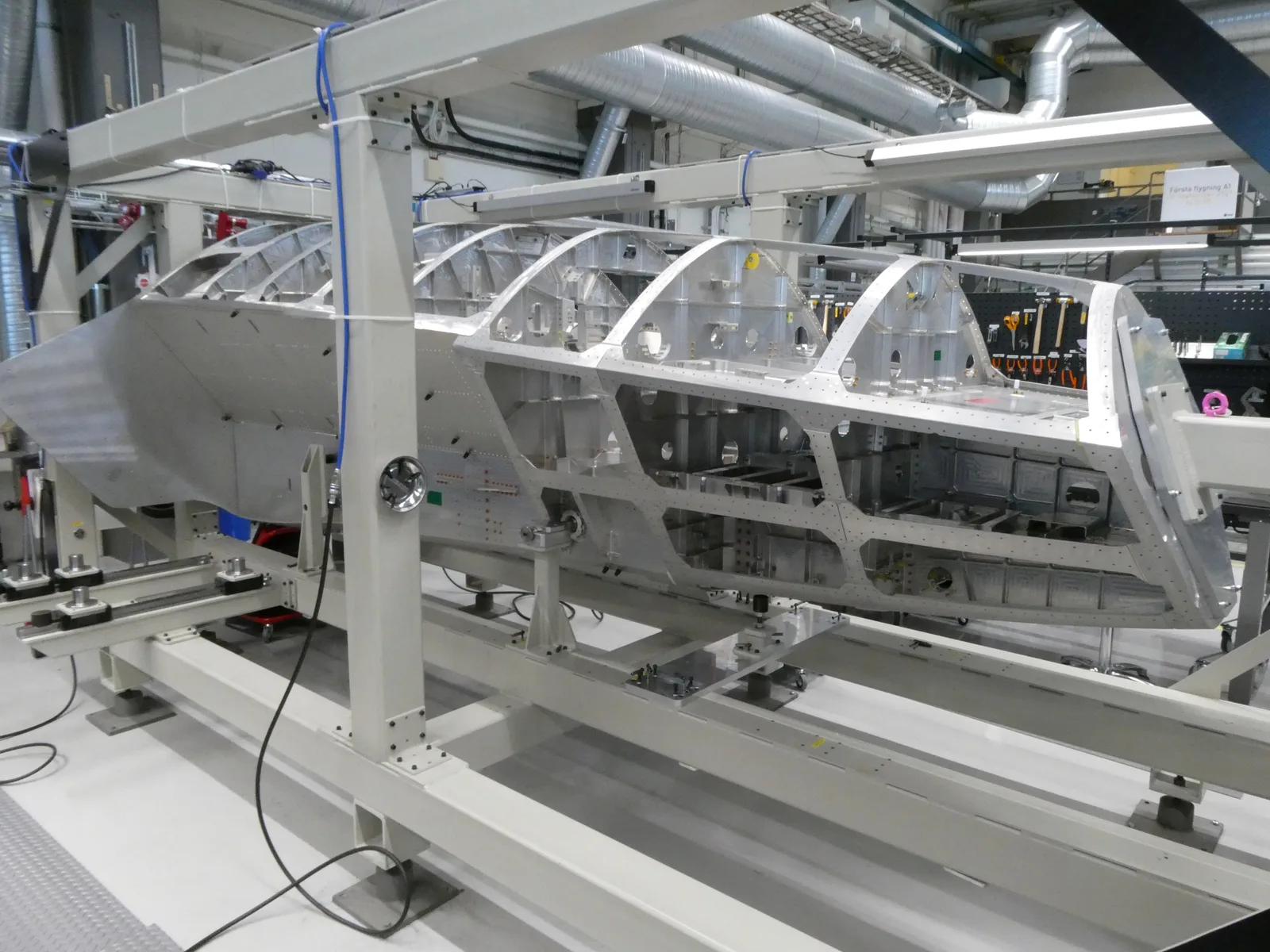
Briefing invited journalists at Malmen Air Base on 21 August, Peter Nilsson, head of Saab’s Advanced Programs business unit, explained that, under this contract with the FMV, Saab is already funded to develop two supersonic ACP demonstrators powered by the General Electric F414 turbojet. The first of these, known as the A1, will be a low-observable air vehicle that is currently in production and likely to make its first flight within the next 15 months, said Nilsson. The follow-on A2, featuring sensors and an internal weapon bay, will then make its first flight at an unspecified time after that, but certainly well within the timeframe up to 2030. The A3, meanwhile, represents Saab’s proposal for what could come after that, although Nilssen noted that there would likely be further iterations of the concept before the SwAF determined that Saab had produced a platform for which it wanted to place orders.

The A1 ACP demonstrator in production at Saab’s facilities in Linköping. A first flight is estimated to be likely within the next 15 months.
The A1 ACP demonstrator in production at Saab’s facilities in Linköping. A first flight is estimated to be likely within the next 15 months. (Saab)

With regard to the cost of a final high-end ACP that could be brought into service and the ratio of such platforms to manned aircraft, Nilsson estimated that the ACP would be valued at around half the cost of a Gripen E and that there would be one manned fighter to perhaps two or three high-end ACPs.

Saab has already been pushing the boundaries of what is possible with AI-powered air platforms. On 28 May 2025, for example, the first flight of a Gripen E fighter was made with Helsing’s Centaur AI agent in total control of the aircraft under Saab’s Project Beyond: a flight that notably took place not over a test range but over the Baltic Sea within Swedish civil airspace.

Nilssen asserted that the future of air power is now at “an inflection point” where “The next five years will matter much more than the last 15 or 20 years.”

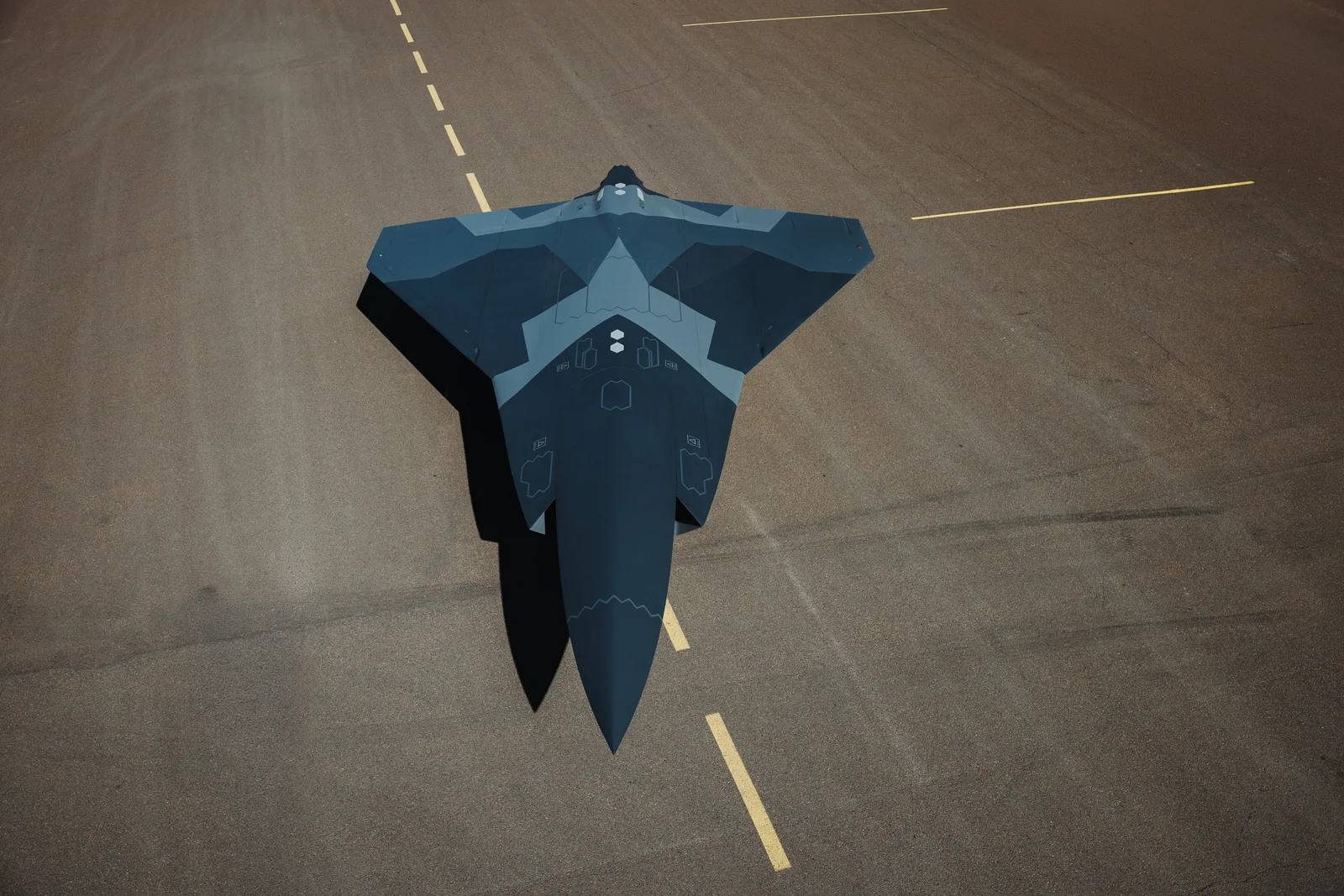
View of the A3 mockup from above, showing the planform.
View of the A3 mockup from above, showing the planform. (Saab)
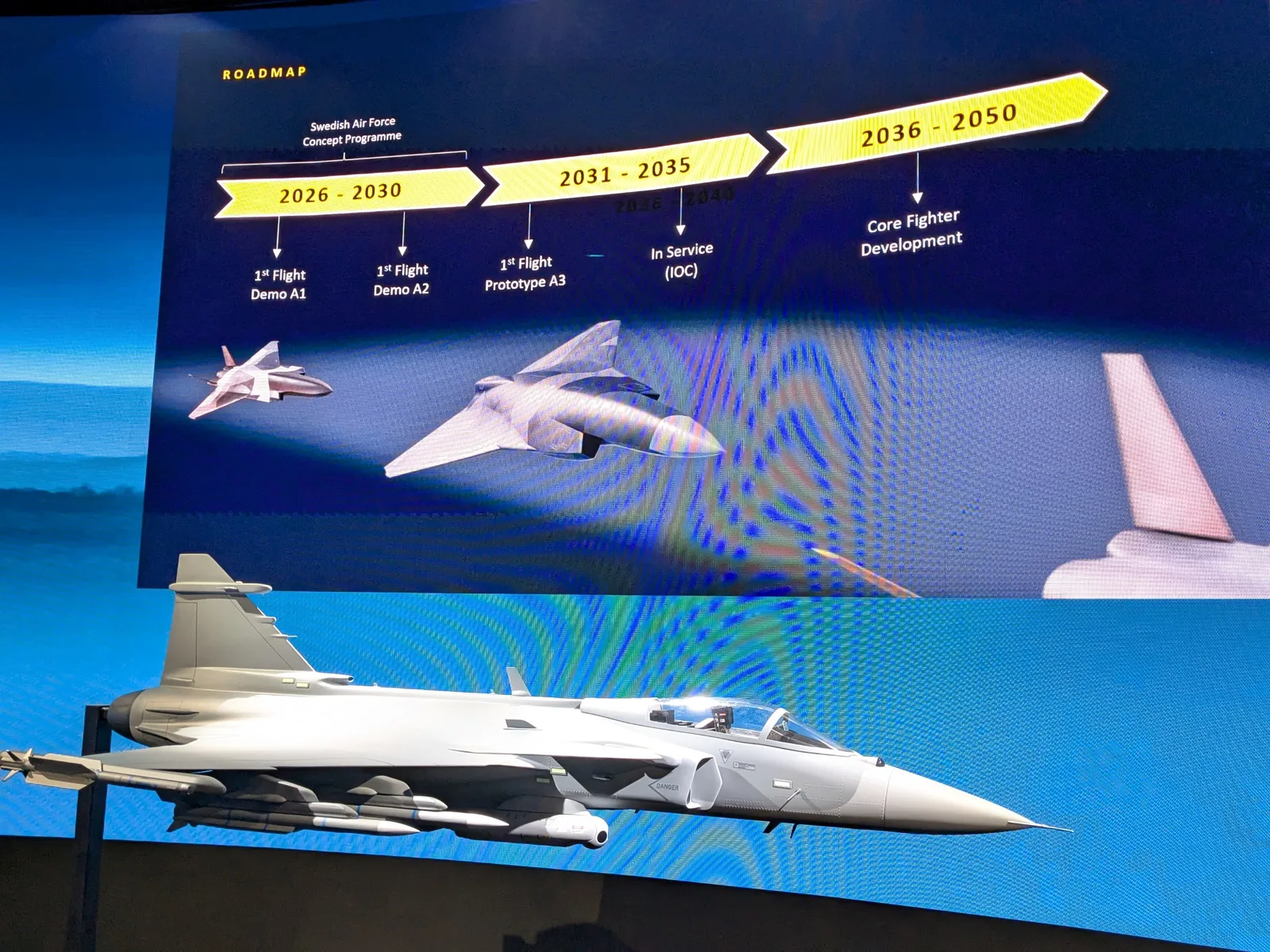
Modell eines Saab Gripen Kampfflugzeugs vor einer Grafik mit dem Entwicklungsplan der schwedischen Luftwaffe bis 2050
An illustration of how the introduction of a Swedish high-end ACP could theoretically pan out over the next decade. (CPM / Peter Felstead)

Saab and Sweden’s future combat air capabilities

Saab’s efforts with AI-powered combat air capabilities, both with Project Beyond and the company’s high-end ACP developments, have certainly put Sweden on the front foot with regard to the country’s future combat air plans. However, Saab officials briefing during the Jubilee Air Show at Malmen Air Base noted that the Swedish government has brought forward by two years the point by which the country will need to decide on its future combat air strategy, with a decision now expected by 2028 instead of 2030.

Given the sovereign capability already developed, it is highly unlikely that Sweden will simply buy off the shelf when it comes to future air power, which leaves two options: either the country will fold into an already existing next-generation programme or instead decide to go it alone.

Regarding the former, Sweden initially signed a memorandum of understanding (MoU) in July 2019 to co-operate with the UK on its Tempest sixth-generation fighter programme and in December 2021 the UK, Italy and Sweden signed a trilateral MoU regarding a Future Combat Air System (FCAS). Ultimately, however, Sweden opted not to proceed with being part of what became the UK-Italian-Japanese Global Combat Air Programme (GCAP).

Meanwhile, with the Franco-German-Spanish FCAS programme (Système de Combat Aérien du Futur – SCAF) having largely fallen apart in mid-2026, either France or Germany could in theory be future partners for Sweden on a next-generation fighter programme.

Conversely, if Sweden were to decide to go it alone on a next-generation combat air platform, then there would always be the possibility of picking up one or more international partners, as Sweden did with Brazil on the Gripen E/F programme.

Although Sweden’s future combat air programme decision point has been brought forward by two years, the country’s nascent Gripen E programme – which essentially put Sweden out of sync with other European future fighter requirements – means the country still has some time to decide on its future path.

Briefing journalists during Sweden’s Jubilee Air Show on 22 August, Saab CEO Micael Johansson stated that there were “no essential discussions going on” involving Saab and potential sixth-generation combat air programme partners.

Asked by Warsight whether talks were occurring to determine what was possible in terms of Swedish participation in a programme such as GCAP, Johansson replied, “We, of course, try to get as much information as possible of what the direction or capability is and how the industry set up was in SCAF, how it looks like in GCAP, and try to assess where those countries are going in terms of capabilities. … On that level there are exchanges between air forces and government MODs [ministries of defence] to MoDs, and we try to understand how the industry set-up looks like so we can make a decision in a proper way. So it’s not that we don’t have any information … we’re agnostic but knowledgeable about what’s going on. … We talk to Airbus, we talk to Dassault, we talk to BAE Systems, so we know what’s going on, but we’re not part of their programmes.”

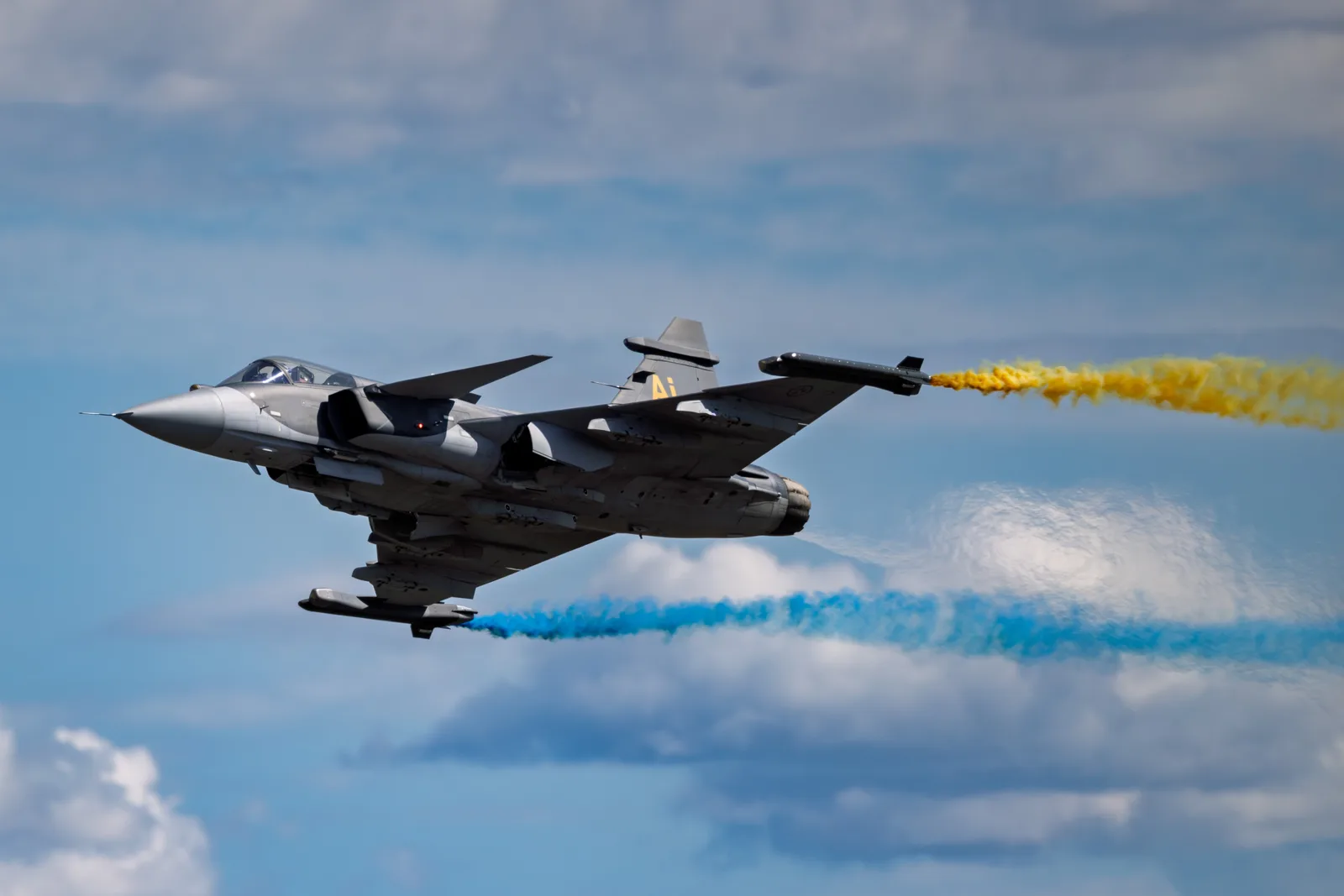
A Saab Gripen E conducting a flight display in August 2026 at the Jubilee Air Show at Malmen Air Base in Linköping, where the Swedish Air Force was celebrating its 100th anniversary. The nascent Gripen E programme means that Sweden still has some time to determine what its next-generation combat air plans will look like.
A Saab Gripen E conducting a flight display in August 2026 at the Jubilee Air Show at Malmen Air Base in Linköping, where the Swedish Air Force was celebrating its 100th anniversary. The nascent Gripen E programme means that Sweden still has some time to determine what its next-generation combat air plans will look like. (Saab)

Share post

You may be interested in

Categories

All NewsAir

Used tags

A3 ACP demonstratorautonomous collaborative platforms (ACPs)SaabSwedish Air Force (SwAF)Swedish FMV

Similar posts