AUSA 2026: AM General details proposal to build Humvee-based UGVs

As the US Army looks to field cheap, flexible UGVs, AM General has outlined a proposal to produce a low-cost UGV based on the Humvee platform. Beyond this, the company is also looking at upcycling legacy Humvees into UGVs.

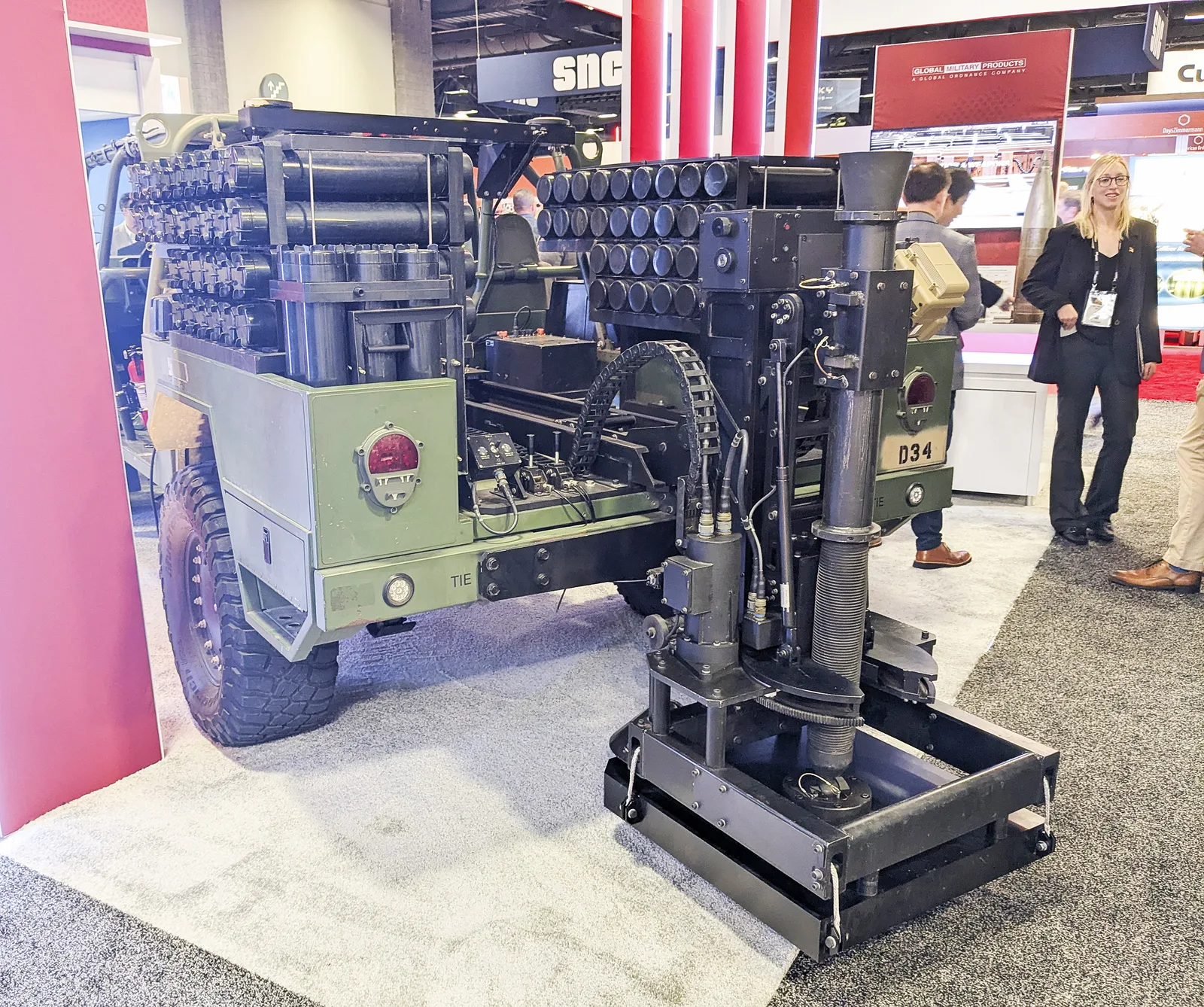
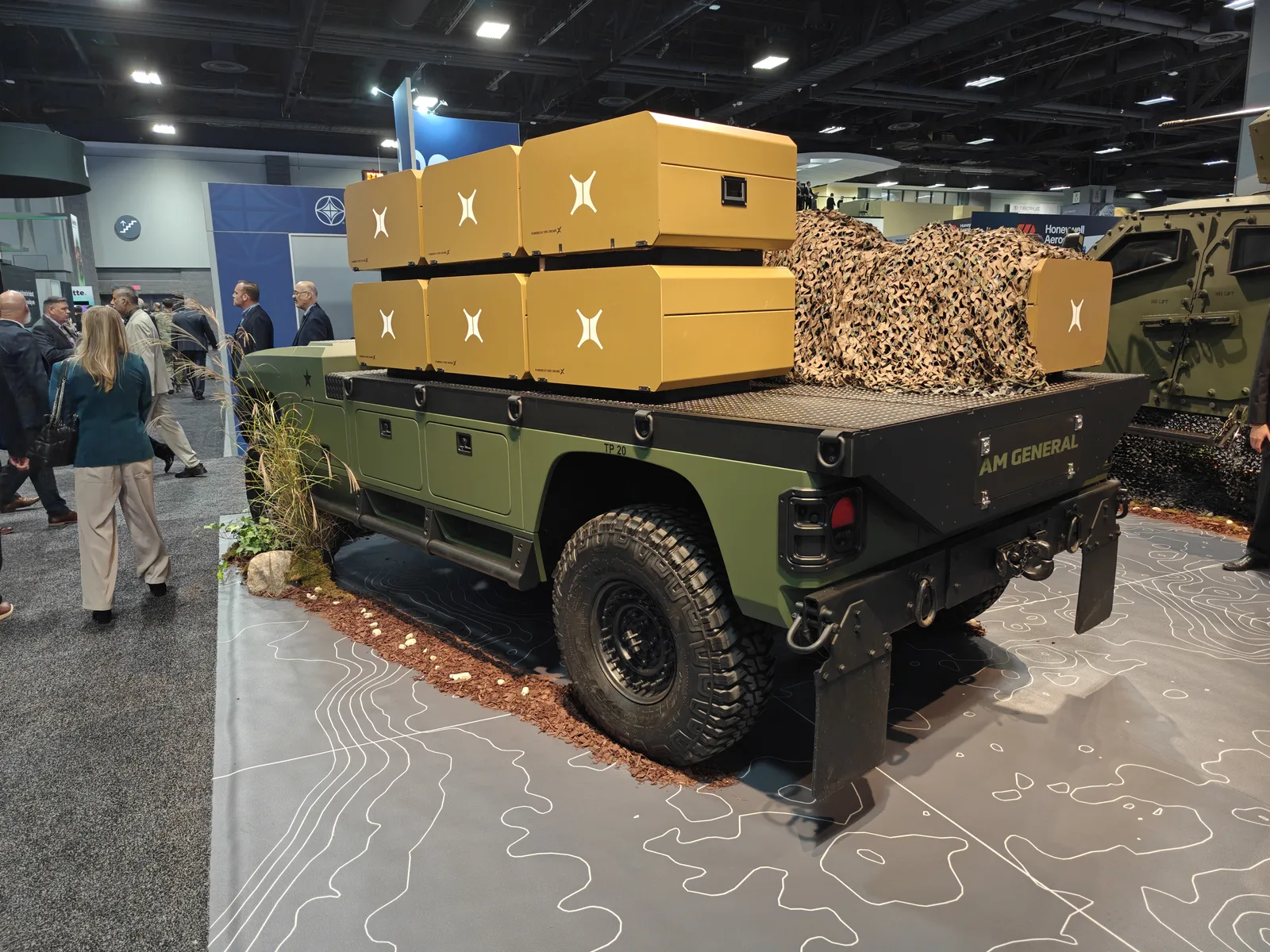
View of the rear-left side of the AM General Humvee-based UGV displayed at AUSA 2026 in the Nest drone carrier configuration. (Mark Cazalet)
View of the rear-left side of the AM General UGV displayed at AUSA 2026 in the Nest drone carrier configuration. (Mark Cazalet)
Mark Cazalet

All around AUSA 2026, perhaps the most numerous type of hardware on display other than small drones, were the wheeled unmanned ground vehicles (UGVs) being pitched to the US Army. These were colloquially referred to as ‘skateboards’, owing to the fact that the form factor in most cases comprised a 4×4 wheeled platform with a flat top deck with an inbuilt L-track fastening system.

The idea behind these skateboards is to provide a flexible UGV platform onto which notionally any payload could be mounted, providing it remained within the platform’s size, weight, and power (SWaP) limits.

The US Army previously  had a modular UGV programme in the form of the Robotic Combat Vehicle (RCV) programme, with Textron’s Ripsaw M3 expected to have been declared the winner, according to reporting in early 2025. However the entire RCV programme was abruptly cancelled in May 2025, amid a raft of sweeping cancellations imposed by Secretary of War Pete Hegseth and US Army leadership.

Cost was among the primary reasons cited for RCV’s cancellation, along with the army evidently deciding to shift their preference to a wheeled platform instead of a tracked platform under initial plans. While the logic behind the switch in choice of running gear was not directly outlined, it likely bears some relation to cost, as tracked vehicles typically tend to be more expensive to both procure maintain than wheeled equivalents.

So following the cancellation of RCV, the army launched their ‘Project Sustainment’ UGV programme, which aims to trial various UGV prototypes, largely for the autonomous logistics and supply distribution role. However, given the varied payloads on display, there is evidently interest in using such autonomous platforms in numerous other roles. Various examples seen on the ground were geared toward the counter-unmanned aerial vehicle (C-UAV) role, along with UAV launcher role, and some not seen but openly discussed, such as the casualty evacuation (CASEVAC) role. Most such examples were based around a common wheeled ‘skateboard’-type form factor capable of flexibly mounting various mission systems.

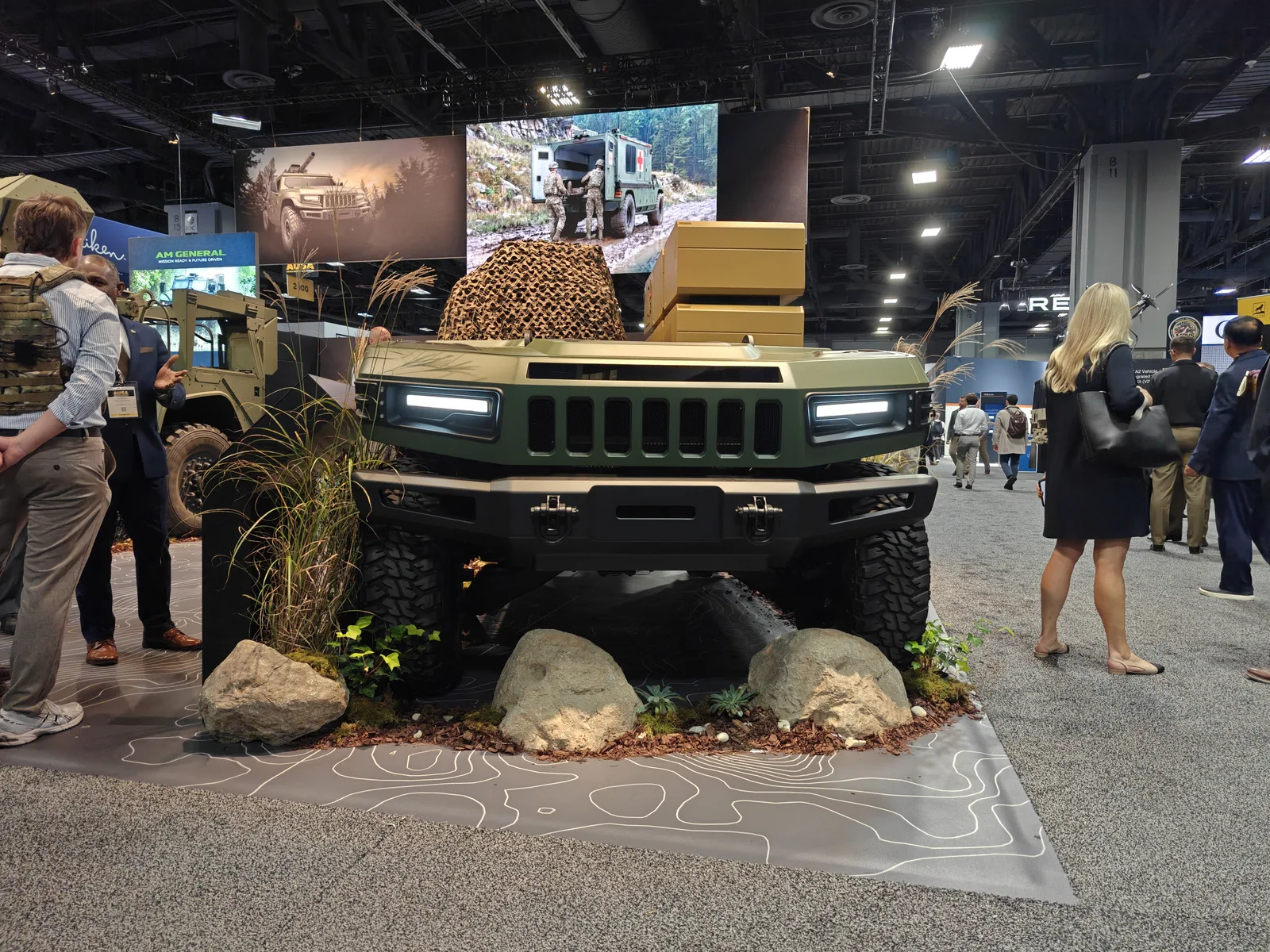
Front view of the AM General UGV displayed at AUSA 2026. (Mark Cazalet)
Front view of the AM General UGV displayed at AUSA 2026. (Mark Cazalet) (Mark Cazalet)

A Humvee-based UGV

Warsight spoke to John P Chadbourne, President and CEO, and Shatiel Edwards, Chief Growth Officer, at AM General to glean more insight into their company’s UGV pitch. As with other exhibitors competing for the wheeled UGV requirement, AM General’s model was simply titled ‘UGV’ for the time being (though you’d hope proper names are coming soon, and in AM General’s case, ‘HumGV’ would seem an obvious contender).

Outlining the core principle behind AM General’s vision, Edwards explained; “The idea is to take something that the army already has in their inventory in a Humvee, and utilise the 13-series chassis, which is what all the Humvee systems are, and make it into that ‘skateboard’. So it’s a wheeled skateboard that has an open architecture, so that you could put different payloads on it.”

The AM General UGV provides sufficient space on the top deck to mount up to four NATO pallets (1.2 m × 1 m), and features an inbuilt L-track fastening system to secure palletised loads.  Thus far, AM General has presented three configurations of their UGV:

  • A logistics configuration, with a remote-controlled T-boom service crane. First shown at AUSA Global Force in March 2026. Also shown here was the vehicle’s potential as a small UGV carrier, with a FireAnt small UGV from Swarmbotics AI on the top deck.
  • A C-UAV configuration, with a Moog RiWP turret mounted on a MR SLED palletised weapon mount, and armed with an XM914 30 mm cannon, a quad-launcher for FIM-92 Stinger missiles and two quad-launchers for APKWS guided 70 mm rockets. First shown at Modern Day Marine in April 2026.
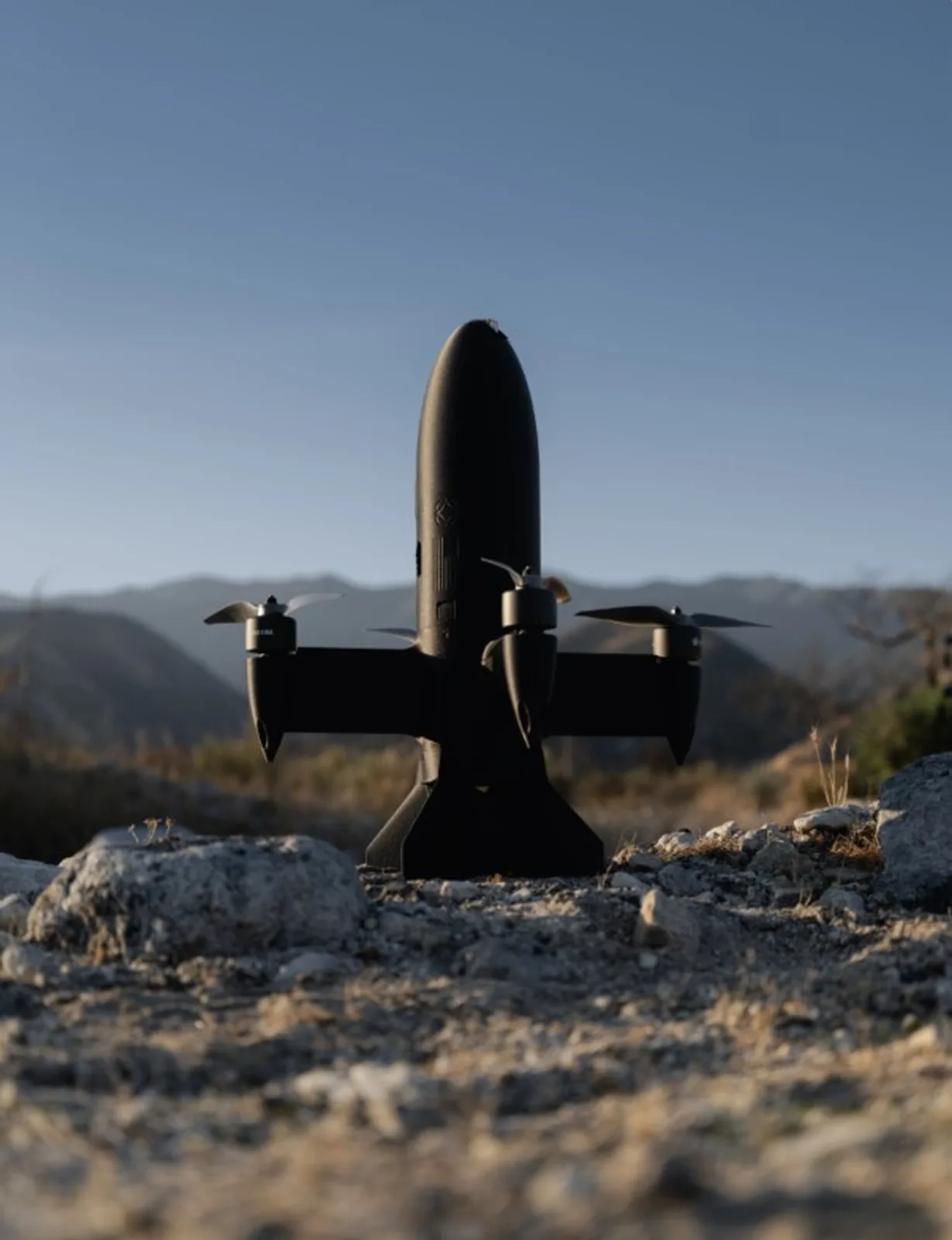
  • A UAV carrier configuration, fitted with the XTEND Nest UAV launcher system, hosting Scorpio 1000 tactical UAVs. First shown at AUSA 2026.

Other variants discussed or shown in CG graphics but not yet publicly displayed include:

  • A CASEVAC configuration fitted with an enclosed medical shelter.
  • A mobile generator variant, fitted with several dismountable generators.
  • A fuel tanker configuration, with a 1,892.7 l (500 gallon) fuel bladder.
A screenshot from AM General promotional video showcasing Humvee-based UGVs of various configurations travelling in a convoy. (AM General)
A screenshot from AM General promotional video showcasing Humvee-based UGVs of various configurations travelling in a convoy. (AM General) (AM General)

According to AM General, the 13-series chassis-based UGV is built on a Modular Open Systems Approach (MOSA) architecture, and has a payload capacity of over 2,268 kg (5,000 lb), and will be powered by a new 6.5 l 8-cylinder common rail direct injection turbocharged multi-fuel engine developing over 186.4 kW (250 hp) and 745.7 (550 lb-ft) of torque, and compatible with JP-8, F-24, or diesel fuel.

The new engine is also planned to power the company’s Humvee 2.0. According to Edwards, the new engine was needed to provide the “engine control module, so that you were able to actually build in control of the system.”

The UGV can be controlled by a human operator using a ruggedised tablet, with control signals sent via Starlink. Navigation is understood to be via global navigation satellite system (GNSS), with the manufacturer stating it will have an inertial navigation system (INS), presumably for use in GNSS-denied areas. Additionally, the vehicle is fitted with eight monochrome thermal cameras and lidar to provide a real-time obstacle detection and avoidance capability.

According to Edwards, the vehicle is primarily intended to move as a convoy, but it has waypoint navigation capability, and individual vehicles are able to avoid obstacles, allowing them to operate in offroad terrain. “Any mission profile that a Humvee can go over and drive through, our UGV can go over that same mission profile” he said.

A screenshot from AM General’s promotional imagery showcasing the Humvee-based UGV’s real-time obstacle detection capability. (AM General)
A screenshot from AM General’s promotional imagery showcasing the Humvee-based UGV’s real-time obstacle detection capability. (AM General) (AM General)

Warsight asked whether the vehicle’s capabilities has been tested in such conditions so far, to which Edwards responded, “the technical alignment review is exactly that. it’s meant to take your system and put it through its paces. So do beyond line of sight operations, actually go through a log pack, so be able to use the crane, pick up a cargo, put it mount it on, attach it, and then be deployed to another rally point, then you’d have to go through obstacle detection. It has to be able to pair with other vehicles and be able to navigate. So all of that happened September 25th this year.”

Warsight also asked if the UGV had a silent drive capability, to which Edwards responded “in the current configuration, the answer is no. We are we have a product improvement programme, an [Internal Research and Development] project in [2027] that will get us there.”

For their UGV bid, AM General has partnered with Textron Systems, who will provide their Coremotion drive-by-wire kit necessary for modifying the vehicles for autonomous operation, and the exportable power stack, alongside Carnegie Robotics, who provide the autonomous sensing hardware, along with the automation and command-and-control (C2) software suite. Carnegie Robotics had already been downselected for the Army’s Autonomous Transport Vehicle System (ATV-S) in April 2026.

Warsight spoke to Sara Willett, Vice President of Uncrewed Land & Air Systems at Textron Systems, who explained, “Coremotion is a set of hardware, drive-by-wire kits, software, and the smarts behind connecting a vehicle control solution. Whether that’s autonomy or teleoperation to actual predictable vehicle motion.”

“There’s no autonomy inherent in Coremotion – it uses standard interfaces via CAN, Ethernet, etc. to transmit and translate that data. And so what we hope is that this product can really provide a standard interface for the Army…whether it be one of our purpose-built UGVs or a Humvee or another vehicle that’s in their fleet that they want to create into an unmanned ground vehicle, while they’re able to have full autonomy in choosing whoever their autonomy provider is,” Willett added.

AM General stated that they would deliver four UGV prototypes to the US Army for trials in 2027, and this is to be followed by soldier touchpoint feedback sessions throughout the year. Additionally, the company has partnered with NEA for an autonomous fuel distribution programme. Edwards explained “So Textron is doing amphibious from ship to shore with a fuel bladder. We will meet it at shore and then fill up our UGV with a fuel bladder and then go to a rally point.”

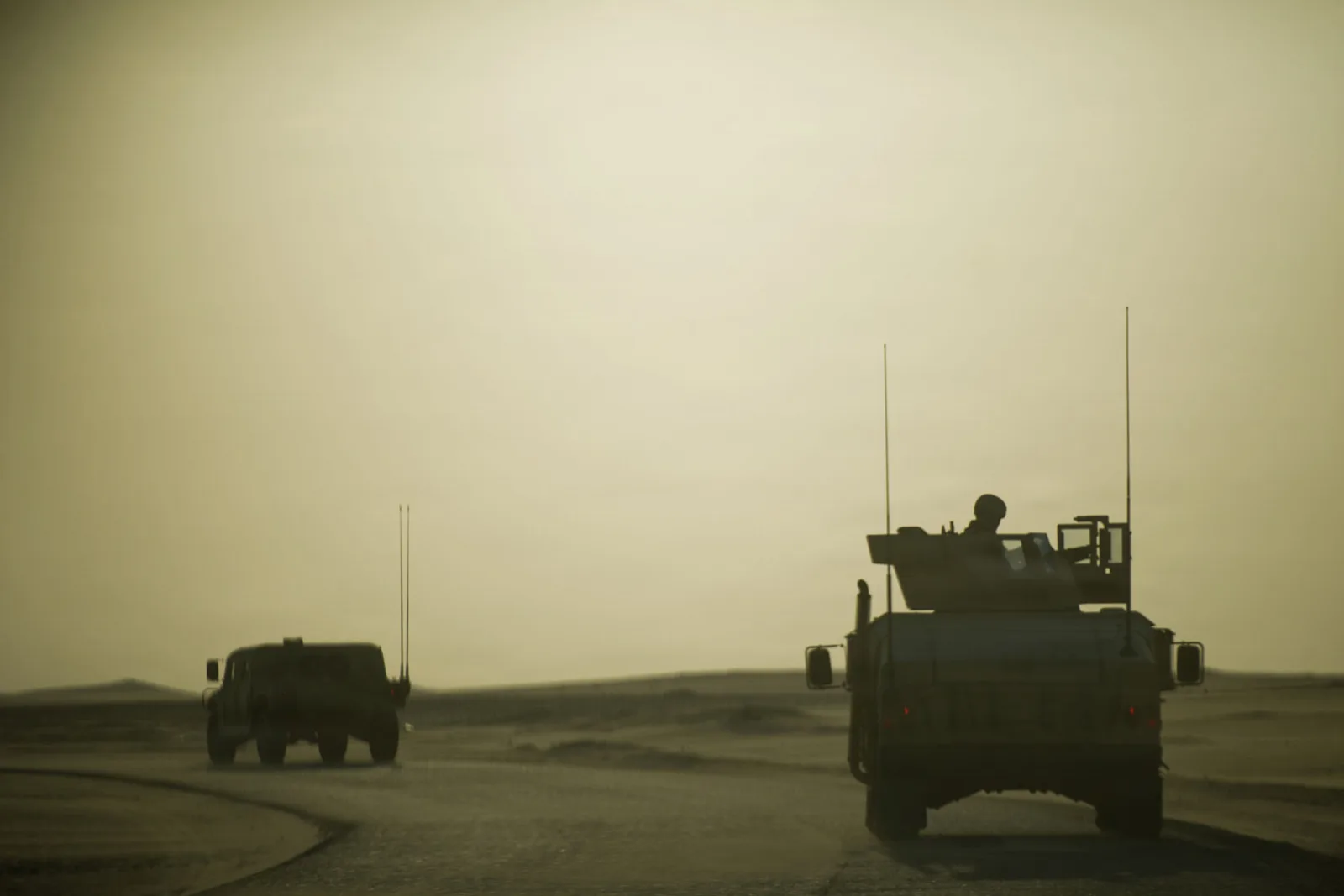
The venerable Humvee remains in service in large numbers across numerous armed forces, thereby providing a ready stock for conversion to optionally-manned vehicles. (USMC/Cpl Tommy Huynh)
The venerable Humvee remains in service in large numbers across numerous armed forces, thereby providing a ready stock for conversion to optionally-manned vehicles. (USMC/Cpl Tommy Huynh) (USMC/Cpl Tommy Huynh)

A second life for old Humvees

Looking at AM General’s UGV bid, there a couple of interesting factors that stand out. One of these being that the HMMWV (Humvee) platform is in wide circulation globally, and as such, much of the requisite infrastructure, repair skills, maintenance facilities, spares, and training is already in place to support their use as UGVs.

While naturally the UGV version showcased at AUSA features a number of differences, a lot of the core automotive components will remain fairly familiar given the UGV being based on the in-service 13-series chassis.

On top of this, AM General noted that much of the technology developed for their Humvee-based UGV would also be applicable to as a retrofit option to older Humvees still in circulation.

In this vein, Edwards stated, “I think one of the things that’s interesting is this capability is not only going to be done in a unmanned variation, but there’s a lot of Humvees across the world, and this will be backwards compatible or compatible to go into an optionally manned environment. So you’d be able to have it on a Humvee, where you can have a driver, or you can take it in that unmanned capacity. I think that’s going to be something that is going to be have a huge demand signal, certainly internationally, as you look at how around the world they utilise Humvee systems.”

Along the same lines, Willett noted, “We’re actually really excited about a larger opportunity to apply promotion to legacy Humvees. We think that that is something between the partnership of AM General and ourselves is another good opportunity,” adding that giving old Humvees “a second life, is a very cheap way to proliferate [UGVs]. I think it’s in alignment with what the army’s kind of changing direction in terms of cheaper, more attritable robots for different mission sets.”

Regarding how the integration process of Coremotion for legacy vehicles, Willett explained, “with legacy Humvees, for example, you do have to physically connect a steering wheel and a brake pedal and a gas pedal….So for every vehicle, there’d be some specifics, but you do that once, and then I’d say what we’ve found is with the amount of work we’ve done, we’ve got like a two-week integration timeline to really get that tuning refined, and then once that’s done and that’s codified, it’s good to go.”

All told, the idea of upcycling legacy vehicles as UGVs, certainly has definite merits from a cost, training, and platform familiarity standpoint. Such an approach does have its limits – not all payloads will be amenable to mounting on an optionally-manned platform, some would benefit more from a ‘skateboard’ form factor. However, there remain plenty of use cases where it presents a compelling approach.

As a case in point, CASEVAC and cargo carrier configurations of the Humvee are already configured to fulfil their role, and so automating the driving and navigation portion would represent a relatively easy way to breathe new life into legacy fleets while decreasing risks to personnel.

Share post

You may be interested in

Categories

All NewsLand

Used tags

AUSA 2026HMMWVHumveeUGVsUSUS Army

Similar posts