The continually increasing risk and damage caused by wildfires across Europe has been requiring greater responses from national and regional governments to deal with fires that can advance rapidly and be difficult to control. As a result, employing firefighting aircraft has been an instrument that has been progressively reached for more and more by civil defence agencies.
The fires in the Gironde region of southwest France have proven to be difficult for the French government to tackle, with other wildfires also threatening Paris and Marseilles. By 23 July 2026 the French Interior Ministry was deploying 65 aircraft in its response to wildfires across the country, including 12 Canadair CL-415 Super Scoopers, eight Bombardier Dash 8-400ATs, six AirTractor AT-802F Fire Bosses, 12 helicopter water-bombers and a further 27 helicopters for transportation and logistics. Three Beechcraft Super King Air aircraft were also being employed for co-ordination, surveillance and airspace control.
Following a request from the French Interior Ministry and Ministry of the Armed Forces and Veterans, an agreement was signed with Airbus on 17 July for a French Air and Space Force A400M to be equipped with a firefighting kit to be ready in 10 days. This required technical preparation, flight testing and qualification of military crews, which began on 20 July. However, the operational need for more aerial assets to support firefighting operations expedited the deployment, with the first drop taking place just a few days later.
Wildfires and the need for new capabilities
The impact of wildfires in Europe has continued to grow in lockstep with climate change. In the European Centre for Medium-Range Weather Forecasts 2024-25 State of Wildfires report, extreme fires in South Korea, Türkiye, Spain, and Portugal collectively burned more than 700,000 hectares and displaced tens of thousands of residents. According to the report, the hot, dry and windy conditions driving these events were strongly influenced by climate change, with fire weather in Spain and Portugal up to 40 times more likely than in a pre-industrial climate. Europe also experienced its worst fire season in two decades in terms of area burned and total emissions of carbon and other smoke pollutants.
In France the threat of wildfires has been a feature of summers for decades and has required a whole-of-government approach to combatting their destructive effects. Military assistance in France to aid in the civil response began in 1984, with the Hephaestus protocol being established to formalise wildfire response in co-ordination with the French Interior Ministry. For the French Air and Space Force this has typically involved hosting and refuelling firefighting aircraft, in addition to airbase firefighters and specialist vehicles being requisitioned by local authorities to operate in local areas.
In this year’s wildfires the French government has also requested support for its response through the European Union’s rescEU mechanism, with four aerial firefighting aircraft being requested from Sweden and Cyprus on 5 July. Sweden’s Civil Defence Agency responded on 25 July, sending four AirTractor AT-802F Fire Boss aircraft that are operated under contract by Saab.
European fixed-wing aerial firefighters
European fixed-wing aerial firefighting capabilities are largely led by the AirTractor AT-802F Fire Boss and the amphibious Canadair CL-215 Scooper and CL-415 Super Scooper aircraft. European air force users of the AirTractor and Canadair family of aircraft include Croatia, Cyprus, Greece and Spain, with a wider user base in the civil defence and fire service branches of government.
The CL-215 and CL-415 have proven to be key workhorses in combatting wildfires, as they are able to take on large amounts of water rapidly from lakes and rivers close to a fire, generating multiple airdrops within a short space of time. However, the closing of the CL-415 production line in 2015 led to a gap in the market for large, fixed-wing aerial firefighting capabilities. DeHavilland Canada, which acquired the manufacturing rights to the Canadair, announced a new-build version of the CL-415 in 2022 known as the CL-515. Manufacturing commenced in March 2026, with early European customers including Croatia, Spain, Italy, Greece, Portugal and France. First deliveries, however, are not expected until 2028.
As there have been a limited number of aircraft available to support large-capacity airdrops, re-roling military aircraft to support aerial firefighting is a low-cost alternative to acquiring new aircraft, while also leveraging the multirole nature of transport aircraft.
The A400M and the road to aerial firefighting
As Europe’s largest tactical airlifter, the Airbus A400M has been increasing used by militaries in the region. With 132 aircraft operational across Europe and Türkiye, there are a wide variety of mission requirements and capabilities performed by the platform beyond tactical airlift.
The airdrop on 24 July was billed by the French Air and Space Force as an experimental mission, yet collaboration between Airbus and the French government’s Military Air Expertise Centre (CEAM) and Directorate General for Civil Security and Crisis Management dates back to 2024 and builds on earlier development and testing of aerial firefighting capabilities for the A400M.
Airbus began initial testing of a roll-on/roll-off (RoRo) firefighting capability for the A400M in 2022, with a prototype system developed in collaboration with the Spanish Air Force’s 43rd Group as well as the Spanish Ministry for Ecological Transition and Demographic Challenge and European firefighting authorities. Testing in Spain involved dropping 20,000 litres of water from a height of 150 ft (46 m) at a speed of 125 kts (232 km/h) in 10 seconds. The system developed for the Spanish tests involved a tank mounted in the cargo hold, with the water or retardant kept in the tank by independent doors connected to two flood pipes. When the discharge was triggered, the water was expelled through two sections at the end of the ramp.
Further development of the system for use by French operators then took place, with testing at Nîmes-Garons in 2025 overseen by the French government’s Entente Valabre Test and Research Centre. Using a gravity-based dispersal system, the revised system was tested at altitudes of 98 ft (30 m) and 125 kts. Imagery from the July 2026 operation showed a single outlet for the discharge, which allows for a more focused and accurate line of dispersal. According to Airbus, refilling the tank could be achieved in 10 minutes using standard ground pumps. Installation can be achieved in under two hours, with the drop mission limited to flat terrain.
MAFFS II
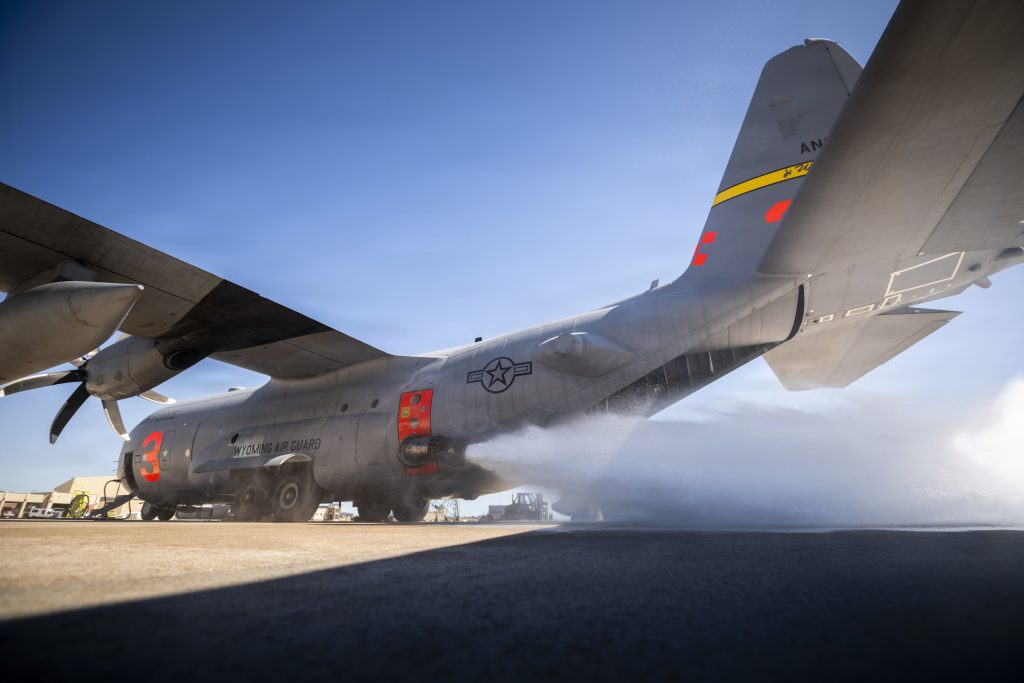
While Airbus has chosen to go with a Ro-Ro kit specifically made for the A400M, a wider number of aircraft manufacturers and operators have opted for the Modular Airborne Fire Fighting System (MAFFS). This system, and its subsequent MAFFS II second-generation iteration, is manufactured by California-based United Aeronautical Corporation and has been at the heart of aerial firefighting capability for large aircraft.
First developed in the 1970s, MAFFS was developed in collaboration with the US Forestry Service, US Air Force (USAF) and Lockheed Martin for installation on the Lockheed Martin C-130 Hercules transport aircraft family. MAFFS works as a Ro-Ro system that can carry up to 3,000 US gallons (11,356 litres) of water or retardant in a single pressurised chamber carried in the cargo hold of an aircraft. The liquids are then ejected through an S-duct located in the portside paratrooper door of an aircraft. Operating at 150 ft (46 m) above ground level at speeds between 120-140 kts (222-259 km/h), a full load can be dispersed in less than five seconds, covering an area 400 m long and 18 m wide.
A MAFFS II unit can be installed onto a C-130 aircraft in approximately two hours, according to the USAF, and does not need any structural modifications to the aircraft. Crews using MAFFS are required to be re-certified every year, with each designated wing required to have five certified crews for each MAFFS-capable unit. There are currently three Air National Guard and one USAF Reserve unit operating MAFFS-capable C-130 Hercules aircraft.
Adaptable European airlift
The renewal of tactical airlift fleets across Europe and beyond has allowed for new missions to be added in to operating requirements. As new platforms, such as the Embraer KC-390 Millenium, become operational, the ability to use these platforms for firefighting operations will help to increase European resilience as the wildfire threat increases each summer.
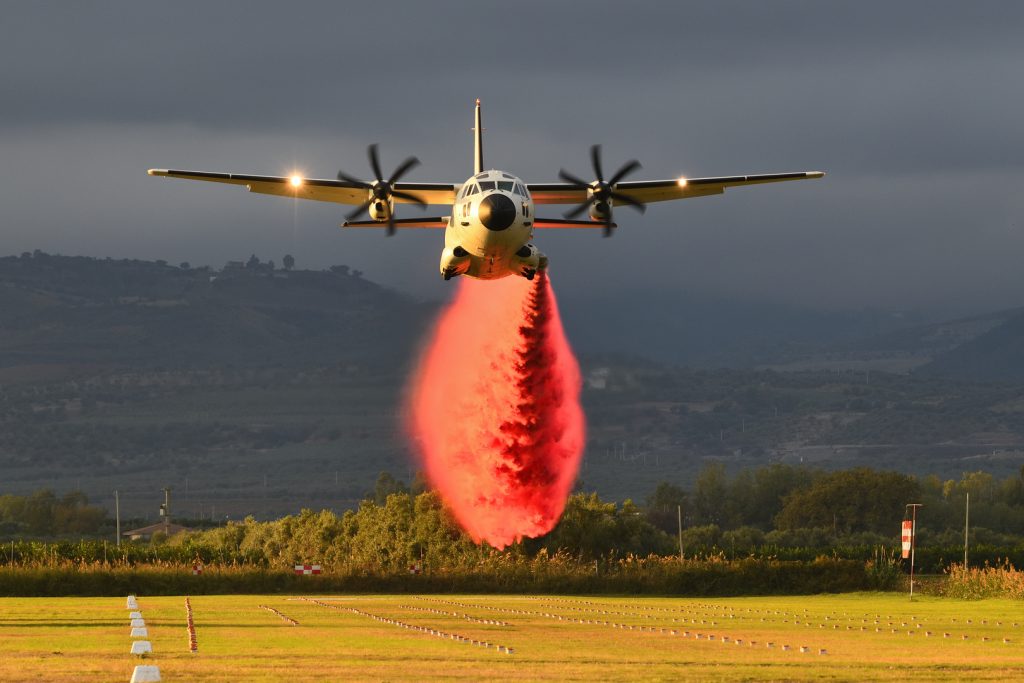
Leonardo’s C-27J Spartan Next Generation aircraft has also been developed with an aerial firefighting capability, with differing levels of system integration. The Romanian Air Force began trialling aerial firefighting capabilities from its Leonardo C-27J fleet in 2013 using the Caylym Guardian system. Less complex than MAFFS, the Guardian system consists of biodegradable cardboard boxes that can carry 1,000 l of water or retardant dropped from the aircraft’s cargo hold. Up to six containers could be carried by a single C-27J, with Caylym claiming a higher operating altitude of 500-1,000 ft (152-305 m). The Slovenian Air Force was the launch customer for the MAFFS-enabled C-27J, with a government-to-government agreement in 2021 stipulating a firefighting capability for the aircraft. Slovenia’s first aircraft was delivered in 2023, with MAFFS to be delivered at a later date. The widening number of European operators of the C-27J, and the integration of the MAFFS II and Caylym Guardian system, can give more countries the ability to support aerial firefighting at home as well as supporting other countries throughout the region.
Airbus’s C295 has been marketed and sold as an aerial firefighter aircraft, with integration of a firefighting kit beginning in the early 2010s. By 2013 testing of a belly-mounted, gravity-based system was underway in Spain. However, the MAFFS II system was later integrated onto the aircraft to allow for rapid conversion of an aircraft from a tactical transport configuration.
Embraer’s KC-390 Millenium has also been developed with a firefighting mission. The MAFFS II system was integrated into the aircraft in 2022 with the support of the Brazilian Military Certification Authority. Use of the Brazilian Air Force’s C-390s during wildfires in Pantanal province led to the procurement of a second MAFFS system at the end of 2024 to augment the fleet’s firefighting operations. According to Embraer, the aircraft’s fly-by-wire capabilities ensure that the low-speed, low-altitude operations required by aerial firefighting can be handled with a greater level of safety. The expanding userbase of the KC-390 in Europe means that there may be a greater interest in adding a MAFFS capability to these fleets. While the Czech Republic, Hungary and Portugal already operate the aircraft, it has also been selected in Europe by the Netherlands, Austria, Sweden, Slovakia and Lithuania.
The future of European military aerial firefighting
Climate change has undoubtedly caused an increase in wildfire activity in Europe. In order to respond to fires that are out of control in a large area or in inaccessible locations, aerial firefighting provides a rapid response with the ability to deliver water or retardant at volume. A mix of small and large aircraft can successfully contain a fire until ground teams can come in and successfully control a fire.
However, a reliance on military transport aircraft to support civil operations may lead to pressures on fleets that could be problematic in times of emergency. Operational surges to support military missions abroad, the need for specialist pilot training and recertification, and aircraft availability could combine to mean that tactical air transport aircraft may not be able to respond to requests from civil authorities.
Continuing to operate specialised large firefighting aircraft, such as the CL-515, will ensure there is a baseline capability for the inevitable increase in firefighting operations. Pooling and sharing assets across Europe will help to maintain an emergency response capacity, but may inevitably lead to political discord over the deployment of aircraft to other countries when there is a need at home. Finding the balance between those platforms operated by civilian agencies and military platforms will come with some challenges, particularly when operating across borders. Outfitting military transport aircraft with firefighting equipment will help to augment responses, but should be used as an support tool in times of need, rather than a permanent part of the emergency response toolkit for wildfires, to prevent military transport and other capabilities being compromised.