FIA 2026: GCAP stakeholders make their presence felt at Farnborough, deliver updates

The UK-Italian-Japanese Global Combat Air Programme (GCAP) had a strong presence at this year’s Farnborough airshow, following funding announcements and amid growing interest in the programme from potential partners and customers. As GCAP-related executives gave their briefings during the show, there was a palpable excitement about what is to come.

Making its Farnborough debut was what purported to be a full-size exhibition model of the GCAP manned combat aircraft platform. Reportedly based on the frame of a previous Tempest airshow mock-up, the model was rather less representative of current GCAP concepts than the 1:1 scale model shown at Farnborough two years ago. (P Felstead)
Pete Felstead

The stakeholders in the UK’s Future Combat Air System (FCAS) programme of record and the associated UK-Italian-Japanese Global Combat Air Programme (GCAP) had a strong showing at the 2026 Farnborough International Airshow (FIA 2026), most obviously through presence of what purported to be a full-size exhibition model of the GCAP manned combat aircraft platform, known as Tempest.

The model, with undercarriage and a ‘visitable’ cockpit, had previously been seen at the DSEI defence exhibition in London in September 2025 and was sited outside the pavilion of Edgewing, the international joint venture established by BAE Systems, Leonardo and Japan Aircraft Industrial Enhancement Co (JAIEC) to lead the development of GCAP, which was making its debut at Farnborough. Reportedly based on the frame of a previous Tempest airshow mock-up, the model was rather less representative of current GCAP concepts than the 1:1 scale model shown at Farnborough two years ago.

As the show progressed, the GCAP/FCAS effort was buoyed by two developments. Firstly, it was officially confirmed on 21 July that Canada has become the first country to be afforded Observer Nation status on the GCAP programme. Then, the following day, the UK Ministry of Defence (MoD) announced that it had awarded BAE Systems, as the UK’s lead system integrator on GCAP, a contract extension worth GBP 708 million (EUR 827 million) to progress the concepting and development of critical sixth-generation combat air technologies for the programme in conjunction with its Team Tempest partners (Leonardo UK, MBDA UK, Rolls-Royce and the MoD). This will involve operational analysis and concept development of the broader FCAS construct, including integrating uncrewed air systems, advanced networks and the latest weapon technologies.

The full-size exhibition model of the GCAP manned combat aircraft platform shown at FIA 2026 featured an undercarriage and a ‘visitable’ cockpit. (P Felstead)

‘There’s a real aircraft coming together in the Northwest’

Meanwhile, during FIA 2026 a number of executives associated with the FCAS/GCAP effort gave updates on their progress.

Introducing a Team Tempest briefing on 22 July, Tony Godbold, FCAS Delivery Director for BAE Systems, said that the team had “made some really great progress”, adding, “We’re really at the business end of this programme now. In terms of the design phase of the aircraft, we’re right at the back end of that process. As we stand, over 11,500 parts are designed and released into the manufacturing process, and that represents around 90% of the weight of this aircraft.”

Godbold explained that the front, centre and rear fuselage of the GCAP Combat Air Flying Demonstrator (CAFD) are being manufactured and built at BAE Systems’ Samlesbury site in Lancashire, while the fins and wings are in build at the company’s Warton site, also in Lancashire.

“The manufacturing process, the build process, in the second half of this year gets really exciting as the final assembly process now starts,” he said. “We’ll see us bring that front, centre and rear fuselage together at Samlesbury and get it ready by the end of the year to move it across and come together with the wings and the fins.”

Godbold said that the CAFD build involves “the largest and most complex panels we’ve ever designed and then manufactured” and that, regarding wings and fins, three are being build of each because one of each unit will be subject to structural testing in the second half of this year.

Beyond the airframe build Godbold said that work across the mission systems and flight systems “is progressing at pace”, adding, “We’re already simulating the flight controls of the aircraft using autocoding software-generating techniques to bring to life the actual computer hardware that will be part of this platform, and that’s connected to real actuation hardware. So we’re actually flying this aircraft now and we’ve got over 300 flying hours of experience with that. … That flight-standard hardware and software is in place now, and that’s what takes us with the build of the aircraft into a very exciting 2027, where the aircraft comes together and systems integration and testing all comes together as well.”

Regarding progress towards flight certification, Godbold noted, “We’re working in conjunction with the MoD and the Typhoon Airworthiness Authority to plot that path, and exercising a lot of new and novel techniques. This will be the first time for both parties that we’d have gone through the process against the MAA [Military Aviation Authority] regulations for a fast jet from first principles since those regulations came into force, so the learning here for both parties is significant.

“That plan is in play as we move through a process of power-on around the middle of next year, then moving forward to engine ground runs, taxi trials and all those sorts of things that naturally build up to first flight,” said Godbold. “We’re on track to get the aircraft ready for the end of next year. We’re harmonising with the MoD now and with GCAP around the flight test schedule we want to achieve. We have a plan that will commence in the early part of 2028 to achieve those test points and demonstrate a significant amount of capability that’s all there to be leveraged into the GCAP programme.

“So it’s great progress and a really exciting time. There’s a real aircraft coming together in the Northwest.”

The BAE Systems Combat Air Flying Demonstrator related to the GCAP programme is coming together at BAE Systems’ facilities in Samlesbury and Warton in Lancashire. (BAE Systems)

Enter Excalibur

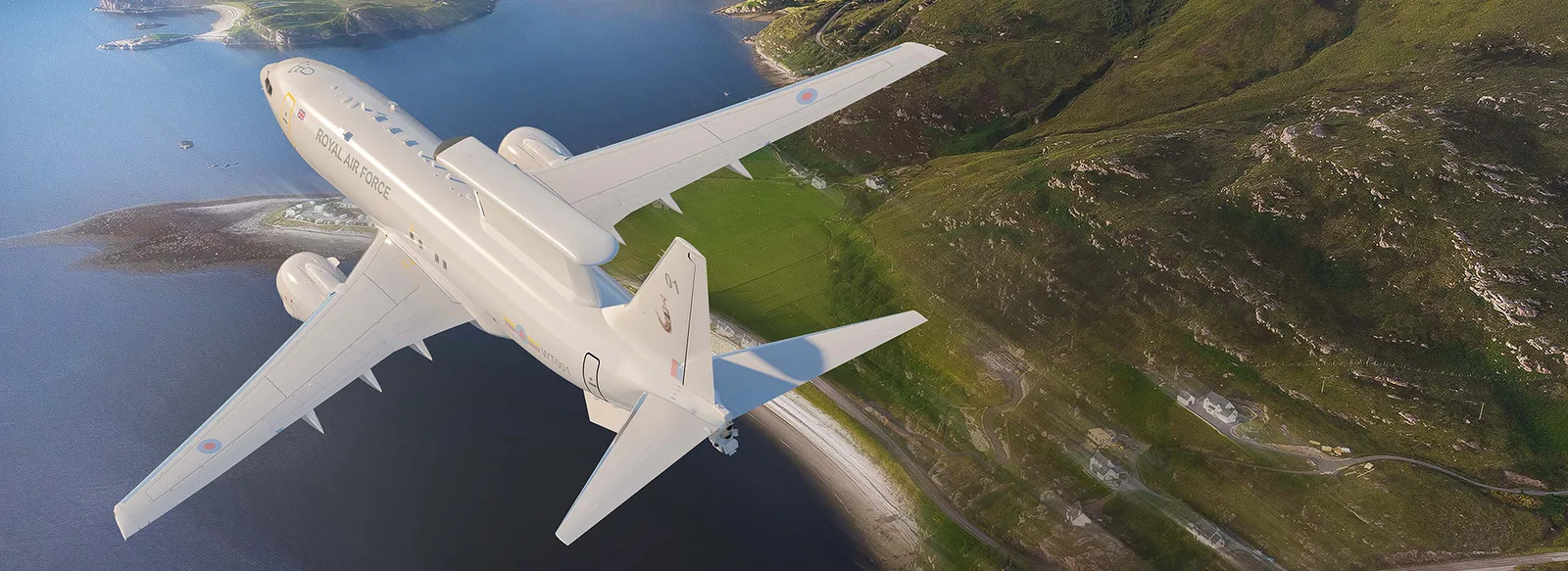
At the same briefing Andrew Howard, Director of Future Combat Air UK at Leonardo, gave an update on progress with the GCAP flight test aircraft. Known as Excalibur, this is a modified Boeing 757 airframe that is designed to be an advanced flying laboratory that can house all the sensors the sixth-generation Tempest aircraft will feature. Leonardo has developed the test-bed platform in conjunction with partner 2Excel.

Excalibur, said Howard, “will essentially be the flying base for all of the TDPs [technology demonstrator programmes] that Leonardo UK has been developing for the last six years, so, as you’d expect, there’ll be a radar and a range of new-generation sensors”.

Operating out of the MoD’s test facility at Boscombe Down, Excalibur is complete and waiting to be put to use as a TDP platform, said Howard.

“That’s the next step along the journey, where we start to embody equipment to really unlock the value of what we’ve designed here,” he said.

Howard noted that adding a fighter nose and chin onto the Excalibur airframe was “a really major engineering task. We had to split the pressure hull at the front and essentially re-engineer the whole front end. There was a massive change to the [centre of gravity] of a 757 with the nose change because there’s quite a lot of structural work behind it to create the strength you’d need to house the radar,” he explained. “The chin provides a test space where we can work with different types of array and different types of sensor, so the combination of the chin and the nose were really challenging things for us to work through.”

Howard added, however, that the crew who have flown Excalibur “have been very complimentary about the handling characteristics” and that concerns regarding the potential for difficult flying characteristics were ultimately proved to be unfounded.

With regard to hardware engineering, Howard said, “The challenge we have within Excalibur and within GCAP is to deliver very strong hardware engineering that has very long-term utility, to allow the software to maintain relevance over time. What we’re expecting to do is essentially complete a period of test flying with the aircraft, largely using the UK TDPs as they start to mature and get embodied onto the platform. That will help us understand better about sensor fusion and the connections we’re trying to create between the various sensors, which is different from what we’ve done before on a Tornado- or Typhoon-generation platform. Once we’ve got that optimised, that will put us in a really strong position to start transitioning that technology into a GCAP space.”

Howard additionally noted, “One of the features of Excalibur is that it has significant onboard computing capability. It has seats down the back that would be familiar to someone who’s been in an AWACS or a Nimrod-type aircraft, but they’re configured in such a way as to allow real-time engineering in the air. There was a real recognition that the modelling was probably taking us to very high 90% confidence, but there was still a gap around in the airborne performance of some of the sensors, where the modelling wouldn’t necessarily get us to the 100% accuracy we need to create the fidelity of integration we’re trying to achieve. The seats in the back of the aircraft allow for real-time adjustments of various sensors to optimise that integration task more quickly. The other expectation for Excalibur is that it’s a key part of our longer-term schedule challenge, which is that it’s going to help us unlock the readiness of the sensors in the timescales required.”

The UK’s Excalibur GCAP flight test aircraft in formation with a flight of RAF Typhoons. Developed by Leonardo and modified for its purpose by 2Excel Aviation, Excalibur is complete and waiting to be put to use as a TDP platform. (BAE Systems)

GCAP weapons integration

Following Howard, Chris Allard, Vice President for the FCAS programme at MBDA, gave an overview of the work his company is doing with regard to the FCAS programme and particularly within Tempest.

“What we’re looking at doing in Tempest, in FCAS, is utilising that experience gained in the UK with BAE Systems, but also on other fourth- and fifth-generation platforms both inside and outside the UK, to try and transform the way we design and integrate complex weapons into sixth-generation capability,” he said.

Allard said there were two key pillars of work in this regard: effects optimisation and digital weapon integration.

“When we say effects optimisation, what I’m talking about is providing the best threat response deployable at the optimum moment that maximises overall mission effectiveness,” Allard explained. “So how can we bring together all of the complexity in the platform and in the mission system sensor suite to deliver, from a complex weapon perspective, that best sixth-generation capability? What we’re doing inside Tempest is utilising our experience across the domains of air, land and sea. We’re looking at our experience in mission systems design and weapon system design, working alongside BAE Systems and Leonardo, to really improve that capability from a weapon perspective. So rather than having just a simple weapon, how do you bring that all together as an effects system?

“Progress has been really good over the last few years inside Tempest and FCAS,” Allard continued. “We’ve matured a large number of algorithms, building up the algorithm readiness level, as well as integrating that into software and bringing that software up through the system readiness levels and the technology readiness levels. We’ve demonstrated and tested that in the lab and on hardware. What we’ve been able to do most recently is test that in some of our facilities in Stevenage, both with an operator in the loop and through broader operational analysis, to really see what those benefits in effects optimisation will bring to the user in that sixth-generation capability.”

Regarding digital weapon integration, Allard said, “What we’re trying to achieve here is to really transform the way we integrate weapons in the future, both from a capacity perspective – so how can we increase the number of weapons through the platforms in the same period of time – but also from a time perspective. How can we reduce the time it takes to integrate weapons, which can take years, down to 18 months? We’re clearly looking forward to working with BAE Systems, the UK MoD and the regulatory authorities to bring some key technologies and techniques to achieve that.”

Allard added that digital modelling and simulation, what he termed “virtualisation”, and AI and machine learning are all key to MBDA’s work.

“The ability to model and to simulate is significantly improving on where we’ve been in the past,” he noted. Using the example of electromagnetic capability testing to demonstrate a weapon can be safely fired from a platform, Allard explained, “What we would normally do is a large number of tests. We put design-specific missiles into chambers, and we have a lot of aircraft testing time. What we’re looking at doing through Tempest and FCAS, and beyond into GCAP, is reducing that time using really sophisticated, complex computer modelling. We’re basically reducing significantly the amount of on-aircraft and in-chamber testing time and doing most of that through simulation and modelling.”

Virtualisation, he explained, relates to “trying to get rid of the hardware, the platform hardware and the missile hardware, and turn that into off-the-shelf software we can use … [to] minimise the reliance on hardware from a mission system perspective and really work from a virtualisation perspective to reduce the time for [weapons] integration”.

On AI and machine learning, Allard said the goal was to use this to analyse the results of tests, analyse some of the software trials, “to bring all that together to write the report for us, to review the report for us and actually provide that evidence to the regulator and through into the platform authority.

“That would reduce significant on-aircraft time, and time spent analysing and writing reports, to really significantly reduce the time to bring those weapons into service,” he said.

A CGI of Tempest. BAE Systems’ Combat Air Flying Demonstrator for the GCAP programme could be in the air in 2028. (BAE Systems)

Powerplant progress

Talking of progress in relation to the GCAP powerplant, Phil Townley, Director of Future Programmes for Rolls-Royce, asserted that the first flight of the CAFD will be “a moment the nation will be proud of”, but explained that the demonstrator will, in fact, use two existing EJ200 engines as employed by the Eurofighter Typhoon.

“It’s a fantastic product, reliable engine,” he said. “We’re tricking that engine, using some clever control-system algorithms, so that when it’s flying in this new aircraft, it thinks it’s in a Typhoon. That’s what we have to do to make sure it can operate and be stable because it knows how it operates in a Typhoon – and you want to make sure it thinks it’s in a Typhoon.

“But it’s not as simple as that,” Townley continued. “If you look at a Typhoon, the proximity from the front of the engine to the outside air is very close, very open. This [the CAFD powerplant] is going to sit behind a long duct. We knew next generation is going to have embedded engines within the aircraft, so we’ve worked closely with our partners, BAE Systems. Several years ago we talked about the duct that was fabricated on our test bed, proving out our digital models and validating them for real-life testing, knowing that we’re good and derisking that programme. That’s getting us ready to fly, teaching the next generation of engineers how to work in partnership and integration of complex challenges that will stand the test of time and get us ready for the next programme that comes.”

Townley said of the engine requirements, “We understand the power demands. … We understand much better what kind of power [our project partners] need, not just the amount. At the start of Tempest, we talked about a twin-spool power generation solution. We’ve further developed that throughout the programme. Early on we saw that as a game-changing concept where we can really ensure that the future power needs of this air vehicle can be delivered. We’ve matured that technology with a better understanding of ‘What kind of power signal do my customers need?’ As we keep saying, this isn’t just an engine; this is a flying power station in the sky. We’re not just going to propel the air vehicle; we’re going to power it too.”

Townley added that one technology of which Rolls-Royce is particular proud is the GCAP powerplant’s combuster, which is manufactured using “a world-leading digital and additive manufacturing capability” using a new digital additive cell at the company’s site in Bristol that is one of the largest such cells in the world.

“Those technologies have been proven out. We can operate the combustor now to temperatures we didn’t think were possible before with that amount of material,” he said. “So we’re therefore making it lighter, we’re making it smaller and we’re making it more powerful, which means the engine can be more compact, which means the air vehicle can be more compact. This is really game-changing technology, proven out through Tempest, and, importantly, engineers are learning their tools of the trade on this programme, which we’ll then bring to bear on the next generations that come through.”

The Tempest powerplant is described as ‘not just an engine, but a flying power station in the sky’. (P Felstead)

GCAP consortiums focused on the future

On 21 July at FIA 2026, a day prior to the Team Tempest briefing, Edgewing hosted a briefing from the GCAP Electronics Evolution (G2E) consortium, which is a partnership comprising Leonardo UK, Leonardo Italy, ELT Group (Italy) and Mitsubishi Electric (Japan) launched in September 2025, and the GCAP Power and Propulsion Domain, which is an international collaboration between Rolls-Royce (UK), Avio Aero (Italy) and IHI Corporation (Japan).

Leonardo’s Andrew Howard, this time briefing as the General Manager of the G2E consortium, explained that its mission “is to ensure that the GCAP platform is the world-class, sixth-generation sensing powerhouse that it needs to be. It needs to run the future battlespace. It needs to integrate and infuse data better, more effectively and more completely than anything that’s gone before.”

Noting that “everything we’re doing is around engineering excellence”, Howard said that the G2E’s “next phase, task one … is really about delivering the infrastructure to really unlock the concept and assessment phase.

“Concepting and assessment is taking good ideas, good TDPs, to the next level of maturity and refinement,” he explained. “What we’re trying to do now is ensure that we have the physical and digital infrastructure to unlock the potential of our people, to do it manifestly different to what’s gone before. During the task one activity, we’ll see recruitment across the four companies, we’ll see new buildings, new infrastructure, new digital infrastructure, more investment in high-powered computing and modelling and synthetics across a range of different types of activity, across different sensing and communicating sensing activities, that we need to do to ensure that the integrated sensing network that we’re trying to deliver is properly informed and enabled.”

“For the next period, for us to really mature our thinking and our design is absolutely critical before we move forward to a design development contract thereafter. Each of the companies is feeling more and more confident that GCAP is going to happen, that our countries are supporting us and backing us. The funding settlements, placement of contracts, gives us a real belief that what we’re doing is valued by our nations, valued in our industry, and we think we’re being disruptive; we’re being disruptive in excellence. We’re really delivering something that’s not out there right now. It’s better; it’s manifestly different to what’s gone before.”

In terms of the technology, Howard said, “We’re at a really important point in the journey. We have a really good idea what future sensing and future communicating means. We know the mix of sensors we’re trying to design. We know what the future communication requirement needs to look like. Our investment is starting to bear fruit. The next 18 months to two years will give us a much better insight into our ability to deliver all of that in the required timelines, but today, with good funding, with a good team, and with a good relationship with Edgewing, we’ve got an awful lot of belief.”

Speaking on behalf of the GCAP Power and Propulsion Domain, Edoardo Curti, General Manager of the Avio Aero Defence Business Unit, explained the complexity of designing the GCAP powerplant.

“As all of you know, we’re not just talking of a simple engine, but of an integrated-power-generation-within-aircraft engine, which is kind of a new breed of machine. That is essential to our effort here,” he said. “So what is essential is how we are preparing to deliver this unprecedented type of technology.

“The team is working together to define the technologies and develop the key technologies today to prepare for this new challenge that we have in front of us,” he continued. “Where we are is … we’ve already matured altogether more than 100 subscale tests, and this is part of our development journey that goes first of all at subscale and component tests, then goes through demonstrators at national level. And then what is unique, I think, for the engine domain is we have a trilateral demonstrator that will be built together by the three companies before going to the final product. So we are excellently positioned to deliver this roadmap.”

Curti noted that, as well as the challenge of geography between the propulsion partners, another is secrecy: securely transferring data between them.

“Now we are actually focusing on how to prepare for the next phase, which is to develop, on the one side, a collaborative hub that we are gearing up here, close to here, to have people physically located all together from the three companies to work together; on the other side, to develop all the digital infrastructure that will enable the exchange of data from the massive amount of engineers and people working around this project over the next years. And that’s a huge challenge, as you may imagine,” said Curti.

“The last point that I would like to mention about GCAP in the engine domain,” Curti added, is just to give you the size of what we are talking about. Probably you’ve read some numbers, but we already have thousands of people working on the development of the product right now, so imagine what this will be in a few years when we will be in full-blown product development and how many high-value jobs this will create in our nations and across also every other nation that will be touched by this product.”

Having noted the large size of the full-scale Tempest mock-up outside the Edgewing pavilion, Warsight asked the presenters to what extent that form was driven by their efforts and requirements and vice versa. Howard replied that, while the large size of the current incarnation of the aircraft, essentially driven by range and payload requirements, is a challenge, in that it’s a large aircraft that needs to be protected, it can also be an advantage – most obviously in providing more in-fuselage real estate to embody complex systems. He added that, compared to a Typhoon, “There’ll be more sensors, more communicating systems, in more locations. And of course, size presents opportunity in that space. We can choose where better to place things, and we’ve more space to work with on the top and the bottom and the front and the back. There’s a lot more choice to exercise in the location and what we’re trying to achieve.”

Curti said that “there is a strong collaboration between the engine domain technical team and the airframe technical team to continuously iterate across requirements, across integration, across needs”, adding that “it’s really built together a single machine”.

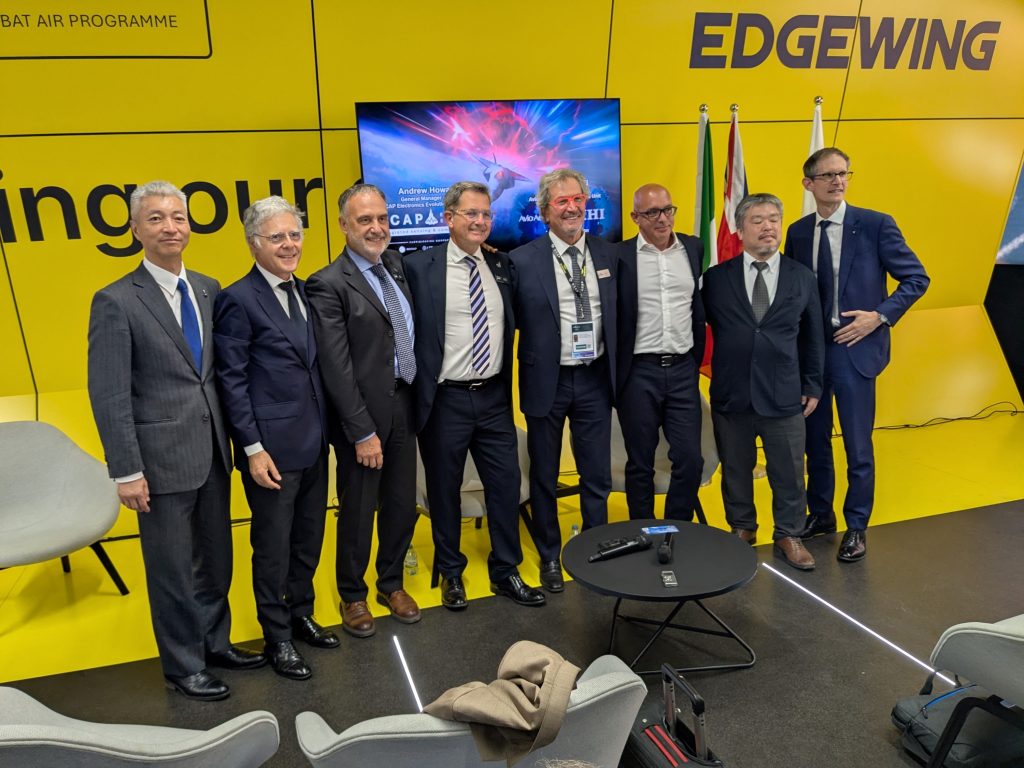
Executives related to the GCAP programme come together for a photo shoot in the Edgewing pavilion at FIA 2026 on 21 July. The enthusiasm among the executives briefing at the show was palpable – a sharp contrast to the ‘other FCAS’: the somewhat fragmented Franco-German-Spanish Système de Combat Aérien du Futur (SCAF) programme. (P Felstead)

Share post

You may be interested in

Categories

All NewsAir

Used tags

Avio AeroBAE SystemsEdgewingELT GroupFuture Combat Air System (FCAS)GCAP Electronics Evolution (G2E) consortiumGCAP Power and Propulsion DomainGlobal Combat Air Programme (GCAP)IHI CorporationJapan Aircraft Industrial Enhancement Co (JAIEC)LeonardoMBDAMitsubishi ElectricRolls-RoyceRoyal Air Force (RAF)Tempest

Similar posts