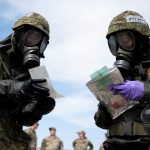
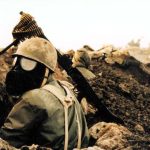
By far the most common Russian use case reported in allegations (and now widely witnessed on social media posts) is use of tear gas hand grenades, either thrown by hand or dropped from small drones. The tactical use appears to be to use the irritant effects of tear gas to force Ukrainian defenders out of fortified positions and trenches in order to make them more vulnerable to conventional firepower. This is broadly similar to the earliest uses of tear gas grenades at the beginning of the First World War and the prolific use of tear gas by the US military in the Vietnam conflict. Unlike those conflicts, however, the scale appears to be smaller and more fragmented.
The large majority of reported incidents involve the common tear gas agent CS, used around the world for riot control and policing. The munition most noted in the conflict is a Russian-made burning-type hand grenade called the K-51, noted for its plastic casing. Lesser numbers of RGR burning CS grenades and RGK-60 explosive bursting CS grenades have been noted. A surprising development occurred when the older tear gas agent CN (aka ‘Mace’ – largely considered obsolete in most of the world) turned up in the form of the RGR grenade. This marks the first outing of CN in decades, perhaps signalling a supply problem for CS.
Neither CS nor CN are considered lethal agents; their lethal concentrations are absurdly high and nearly impossible to achieve with grenades in the field. It is important to note that most of these munitions burn fuel and oxidisers to make a smoke cloud full of the chemical agent. Because burning CS and CN grenades can achieve very high temperatures (some similar grenades elsewhere have measured up to 800 °C), the munitions have occasionally doubled as de facto incendiary weapons in confined spaces. Few fatalities have been noted from their use, but it is plausible that some or the majority of those fatalities were due to the grenades setting other things on fire or oxygen depletion (a known issue that caused an Australian fatality in Vietnam).
A handful of allegations have involved apparent improvised devices, and this has made identification of the chemicals involved difficult. There have been numerous allegations of the use of the chemical chloropicrin. On the one hand, these allegations are troubling as this chemical – that has legitimate uses in industry and agriculture (as a fumigation agent, for example) – is far more toxic and irritating than CS or CN, albeit not quite approaching the toxicity of things like phosgene, blister agents, or nerve agents. Indeed, chloropicrin has a decade or more of history as a tear gas agent in the early 20th century. On the other hand, the descriptions in Soviet-era military handbooks, symptoms, and smell of chloropicrin are very close to that of CS and CN tear gases, so there may be some misidentifications occurring. However, the consensus belief is that a small number of chloropicrin incidents have occurred.
The history of these incidents actually pre-dates the February 2022 invasion as there were a handful of allegations of use during the 2014-2022 period. However, the first reported Russian military use after the February invasion came within about two months. Early stocks may have been part of riot control equipment as the initial Russian invasion force was expecting massive civil unrest in occupied areas. But as the war has drawn on, the ‘ill-disciplined troops using up riot control stockpiles’ hypothesis has worn thin.
The nature of the small munitions, dropped singly or in small numbers, means that no major chemical attacks of First World War scale have happened. This is a more dispersed phenomenon. Incidents have been scattered but numerous. A Ukrainian statement to the OPCW on 10 July 2025 alleged that 9,905 incidents had occurred, with 2591 personnel seeking medical care, and a handful of fatalities. Interesting, but not a large factor in such a high intensity conflict.
It should be noted that it has been Russian policy to make both strong denials and nearly identical counter-allegations. Some of the counter-allegations have been nearly farcical in nature, while some others use images of dubious provenance as “evidence”. In some of these videos, it is not at all clear that tear gas is being used and some social media footage has been deliberately misattributed, as both sides are using drones to deliver small munitions and the allegations allege effectively the same types of munition. It certainly cannot be ruled out that grenades tossed by Russians have at times been thrown back, or if individual Ukrainians have used captured items, but systematic investigations by Ukrainian authorities claim that no tear gas grenades are in their inventory.
This issue is important because use of such chemicals undermines the established rule of law. Use of riot control agents in warfare is strictly prohibited by the Chemical Weapons Convention (CWC). Tear gas in warfare is a war crime, although the CWC also specifically allows its use for civilian policing. A strong rationale for the ban is that tear gas could be mistaken for more serious banned weapons. Indeed, that may be what is happening with some of the chloropicrin allegations. The issue points out inherent weaknesses in the chemical arms control world. Russia is already heavily sanctioned. What sanction could make much difference? Given some of the other human rights violations and war crimes going on, some would argue the tear gas uses are minor by comparison. Does this encourage other CWC violations elsewhere? It is too early to tell, but weakening the existing regime cannot be a good idea.