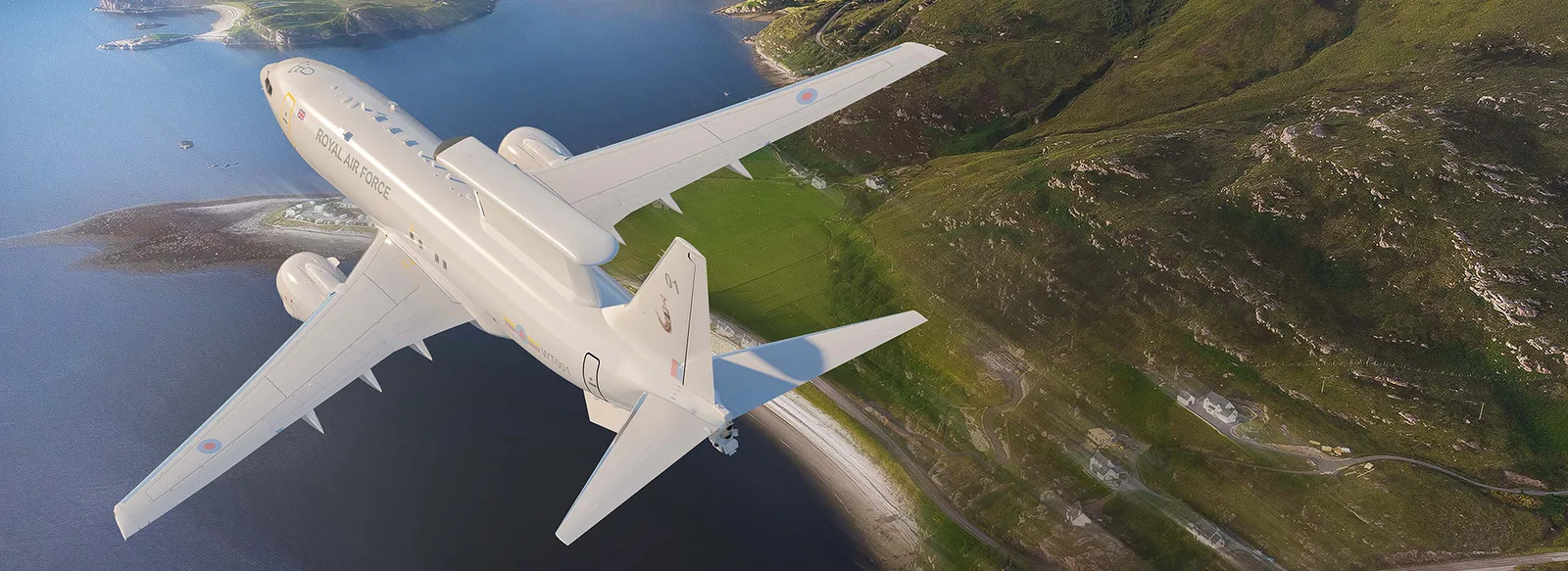
Collaborative combat aircraft (CCAs) lie at the heart of a new, refreshed combat air strategy commissioned by Air Chief Marshal Sir Harv Smyth, the Chief of the Air Staff (CAS). This will aim to “fundamentally change the concept of operations and how we do control of the air”, ACM Smyth told Aviation Week’s Tony Osborne. A first draft of the document is expected in the autumn.
ACM Smyth hopes to dramatically accelerate the service entry of CCAs as part of a wider effort to turn the Royal Air Force (RAF) into what he has referred to as a “sixth-generation” air force. The CAS also plans to invest heavily in artificial intelligence (AI), edge computing and human/machine teaming.
This echoes First Sea Lord Sir Gwyn Jenkins’ drive towards much greater use of unmanned platforms in the Royal Navy and both approaches have attracted some degree of criticism. Many believe that a cash-strapped UK Ministry of Defence should perhaps concentrate its resources on the ‘basics’, prioritising the availability and operational effectiveness of existing, more traditional platforms, weapons and capabilities, leaving experimentation in unproven and immature exquisite technologies to the US military, at least for now. Being first in any field imposes massive cost and risk, with many believing that UK aspirations to field the first sixth-generation air force (or navy, or army) are foolish and will require proven conventional capabilities to be gutted. These critics would want to let richer nations do the experimentation and develop the doctrine and tactics, techniques and procedures (TTPs), for the UK to then ‘steal what works and refine it’.
Such an approach might not win ACM Smyth his ‘place in history’ as ‘father of the world’s first sixth-generation air force’, but it would allow him to have discharged his responsibilities wisely and frugally.
Critics also point out that the threat UK forces face remains largely traditional and based on platforms and weapons dating from the Cold War, against which the UK’s existing platforms and capabilities are more than adequate – assuming that their availability can be assured.
Earlier CCA plans
The UK was already moving towards greater manned/unmanned teaming (MUM-T, also known as crewed/uncrewed teaming (CUC-T)). The Tempest manned fighter being developed under the Global Combat Aircraft Programme (GCAP) has always been envisaged as sitting at the heart of the Future Combat Air System (FCAS) ‘system of systems’, operating alongside an array of unmanned adjuncts and effectors.
In January 2021 Spirit AeroSystems in Belfast was contracted to develop and flight test a demonstrator of the Mosquito ‘loyal wingman’ under the then Lightweight Affordable Novel Combat Aircraft (LANCA) programme. The programme was abandoned ‘half way through’, in 2022, when it was said that the RAF’s focus had shifted to systems that could be “operationalised” at a “much faster pace”. About 90% of the GBP 300 million (EUR 353 million) allocated to Mosquito went unspent.
ACM Smyth’s use of the CCA acronym is interesting, as this is the term preferred by the US military, whereas the UK has hitherto used the acronym ACP, for autonomous collaborative platform. ACM Smyth is part of a generation of RAF senior officers who historically favoured ‘harmonisation’ with the US and he echoed parts of the US approach, although his emphasis on ensuring that the CCA platform could be delivered by UK industry, including SMEs as well as major primes, was reassuring. ACM Smyth was also at pains to stress that what he called the “Royal Air Force kitemark” could give a very real possibility of export success and act as an engine for growth for the UK aerospace industry.
New programme, new timeline
The formal launch of the new CCA programme was enabled by GBP 300 million of new funding under the newly published Defence Investment Plan (DIP). Interestingly, this is the same amount that was allocated to Mosquito, suggesting a similar ‘scope’ and level of ambition. Before this ‘launch’, ACP/CCA development was tied to GCAP timelines, while the new programme is bringing forward the timescales by about 10 years and will produce adjuncts that will operate alongside F-35 and Typhoon, as well as operating with Tempest later on.
ACM Smyth believes that advances in AI and autonomy mean that the technology exists to deliver a viable CCA this decade. He told Aviation Week that he wants an operational concept demonstrator to be flying alongside a Eurofighter Typhoon by the time of NATO’s ‘Steadfast Defender’ exercise in 2027, with an operational capability in service before the end of the decade.
The air chief referenced the ‘Digital Century Series’ approach outlined by former US acquisition chief Will Roper as a means of rapidly iterating new designs and expressed his willingness to ‘spiral’ new capabilities, adopting a ‘fail-fast’ approach in order to identify problems and wrong turns early, learn from them and adapt or pivot without sinking massive resources into a doomed project. He hopes to see several iterations of UK CCA platforms by the time the Tempest fighter enters service in the second half of the 2030s.
Speaking at the Global Air and Space Chiefs Conference in London, Defence Readiness and Industry Minister Luke Pollard announced, “Our new autonomous CCA programme will be named Storm Fighter. It will make the RAF Europe’s first sixth-generation air force.”
The Storm series
ACM Smyth announced an expansion of the Storm series, telling conference attendees about the new Storm Chrome electronic warfare drone and the RAF Regiment’s new 1,000-mile (1,609 km)-range, ultra-low cost, one-way attack drone, the Storm Fire (probably a renamed Safran/Edge Autonomy Lanner, which is a derivative of the Latvian Penguin C unmanned aircraft system (UAS), which will join the Tekever-based StormShroud ACP.
“We aspire to spiral and expand at pace our new Storm series of capabilities to remain ahead of the adversary and stay [in] lockstep with today’s and tomorrow’s rapid technology development,” ACM Smythe said.
Mark Urban, a British defence journalist and and commentator for The Sunday Times, cited a unit price of GBP 20 million (USD 27 million) for the Storm Fighter, or between one fifth and one sixth of the unit flyaway cost of an F-35B Joint Strike Fighter. This is likely significantly cheaper than the price of the main US CCAs, which are frequently stated to be one third to one quarter of the cost of an F-35. (The USAF F-35A comes in at a Gross/Weapon System Unit Cost of USD 116 million in FY2026, with a USD 97.98 million flyaway cost).
To do the CCA/ACP mission as it is usually framed, such a platform would have to match the performance, survivability and range of manned combat air platforms, since CCA/ACPs might need to escort a combat air package ‘en route’ and then position ‘up threat’, persisting long enough to cover the package while carrying a useful payload. Critics suggest that none of today’s CCAs can do those things – and certainly not at a USD 27 million price point.
The worry is that a GBP 20 million ACP will be inadequate to do its job and yet at the same time be too expensive to be viewed as expendable.
ACM Smyth suggested that by the 2030s the optimum mix of manned combat air and CCA/ACPs might consist of four to five unmanned adjuncts operating ahead of a Eurofighter, which would sit back and act as a battlespace manager or ‘quarterback’. These CCA/ACPs would need overall direction, rather than granular individual control. The AI required might be at a relatively simple level.
“The whole point of AI is that it is pre-programmed to know what to do and follow a bunch of pre-determined parameters,” asserted an experienced RAF fast jet practitioner. “If it is well designed and well integrated, the FJ pilot won’t need to do very much at all. The drones are just there as assets at his/her disposal, like having extra missiles or a longer-range sensor. I really don’t think it will involve a pilot flying a Typhoon/F-35/Tempest while simultaneously controlling a bunch of drones with a controller!”
Another ex-Harrier/Sea Harrier/Super Hornet pilot noted, “Quite aside from AI, an autonomous system can be wonderfully dumb – in a positive sense. No AI whatsoever is required for the following:
- Follow the ACO outbound to the millimetre;
- Don’t run out of gas;
- Don’t transgress any known ACM [air combat manoeuvres];
- Don’t penetrate a known MEZ [missile engagement zone]; I’ll let you know by text if there are any new ones;
- Don’t leave the FIR [flight information region];
- Don’t fly into me;
- Don’t get more than 20 n miles from me;
- Don’t employ weapons without my say so;
- If you’re near a POI [point of interest] and can capture an ISR [intelligence, reconnaissance and surveillance] product, please do;
- If we lose comms for ‘x’ minutes go back to CAP [combat air patrol], for ‘y’ minutes then return to base;
- Go home obeying the ACO [airspace control order] to the millimetre.”
“These are all things that you might hope your manned wingy would achieve but that you could never guarantee, These are now simply check boxes on a mission planner.”