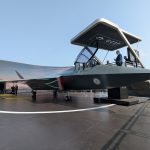
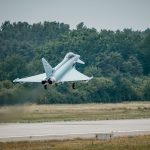
Germany’s Luftwaffe unveiled a new 70th anniversary logo on the tails of a Eurofighter and an A400M at the 2026 Berlin ILA Airshow, held from 10 to 14 June. It was notable for featuring the head-on silhouette of the Dassault New Generation Fighter (NGF) concept, rather than the alternative Airbus concept. Many surmised that this surprisingly diplomatic gesture by Germany was intended to smooth the way to getting the Franco-German-Spanish combat air programme back on track, perhaps with the signature of the delayed Phase 2 contract.
Of course, by the time ILA kicked off, the NGF programme was dead and the French concept was entirely unrepresentative of what might come next for the Luftwaffe.
German Federal Defence Minister Boris Pistorius outlined a number of possible options as to what that might be. One would be to buy more Lockheed Martin F-35As; another would be to join an existing international fighter programme “with sixth-generation features”. A third option was one that he said he did not yet want to talk about, which was taken to be a possible collaboration with Sweden and Saab.
A fourth option would be for Germany to start its own programme, and Pistorius confirmed that he and other defence leaders had been talking to Airbus about possible options “for months”. Airbus had quietly formed a ‘Team Gen 6’ consisting of itself alongside MBDA, MTU Aero Engines, Autoflug, Diehl Defence, Hensoldt, Liebherr and Rohde & Schwarz.
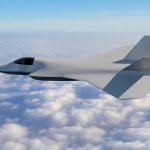
This was all in progress well before ILA, so Airbus was able to issue a press release and to show a new video. This featured an unusual ‘inverted gull wing’ design like that fitted to the Second World War-era Junkers Ju 87 Stuka and Vought F4U Corsair and to the post-war Fairey Gannet – and not seen since!
The aircraft appears smaller than previous Airbus Future Combat Air System/Next Generation Weapons System (FCAS/NGWS) concepts, as a single seater of broadly F-35 size. The aircraft has widely spaced canted twin tails, as well as canard foreplanes (which may be fixed or moving) and an inverted gull wing that is similar to that of the F-22 in planform. The aircraft has a single ‘chin’ intake with a prominent diverterless supersonic inlet (DSI) ‘bump’. It isn’t clear whether the aircraft is single or twin engined and no details of internal payload bays can be discerned.