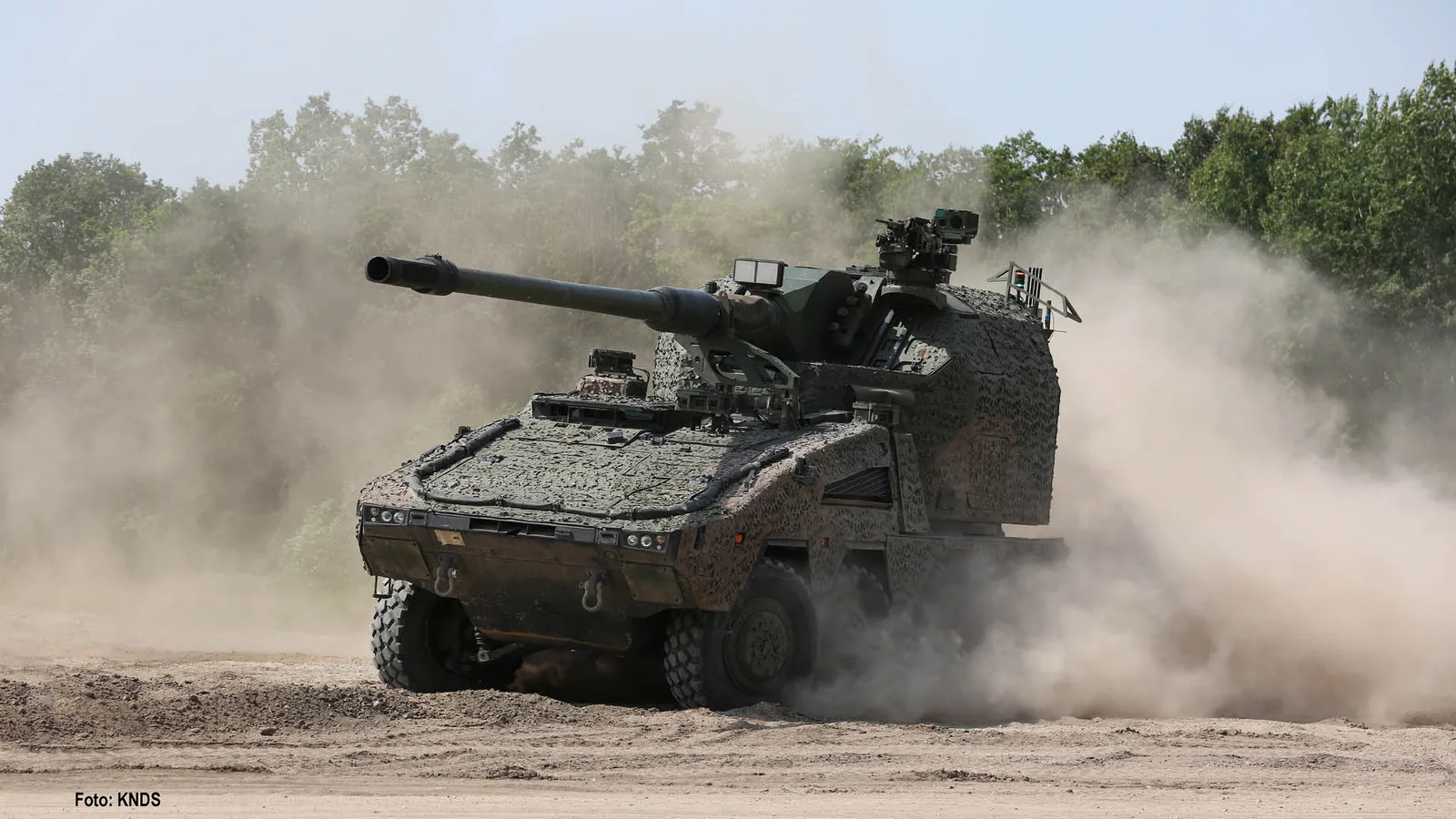
German news outlet Handelsblatt reported on 5 November 2026 that the German government has signed an agreement to acquire the 50% stake in KNDS owned by Wegmann Holding, bringing the ownership of the company under equal state ownership between France and Germany.
Wegmann Holding is owned by the Braunbehrens and Bode families, who had controlled Krauss-Maffei Wegmann (KMW) prior to its merger with France’s Nexter Systems in 2015. Nexter Systems had been owned by the French state through GIAT Industries, with the merger giving Wegmann Holding and GIAT Industries an equal share of the company.
The move comes after attempts to publicly list KNDS through an initial public offering (IPO) in June were postponed in July due to “current volatility of the European defence sector”. The company had completed the preparation process and engaged with potential investors, but received a lukewarm approach to the possibility of listing. At the time of the postponement in July, the company noted that it had a backlog of EUR 33.1 billion at the end of December 2025.
A release at the start of the IPO process outlined that the German government would acquire a 40% stake in KNDS from Wegmann Holdings, with the latter to sell its remaining 10% stake through the IPO. GIAT Industries would then add 10% of its 50% stake in the company, leaving the German and French governments with an equal 40% ownership and 20% as a free-market float.
German budget documentation tabled in July noted that the acquisition would cost in excess of EUR 8 billion, with EUR 346,000 paid annually to 2030 with future payments to be valued at up to EUR 7.2 billion.
Would defence collaboration be improved?
The joint ownership of the company between France and Germany would, in theory, bring some harmony to co-development of land systems and munitions. Jointly funded projects could leverage the in-house expertise between the two organisations and the wider research and development ecosystem that exists in France and Germany. Recent history has, however, proven to be more complicated.
The initial attempts at demonstrating Franco-German harmony within KNDS were shown in 2018 with the launch of the European Main Battle Tank, which married a Leopard 2A7 chassis with the turret from a Leclerc main battle tank (MBT). Further collaboration on the project led to the Enhanced Main Battle Tank in 2022, featuring a 120 mm main gun, and a further variant in 2024 equipped with a 140 mm main gun.
The Franco-German MBT programme, now dubbed the Main Ground Combat System (MGCS), was formally stood up by KNDS in 2025. By mid-2026, however, collaboration on the system had been refocused. The German Ministry of Defence revealed in July 2026 that the MGCS programme was now “a platform-independent technology for future manned and unmanned armoured platforms and their networked interaction with main battle tanks”, showing that the programme was beginning to evolve beyond an MBT concept. By October the development of the MGCS tank had collapsed, with the French government stating that the industrial offering was “incompatible with the replacement of current tanks”. Germany had also launched a national study for the replacement of the Leopard 2, leaving France to pursue an “intermediary capability” ahead of the now-delayed MGCS solution commissioning in the 2040s.
Overall, the project had shown the hallmarks of the continuing disharmony between the French and German governments on defence technology. The Franco-German Future Combat Air System/Système de Combat Aérien du Futur (FCAS/SCAF) was launched in 2017, with an industrial agreement between Airbus and Dassault Aviation announced in 2018. A key plank of this was the development of the Next Generation Fighter aircraft, alongside other technology developments in areas such as unmanned systems and a ‘combat cloud’ digital architecture. Continuing delays in development and arguments over intellectual property and workshare ultimately led to the collapse of the project in 2026.
Outlook for KNDS
The French and German governments will ultimately be able to leverage increased defence spending on the land domain, with KNDS undoubtedly being a key beneficiary of this expenditure. The ability to return profits to the national budget – particularly when dealing with export contracts and work from KNDS sites in third countries – will undoubtedly be an attractive one.
However, it is highly likely that discord between the two national governments will create tension within KNDS. For the German government, the previous ownership structure left the French government dealing with a commercial entity – meaning that any disagreements would be dealt with internally or in the courtroom. As two national governments now control the business, the potential for commercial disagreements to spill over into the political space is now much greater.
Bickering over investments, workshare, research and development expenditure, and profit sharing are more than likely. Caught between lawmakers demanding their fair share and operational managers, state ownership funds face an unenviable task in both managing expectations and delivering returns. Parliamentarians will be able to link business success and failure to local jobs, while painting their national partners as roadblocks. The precedents set by the MGCS and FCAS programmes demonstrate that there is a high risk of falling out over collaborative defence technology. The future of KNDS will also face similar challenges.