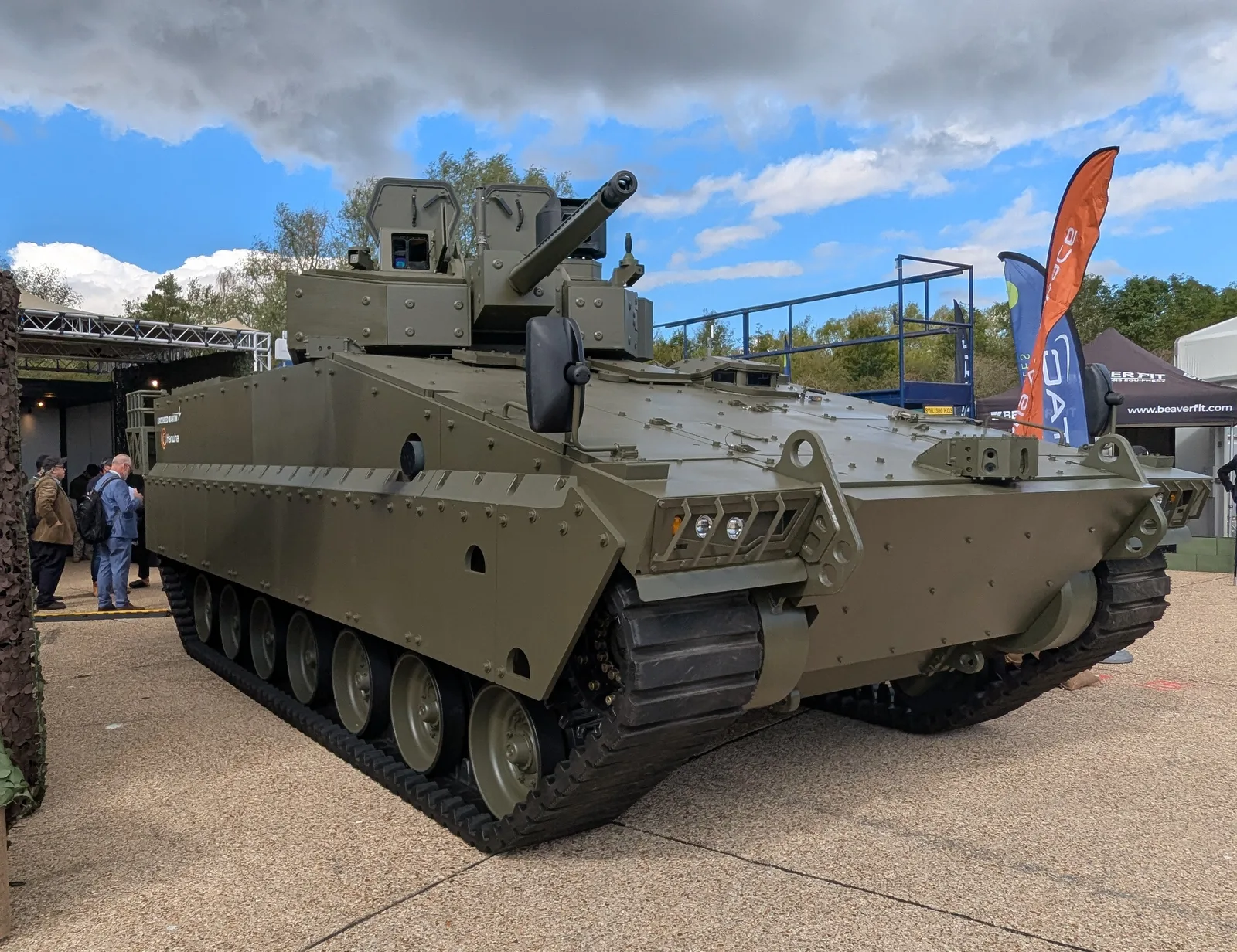
At its recent inaugural tech summit, Thales briefed invited cutomers and journalists on new military technologies the company is looking to field in both the near and longer term.



At its recent inaugural tech summit, Thales briefed invited cutomers and journalists on new military technologies the company is looking to field in both the near and longer term.
At the inaugural Thales Tech Summit in London on 14 September 2026, at which senior executives launched the company’s new technology strategy, a number of new and novel technologies were displayed to customers and journalists.
In the defence domain these included next-generation sensors for extra-large unmanned undersea vehicles (XLUUVs), a new concept for a mobile ultra-high-frequency (UHF) radar and a lightweight soldier-worn protection system.
In the spring of 2026 the Type 23 frigate HMS St Albans, replenishment oiler RFA Tidespring, Royal Navy (RN) Merlin helicopters and Royal Air Force P-8 Poseidon maritime patrol aircraft thwarted an attempt by deep-sea submarines from Russia’s Main Directorate of Deep Sea Research (GUGI), abetted by a Russian Akula-class attack submarine and other vessels, to interfere with critical undersea infrastructure within the UK’s exclusive economic zone.
Noting that month-long incident at the Thales Tech Summit, Ian McFarlane, the company’s sales director for underwater systems, said, “We can see that potentially happening more and more, and therefore the RN knows we need to have mass and persistence at sea to act as that deterrent to ensure our infrastructure is maintained and therefore our way of life is maintained.
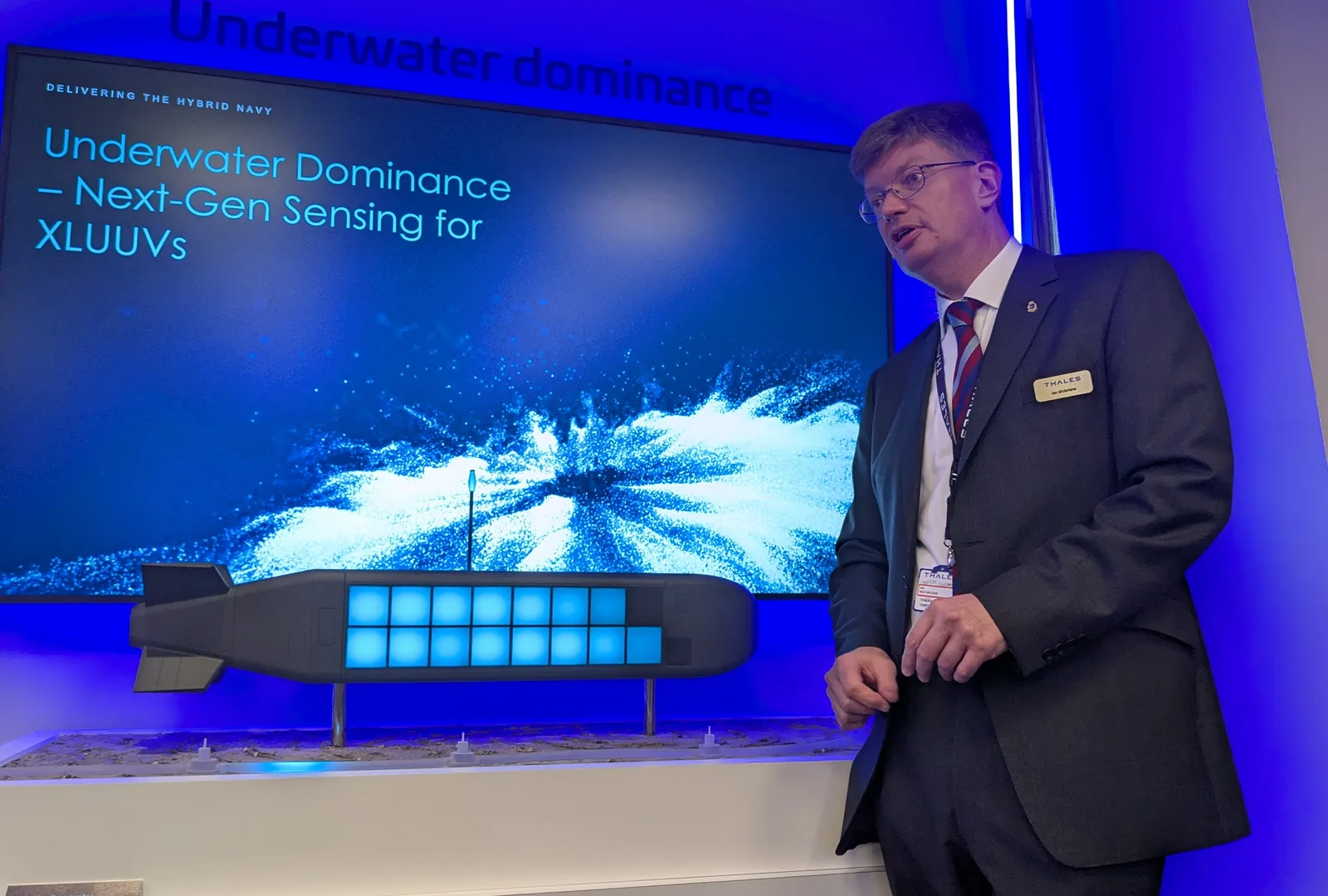
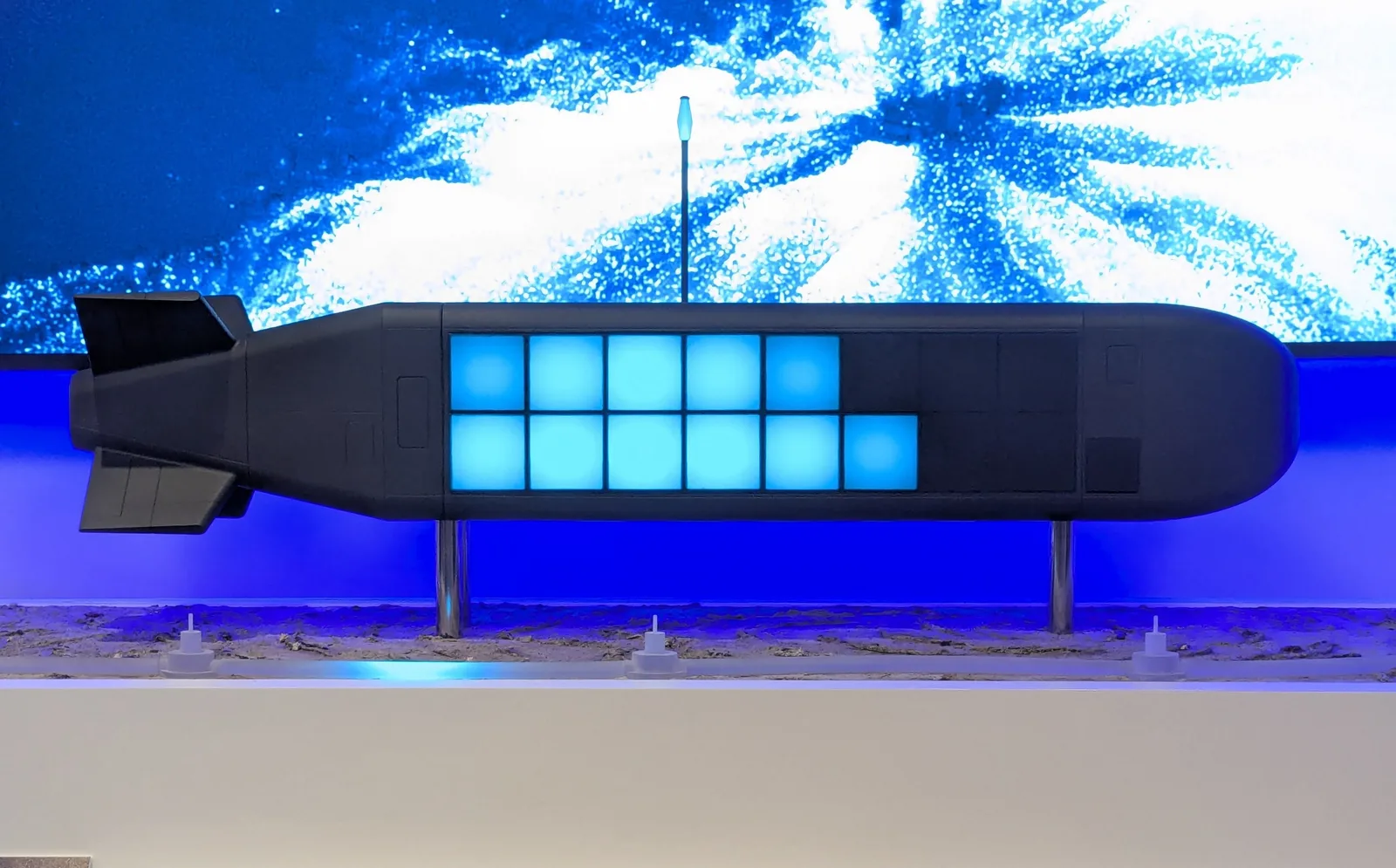
“The current best approach to do that is to move towards this type of vehicle,” said McFarlane, standing beside a model of an XLUUV. He explained that around 18 months ago Thales decided to invest its own money in developing a suite of sensing capabilities for such platforms by taking the technology of what the company does for larger, crewed RN submarines and miniaturising it as much as possible to an extent where a capability could be provided for an XLUUV-sized platform. The results of this work were a modular and scalable flank panel sonar solution, which can be used either passively or with an active transmit element provided by an SME called Neptune Sonar; a retractable optronic ISTAR mast; and a thin-line towed array.
The flank sonar panels are vehicle agnostic and a set size, so their capability can be scaled up or down by fitting more or less of them, depending on the size of the host vessel. When used with the active transmit element emitting a sonar ‘ping’ out into the water space, the panels use the return signals to either detect hostile submarines or map the seabed for change detection. Employment of active or passive mode, McFarlane noted, would depend on how much sonar data the XLUUV’s operators wanted to immediately gather and whether they wanted the vessel’s presence to be known or not.
The retractable optronic ISTAR mast has essentially been developed from the optronic masts that Thales provides for manned submarines and features a 360° staring capability and laser rangefinder, with electronic warfare and communications capabilities also being options.
The thin line towed array is a stream of hydrophones within a long cable around 38 mm in diameter that is trailed from the rear of the XLUUV. This is capable of sensing very low frequencies, with McFarlane explaining that the lower the frequency of sound, the further it travels in water, meaning that if a system can ‘hear’ at the lower frequencies it can detect objects at greater range.
“What we’re doing is to try and get close to the sensing capability of an attack submarine,” said McFarlane, although he stressed that there is no intention to replace crewed submarines but rather provide a capability that operate alongside or independent of them – and most crucially with significant degrees of endurance.
A key aspect to what Thales has developed with these systems is that the enormous amounts of data data they collect, which McFarlane noted runs into the terabytes, is edge processed on board use the company’s Digital Crew concept. That information is then data-bursted through a gateway buoy back to shore or back to another Royal Navy or allied asset.
McFarlane noted that the technology he presented is at Technology Readiness Level (TRL) 7 and has already been wet-tested. Asked by Warsight whether this was on XV Excalibur – the RN’s first, experimental XLUUV, which was built by Plymouth-based MSubs and handed over to the navy in December 2025 – McFarlane declined to confirm that (although it almost certainly was). Given that the XLUUV model shown by McFarlane certainly corresponded to the design of XV Excalibur, it could be deduced that, like the model, XV Excalibur would be able to accommodate 16 sonar panels on either flank, with Mcfarland noting that a vessel able to accommodate 48 panels on each flank would be afforded a capability akin to a conventional crewed submarine.
The wet-testing was done with panels that McFarlane said Thales “would intend to take to production if they bear out the results that we expect, which they are currently, and that then means any final design optimisation in the next three to six months and final design for manufacture for three to six months”, adding, “I’d really want to be building this time next year.”
Asked by Warsight whether Thales has done any work on weaponising XLUUVs, McFarlane declined to answer directly, but noted, “Let’s say, three years ago, we were at this stage in the air domain, and now in the air domain [the company is] looking at fitting weapons on uncrewed aerial platforms [under Project Peregrine and Project Nyx]. … I can see a situation where in the future this sort of vehicle will be fitted with weapons and there will be something that says, ‘Can I release?’, some set of conditions that says, ‘Can I release?’”
Regarding its research into new radar technology, Thales also briefed on Deepfinder Tactical: the concept for a long-range UHF early warning radar system that will complement the company’s SkyDefender integrated air and missile defence family of solutions.
“Threats are evolving all the time. They have done in the past and they are evolving dramatically again today,” said Peter Terpstra, global policy director for surface radars at Thales. “Radars need to evolve with them, so we are now developing a family of UHF radars and this is the third member of this family: the Tactical DeepFinder.”
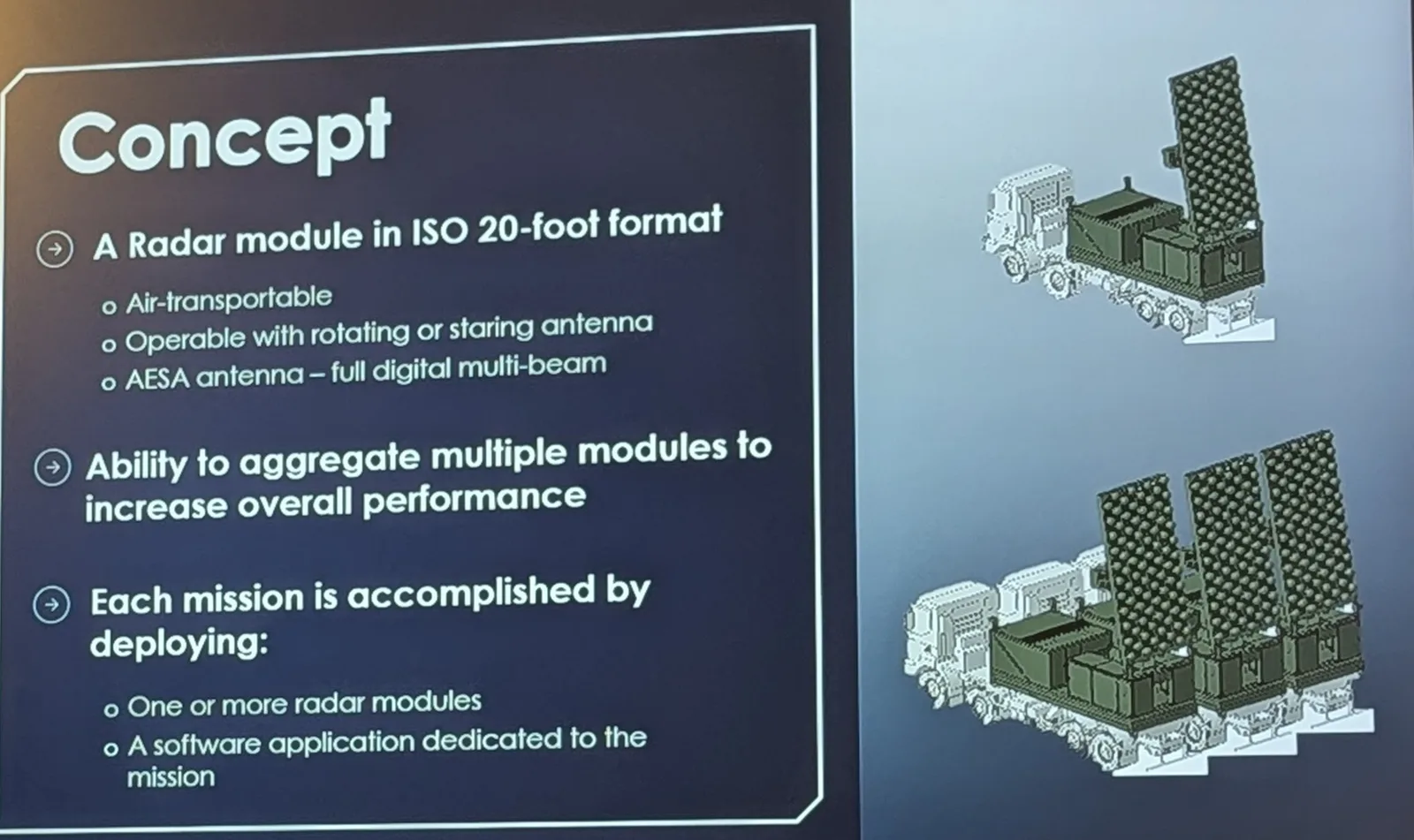
However, while Thales’ DeepFinder Strategic and DeepFinder Space UHF radars operate as fixed installations, DeepFinder Tactical is a truck-based mobile solution, which Thales describes as “a disruptive concept that combines ultra-long-range surveillance and tracking, up to several thousand kilometres, with high tactical mobility and without compromise”.
Outlining the scale of the threat, Terpstra said, “Ballistic missiles today have very short flight times. If you have a medium-range missile of around the range of 1,000 km, between launch and impact you have between seven and 10 minutes; that’s fast. You have hyper-velocity threats, gliders, cruise missiles. You have stealth threats, fifth-generation aircraft, combat drones. The weapons themselves are stealthy. The [threat] environment is getting very complicated. They’re not only flying in the atmosphere; they’re also now flying near space and low Earth orbit, so the amount of threats and the complexity we have to address has increased dramatically.”
Explaining the advantage of UHF radars, Terpstra said, “The first thing is that stealth targets, all the stealth measures, radar absorbent materials, they work badly or not at all in UHF, so I have suddenly a 10-times-better visibility or reflectivity of the targets versus classical radar bands like S-band.
“The other advantage you have in UHF, because it [involves] large systems, you can put in a lot of power,” said Terpstra. “A classical air defence radar has a range of a few hundred kilometres. The radar I’m presenting here today has a range of a few thousand kilometres, which means that such an air defence system can launch its missile before it sees [the threat] itself. That’s called launch on remote. Based on my data, they can launch the missile, it’s already in the air, then their fire control radar picks it up and does the final guidance. So the area you protect is much larger and also the chances of you of hitting it is much larger and you work much quicker. And I think with seven minutes, as I’ve said before, every second counts.
“So the next question is, if UHF is such a miracle, why didn’t we use it before?” Terpstra continued. “Yes, we did; UHF radars exist. But these radars are very big; they are buildings. And the problem with a building is it’s not mobile. The Tactical DeepFinder is now the first radar that gives all these advantages with a very high mobility.”
A typical UK-based example of a UHF radar installation is the site at RAF Fylingdales in North Yorkshire, which features the Raytheon AN/FPS-132 Solid State Phased Array Radar and operates as part of the Ballistic Missile Early Warning System (BMEWS) capability in partnership with the US military. As a static site that has been in operation since 1963, however, RAF Fylingdales is an obvious strategic target.
“We have in the past decade developed a technology and algorithms to make multiple antennas work as one. It was very difficult, but we managed, and the payoff is that if you look at the trucks,” said Terpstra, pointing to a presented graphic, “you can see that the radar is a 20-ft ISO container. … So we get now a combination of extension of the speed ranges up to Mach 10+ for the [hypersonic threats], a very long range, thousands of kilometres, and stealth resilience. Also, we have increased the ceiling up to space, so you cannot fly over the radar anymore, and all this combined with high mobility. The system is in operation within 30 minutes, and it’s faster than it needs to get away. So for such a long-range system, which usually was a building, this offers incredible survivability. And it’s also completely software defined, so we can use it in ground-based air defence, air surveillance, early warning, many missions.”
Terpstra additionally noted the scalability of the system. “You can use one system, or three or more, depending on your need,” he said, “so not only on the inside it’s scalable [but] with building blocks on which we build a family of three radars: a large strategic DeepFinder, a satellite-finding DeepFinder and this now, the mobile [Tactical] DeepFinder, which is a game-changer in this new world.”
Asked by Warsight what stage the development of DeepFinder Tactical has reached, Terpstra replied, “We have a very large demonstrator in the south of France, which is in operation for quite a few years. With this one, the TRL is so high that we launched full development, and the first radar must run out for testing this decade, which is very soon.”
Asked if Thales had any customers lined up for DeepFinder Tactical, Terpstra replied, “We can’t comment on customers, but I think you can make a good guess.”
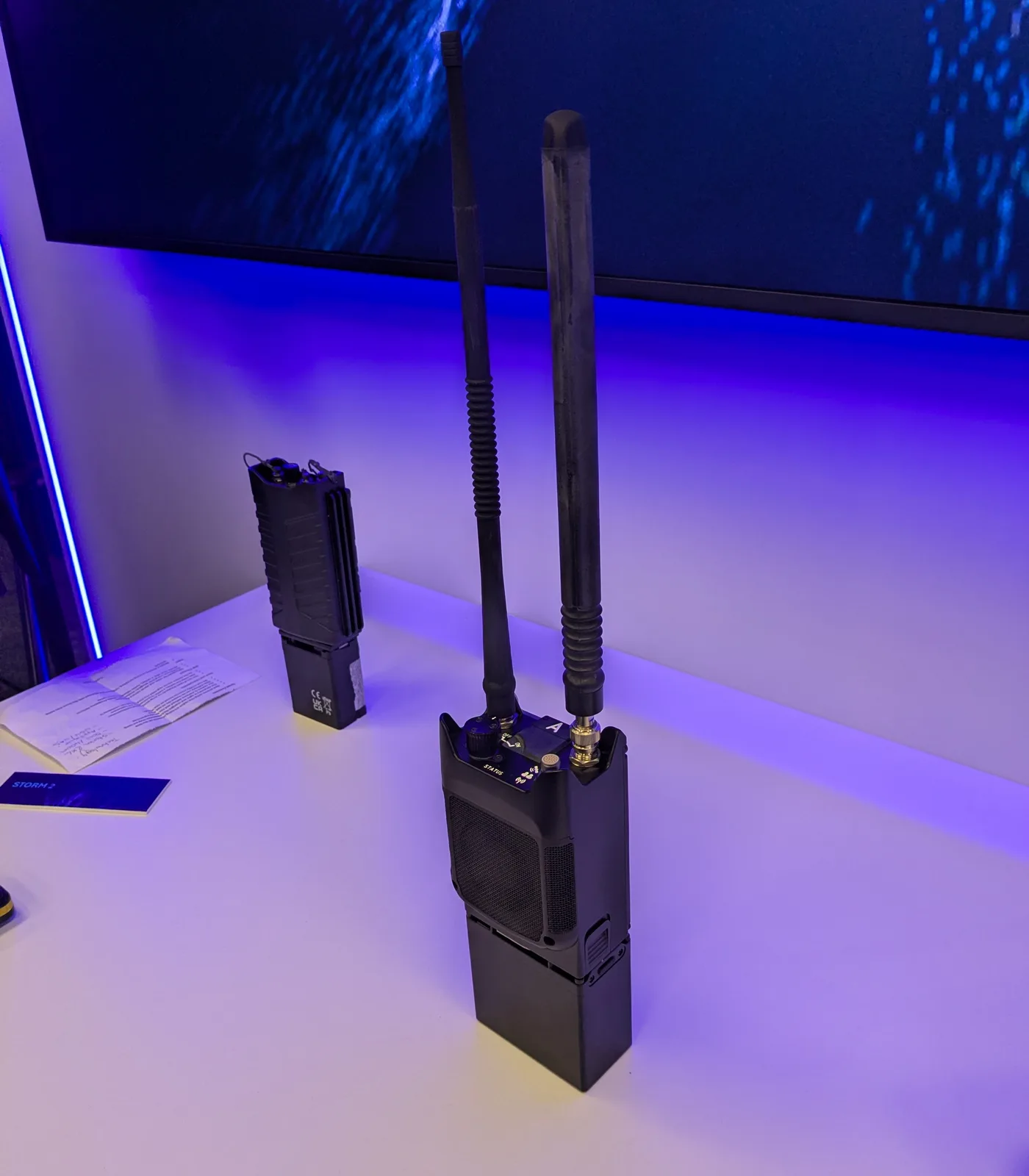
Regarding the land domain, Thales presented the Storm 2: a lightweight, soldier-worn protection system that safeguards dismounted troops against radio-frequency (RF)-controlled threats. Originally designed to provide protection from radio-controlled improvised explosive devices (IEDs), Storm 2 is a next-generation individual cyber and electromagnetic activities (CEMA) node that also provides a dismounted counter-unmanned aerial systems (C-UAS) capability. The system was officially launched in March 2026.
While such systems currently come in the form of a manpack-sized package, Storm 2 reduces this to the size of a handheld radio, allowing individual dismounted troops to carry it.
Paul Curtis, the CEMA design authority and deputy technical director at Thales UK, described the Strom 2 as a “wearable jammer”, but noted that “It’s much more than that.”
Curtis noted that Storm 2 “fits as part of a layered approach to counter-UAS, perhaps in that last 200 m of defence from radio-controlled FPV and ISR drones. … Because it’s a wearable jammer, what it really does is it detects RF signals. It knows which RF signal is a threat, and then it delivers electronic attack to jam that threat.”
Because of the Storm 2 system’s low size, weight and power (SWaP) footprint, Curtis said that the system “attaches to the webbing, the load carriage of the soldier, and they can go about their day job without having to think about the delivery of ECM [electronic countermeasures] effects”.
Weighing 2 kg with a current power output of 10 W, the system is much lighter than the 20 kg weight of a current backpack-based RF jamming system.
“Our adversaries are agile in the electromagnetic spectrum, so they can quite easily change the frequencies that their drones operate at, so in that sense we have to be very agile as our threats evolve,” said Cutis, noting that with the Storm 2 “we can update our software in the system because it’s a software-defined radio. It’s a bit like loading an app in the app store onto your phone to deliver a new capability.”
Curtis additionally noted that Thales has “designed a cradle environment that we’re calling Storm 2 XL, and the Storm 2 slots into that cradle and gives you up to 50 Watts of RF power. That system would be powered from a vehicle’s main battery source, so it could be a small vehicle, like a mine-resistant ambush protected platform, possibly a UGV.”
Regarding the system’s software, Curtis said that this was “all about using open standards for both the software when that’s loaded and the way the software is designed, and also open standards from a communications perspective, so when we communicate with other things that we can plug into … that allows third parties to update an interface with Storm 2, which is a value proposition for the customer. They get more value out of the product because third parties can get involved. It’s less proprietary to Thales. That’s quite a powerful point for customers.”
In this regard Curtis noted Thales’ co-operation with partner company MyDefence and its Wingman drone detector and tracking product, giving the Storm 2 system a much greater capability to detect hostile drones.
The Storm 2 operates in two bands: a low band going from 20 to 500 MHz and a high band from 500 MHZ up to 6 GHz. Curtis noted that it typically has an effective jamming range of 200 m against FPC drones, which would rise to 400 m with the Storm 2 XL system, and can operate in multiple modes, including an active ‘barrage’ mode where the customer wanted to be very deliberate with regard to jamming, with no concern for the adversary detecting that, to a more reactive mode, where the jamming is only turned on when a hostile threat is detected.
Curtis noted that the Storm 2 system is currently at TRL 8. While the system has yet to be deployed with a customer, he said, “We do have live contracts with the UK customer which are built on this technology, but ultimately we’re looking to secure our first export or domestic orders, I would say, this calendar year.”