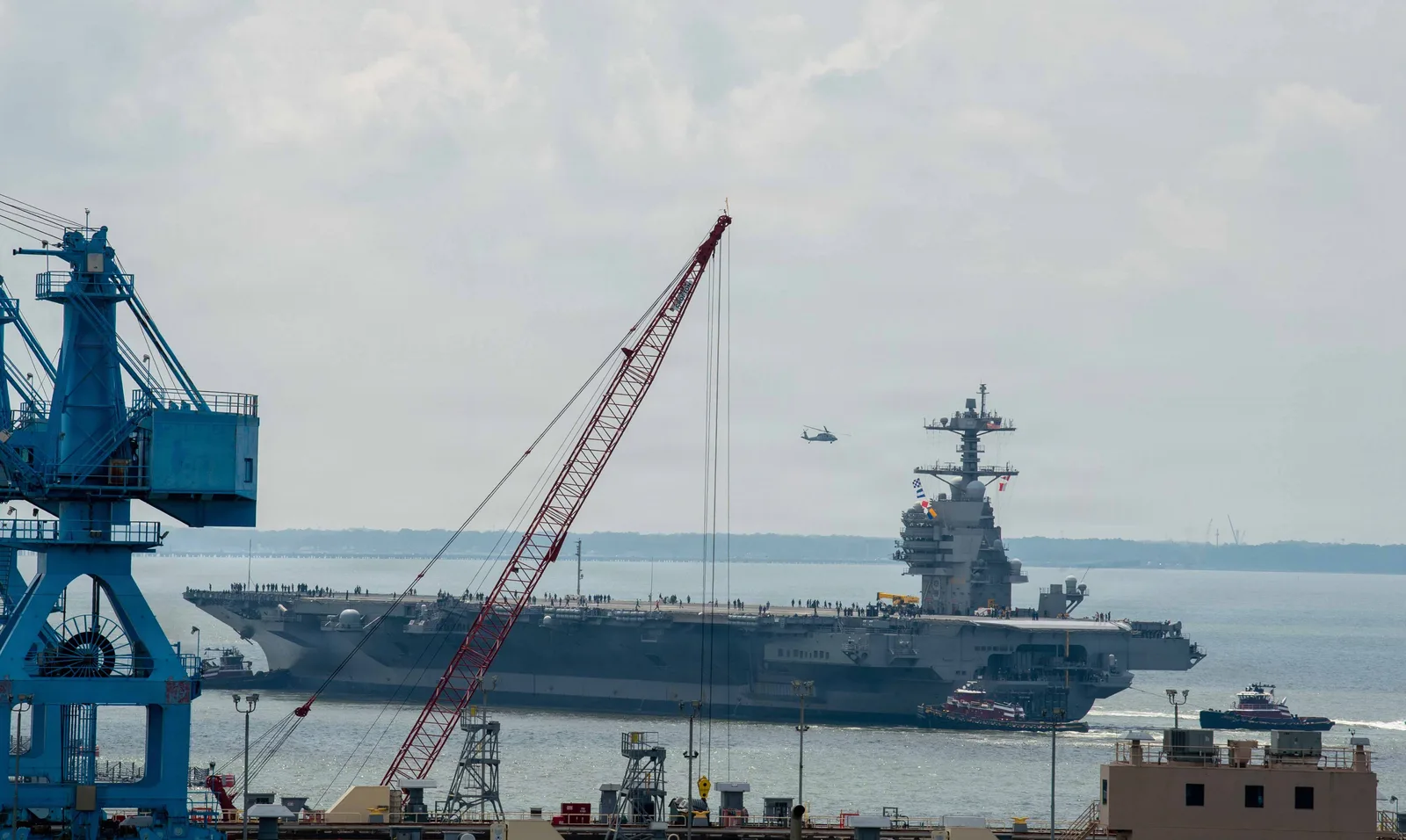
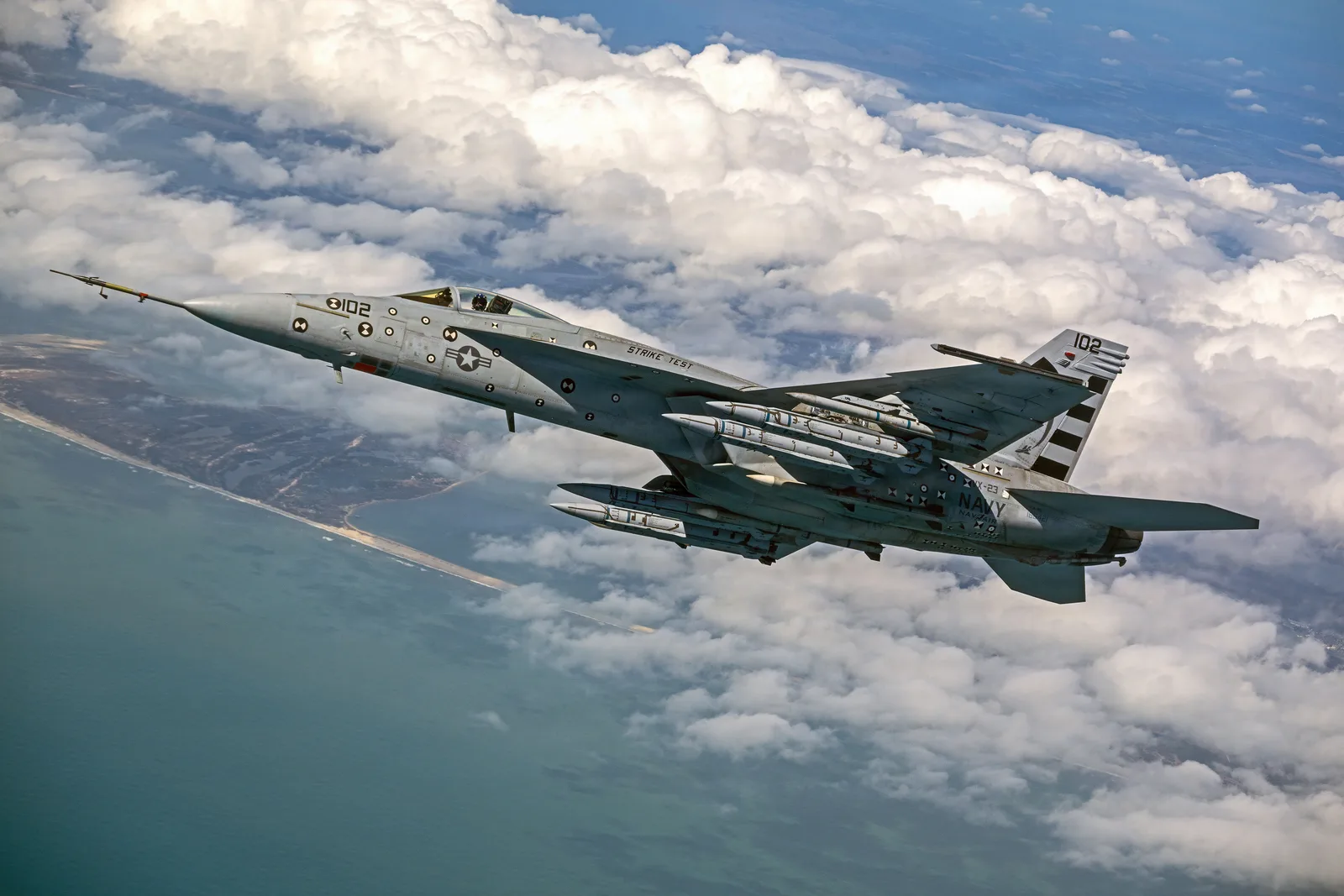
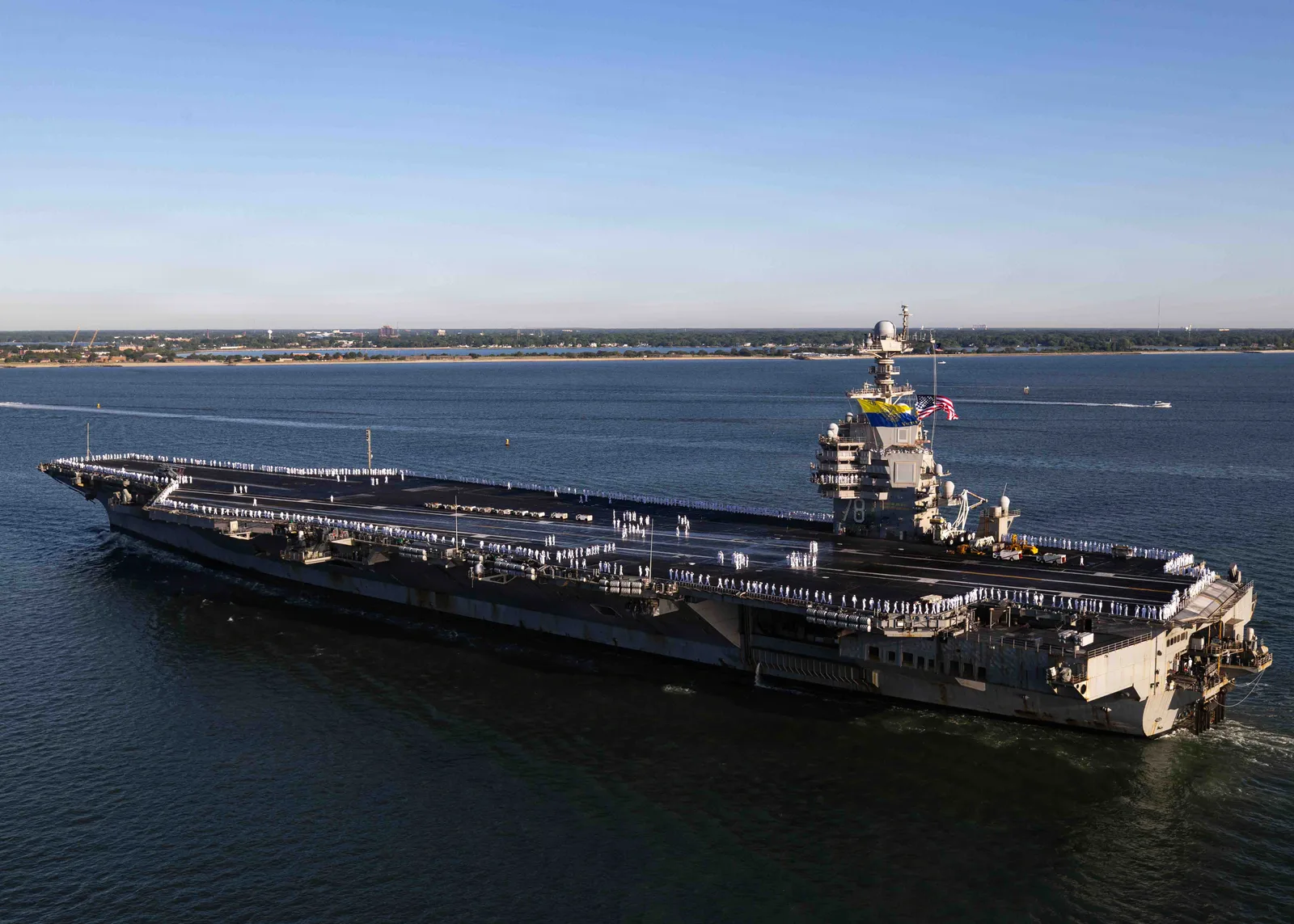
The aircraft carrier-building plans of the US Navy (USN) have been thrown into disarray by the insistence of President Donald Trump that the navy returns to using steam catapults instead of the Electromagnetic Aircraft Launch System (EMALS), starting with the fourth Gerald R Ford-class nuclear-powered aircraft carrier: the future USS Doris Miller (CVN 81).
Trump’s directive was contained in a ‘Memorandum for the Secretary of War’ issued by the White House on 13 August 2026 that otherwise focused on rebuilding the US naval shipbuilding industrial base.
The document states, “Within 60 days of the date of this memorandum, the Secretary of War, in consultation with the Secretary of the Navy, shall provide to the President, through the Director of the Office of Management and Budget (OMB) and the Assistant to the President for National Security Affairs (APNSA), a plan on the required measures to replace the Electromagnetic Aircraft Launch System and Advanced Weapons Elevators with steam and hydraulic systems for the construction of CVN 81, including timelines and resourcing requirements.”
Implementation of the directive would represent an astonishing reversal of technological progress for the USN, which first implemented EMALS, designed and manufactured by General Atomics, on the first-of-class carrier USS Gerald R Ford, which was commissioned – by President Trump himself during his first term – on 22 July 2017.
Moreover, the directive to change from EMALS to steam catapults from the fourth Ford-class carrier onwards directly flies in the face of another point contained in the memorandum, which directs that the USN “shall not impose iterative design changes upon … original mature parent designs”.
Ditching EMALS would also be an international embarrassment for the USN, given that China’s People’s Liberation Army Navy has implemented its own electromagnetic launch system on Fujian: its first indigenously designed aircraft carrier. Video imagery emerged of Fujian conducting dead-load launch testing of its three electromagnetic catapults on Chinese social media channel Weibo on 26 November 2023. Footage released by Chinese state broadcaster CCTV on 22 September 2025 showed multiple aircraft types conducting catapult-assisted take-off and arrested landing training on Fujian and the carrier was officially commissioned into active service on 5 November 2025.
EMALS: an uneasy introduction
Along with numerous new technologies introduced on USS Gerald R Ford (CVN-78) and subsequent carriers of the class, EMALS has suffered from development issues and contributed to significant delays to the Ford-class build programme, which is now years behind schedule and billions of dollars over budget. A few months before Gerald R Ford was commissioned, Trump railed against EMALS during an interview with Time magazine published on 11 May 2017, stating, “I realised they’re going to digital. I said, ‘No, digital is no good. It’s got to be goddamn steam.’”
As with all new technologies, the issues with EMALS as well as others, such as the Ford-class carriers’ Advanced Weapons Elevators and Advanced Arresting Gear (AAG), which replace the older hydraulic systems of the USN’s Nimitz-class carriers, are being worked through.
The FY2025 report from the US Department of War’s Director, Operational Test and Evaluation (DOT&E), published in March 2026, states of the EMALS on USS Gerald R Ford, “Data collected during CVN 78’s FY25 pre-deployment work-up cycle indicate that EMALS reliability remains consistent with developmental and operational test data collected in FY23 and FY24. Engineering upgrades to hardware and software have produced gradual improvements in cumulative reliability and availability. Reliance on off-ship technical support remains a challenge. NAVAIR [Naval Air Systems Command] is continuing development on improvements.”
The advantages of EMALS
Compared with steam catapult technology, which was developed in the 1950s, EMALS is more efficient, smaller, lighter, more powerful, less manpower intensive and much easier to fine tune. The system can launch aircraft that are both heavier and lighter than those launchable by a steam catapult and, due to the way EMALS can be controlled, it puts less stress on the airframes that it launches. EMALS, moreover, is designed to deliver sortie rates that steam catapults could never match.
Apart from the USN throwing away those advantages if it ditches EMALS, any return to steam catapult technology will be extremely difficult and very costly. The last of the USN’s Nimitz-class carriers, USS George H W Bush, was launched in October 2006, meaning that no US company has manufactured steam catapults in 20 years.
Furthermore, the Ford class and its operational systems have been designed specifically to take advantage of the ship’s nuclear powerplant’s ability to generate much larger volumes of electrical energy than the Nimitz class, meaning that significant design alterations would be required to retrofit a steam catapult system, adding multiple tens of millions of dollars to the cost of the Ford-class carrier programme and delaying it by years.
The response from General Atomics
General Atomics, which has a USD 1.2 billion (EUR 1.04 billion) contract to build the EMALS and AAG system for Doris Miller, issued a diplomatic but to-the-point statement on 17 August.
“General Atomics is committed to supporting the warfighter and ensuring the Navy maintains the capabilities necessary to meet current and future operational demands,” the statement read. “Given CVN 78’s successful operational performance, record 326-day deployment and receipt of a rare Presidential Unit Citation for the Carrier Strike Group’s role in Operation ‘Epic Fury’, the decision not to proceed with EMALS on CVN 81 warrants careful reconsideration. With nearly 50% of production complete, changing course now would introduce significant cost, schedule, and integration risks.
“The decision will have broader implications for carrier readiness, national security, and US technological superiority, potentially creating opportunities for adversaries to close the capability gap,” the statement continued. “It also comes at a time when strengthening the US supplier industrial base is a national priority, making workforce stability, production capacity and the ability to sustain critical technologies more important than ever.”
A potential split in class
The Ford-class programme is intended to deliver to the USN a force of 10 carriers.
While first-of-class USS Gerald R Ford was commissioned on 22 July 2017, second-of-class John F Kennedy (CVN 79) successfully completed its acceptance sea trials on 16 August 2026, moving the ship closer to being delivered to the USN in 2027, and the third Ford-class carrier, Enterprise, was laid down in August 2022 and is likely to be delivered to the USN around 2031.