The European Combat Vessel (ECV) programme is an ambitious multilateral European project to develop a multipurpose warship. Seven member states – Belgium, Cyprus, Greece, Italy, the Netherlands, Portugal, and Spain – have signed a letter of intent to develop the ship family for the 2040s, under the European Defence Agency (EDA) framework. Jürgen Scraback, Head of Unit – Maritime Domain at the EDA explains the thinking and vision behind ECV. This article originally appeared on Defence-Network.
The European Combat Vessel: The backbone of Europe’s future hybrid fleet
Europe’s maritime security environment has entered a new era. Russia’s war of aggression against Ukraine, attacks on critical underwater infrastructure, growing strategic competition in the Indo-Pacific, and the increasing importance of the Arctic have returned the maritime domain to the centre of geopolitical competition. For Europe – whose prosperity depends on secure sea lines of communication and resilient maritime infrastructure – credible naval power has once again become a strategic necessity.
At the same time, naval warfare itself is undergoing its most profound transformation in decades. Artificial intelligence (AI), autonomous systems, advanced networking, and digital combat architectures are reshaping how maritime operations will be conducted. As these technologies mature, a recurring question emerges: Do surface combatants still have a future?
The answer is unequivocal. Yes – but not because their role remains the same. Their value lies precisely in how that role is evolving.
The warship is not disappearing – it is becoming more important
Military history demonstrates that disruptive technologies rarely replace existing platforms outright. Instead, they redefine their purpose. Aircraft did not replace tanks, tanks did not replace infantry, and submarines did not replace surface fleets. Likewise, autonomous systems will not replace the surface combatant.
Warships deliver far more than kinetic effects. They provide persistent presence, strategic deterrence, command and control, protection of maritime trade routes, defence of critical infrastructure, crisis response, and the political signalling that only sovereign naval forces can provide. Their endurance, mobility, survivability, and command capabilities remain unmatched by any other maritime platform.
Surface combatants will therefore continue to form the backbone of European naval power. What is changing is not the platform itself, but its role.
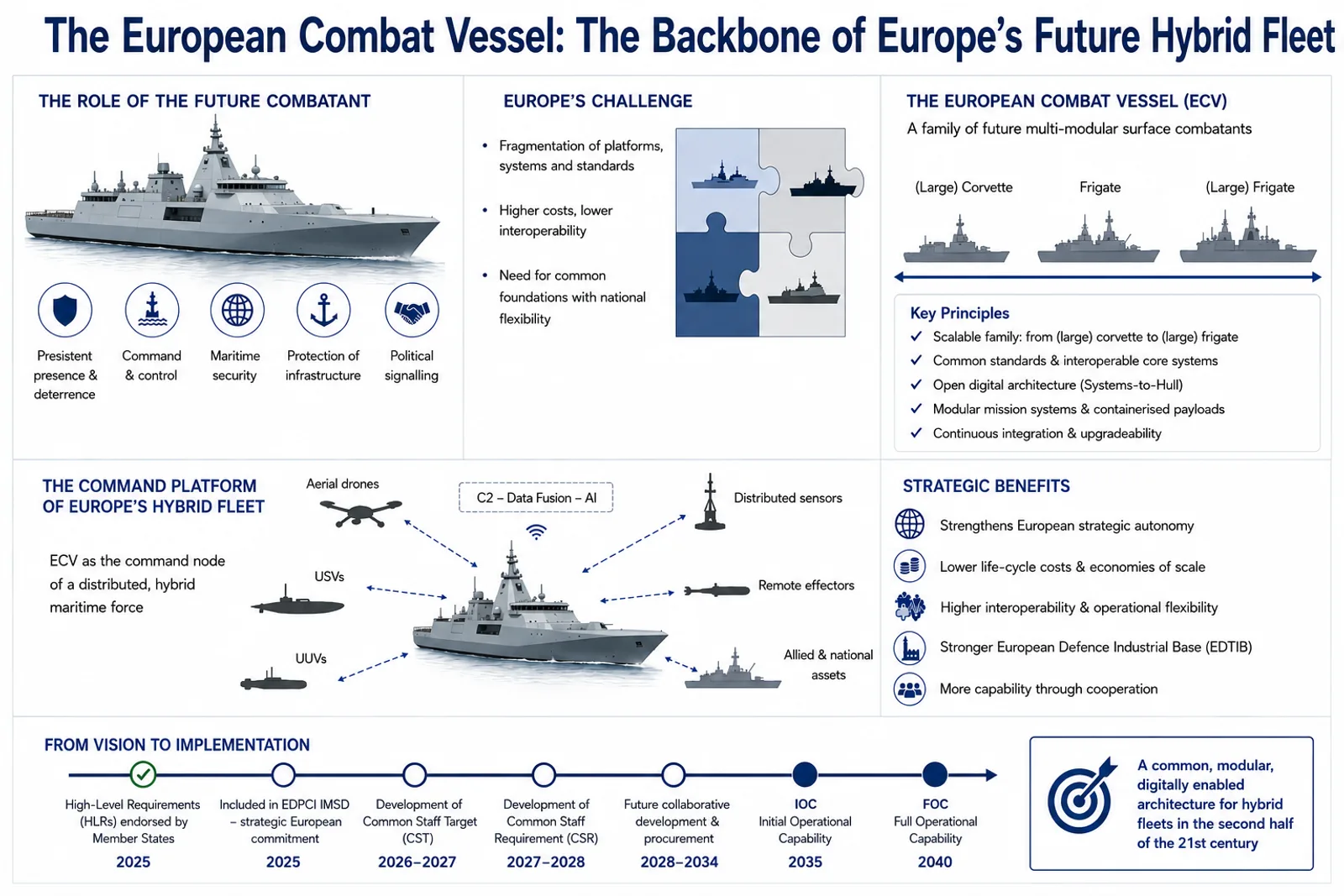
The future combatant will increasingly serve as the command node of a distributed, hybrid force. It will coordinate crewed and uncrewed systems, fuse information from multiple domains into a common operational picture, and orchestrate effects across the maritime battlespace.
Future combat power will no longer reside in a single ship. It will emerge from the performance of the entire network.
Europe’s strategic challenge: From fragmentation to commonality
Alongside this technological revolution, Europe faces a structural challenge. European navies currently operate a wide variety of ship classes, combat management systems, sensors, weapons, and logistics solutions. While this diversity reflects national sovereignty and industrial strengths, it also creates unnecessary duplication, higher life-cycle costs, and reduced interoperability.
As defence investment increases across Europe, simply procuring more ships will not be enough. The real challenge is creating common technological foundations that enable nations to retain sovereign choices while benefiting from shared development, interoperability, and economies of scale.
This is precisely the ambition of the European Combat Vessel (ECV).
The European Combat Vessel: A family, not a single ship
The ECV is not intended to become a single European frigate. Instead, it establishes a scalable family of future multi-modular surface combatants – from (large) corvettes to (small) destroyers – built on common standards, interoperable core systems and shared digital architectures, while allowing nations to tailor platforms to their operational needs.
The programme is complemented by PESCO project Essential Elements of European Escorts (4E). While the ECV focuses on the common platform family, 4E develops the shared mission systems, combat systems, digital architecture and enabling technologies. Together, they represent one of Europe’s most ambitious efforts to establish a common naval systems architecture.

From hull-centric design to systems-centric design
Perhaps the most significant innovation is conceptual rather than technological. Instead of integrating systems into an already designed platform, the ECV adopts a genuine systems-to-hull approach, designing the ship around an open digital architecture from the outset.
This enables continuous integration of new sensors, effectors, software, AI and autonomous capabilities throughout the ship’s service life, reducing upgrade costs while preventing technological obsolescence. Standardised mission modules and containerised payloads further enable rapid mission reconfiguration, multinational interoperability and significantly greater operational flexibility.
The command platform of Europe’s hybrid fleet
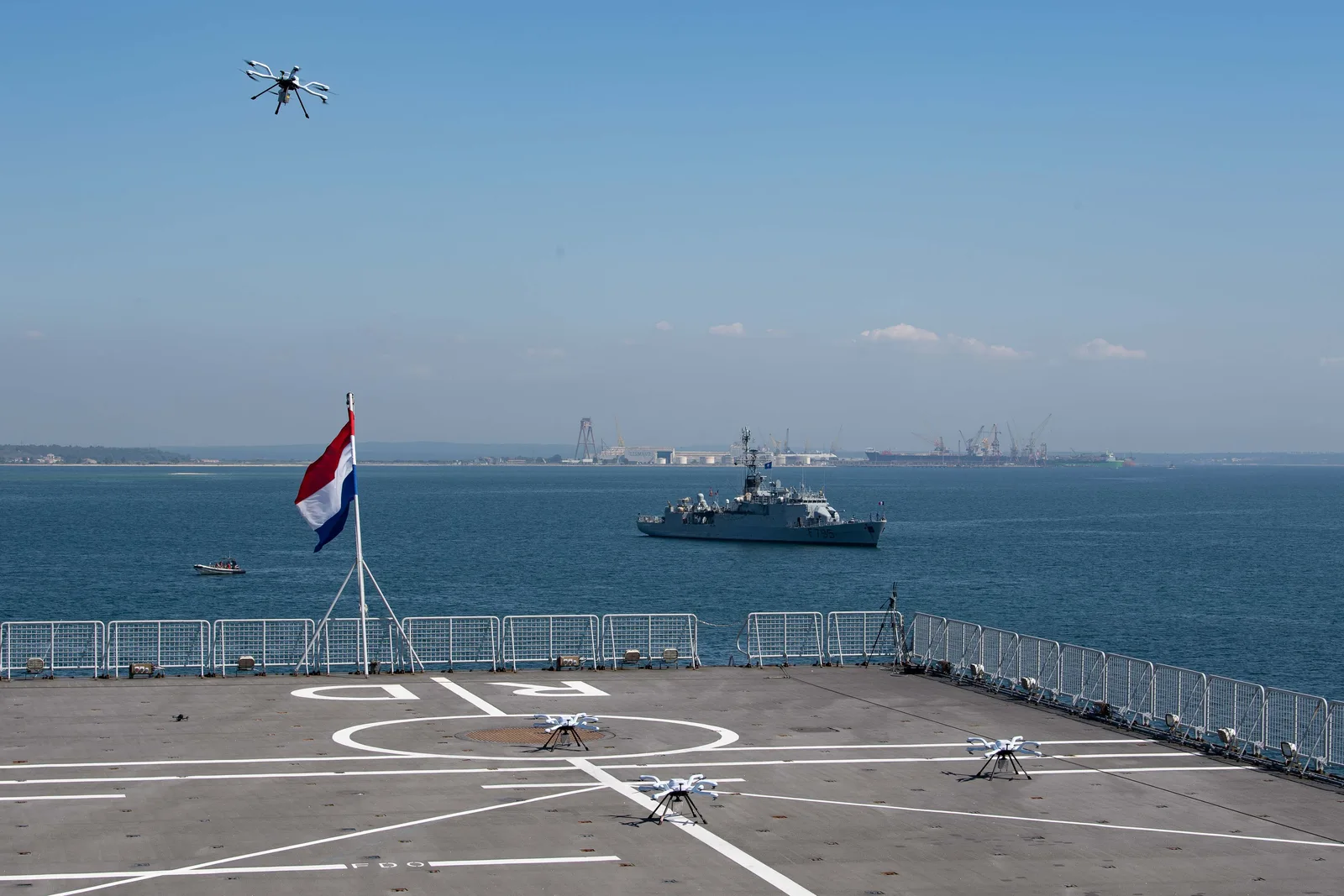
The widespread introduction of autonomous systems fundamentally changes the operational role of the surface combatant. The ECV is therefore far more than a ship capable of embarking drones. It is conceived as the command platform of a distributed hybrid fleet.
Autonomous surface vessels, uncrewed underwater vehicles, aerial drones, distributed sensors, and remote effectors will all operate as part of an integrated force directed by the ECV. Rather than concentrating combat power within a single platform, the ECV becomes the central command node of a distributed maritime combat network.
Its greatest strength will no longer be measured solely by the weapons it carries, but by the systems it commands.
Strengthening Europe’s defence industrial base
The strategic significance of the ECV extends well beyond naval capability. By promoting common standards, open architectures, and modular design, the programme creates new opportunities for collaborative European research, development, production, and procurement.
It reduces duplication, enables larger production runs, lowers life-cycle costs, and strengthens the competitiveness of the European Defence Technological and Industrial Base (EDTIB).
The ECV is therefore both a military capability programme and a strategic industrial initiative that reinforces European technological resilience and strategic autonomy while delivering greater value for defence investment.
Looking beyond the platform
The debate should no longer focus on whether Europe still needs surface combatants. The real question is what role these ships must fulfil within an increasingly networked, autonomous, and multi-domain battlespace. The ECV provides a credible European answer.
Combined with the 4E project, it moves beyond the traditional concept of designing individual ships and instead establishes the technological foundation for a future European naval ecosystem – one built on openness, interoperability, modularity, and continuous innovation.
In doing so, the ECV represents more than a new family of warships. It marks a fundamental shift in European naval capability development: from nationally optimised platforms towards a common, modular, digitally enabled architecture capable of supporting hybrid fleets throughout the second half of the 21st century.
Ultimately, the ECV demonstrates that European cooperation is not merely about sharing costs. It is about multiplying capability, accelerating innovation, strengthening strategic autonomy, and ensuring that Europe retains credible maritime power in an increasingly contested world.

From vision to implementation
The ECV is no longer merely a vision – it is becoming a concrete European capability programme. With the recent endorsement of the high-level requirements (HLRs) by the participating member states, the initiative has completed its first major milestone and entered the capability definition phase.
The ECV is also included in the proposed European Defence Project of Common Interest – Integrated Maritime and Seabed Defence (EDPCI IMSD), underlining its strategic importance within Europe’s collaborative maritime capability development.
Building on this momentum, the European Defence Agency (EDA) and the participating Member States have launched the development of the Common Staff Target (CST) and the Common Staff Requirement (CSR). These activities will translate the agreed strategic vision into harmonised operational requirements, laying the foundation for future collaborative development and procurement.
More broadly, the ECV illustrates a new model of European defence cooperation, linking common military requirements, industrial collaboration and long-term capability development within a single coherent framework. It demonstrates how European cooperation can simultaneously strengthen operational readiness and the competitiveness of the European Defence Technological and Industrial Base, paving the way for the next generation of interoperable European surface combatants.
Share post