A recent dangerous and reckless Russian interception of a British RC-135W SIGINT aircraft over the Black Sea was not an isolated incident but part of a pattern of Russia increasingly exploiting grey zone operations against the NATO allies.


A recent dangerous and reckless Russian interception of a British RC-135W SIGINT aircraft over the Black Sea was not an isolated incident but part of a pattern of Russia increasingly exploiting grey zone operations against the NATO allies.

Submarines of the Russian Federation Navy have long used the so-called ‘Crazy Ivan’ as an evasive manoeuvre, or to clear a boat’s acoustic blind spot (known as the ‘baffles’) and detect enemy submarines attempting to ‘tail’ them. A ‘Crazy Ivan’ is a sudden, unpredictable hard turn through up to 180° and was made famous in Tom Clancy’s novel The Hunt for Red October.
It now seems that the Russian Air and Space Forces (VKS) are doing something similar to intimidate intercepted NATO intelligence, surveillance and reconnaissance (ISR) platforms, pulling up close in front of a NATO aircraft or turning hard across its nose. This is known as ‘thumping’.
In an incident made public by the UK Ministry of Defence on 20 May 2026, a Royal Air Force (RAF) RC-135W Rivet Joint signals intelligence (SIGINT) aircraft of No 51 Squadron, flying in international airspace over the Black Sea, was intercepted the previous month by a pair of Russian fighters: one a Sukhoi Su-35 (appropriately painted as Bort Red 51) and the other an Su-27SM3 (Bort Blue 19).


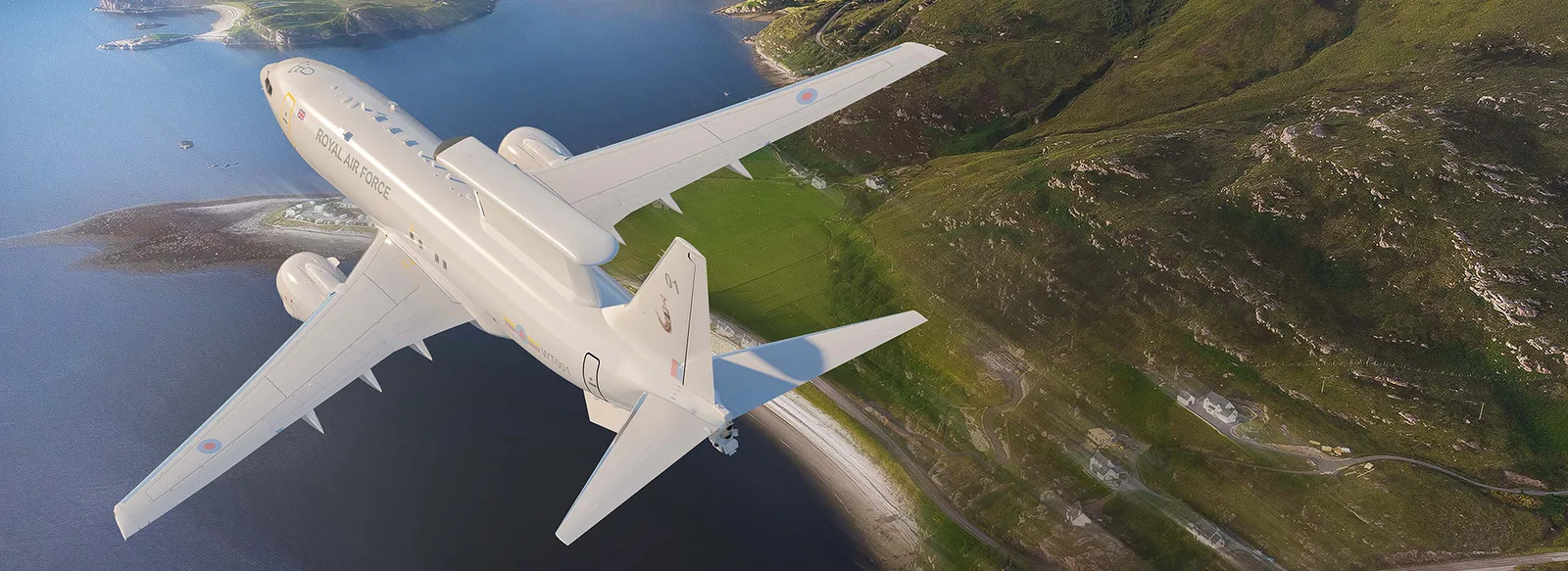
The RAF’s Rivet Joint is a key SIGINT platform and provides vital situational awareness to UK and NATO commanders, contributing to NATO’s collective deterrence posture and the security and stability of the Euro-Atlantic region. The aircraft carry a crew of up to 30 specialist operators, who gather electronic and communications intelligence to help maintain a clear understanding of activity across the battlespace. The Rivet Joints routinely operate in international airspace, in full accordance with international law, flying along the borders of the Russian Federation but never crossing them.
The RAF’s No 51 Squadron (and No 192 Squadron before it) has a longstanding history of conducting such missions safely, professionally and transparently – often alongside allies. These operations are entirely defensive in nature and form a critical part of NATO’s mission to preserve freedom of navigation and overflight, but they frequently attract the unwanted attention of hostile fighters.
In September 2022 a Russian aircraft launched a missile in the vicinity of an RAF Rivet Joint operating over the Black Sea. At the time the UK government did not challenge a Russian claim that the incident had been caused by a “technical malfunction”. It subsequently emerged that a Russian pilot had tried to shoot down the RAF aircraft, believing that he had permission to fire. The first missile fired missed (rather than malfunctioning, as was claimed at the time).
Intercepted communications reportedly showed that the Russian pilots received an ambiguous command from a Russian ground control station and that the second Russian pilot remonstrated with and swore at his wingman when he fired the first missile because he did not think they had been given permission to fire. The weapon successfully launched but failed to lock on to its target, while a second missile fell from the wing – suggesting that the weapon had either malfunctioned or that the launch was aborted.
This time, the two Russian fighters approached far too close to the Rivet Joint – within 6 m – and both crossed close in front of the RAF aircraft’s nose.


“This incident is another example of dangerous and unacceptable behaviour by Russian pilots towards an unarmed aircraft operating in international airspace,” stated UK Defence Secretary John Healey soon afterwards. “These actions create a serious risk of accidents and potential escalation. Let me be clear: this will not deter the UK’s commitment to defend NATO, our allies and our interests.”
Air Chief Marshal Sir Harv Smyth, the Chief of the Air Staff, added, “This incident highlights the challenging operating environment in which our crews routinely operate and the reckless and unprofessional airmanship of the Russian Air Force. Despite interference, RAF personnel maintained control, upheld safety and continued to deliver the task in support of NATO.”
Although the UK changed its legal position in January 2026, allowing it to board and detain sanctioned Russian ships, no such boardings have been undertaken, with some believing that Russia has been emboldened as a result. Sweden, France and Belgium have all seized Russian ‘Shadow Fleet’ vessels.
During April and May 2026 the Russian frigate Admiral Grigorovich, was leading a Russian naval detachment off the British coast. The lead ship in a class of six Project 11356P frigates and armed with Kalibr-NK cruise and Shtil-1 surface-to-air missiles, Admiral Grigorovich was supported by the Amur-class repair ship PM-82, the Ropucha-class landing ship Aleksandr Shabalin and the ‘Kilo’-class submarine Krasnodar. Claiming to be defending Russian ships from piracy, the Russian flotilla was escorting sanctioned tankers as they transited through the Channel. At one point the frigate paused to take on fuel and supplies near key UK national infrastructure, including the Galloper wind farm off the Suffolk coast.
Doing this openly in proximity to UK national infrastructure was provocative, since it entails environmental risks from ship-to-ship fuel transfers.
Admiral Grigorovich was “constantly monitored” throughout April, according to the Royal Navy, including by the River-class offshore patrol vessels (OPVs) HMS Tyne, HMS Mersey and HMS Severn, the Tide-class fleet replenishment tanker RFA Tideforce and Wildcat helicopters from No 815 Naval Air Squadron.


A second Russian frigate, Admiral Kasatonov, escorted more merchant ships through the Channel in early April 2026, while separately the Type 23 frigate HMS Somerset intercepted Russian Udaloy-class destroyer Severomorsk and its accompanying oiler, Kama, off the coast of Brittany on 31 March 2026.
At least 14 sanctioned Russian tankers sailed through the Channel while accompanied by Russian naval vessels during a two-month period with no ships being seized. The situation demonstrated the difficulty of sanctions enforcement and maritime interdiction without unnecessarily escalating tensions. Some experts interpreted the Russian operation as a brazen attempt by Russian President Vladimir Putin to call the UK’s bluff or to demonstrate its impotence.
First Sea Lord General Sir Gwyn Jenkins, the head of the Royal Navy, noted that NATO needed the “collective combat power necessary” to deter Moscow at sea, or it would otherwise risk a direct military confrontation.
On 21 May 2026 an Dassault Envoy IV CC1 (Dassault Falcon 900LX) VIP aircraft carrying Healey encountered GPS jamming and spoofing while the defence secretary was returning from Tallinn, Estonia. Onboard internet and connectivity for laptops and smartphones were also disabled. It is unclear as to whether Healey’s aircraft was intentionally targeted or was disrupted as part of wider and less specific Russian electronic warfare interference. Whichever is the case, that day saw at least 160 commercial flights operating in the area report similar GPS spoofing and/or jamming, including services operated by British Airways, Jet2 and EasyJet.