
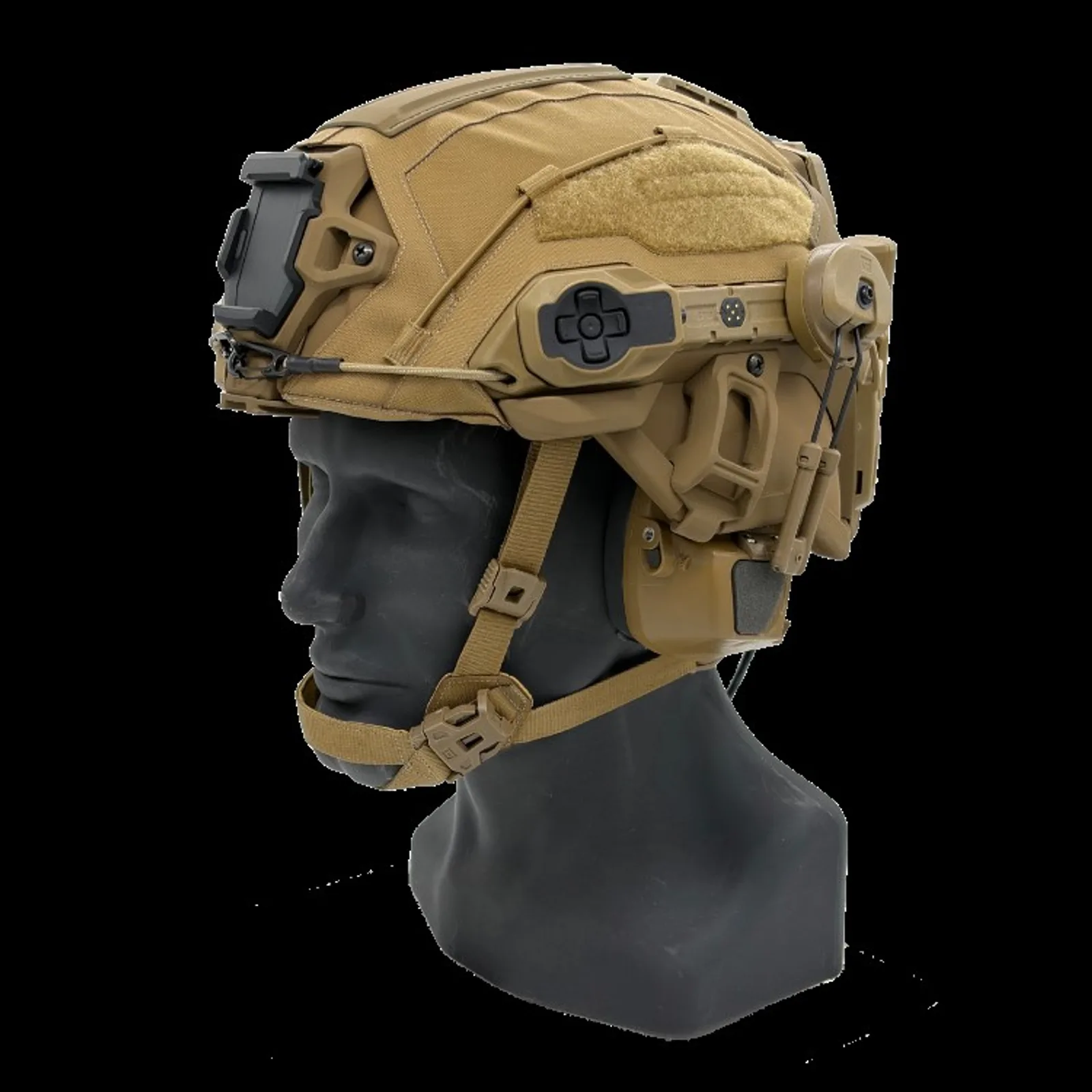
Helmet, power and data management solutions provider Galvion showcased a new Cortex EVO HALO integration concept for the US Army’s in-service Next-Generation Integrated Head Protection System (NG-IHPS) at the AUSA 2026 exhibition, held in Washington, DC, on 12 to 14 October.
Cortex EVO is a deeply integrated architecture that combines protection, power, data and computational capabilities within a unified headborne system, while the EVO HALO configuration provides a flexible implementation pathway that can be delivered as part of new helmet systems or integrated onto fielded helmets through upgrade and modernisation programmes.
The NG-IHPS concept marks the latest evolution of Galvion’s Cortex EVO architecture and the first time EVO HALO has been integrated onto a non-Galvion helmet.
Applying EVO HALO to NG-IHPS illustrates how advanced headborne capabilities could be introduced to the US Army’s fielded NG-IHPS inventory while continuing to leverage the existing protective platform. The approach provides a potential upgrade path as soldier-worn technologies and operational requirements continue to evolve.
The Galvion integration platform concept
Explaining the overall concept, Jonathan Andree, technical director for advanced capabilities at Galvion, told Warsight at AUSA 2026 on 12 October, “A lot of people are trying to get AR [augmented reality] data into the eye, so what we’ve done is we went back to our design team and said, ‘Now that you know everything we’re trying to get on the helmet [such as night vision goggles for example], start fresh. How would you design a new helmet?’ And what they came up with was this. They flipped the helmet inside out; they put ballistic material on the inside, with the carbon fibre shell on the outside, and then standing in between is electronics that are in here and cable links; it’s all within the helmet.”
EVO HALO, meanwhile, is a cover [helmet] system that takes the electronics “and puts it into something that can be retrofitted to an existing helmet”, explained Andree. “We have it with different helmet shapes, including the IHPS,” Andree added.
Embedding the cabling and electronic connections within the helmet thus minimises any cabling on its outside, protecting the electronic connections and preventing any cabling getting snagged during operations in the field.
“So really, we think that this is no longer a helmet,” said Andree, pointing to one of Galvion’s Caiman systems featuring the technology. “It’s really an integration platform.”
Quoted in a Galvion press release, Jonathan Blanshay, founder and executive chairman of Galvion, stated, “Modernisation doesn’t always have to mean replacing proven equipment. Embedded EVO shows what is possible when integration begins at the helmet design stage, while HALO provides another pathway for helmet systems already in service. By integrating EVO HALO onto NG-IHPS, we’re showing how an existing protective platform could evolve to support new capabilities as requirements and technologies advance, while preserving the investment already in place.”









