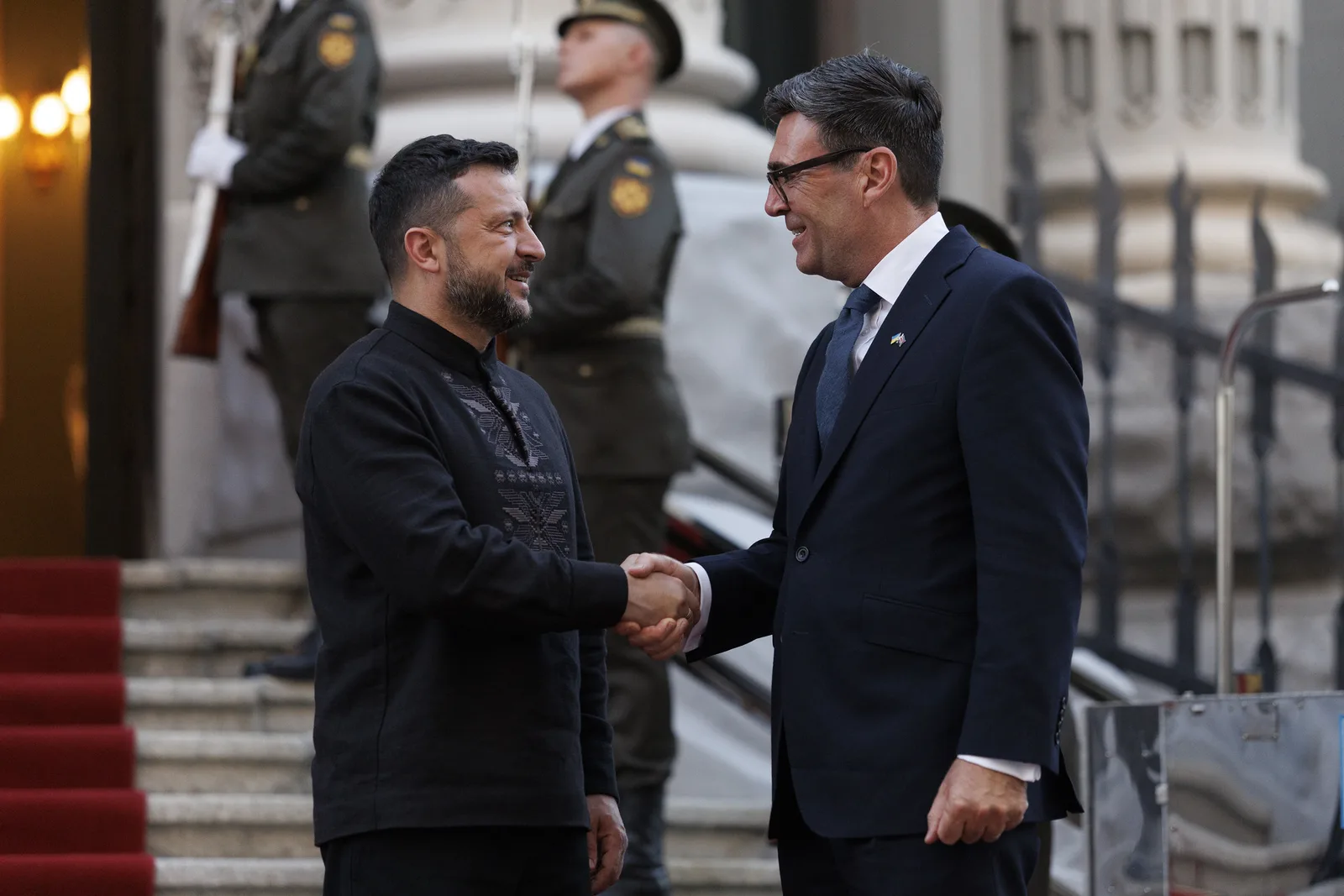
Ukraine is to be granted a licence to manufacture Patriot air defence missiles, according to a statement made by US President Donald Trump stated at the NATO Summit in Ankara.
During a meeting with Ukrainian President Volodymyr Zelenskyy in Ankara on 8 July 2026, Trump stated, “We’re going to give a licence to you to make Patriots. That’s pretty cool. This way, you can’t complain that we’re not giving ’em enough.”
While the prospect of the Trump Administration granting Ukraine a Patriot licenced production agreement is clearly a welcome one, even if such a deal is signed imminently it will take years before Patriot interceptors will be produced as a result – at a time when Ukrainian air defenders are running critically short of them. The Patriot system is the only air defence weapon Ukraine has that is effective in shooting down Russian ballistic missiles such as the air-launched Kh-47M2 Kinzhal. Early on 6 July, for example, Russia launched 351 drones and 68 missiles at Ukraine, targeting mainly Kyiv, according to the Ukrainian Air Force. Among these weapons, all 29 ballistic missiles struck their targets.
In the wake of that attack Ukrainian Defence Minister Mykhailo Fedorov asserted on 6 July that Russia is deliberately ramping up its ballistic missile attacks on the country to capitalise on a critical shortage of Patriot missiles.
“The world builds fewer of these missiles per month than Russia fires at Ukraine in that same time,” said Fedorov, adding that, although Ukraine has secured future deliveries of Patriot rounds, these will not arrive until 2027. Fedorov is therefore negotiating with his European counterparts to secure more immediate Patriot deliveries.
“We have already secured contracts for Patriot missiles, with deliveries starting next year,” he stated. “Our request to partners is to transfer missiles from their current inventory now, which we will replace with our upcoming deliveries,” he explained, adding that he was urging Kyiv’s allies to temporarily transfer Patriot interceptors to Ukraine to save civilian lives.
Meanwhile, any Ukrainian licensed production of Patriot interceptors could be at least three years away, judging from the timelines at COMLOG: the joint venture between US company Raytheon and MBDA Deutschland. Initially founded in 1987 to provide logistic and maintenance support for Patriot missiles in Europe, COMLOG was in January 2024 awarded a new-build contract to produce Patriot Advanced Capability 2 Guidance Enhanced Missile (PAC-2 GEM-T) rounds by the NATO Support and Procurement Agency (NSPA). Awarded under the European Sky Shield Initiative, this contract was valued at up to USD 5.6 billion and could see the production of up to 1,000 PAC-2 GEM-T missiles if all options are exercised. It was put in place to meet the increasing demand for Patriot interceptors in Europe in the wake of Russia’s February 2022 invasion of Ukraine and hostilities in the Middle East following the October 2023 attack on Israel by Hamas.
However, COMLOG’s new missile manufacturing facility in Schrobenhausen, Germany, is not set to begin operations until September 2026, with the first completed GEM-T rounds expected to roll off the assembly line some time in 2027.
The only other licensed producer of Patriot systems and their missiles outside the United States is Mitsubishi Heavy Industries (MHI), which in November 2025 delivered the first batch of domestically produced PAC-3 interceptors to the United States to help replenish US stocks following US missile transfer to Ukraine.
Meanwhile, it will be interesting to see where any Ukrainian licensed production of Patriot rounds is based, as a major production facility in Ukraine itself would be a magnet for Russian drone and missile strikes.
Warsight has approached RTX/Raytheon for comment on Trump’s announced plans of Ukrainian licensed manufacture of Patriot interceptors.
Patriot’s growth in capability
The MIM-104 Patriot air defence system was originally developed by Raytheon (now part of RTX) and first deployed in late 1984. Since then, however, both the system and the missile rounds it fires have been successively upgraded, especially to afford the system an effective anti-ballistic missile capability well beyond its original anti-aircraft remit.
The focus on giving the Patriot system a more effective anti-ballistic missile capability came in the aftermath of the 1991 Gulf War, when it was determined that Patriot interceptions of Iraqi ‘Scud’ missiles fired at Saudi Arabia and Israel had been much less successful than first thought. This led to the development of the PAC-2 GEM-T missile and ultimately the PAC-3 Missile Segment Enhancement (MSE) hit-to-kill kinetic interceptor.
For current Patriot production in the US, Raytheon produces all the ground-based infrastructure – including the system’s AN/MPQ-53 (PAC-2) and AN/MPQ-65 (PAC-3) radars, engagement control stations and launchers – as well as the PAC-2 GEM-T missile. Lockheed Martin, meanwhile, developed the system’s PAC-3 CRI hit-to-kill interceptor and currently produces the PAC-3 MSE interceptor.