Boeing unveils a larger, more capable Ghost Bat

Among the highlights of the 2026 ILA Berlin Air Show was the unveiling of a Block 3 MQ-28 Ghost Bat collaborative combat aircraft by Boeing and Rheinmetall.

Block 3 MQ-28 Ghost Bat
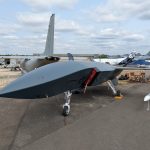
Boeing and Rheinmetall unveiled the Block 3 MQ-28 Ghost Bat at the ILA Berlin Air Show on 10 June 2026. (Boeing)
Jon Lake

On 10 June 2026 at the ILA Berlin Air Show Boeing and Rheinmetall unveiled the Block 3 MQ-28 Ghost Bat: already viewed by many as being the most mature and most operationally suitable collaborative combat aircraft (CCA) seen so far.

The MQ-28 Ghost Bat has a longer range than many of its competitors and in Block 3 form will have internal weapons carriage, maintaining its low radar cross-section (RCS) and making it harder for enemy radar to detect and thus better able to operate in highly contested environments.

Brad Thompson, the director of Boeing’s Phantom Works Australia prototyping arm, observed, “The combination of a highly capable platform, stealth features and advanced autonomy will provide an unprecedented ability for air forces to extend their mission effectiveness and operational flexibility.”

The MQ-28 has already demonstrated a successful AIM-120 Advanced Medium Range Air-to-Air Missile (AMRAAM) firing and the Royal Australian Air Force (RAAF) has demonstrated the Ghost Bat’s ability to engage an aerial target while under the control of an E-7 Wedgetail airborne early warning and control (AEW&C) aircraft.

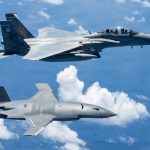
An MQ-28A preparing to conduct a first live AIM-120 AMRAAM firing, which occurred on 8 December 2025. (Boeing)
The MQ-28A conducted a first live AIM-120 AMRAAM firing on 8 December 2025. The MQ-28 was acting as a loyal wingman to an F/A-18F Super Hornet, with both aircraft being controlled by an RAAF E-7 Wedgetail AEW&C aircraft. This was the first time that an unmanned aircraft had fired an AIM-120 AMRAAM. (Boeing)

The new Block 3 variant of the MQ-28 has extended operational capabilities, enhancing the type’s flexibility, range and capability. The Block 3 has a 25% larger, increased-span wing, allowing it to carry 2,000 lb (907 kg) more payload, thus taking its maximum take-off weight (MTOW from 10,000 lb to 12,000 lb and its maximum payload up to 4,500 lb (2,041 kg).

“That additional capacity gives operators freedom to balance payload and endurance to configure for the mission at hand, whether that means carrying extra fuel for longer-range operations, increasing weapons carriage, or any combination of both,” noted Glen Ferguson, the MQ-28’s global programme director.

The new variant has the ability to carry a pair of AIM-120 missiles or four Small Diameter Bombs internally and has the option for three external weapon stations if required. ­

The MQ-28 Block 3, with its greater capacity and lethality, thus offers more punch and extended combat reach.

The Block 3 MQ-28 has large payload bays on the fuselage sides. They are seen here partially cracked open and can accommodate the AIM-120 AMRAAM and the SDB/SDB II. (Boeing)

The aircraft has a number of new features, developed in partnership with the RAAF, and the platform will be further enhanced under the MQ-28 technology roadmap. It has been said that these features will be progressively released to the fleet through a spiral upgrade programme and will be available to interested allied countries.

Rheinmetall is partnering with Boeing to offer the Block 3 MQ-28 to the German armed forces and the potentially lucrative wider European CCA market.

“The advanced maturity of the MQ-28 systems is what allows us to continually adapt to the changing operational environment and minimise the risk as we transition to operations,” stated Amy List, the vice president and managing director of Boeing Defence Australia. “Combined with the MQ-28’s confirmed low observability characteristics and survivability upgrades, these capability enhancements support more flexible mission concepts and further allow defence customers to distribute operational risk.”

­The Block 3 MQ-28 features an upgraded modular, missionised nose that provides enhanced payload configuration options and supports the insertion of third-party capabilities.

The new Ghost Bat also introduces beyond-line-of-sight communication links, enabling the MQ-28 to operate from a crewed aircraft, ground station or naval vessel at unlimited stand-off distances, increasing command-and-control (C2) flexibility. It may also give greater resilience in harsh electronic warfare combat environments.

“Inclusion of features such as BLOS capability are a direct result of our learnings to date along with feedback from air forces as they understand more about the role and integration of CCAs into joint force operations,” explained Ferguson.

The Block 3 Ghost Bat also features what Boeing calls “significant software development upgrades compliant with government reference architecture”: an open standard architecture that enables operators to integrate indigenous weapons and payloads, and to tailor C2 and mission autonomy to suit national operational requirements.

These upgrades “improve interchangeability and interoperability with Boeing and non-Boeing platforms for allied forces and give operators a highly configurable, mission-adaptable solution that can be tailored to meet their sovereign operational needs,” said List.

Eight pre-production Block 1 MQ-28s are being operated in Australia and an initial nine Block 2 aircraft are now in production. These will provide an initial operational capability that will be expanded when the Block 3 arrives.

Three early Block 1 MQ-28s at the RAAF Woomera Test Range Complex. The aircraft has also been operated from RAAF Base Tindal. (Boeing)

Ferguson noted that the MQ-28 programme is “on point to build our first Block 3 aircraft next year”.

The MQ-28 is expected to be in service with the RAAF in 2028, which would make it “the first operational CCA anywhere in the world”, according to Boeing.

In March 2026, when Boeing and Rheinmetall announced their strategic partnership, it was announced that the MQ-28 could be provided to the German armed forces by 2029, subject to a contract being signed by 2027.

The Block 1 and Block 2 variants have already undertaken more than 150 test sorties in Australia and the United States and the type is now undertaking test flights from Naval Base Ventura County at Point Mugu, California: home to the Naval Air Warfare Center’s Weapons Division and large numbers of unmanned aerial target systems.

One likely role for the MQ-28 will be escorting high-value assets like the E-7A Wedgetail AEW&C aircraft. (Boeing)

Share post

You may be interested in

Categories

All NewsAir

Used tags

AIM-120 AMRAAMBoeingcollaborative combat aircraft (CCA)MQ-28 Ghost BatRheinmetallRoyal Australian Air Force (RAAF)
Ad

Similar posts