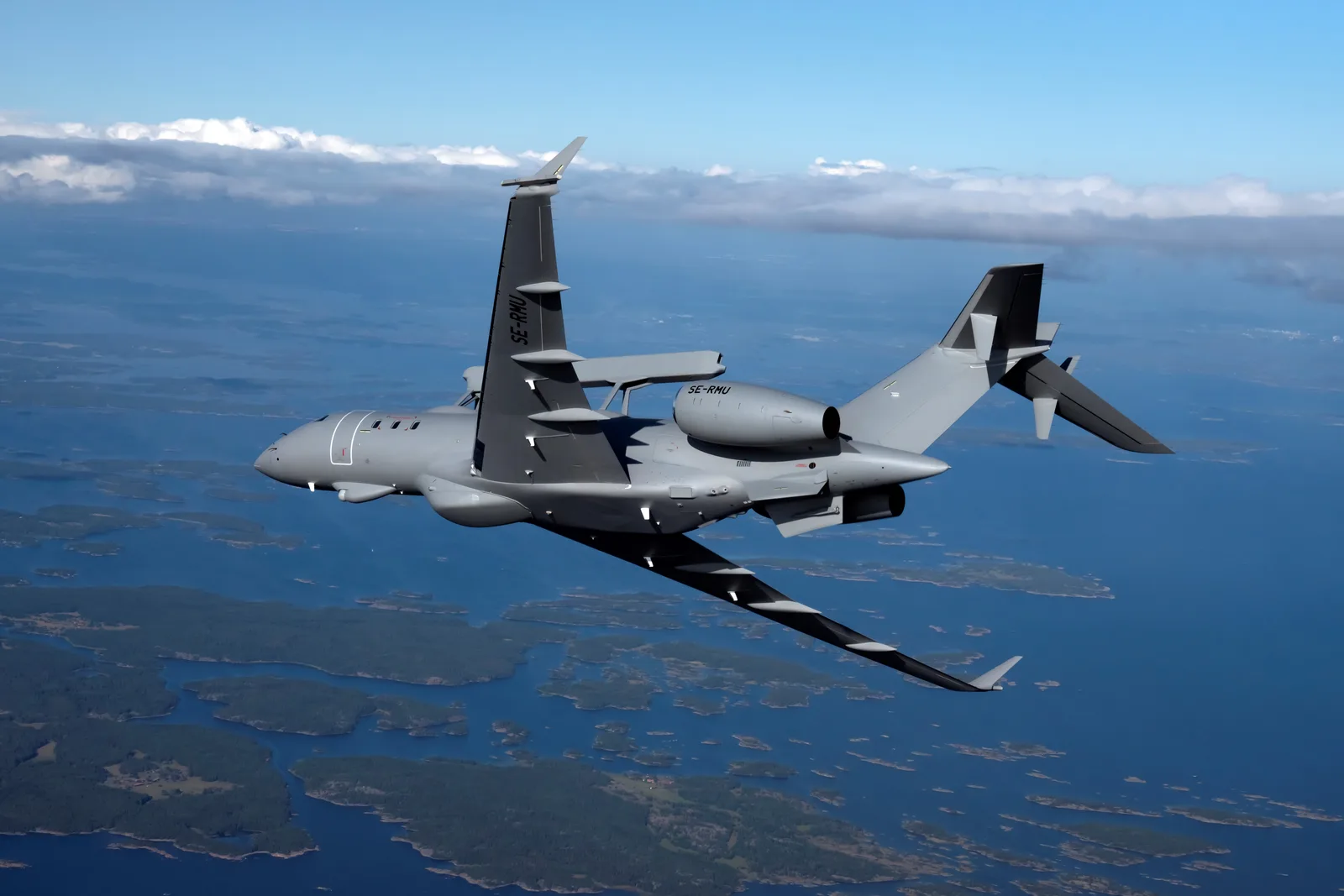
Canada is to become the fourth country to operate the Saab GlobalEye AEW&C platform.


Saab signs MoUs to expand its engagement in the space domain
Saab announced on 24 September…

Canada is to become the fourth country to operate the Saab GlobalEye AEW&C platform.

The Canadian government has selected Saab’s GlobalEye platform as the preferred solution to its airborne early warning and control (AEW&C) requirement and has entered into detailed discussions and formal negotiations with the Swedish company to firm up a contract.
The announcement was made on 27 May 2026 by Canadian Prime Minister Mark Carney as he attended the country’s CANSEC defence and security and trade show in Ottawa. The number of platforms to be procured was not mentioned, but the Royal Canadian Air Force (RCAF) has publicly stated its intention to procure between six and eight AEW&C platforms.
While US companies Boeing and L3 Harris had competed for the Canadian AEW&C requirement with the E-7 Wedgetail and Aeris X platforms respectively, Canada’s currently strained political relationship with the US Trump Administration was always going to be a factor in the procurement, despite the Aeris X – like GlobalEye – being based on the Global 6500 business jet platform, which is manufactured by Canada’s Bombardier at its facilities in Toronto.
Saab has also pitched its Gripen E/F fighter to Canada, given that Ottawa’s January 2023 agreement to buy 88 F-35A Joint Strike Fighters from US company Lockheed Martin is being reviewed in light of trade tensions with the Trump Administration.
Canada is to become the fourth country to operate the GlobalEye platform after the United Arab Emirates (five in service), Sweden (three on order) and France (two on order). A number of other countries are considering a GlobalEye purchase, as is NATO, after it decided in November 2025 to follow the US Air Force in cancelling its order for E-7 Wedgetails.
Saab stated in a press release on 27 May that it “has offered to build, maintain and upgrade the Canadian GlobalEyes with a team of Canadian partners”, adding that the goal “is to transfer knowledge and technology to Canada that will grow the domestic defence industry”.
Asked by Warsight to elaborate on the technology transfer intended, a Saab spokesperson stated, “In addition to Bombardier, Saab also has a strong partnership with CAE. Saab and CAE have an established Global Cooperation Agreement on the GlobalEye platform for training and simulation, which as we announced on 27 May is to be expanded to include Canada’s needs.
“Saab has also signed an agreement with Cohere for advance AI collaboration,” the spokesperson added. “In addition Saab, Ericsson Canada and Calian have signed a memorandum of understanding to explore opportunities for collaboration in advanced, secure and resilient communication systems.
“Saab has been actively in discussion with other potential partners and we will have more information to provide on this in the coming weeks and months.”
A press release by the Canadian prime minister’s office the same day stated that the Canadian GlobalEye programme “is projected to support 3,000 jobs in the Canadian aerospace and defence sector” and that “no less than one third of the projected fleet of GlobalEye aircraft will be manufactured in Canada over the next 15 years”, asserting that this “means at least 40 aircraft, including orders from Allies, built by Canadian workers”.
Saab’s GlobalEye multi-role AEW&C platform, which can comfortably offer a mission endurance of more than 12 hours, features a dorsally mounted Saab Erieye ER (Extended Range) S-band active electronically scanned-array (AESA) radar as its main sensor. Saab has stated that the Erieye radar has an instrumented range “well above 650 km” and that its multi-domain performance allows it to pick up air threats from ballistic missiles to relatively small drones as well as maritime targets down to jet-ski size.
GlobalEye also has a Leonardo Seaspray 7500E maritime surveillance radar mounted on the underside of the fuselage, an opto-electronic/infrared sensor housed in a stabilised turret beneath the forward fuselage, a suite of electronic support measures (ESM)/electronic intelligence (ELINT) systems, an Automatic Identification System (AIS) to track and identify shipping, IFF and ADS-B transponders to distinguish between friendly and potentially hostile aircraft, and a self-protection suite of laser and radar warning receivers, missile approach warners and integrated countermeasures systems.