Swarm autonomy and GNSS-denied navigation
A central theme at the SAHA 2026 exhibition was the development of systems capable of operating in highly contested environments where satellite navigation is often unreliable. Prior to their public debut, on April 17, 2026, Baykar’s K2 one-way attack (OWA) unmanned aerial vehicle (UAV) and Sivrisinek loitering munition were demonstrated at the Keşan Flight Training and Test Center in a coordinated swarm scenario.
During the test, five K2 UAVs launched in quick succession and performed formation flights in multiple configurations. These were joined by ten Sivrisinek loitering munitions, forming a mixed swarm supported by larger medium-altitude long-endurance (MALE) UAVs such as Bayraktar TB2, TB3, and Akinci, which monitored the operation from the air.
The demonstration highlighted AI-supported visual navigation, allowing the platforms to operate independently of global navigation satellite system (GNSS) signals. Both systems also showcased automatic target detection and autonomous strike capability, with Sivrisinek units conducting coordinated dives on designated targets, followed by a K2 executing a high-speed attack profile.
Expanding the loitering munition family
Shown at SAHA, the Sivrisinek (ENG: ‘Mosquito’), developed by Baykar, is positioned as a next-generation loitering munition designed for long-range and high-autonomy operations. It is capable of maintaining communication within a swarm and sharing detected targets in real time. The system is designed to function even in GNSS-denied environments through visual positioning and artificial intelligence (AI)-supported navigation.
According to published specifications, Sivrisinek offers an operational range of up to 1,000 km, with endurance exceeding 9 hours depending on configuration. It carries a 20 kg warhead and is launched via a catapult, and so does not require runway infrastructure.
For heavier strike roles, Baykar’s Mizrak introduces a larger and more flexible loitering munition. The platform can be configured with a 40 kg dual-warhead for maximum destructive effect; or a 20 kg warhead combined with a radio frequency (RF) seeker for improved precision against emitters such as radars. In addition to strike capability, Mizrak supports reconnaissance missions through interchangeable optronic payloads.
Mizrak is designed for both runway operations and rocket-assisted take-off (RATO), enabling deployment from limited or unprepared areas. The munition has a stated >1,000 km operational range and >7 hours of endurance, as well as a >80 km line of sight (LoS) communications range.
Deep-strike capability with runway-independent launch
The exhibition also featured systems geared toward on long-range strike missions. The Kuzgun, unveiled by STM, is a fixed-wing OWA UAV designed for strikes at operational depths. Weighing approximately 200 kg, it offers a range of >1,000 km and an endurance of > 6 hours. The munition is intended to target critical assets such as command centres, radar systems, and air defence units.
Kuzgun is designed to operate without runway infrastructure, using RATO from mobile platforms or fixed launchers. It incorporates a jamming-resistant navigation system and is capable of fully autonomous flight along predefined routes.
A compact ISR solution
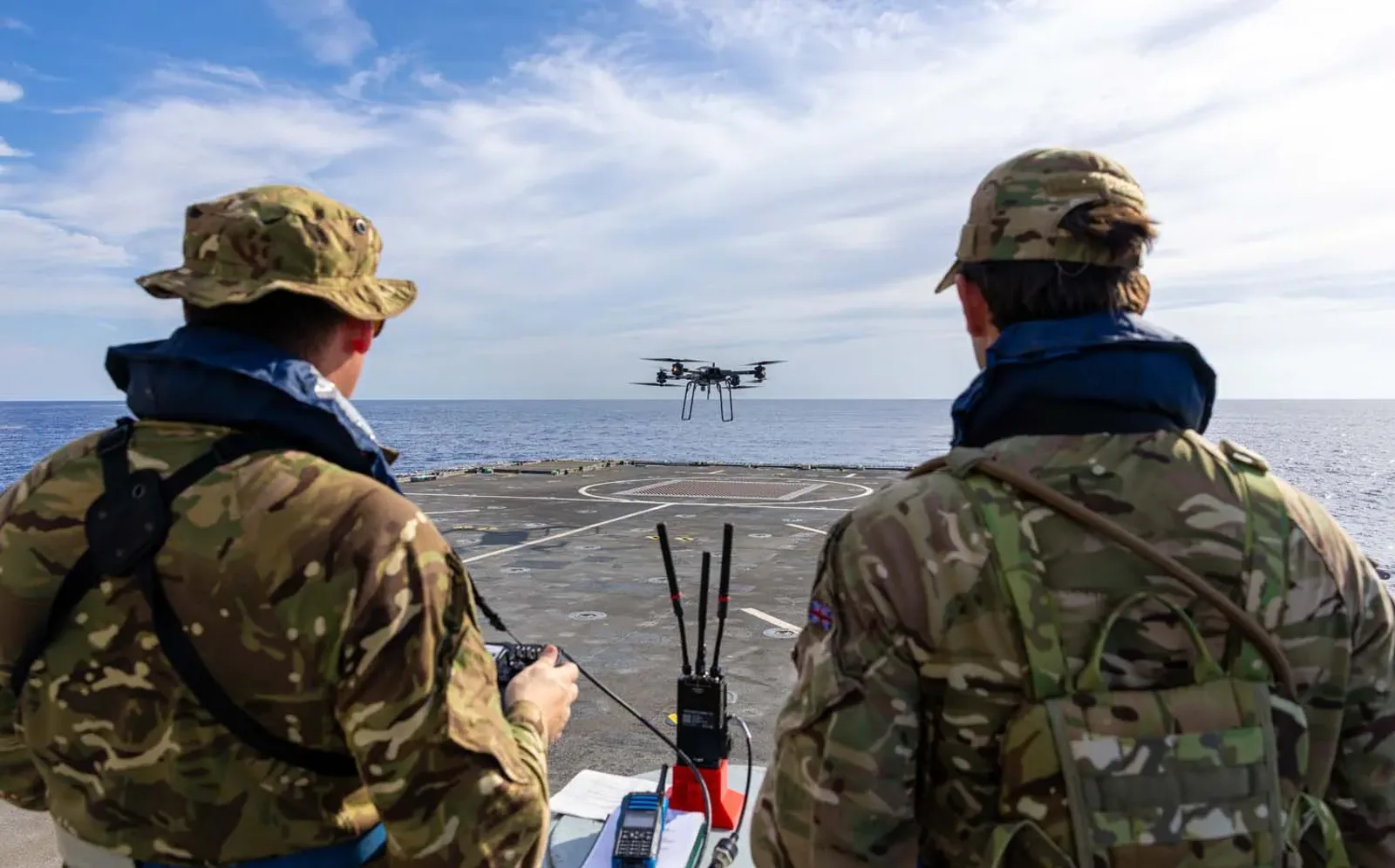
In addition to strike-oriented systems, STM also introduced the Togan-M Mini reconnaissance and surveillance UAV, the smallest member of its tactical UAV family. Weighing under 2.5 kg, Togan-M is a foldable quadcopter design aimed at rapid deployment in both military and civilian scenarios.
The system is equipped with a 4K day camera and a thermal imaging system mounted on a 3-axis stabilised gimbal, enabling day and night surveillance capability. It also includes a laser rangefinder with a range of >1,200 m. Designed for operations in contested environments, Togan-M uses a frequency-hopping communication system for resistance against jamming, and can switch to LTE-based communication in case of signal loss.
Togan-M is also purportedly capable of operating in GNSS-denied environments, using an optical flow camera for autonomous takeoff and landing. Technical specifications include 30 minutes endurance, a 6.5 km LoS communication range, and an can fly to a height of 500 m above ground level (AGL) or altitude of 3,000 m over mean sea level (MSL).
Dedicated interceptors for the counter-drone fight
To address the increasing threat posed by hostile OWA UAVs such as Shahed series, STM unveiled the Tunga-X interceptor UAV. In principle, this is fairly similar to recent interceptor drone designs seen coming out of Ukraine.
Tunga-X can be integrated with detection radars to facilitate interception of aerial threats. Once a target is detected, the system is deployed toward the predicted flight path, where it confirms the target using its optronic camera and neutralises it using a proximity-fuzed warhead. The platform uses a quad-rotor and stub wing design, capable of vertical take-off or landing (VTOL), allowing the operator flexibility in its launch site.
Tunga-X’s specifications state a maximum speed of 300 km/h, an endurance of 15 minutes, and a 25 km operational range. Additionally, Tunga- X can abort missions and return safely if engagement is not required, providing a reusable solution during counter-drone operations.