Polish company Huta Stalowa Wola just unveiled their Ratel IFV prototype at MSPO 2026. Here’s what we know so far.


Polish company Huta Stalowa Wola just unveiled their Ratel IFV prototype at MSPO 2026. Here’s what we know so far.
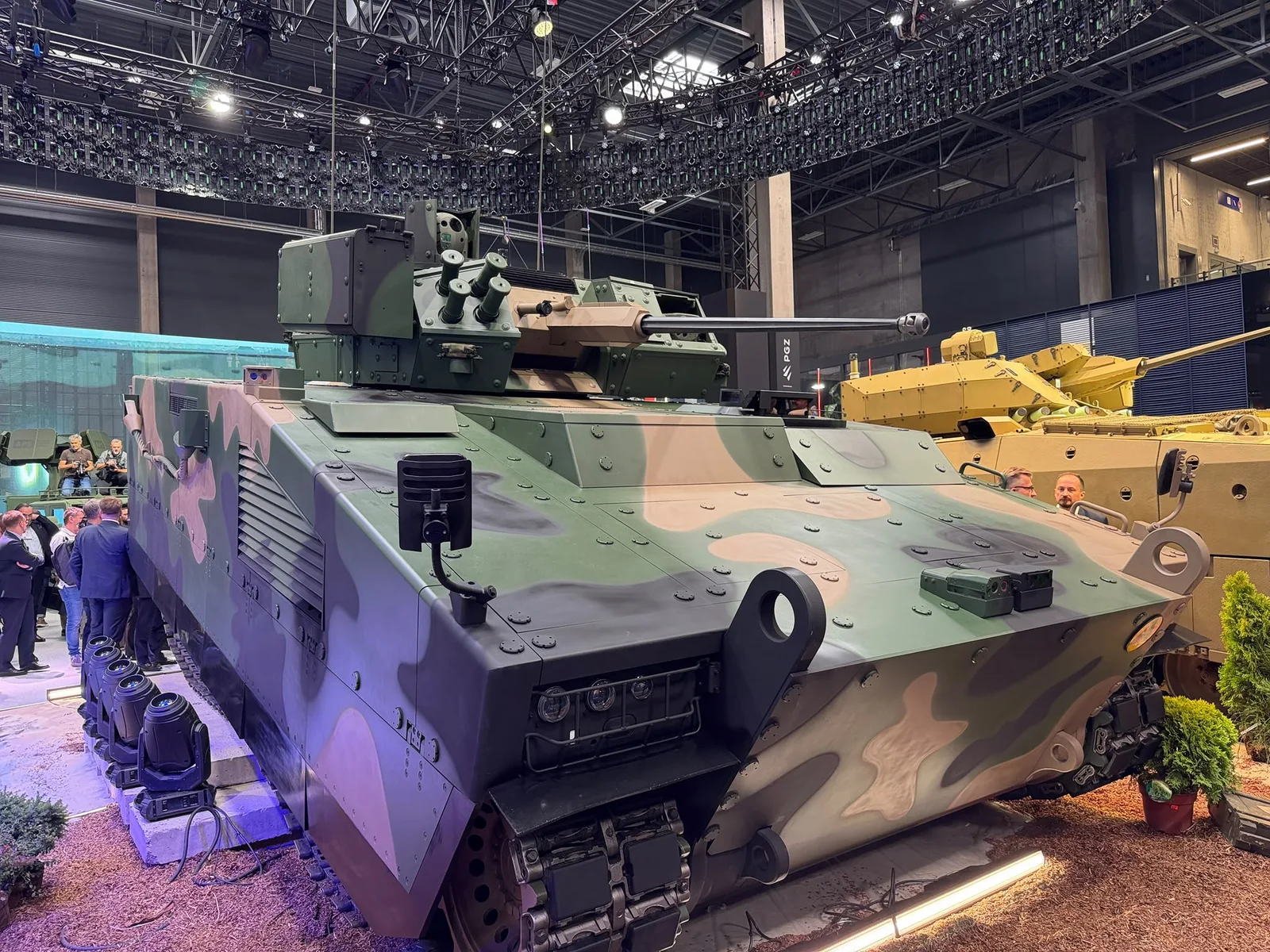
On 8 September 2026, Poland’s Huta Stalowa Wola, part of the PGZ consortium, unveiled their new Ratel (ENG: Honey Badger) infantry fighting vehicle (IFV) prototype at the MSPO 2026 exhibition in Kielce, Poland. The unveiling ceremony was attended by the PGZ management board and the presidents of PGZ’s constituent companies.
Ratel is Poland’s third domestically-developed modern medium-weight tracked platform design after the Borsuk (ENG: Badger) also from HSW, and the UMPG (first presented as the ‘WBP Anders’) from OBRUM. Yet unlike the former two, Ratel is envisioned as a Polish domestic solution to the country’s CBWP (Ciężki Bojowy Wóz Piechoty; ENG: heavy infantry fighting vehicle) requirement.
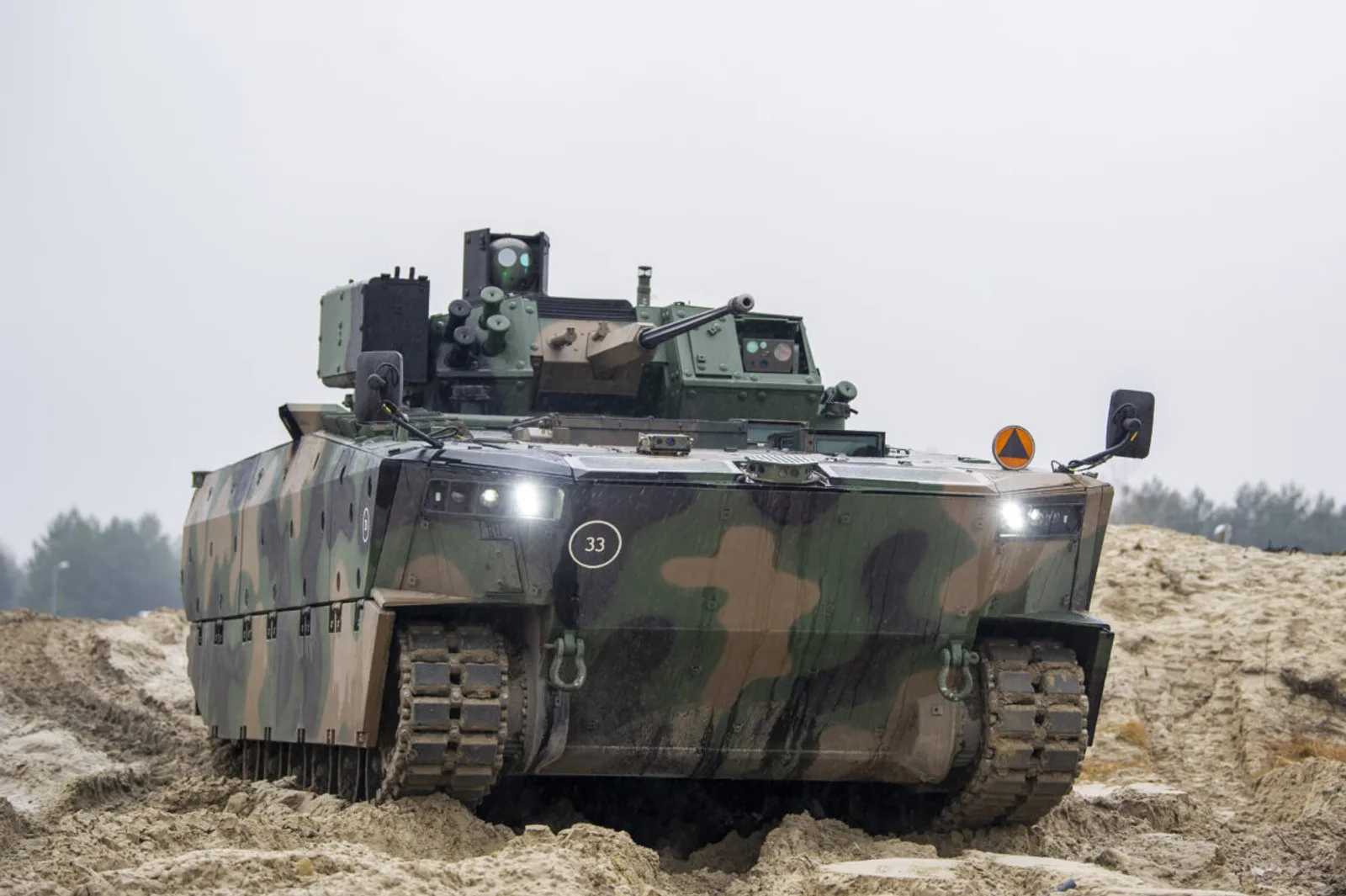
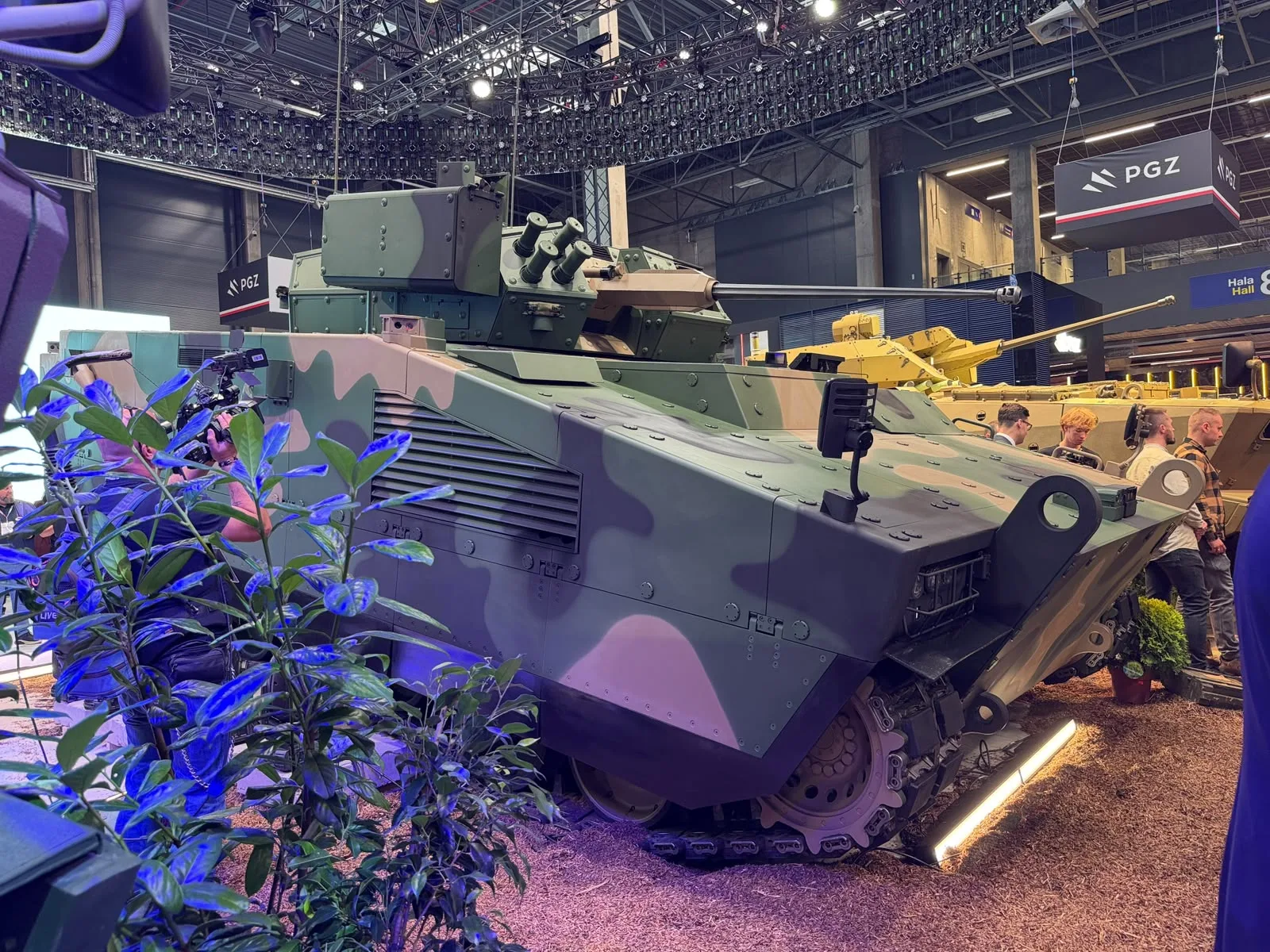
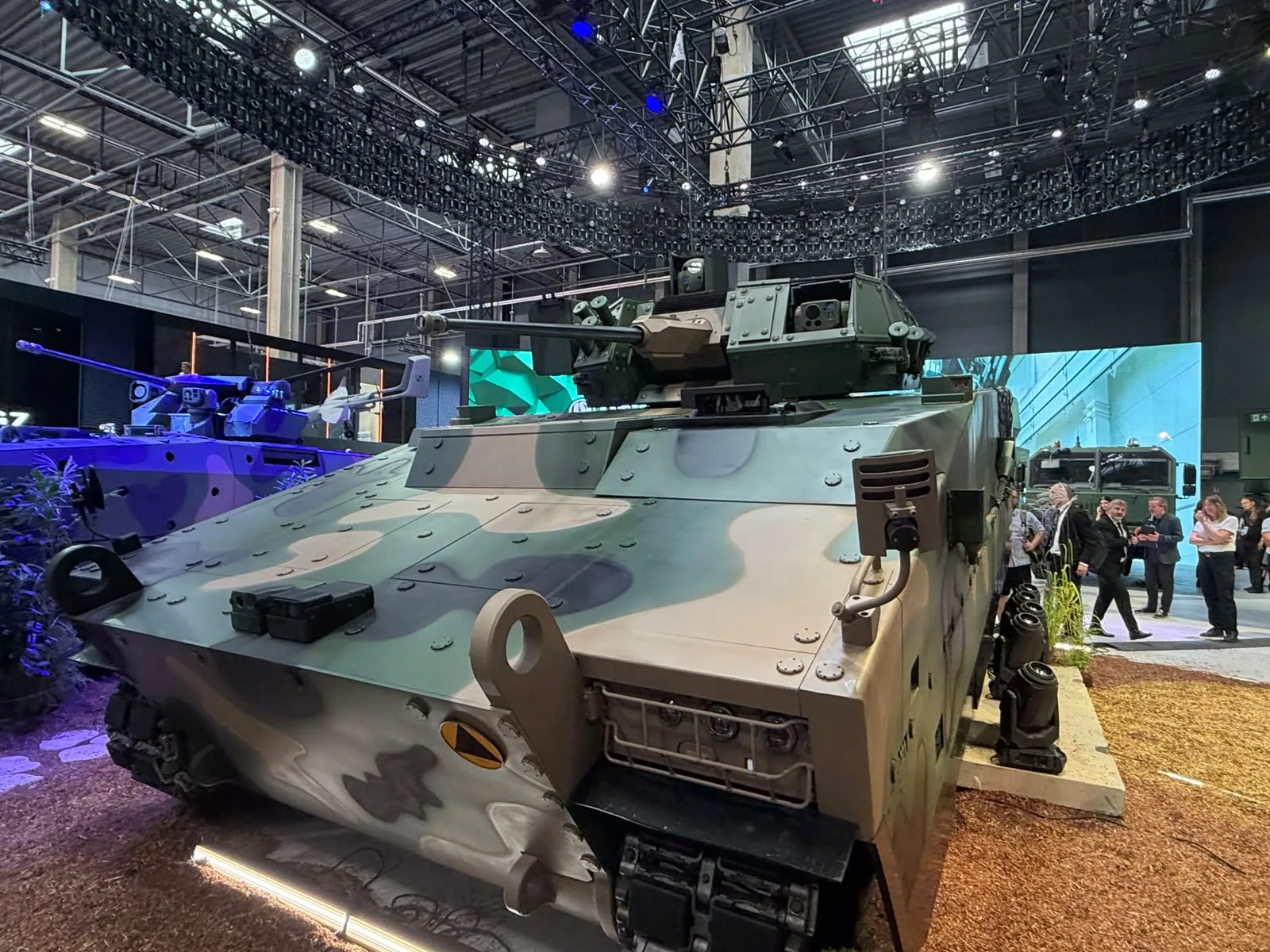
Ratel’s design is fairly typical of a modern IFV, with a fairly standard hull shape and layout, of driver’s compartment and engine are at the front with exhaust via the front right-hand side, and dismounts in the rear, with access and egress via a ramp fitted with an inbuilt door. Crew features included a 360° local situational awareness camera system, including dedicated cameras for the driver. Running gear comprised seven roadwheels running on steel tracks.
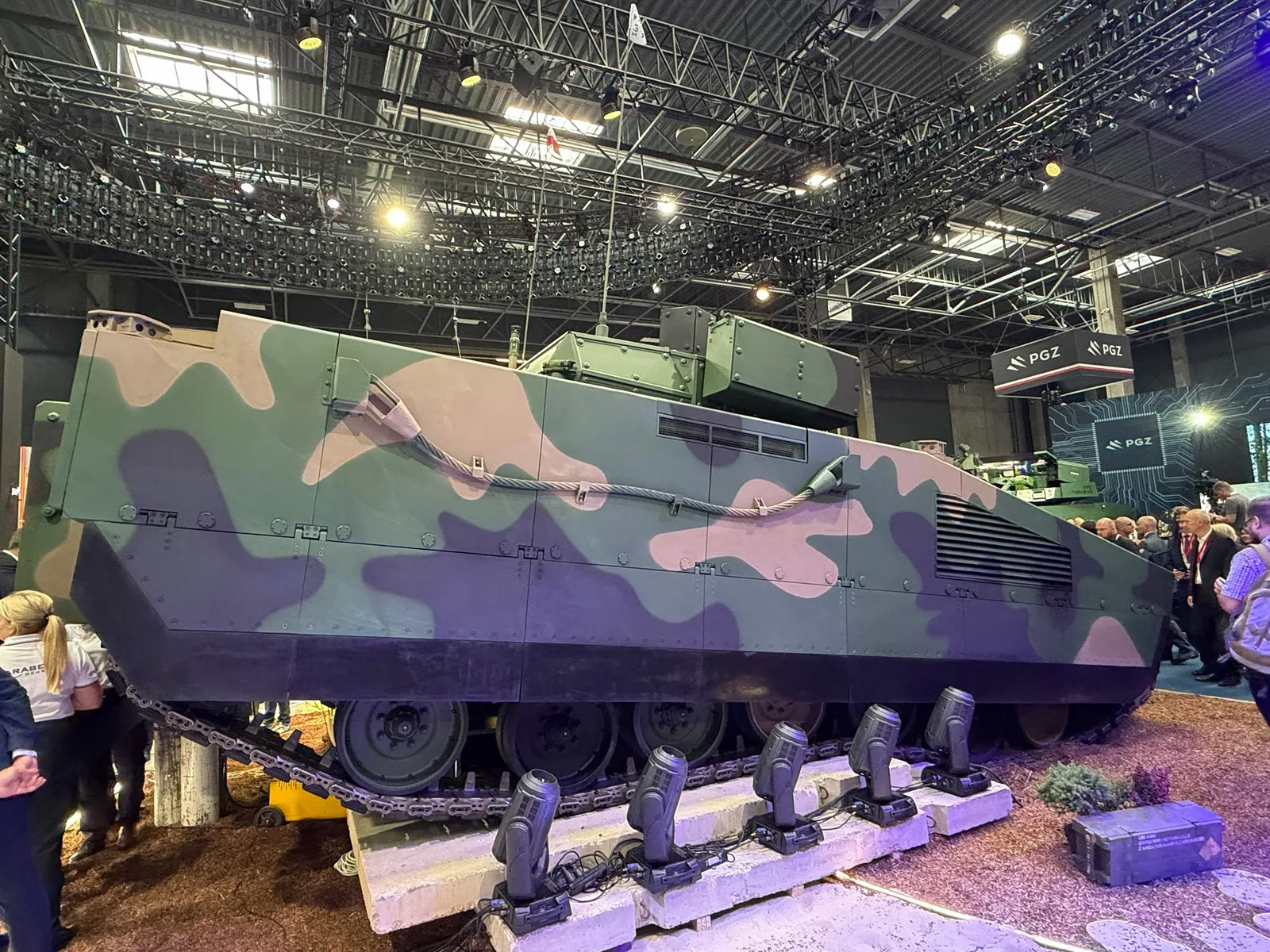
An earlier scale model of Ratel displayed at MSPO 2025 appeared to show the vehicle fitted with hydropneumatic suspension. While this would make sense given this system was also used on HSW’s earlier Borsuk IFV, it could not be confirmed whether this design element had made the leap from model to prototype.
Observable differences between the scale model and the prototype included several features missing from the model altogether, such as the radiator, intake and exhaust, and in other cases included structural changes, such as the raised portions of the glacis in front of the driver’s hatch and the radiator. Additionally, the appliqué armour kit shown on the prototype appeared different to that on the model, and looked somewhat thin in places. However it is quite plausible that the prototype was fitted with an interim package for display purposes, and a further-developed package is likely to appear in future.
In terms of armament, the Ratel prototype was fitted with a ZSSW-30 turret, armed with a Bushmaster II Mk44S 30 mm dual-feed automatic cannon with 200 ready rounds (120 and 80 respectively in each feed), alongside a coaxial UKM-2000C 7.62 mm machine gun with 400 ready rounds, and a pod of two anti-tank guided missiles (ATGMs), understood to be the Spike LR2. The gunner sight and commander’s independent panoramic sight both have day and thermal channels. The turret is provided with OBRA 3 laser warning receivers (LWRs) and eight obscurant smoke grenade launchers.
Przemiera na MSPO 2025. Model ciężkiego bojowego wozu piechoty opracowywanego przez HSW. pic.twitter.com/TbDePpkPA4
— Marcin Strembski (@MStrembski) September 1, 2025
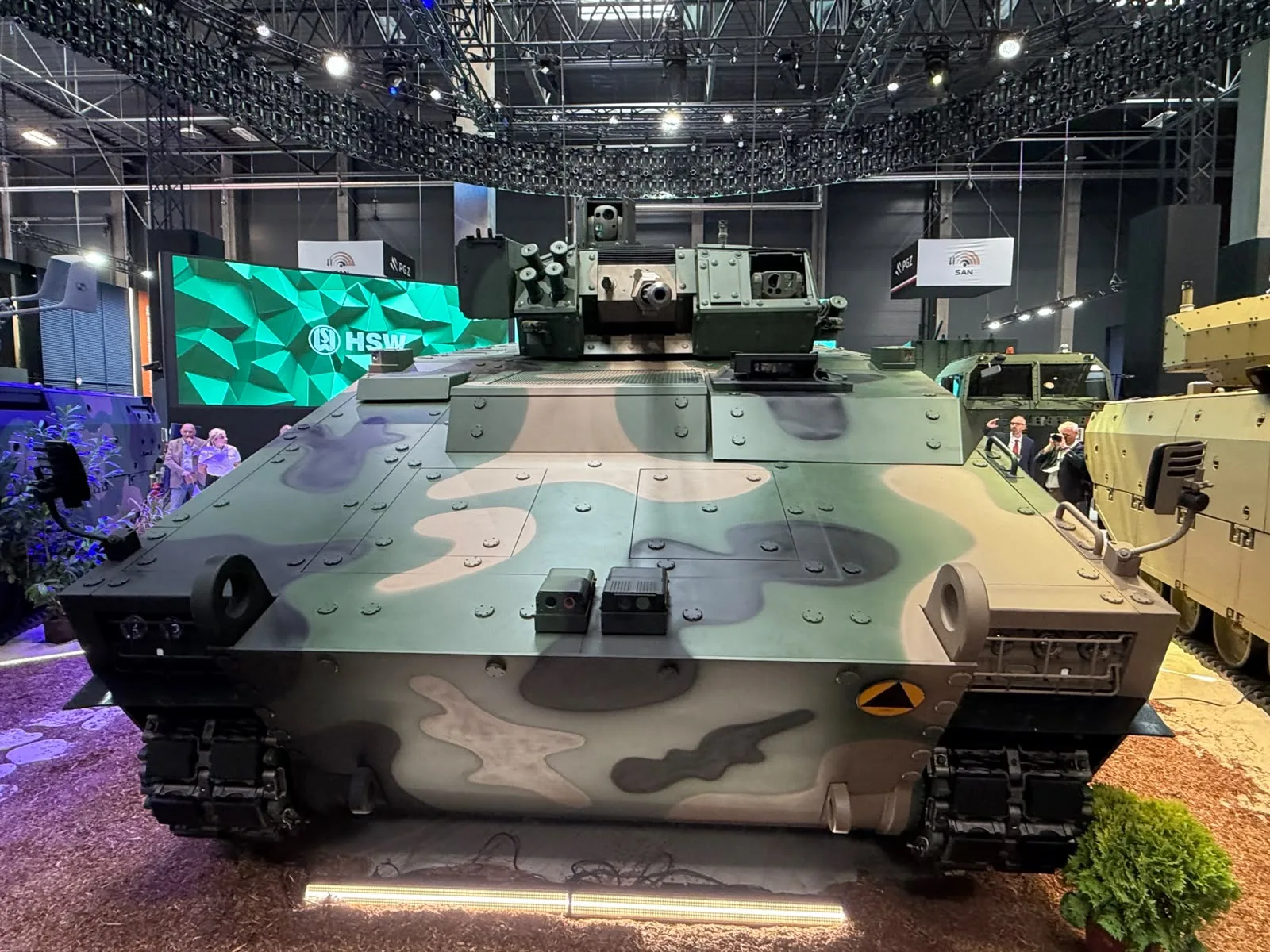
The ZSSW-30 turret has already entered service on the upgraded versions of Poland’s Rosomak 8×8 in IFV configuration, and the Borsuk IFV. While HSW did not provide detailed specifications for the prototype vehicle, some preliminary information has been provided leading up to the launch, and some additional information was provided at the launch event. This is summarised in Table 1.
| Table 1: Ratel IFV preliminary specifications | |
| Crew: | 3+8 or 3+6 (depending on configuration) |
| Gross vehicle weight: | ~42 tonnes |
| NBC protection: | Yes |
| Engine model: | MTU (unspecified model) |
| Engine power: | 800 kW (1,073 hp) |
| Tracks: | Steel, double-pin, with rubber pads |
| Amphibious: | No |
| Maximum gradient: | 60% |
| Side slope: | 30% |
| Trench crossing: | >2 m |
| Fording: | 1.2 m |
Ratel’s development does raise a question: If Poland had already developed a domestic IFV in the form of the Borsuk, why does it need Ratel? After all, operating two different tracked IFV families simultaneously is a luxury not all militaries can afford. But then again, much the same could be said for operating four completely different main battle tank (MBT) families simultaneously, which Poland already does.
Broadly speaking, Ratel and Borsuk have slightly different roles envisioned. Reporting has indicated that Poland plans to operate different weight class IFVs within its varying armoured/mechanised formations:
Poland’s geography makes wet gap crossing an important capability for its armed forces, with many rivers, lakes, and areas of marshland dotted across its landscape. While a member of the Warsaw Pact, Poland’s armed forces have long operated amphibious vehicles such as the Soviet BMP-1, over which Borsuk represents a fairly substantial improvement while remaining fairly like-for-like in terms of role. A domestic design also made sense here, as many European/NATO countries did not have an amphibious requirement for their IFVs, and therefore many of the available tracked IFV designs catered toward the heavier end of the spectrum.
With Borsuk completing development, Poland ordered the first batch of 111 vehicles on 27 March 2025, with deliveries are due to be completed in 2029. The wider Borsuk framework agreement signed by Poland in 2023 covered 1,355 vehicles, of which 1,014 would be in the IFV variant, and the remaining 341 vehicles comprising other variants. Borsuk’s specifications have been summarised in Table 2.
| Table 2: Borsuk IFV specifications | |
| Crew: | 3+6 |
| Dimensions (LWH): | 7.6 m × 3.4 m × 3.1 m (to turret roof) |
| Gross vehicle weight: | 28 tonnes |
| Protection rating: | Front: STANAG 4569 Level 4 Sides/Rear: STANAG 4569 Level 3 |
| NBC protection: | Yes |
| APU: | Yes |
| Engine model: | MTU 8V199 TE20;
(Cummins engine variant in development) |
| Engine power: | 530 kW (720 hp) |
| Transmission model: | Allison 3040 MX |
| Tracks: | Soucy CRTs |
| Suspension: | Hydropneumatic |
| Range: | 550 km |
| Max speed: | 65 km/h |
| Amphibious: | Yes |
| Swim speed: | 8 km/h (propelled via pump jets) |
| Maximum gradient: | 60% |
| Side slope: | 30% |
| Trench crossing: | 2.6 m |
Yet Borsuk is fairly light by modern IFV standards, by virtue of being an amphibious design. In turn, the lower weight needed for swim capability is nearly invariably means a lower level of passive protection compared to non-amphibious vehicles. This is where CBWP comes in, as Poland also required a class of IFV able to operate in higher-threat environments than Borsuk. For the CBWP requirement, Poland has allegedly considered the AS21 Redback, KF41 Lynx, and Tulpar, while also keeping a domestic option in the works – Ratel.
Compared to Borsuk, the Ratel is larger and much heavier, with a gross vehicle weight (GVW) of circa 42 tonnes compared to the circa 28 tonne GVW of Borsuk, and capable of carrying up to eight dismounts to Borsuk’s six. As the weight suggests, Ratel should have greater passive armour protection, at the cost of an amphibious capability. Armament-wise, the two are identical in their IFV configurations, but Ratel’s greater size and higher GVW would provide more options for mounting different turrets or armaments down the line.
Beyond giving Poland a domestic contender for the CBWP requirement, Ratel’s unveiling is a major symbolic milestone for Poland’s armoured vehicle design capability. Without mincing words, it is the first domestic clean-sheet >40 tonne armoured fighting vehicle design in the country’s history.
This may sound surprising, since Poland has previously produced vehicles in the >40 tonne weight class, such as the PT-91 Twardy series of main battle tanks, and the Krab self-propelled howitzer (SPH). Yet examples such as these were adaptations based on existing designs. The PT-91 was a deep modernisation of the T-72, while the Krab mated the UK’s ‘Braveheart’ AS90 turret with a Korean K9 hull.
Ratel on the other hand is a clean-sheet design. These do not come along all that often, which is why they tend to generate a lot of buzz when they do, and are often treated as a proxy indicator for the maturity of a country’s industry.
Yet despite being a symbolic milestone for Poland’s armoured vehicle industry, Ratel is being born into a difficult market. Put bluntly, did the market need yet another ~40 tonne tracked IFV?
European and NATO allied countries looking to buy a modern tracked platform in the roughly 35-45 tonne gross vehicle weight (GVW) class already have a wealth of options to pick from, including: CV90 MkIV, AMPV, ASCOD – Light/Heavy (and their one roadwheel shorter US cousins in the Griffin series, and probably also the XM30 Wolf), AS21 Redback, KF41 Lynx (and theoretically also the KF31), Boxer Tracked, Puma, and Tulpar. This end of the market then, is already quite full.
In the 25-35 tonne GVW class the competition is somewhat less crowded, with PMMC G5, Borsuk, Kaplan FSRV, Hunter AIFV, and (theoretically) the UMPG. The 15-25 tonne segment has seen relatively few entrants in recent decades, with occasional examples like the Bionix series, and Kaplan-20 (both understood to be no longer offered), and Tulpar-S cropping up since the end of the Cold War. However, arguably this segment is also served by lower-weight configurations of the category above it.
Getting lighter still, the sub-15 tonne segment is nearly empty bar refurbished M113 and MT-LB derivatives, with just two new-build options filling this segment: TRACKX and Kaplan-10. China and Russia both operate a wide range of vehicles at the lighter ends of the tracked vehicle scale, but neither country tends to be a popular choice for European and NATO users today.
So as things stand, Ratel is the unproven newcomer to one of the most crowded armoured fighting vehicle segments on the planet. However, this does not necessarily signal the end of Ratel’s story.
Poland’s economy is growing faster than many of its European neighbours, projected to grow by 3.5% in 2026. In a similar vein, its defence expenditure reached at 4.48% of GDP in 2025, and may reach 4.81% in 2026. So Poland has the financial clout to make Ratel a domestic success story if it chose to. This would mean nurturing an entirely domestic industrial design and production capability in an important vehicle segment. A wholly-owned domestic design would also give Poland the freedom to modify the design as required without consideration for foreign licensing requirements. Yet this choice would not be without its trade-offs.
The first thing to be sacrificed on the altar of going domestic would likely be delivery and fielding timescales. Developing a new armoured vehicle from scratch is not easy, and getting one into service is even harder. There would likely need to be several years of trials, equipment integration, and qualification work before Ratel is ready for serial production and fielding.
Complicating things further, Ratel had already become something of a political football prior to its unveiling, with the announcement that the vehicle would be produced at the Wielkopolska Armoured Centre in Poznań, run by Wojskowe Zakłady Motoryzacyjne (WZM) and Hipolit Cegielski – Poznań, rather than at HSW’s plant at Stalowa Wola, as might have been expected.
Such complications are less than ideal. Poland’s armed forces modernisation has been remarkably fast compared to many of its allies, with the aim of making the country ready for a peer conflict. Delays would hinder this, and in theory, it may be quicker and more practical to choose an existing design. Though having said that, procurement history (particularly the UK’s) is littered with examples of seemingly simple purchases which ended up incurring major delays.
Next, even assuming Ratel managed to enter production and service without a single hitch, Poland would then find itself operating an IFV that has fairly little commonality or interoperability with the vehicles used by any of its NATO allies, and highly dependent on domestic supply chains and repair capability.
On the export market, it would be left competing against far more mature platforms with long-established user groups and supply chains, as well as entrenched multinational industrial, economic and political interests.
Worse still, it looks to have arrived too late to the party to be a major export contender within Europe and NATO countries – since many have either already started or completed their IFV procurement for this generation. Moreover, the move creates more fragmentation within Europe’s defence market at precisely the time European leaders are calling for less.
Outside of Europe/NATO markets, things don’t necessarily look much easier. African, Middle Eastern, and Latin American vehicle requirements tend to skew mostly wheeled. In cases where there may be openings in the market for a medium-weight tracked vehicle, established US, EU, and Turkish players in the IFV segment would be expected to offer shorter production timescales.
While some of these critiques could also be levelled at Borsuk, they apply to a much lesser extent. Borsuk occupies a less crowded tracked vehicle weight class, and despite arriving fairly late, it was still able to at least begin competing in Europe (notably making it to the four platforms considered for Slovakia’s IFV requirement) and has a genuine raison d’être in the form of its amphibious capabilities, which few of its competitors in the same weight class offer. Moreover, Borsuk’s production is somewhat de-risked by strong domestic demand under its framework agreement.
It will be interesting to see what decisions Poland’s leadership make regarding Ratel. From an export standpoint, its path does not appear straightforward. But from a national industrial standpoint, the vehicle represents a positive sign of progress in Polish armoured vehicle design capabilities.