It has been officially confirmed that NATO is to procure up to 10 Saab GlobalEye platforms under its AWACS replacement programme.


Saab signs MoUs to expand its engagement in the space domain
Saab announced on 24 September…

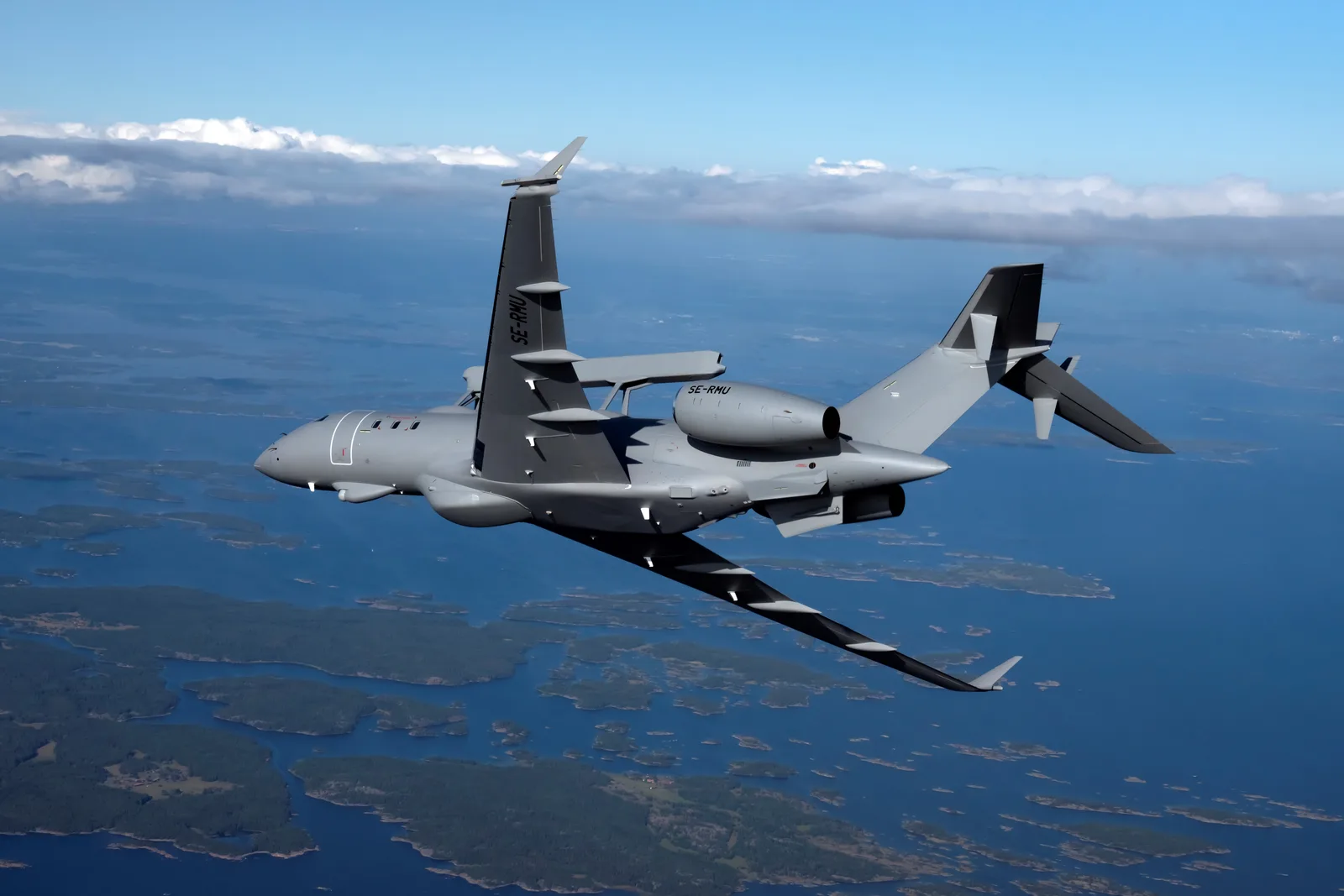
It has been officially confirmed that NATO is to procure up to 10 Saab GlobalEye platforms under its AWACS replacement programme.

The rumours were finally confirmed at the NATO Summit Defence Industry Forum in Ankara on 7 July 2026 that the alliance has selected the Saab GlobalEye platform as its new Airborne Warning and Control System (AWACS) solution.
Under the initiative 11 NATO allies (Belgium, Canada, Denmark, Germany, Latvia, Lithuania, Luxembourg, the Netherlands, Norway, Romania and Sweden) will jointly procure a fleet of GlobalEye airborne early warning and control (AEW&C) aircraft, although no contract has yet been signed.
In announcing the selection NATO Secretary General Mark Rutte said that “up to 10 Saab GlobalEye aircraft” would be jointly procured.
Saab will now proceed to formal negotiations with the NATO Support and Procurement Agency (NSPA) to secure the contract.
The GlobalEyes will replace the alliance’s fleet of 14 Boeing E-3A Sentry AWACS platforms, which are operated by the NATO Airborne Early Warning and Control Force (NAEW&CF) Headquarters, located at NATO Air Base Geilenkirchen, Germany. The alliance’s E-3A component was officially activated on 28 June 1982 and reached full operational capability at the end of 1988.
NATO had initially announced in November 2023 that it had formally selected Boeing’s E-7 Wedgetail platform and would procure six such aircraft. However, after the US Air Force (USAF) paused its own domestic E-7 programme over rising costs and delays, the Dutch Ministry of Defence announced on behalf of NATO on 13 November 2025 that the alliance had terminated its E-7 acquisition.
The Pentagon subsequently reinstated the US E-7 programme, with Air Force Secretary Troy Meink telling US lawmakers on 30 April 2026 that the USAF had signed contracts for five E-7 Wedgetail aircraft in addition to two rapid prototypes.
Saab’s GlobalEye multi-role AEW&C platform is based on the Bombardier Global 6000/6500 business jet, which can comfortably offer a mission endurance of more than 11 hours. Its main sensor is a dorsally mounted Saab Erieye ER (Extended Range) S-band active electronically scanned-array radar, which Saab states has an instrumented range “well above 650 km”. The Erieye ER’s multi-domain performance allows it to pick up air threats from ballistic missiles to relatively small drones as well as maritime targets down to jet-ski size. The GlobalEye also features a Leonardo Seaspray 7500E X-band maritime radar mounted under the forward fuselage and a turreted electro-optical/infra-red sensor mounted under the forward fuselage.
News of NATO’s selection of GlobalEye came soon after the Canadian government announced on 27 May 2026 that it had selected the Saab platform as the preferred solution to its AEW&C requirement.
NATO will thus become the fifth GlobalEye customer after the United Arab Emirates (five in service), Sweden (three on order), France (two on order) and Canada (yet to order).
In additional remarks made in Ankara on 7 July 2026, Rutte stated that “several Allies are launching today a multi-national project to co-operate on procuring and fielding more airborne early warning capabilities, such as GlobalEye, to respond to their national requirements”.
Meanwhile, NATO also announced on 7 July that seven allies (Belgium, Croatia, France, Poland, Spain, Türkiye and the United Kingdom) have launched a new multi-national High Visibility Project for a fleet based around the Airbus A400M military transport aircraft.
The A400M multi-national initiative follows the success of the multi-national Airbus A330 Multirole Tanker Transport (MRTT) fleet, which received its first aircraft in 2020. It will follow the same ‘pooling and sharing’ concept, where participating countries pool the aircraft and share costs, benefitting from economies of scale. The project also allows participating allies to co-operate in areas such as joint procurement, logistical support or training.
Alongside the A400M multi-national initiative, Finland joined the Multinational MRTT Fleet (MMF). Together, the nine MRTT members (Belgium, the Czech Republic, Denmark, Finland, Germany, Luxembourg, the Netherlands, Norway and Sweden) also announced the imminent delivery of the 10th Airbus A330 MRTT aircraft, bringing the fleet closer to its full capacity of 12 aircraft.
Also on 7 July Denmark, Finland, Germany and Norway announced the procurement of up to five Northrop Grumman MQ-4C Triton high-altitude/long-endurance (HALE) uncrewed aerial vehicles (UAVs). The new MQ-4Cs will complement NATO’s Alliance Ground Surveillance (AGS) fleet that operates from Sigonella airbase in Italy and currently comprises RQ-4D Global Hawk Phoenix HALE UAVs. The MQ-4C Triton is a development of the RQ-4 optimised for maritime surveillance.