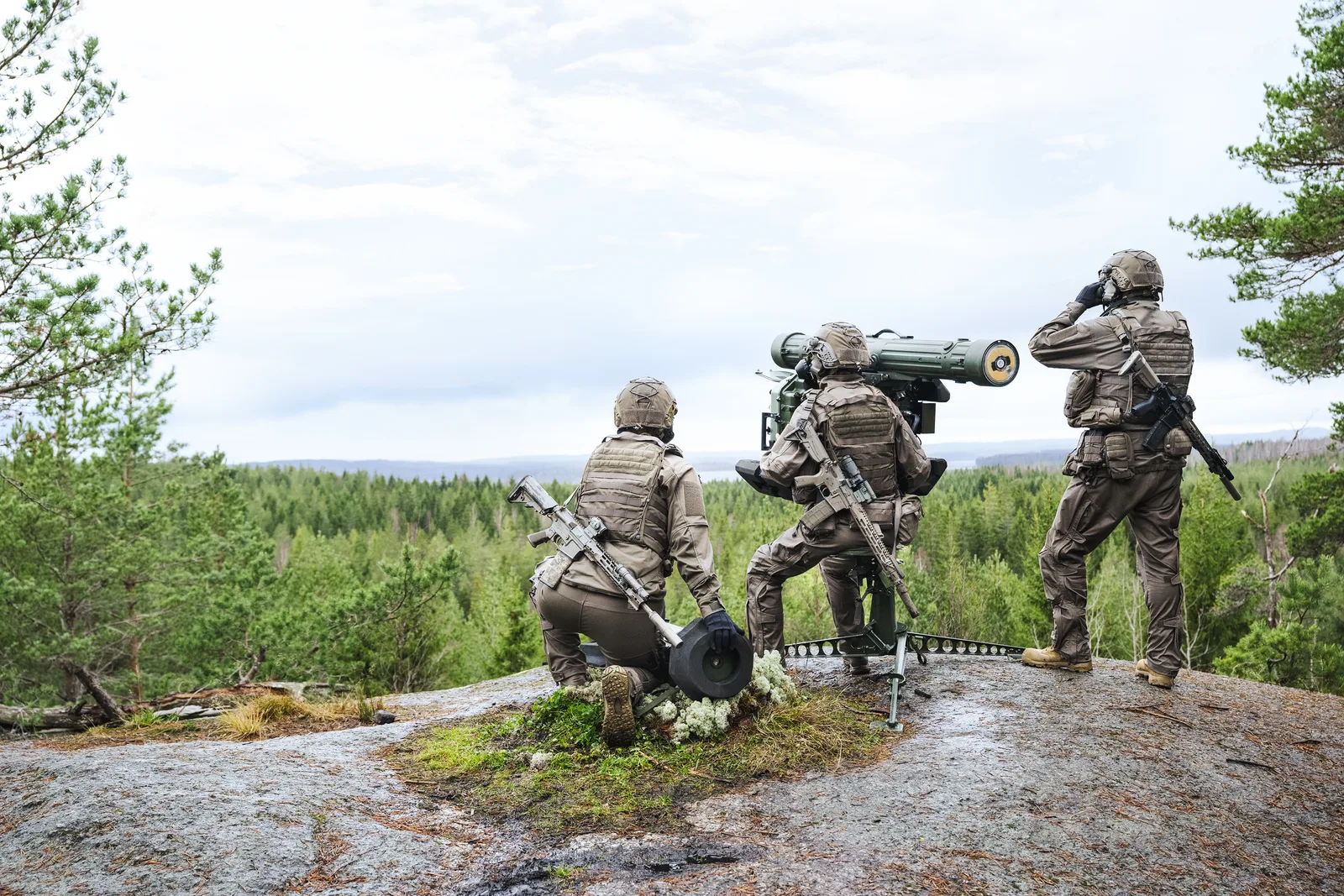
Saab has introduced a new missile, the Bolide 2, for its RBS 70 short-range air defence system that features a larger warhead, better terminal flight performance and a modular architecture.


Saab has introduced a new missile, the Bolide 2, for its RBS 70 short-range air defence system that features a larger warhead, better terminal flight performance and a modular architecture.

Saab has launched a new missile for its RBS 70 short-range air defence system. Called the Bolide 2, the new missile features a larger warhead and better terminal flight performance.
While the Bolide 2 missile has the same range as the Bolide missile introduced in 2003 – a 9 km range to altitudes up to 5 km – a key difference with the Bolide 2 is that it has a modular architecture, allowing the design of the missile to be evolved in future, along with a larger warhead facilitated through the use of smaller hardware components, while the introduction of an inertial measurement unit (IMU) has improved the missile’s manoeuvrability and gives better flight performance at higher altitudes.
Briefing a select cadre of journalists at Saab’s facilities in Karlskoga, Sweden, on 5 May 2026, Mats Olof Rydberg, head of the Ground Based Air Defence unit at Saab Dynamics, noted that the introduction of smaller hardware and electronics in the Bolide 2 missile has facilitated the introduction of a warhead that contains around 50% more explosives and 40% more fragments to increase its lethality. Employing an aluminium casing instead of the original steel one, meanwhile, has meant that the Bolide 2 missile is the same weight as its predecessor.
Rydberg added that moving from a copper cone in the original Bolide shaped-charge warhead to an aluminium one in the Bolide 2 has resulted in a more optimal performance against its intended targets – airborne threats including armoured attack helicopters – while also maintaining the weapon’s secondary ground-to-ground capability against targets such as armoured personnel carriers.
Like the Bolide missile before it, the Bolide 2 employs an adaptable laser proximity fuse, which can be used to optimise performance against smaller air targets such as cruise missiles or unmanned aerial vehicles.
“Going forward we’re looking into more of a spiral development of the system, and the architecture aids that,” Rydberg explained. “Also, at the same time, we have added a new launch tube … it’s prepared now for fully automatic production, which is, of course, very important for us going forward, when we’re increasing the rate of production of the missile dramatically during the last couple of years.”

As a laser-beam-riding air defence system, Rydberg noted that the RBS 70 is unjammable and has relatively low-cost missile rounds, given that its missiles do not employ an expensive seeker head that could be interfered with by a target aircraft’s self-protection systems. Instead, the launcher projects a laser beam at the target that optical sensors on the back of the missile use to ‘ride’ it onto the target. By redirecting the beam the target can be changed, while if the missile loses the beam for a number of seconds if goes into ‘unsafe’ mode and self-destructs.
With regard to production of the Bolide 2 missile, Rydberg said, “We’re entering pre-production this autumn. It will be delivered to customers starting next spring.”
As deliveries start in 2027, the Bolide 2 will become the standard ammunition for the Saab RBS 70 NG short-range air defence system, although it can still be fired by previous-generation RBS 70 launchers.