Kongsberg Defence & Aerospace presented its latest developments in adding counter-unmanned aerial system (C-UAS) capabilities to its remote weapons stations (RWSs) at the Association of the US Army (AUSA) 2026 symposium, held in Washington, DC, from 12 to 14 October.
Over the last 20 years Kongsberg has provided around 17,000 of its Protector RWSs to the US Army under the Common Remotely Operated Weapon Station (CROWS) programme. As the army looks to update those systems, it provides an ideal opportunity to give them a C-UAS capability, which is what Kongsberg is currently pitching.
The original CROWS units already feature an opto-electronic targeting system, to which Kongsberg adds a radar to facilitate a C-UAS capability; typically an Echodyne EchoShield radar has been used, which operates in the Ku-band and can track targets beyond 10 km.
However, as Kongsberg looks to remove analogue components from those RWSs and make them digital as part of the upgrade process, that also enables them to receive further enhancements through software updates.
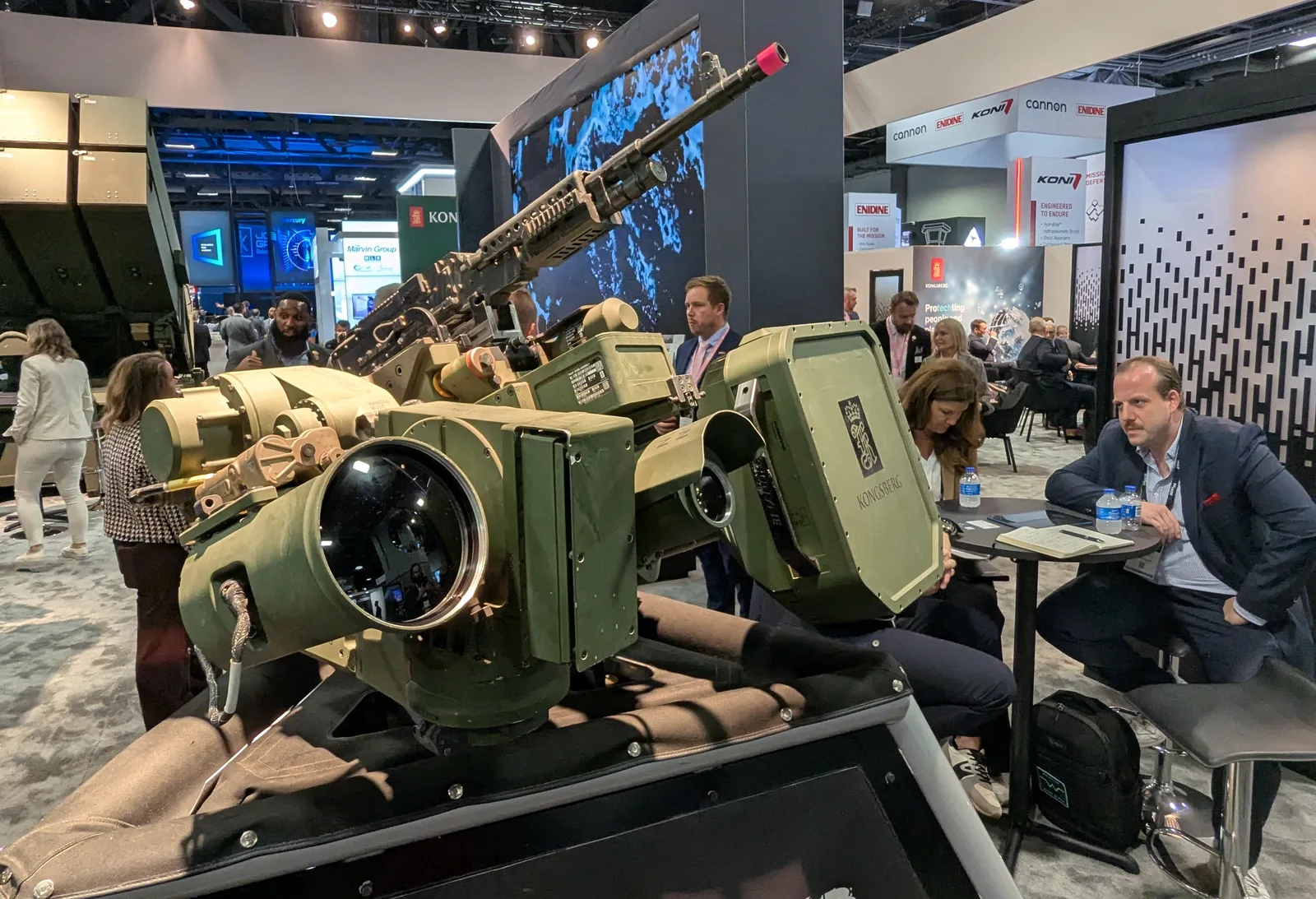
Speaking to Warsight at AUSA 2026 on 13 October, Martin Rold Hansen, vice president for marketing and sales for land systems at Kongsberg, noted that one of the systems displayed on the company’s stand was the CROWS Low-Profile RWS, as fitted to US Army M1A2 Abrams main battle tanks.
“We have operated it with new software, and earlier this year we did a test on the Abrams platform, an engagement with this type of system,” he said, in which a UAS was successfully targeted using a 7.62 mm machine gun.
Hansen said this was just “one very recent example of how such an upgrade can be done and be effective immediately”.
CROWS RWSs support the M2 .50 cal machine gun, the M240B 7.62 mm medium machine gun and the M249 5.56 mm Squad Automatic Weapon, as well as the MK19 grenade machine gun.
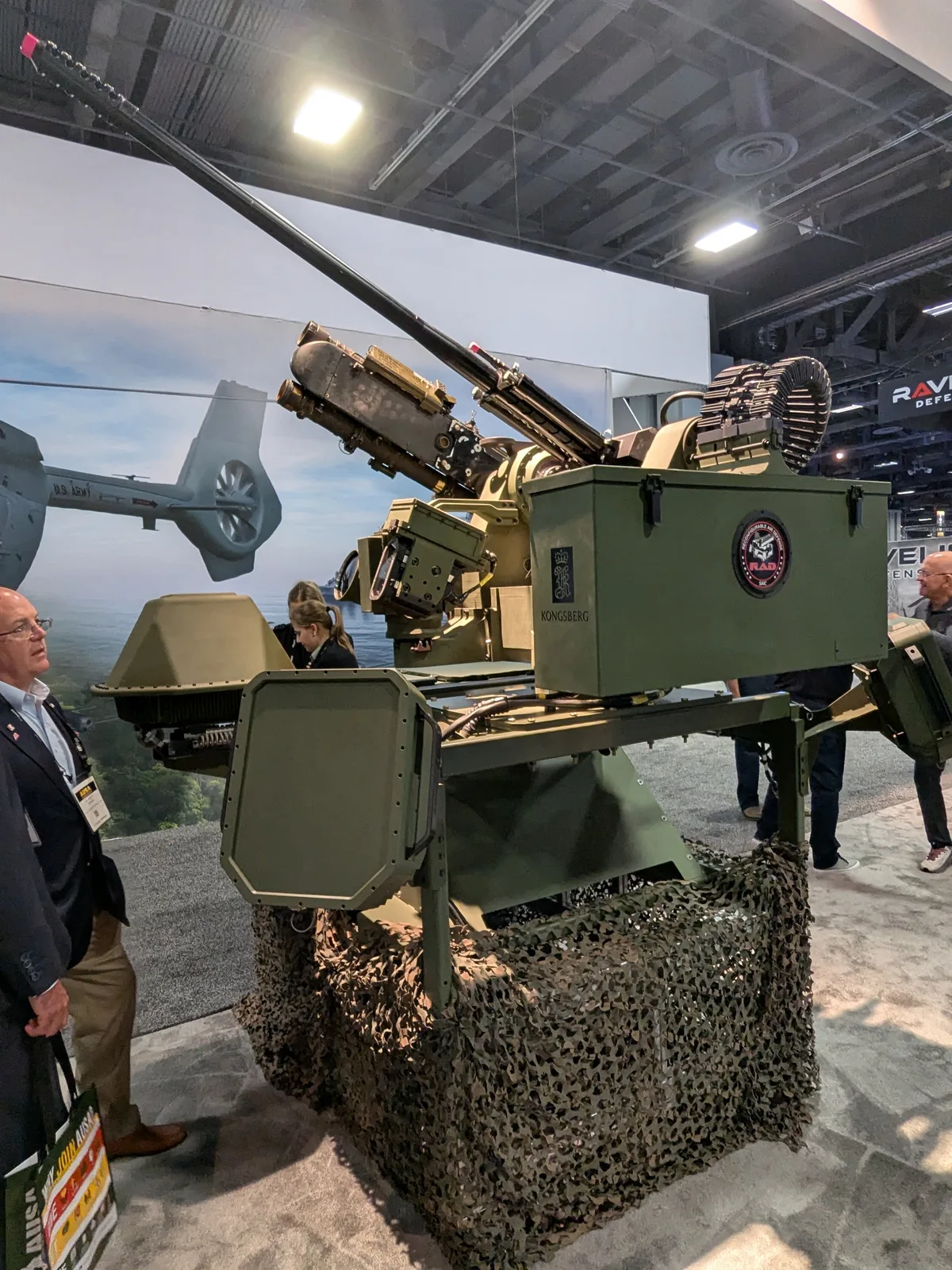
Hansen pointed out that also on the Kongsberg stand was a Protector RS6 RWS, which he described as the “bigger brother” to the CROWS system. “As you can see, it integrates a bigger weapon – in this case it’s a 30×113 mm automatic cannon – and this is in use with the US Marine Corps [USMC],” said Hansen.
Protector RS6 RWSs are integrated onto USMC Joint Light Tactical Vehicles (JLTVs) alongside Stinger surface-to-air missiles under the Marine Air Defense Integrated System (MADIS) programme. These Mk1 MADIS vehicles form a pair with JLTV-based MADIS Mk2 vehicles mounting 360° radar system, a command-and-control suite, a 7.62 mm M134 Minigun and an electronic warfare system. Both vehicles feature opto-electronic/infra-red systems for targeting.
Hansen noted that Kongsberg has delivered more than 100 Protector RS6 RWSs to the USMC.
Kongsberg RWSs in Ukraine
Kongsberg RWSs upgraded with a C-UAS capability are also in service in Ukraine.
“We have delivered Protector weapon stations with counter-UAS capability to the Ukrainian armed forces and they’ve been in use there for more than two years,” said Hansen. “That was also a story of retrofitting counter-UAS equipment to existing weapon stations because we started by delivering 10 systems [that were] donations from the Norwegian army: 10 Dingo vehicles with relatively old weapon stations, more than 15 years old, already on there. We made an upgrade with a radar system and updated the software, and they were fielded at really short notice. I think the total duration of the project was six months from start to finish.
“They’re downing Shahed drones; they’ve actually even downed cruise missiles,” Hansen added. “I know that’s not the intended purpose, but they have demonstrated that it’s actually possible.”
Hansen noted that the Ukrainian Protector RWSs work in pairs of two, or three vehicles together. “They use them mainly to protect critical infrastructure,” he said. “They drive these vehicles out to the area that they have to protect; they are networked together; they do the engagements together.
“We are now in the in the process of delivering more [systems to the Ukrainians],” said Hansen, “but with effectors that will reach even further because they realise that the drone threat is sometimes beyond the reach of a 12.7 mm machine gun, so they are now getting APKWS rockets that can fly even further.”
These additional systems for Ukraine will be mounted on different vehicles, although Hansen was not able to divulge specifics or numbers.
Flexible C-UAS options
Hansen added that since last year the company has been doing a lot of testing with its entire portfolio of weapon systems with regard to adding C-UAS capabilities.
“From the relatively small systems like the one you see here on Abrams,” he said, referring to the CROWS Low-Profile RWS, “six weapon stations like that one we have been testing in Sweden. We have done testing in Switzerland. We’ve done testing in Lithuania. So we’ve been many places, demonstrating this capability again and again.”
Referring to the Protector RS6 RWS on the Kongsberg stand, Hansen said, “As you can see here, this weapon station is not mounted on a vehicle; it’s mounted on a so-called sled. This structure is made by SAIC: an American company that we work together with. The intent of this integration is that you have a fixed, standardised platform that you can easily put on different types of vehicles, so easy, integration wise. This enables the armies to move a lot quicker to put it on different platforms. The system can even be put on the ground, like you see here. It has its own power; it could be static as well. Again, it gives that flexibility.”
Hansen added that the Protector RS6 RWS is now being offered to the US Army’s Maneuver Short-Range Air Defense (M-SHORAD) programme: a major modernisation initiative designed to protect mobile ground forces.
He also referenced the Polish SAN programme, for which Kongsberg won a NOK 16 billion (EUR 1.53 billion) contract in January 2026 covering the provision of 16 SAN C-UAS batteries. These batteries will include a wide variety of effectors, including 35 mm, 30 mm and 12.7 mm guns as well as missiles and interceptor drones, to counter aerial threats.
“It’s basically their drone shield programme,” Hansen explained. “Along the Polish border they are now strengthening how they defend themselves against drones, and we play a major part of that by providing our 30 mm turrets for drone engagement.” These are integrated onto a 20 ft (6 m) ISA container-footprint skid mount.
“The key word here is the flexibility you get,” said Hansen. “You can move the skid up and down from a truck. You can have it as a fixed asset that is on the ground, or you can keep it on the truck and drive it around.”