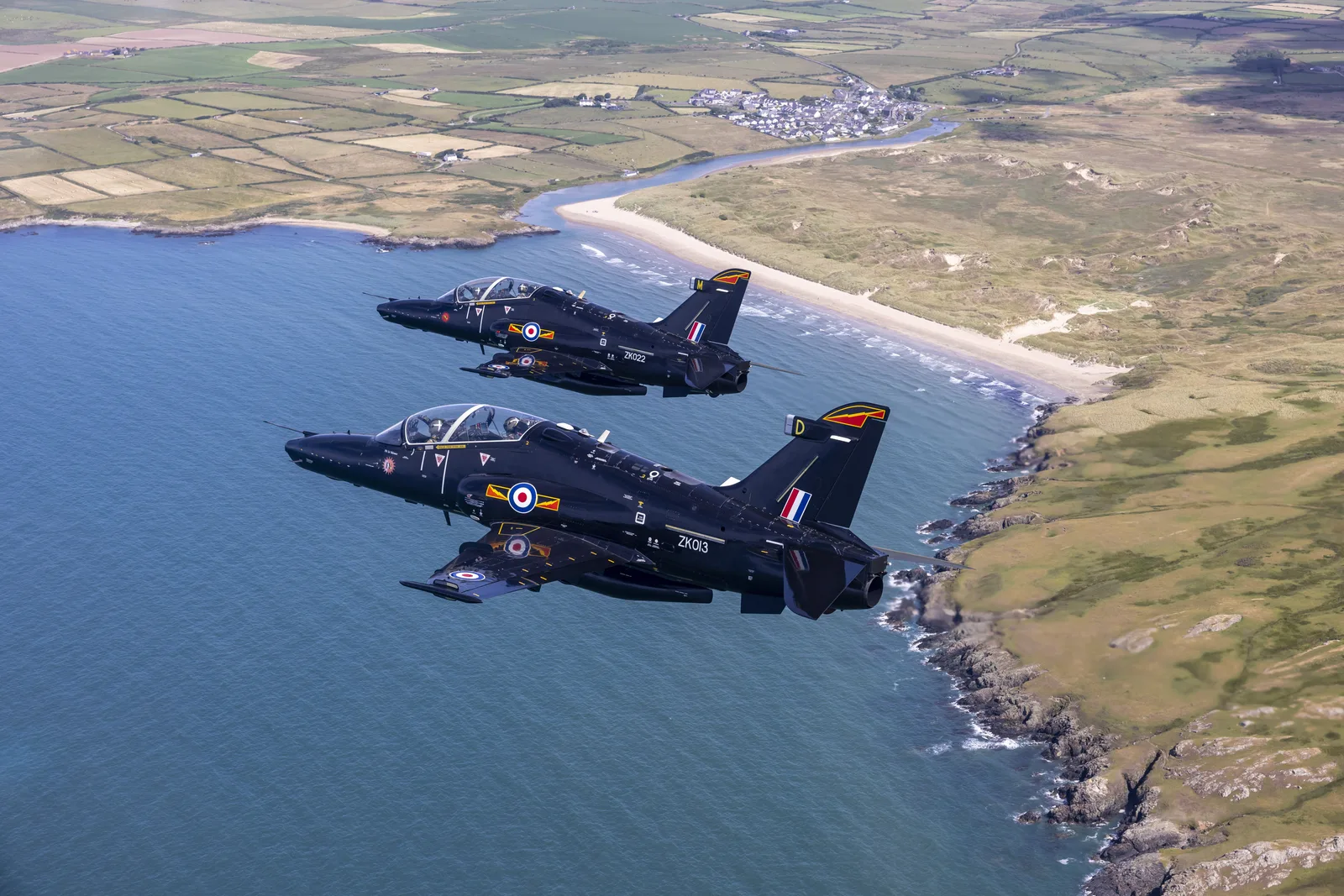
Eight days after Warsight published its report into a Typhoon test aircraft firing APKWS rockets, BAE Systems issued a press release and new photos regarding the development. We have taken the opportunity to update that element of our story.
BAE Systems details work integrating APKWS onto Typhoon as low-cost drone killer
Although the Eurofighter Typhoon has enjoyed great success in intercepting and destroying unmanned aerial vehicle (UAV) threats, it has done so primarily by using the GBP200,000 (EUR 230,043)-per-shot MBDA ASRAAM IR-homing air-to-air missile (AAM).
In fact, these successes go back to 14 December 2021, when a Royal Air Force (RAF) Typhoon downed a “small hostile drone” near the coalition base at Al Tanf in Syria, marking the first air-to-air UAV kill for the ASRAAM and the Typhoon.
Further similar kills followed, while in November 2025 it was confirmed that four successful air-to-air engagements had been conducted against difficult air targets over the Middle East during the previous 18 months. It was later reported (in a UK TV documentary, ‘Top Guns: Inside the RAF’, screened in January 2026) that three of these targets were among 170 one-way attack (OWA) drones launched against Israel on the night of 13–14 April 2024 along with 30 cruise missiles and 120 ballistic missiles.
Iran responded to the US/Israeli Operation ‘Epic Fury’ by launching waves of drones, as well as cruise missiles and ballistic missiles. The RAF deployed fighters to defend its base on Cyprus, RAF Akrotiri, but also to bolster allied air defences, and the ASRAAM missile again played a leading role.
A No 12 Squadron Typhoon scored the RAF’s first kill of the campaign on 1 March 2026, shooting down a Shahed drone targeting Qatar. On 2 March a Royal Navy F-35B pilot serving with the RAF’s No 617 Squadron ‘splashed’ two enemy drones in Jordanian airspace, again using ASRAAM missiles. Interestingly, the F-35B was reported to have been flying alongside two Typhoons from RAF Akrotiri.
A cheaper effector
Even before this, as drone threats have become more widespread, there has been a growing recognition of the need for a cheaper ‘effector’ to deal with them more cost effectively than high-end AAMs. Using an ASRAAM, a USD 500,000 AIM-9X or a EUR 1.2-2.2 million MICA against a Shahed-class drone costing USD 20,000 can, of course, be justified when doing so saves a high-value target, but it is obviously better to use a cheaper solution if available.
In September 2025, during the DSEI exhibition in London, BAE Systems said that it was assessing the Advanced Precision Kill Weapon System (APKWS) guided rocket as one of a range of potential counter-drone weapons for the Typhoon. APKWS is intended for both air-to-air and air-to-ground scenarios; manufactured by BAE Systems Inc in the United States, it uses distributed aperture semi-active laser seeker (DASALS) guidance and features a proximity fuse, as well as air-to-air optimised guidance and sensing algorithms.
When an APKWS kit is fitted to a Hydra 70 Mk 66 70 mm rocket, the resulting weapon is designated the AGR-20F APKWS, also known as the FALCO (Fixed Wing, Air Launched, Counter-Unmanned Aircraft Systems Ordnance). The weapon has been combat proven by US Air Force (USAF) F-15E Strike Eagle and F-16C Fighting Falcon combat aircraft (making a combat debut against Houthi drones), by Ukrainian F-16As and USAF A-10C Thunderbolt II close air support aircraft, and by various rotary-wing aircraft. APKWS is regarded as a mature, multi-mission solution and as a highly effective, affordable counter to UAVs.
The F-15E and Typhoon are likely to carry up to 42 precision-guided APKWS rockets in six seven-round pods, thereby providing a volume of fire that is unmatched using conventional AAM loadouts. With some estimates suggesting a unit cost as low as USD15,000-20,000, a full loadout costs less than a single MICA.
Although BAE Systems had said in September that the RAF had no requirement to integrate the weapon on the Typhoon, on 3 March 2026 it became clear that integration work was underway. On that day (the day after the F-35B’s double drone kills), aircraft spotters outside BAE’s Warton factory aerodrome in Lancashire photographed ZE356, a Typhoon test aircraft, carrying (apparently empty) seven-round rocket pods under each wing. The aircraft flew a sortie using the callsign ‘Tarnish 15’.

The following day the same aircraft (previously used for Spear missile test firings) flew again. This time the aircraft carried a single APKWS round in the centre position of the starboard pod. The aircraft flew out over Wales to the Aberporth range, where a subsequent BAE Systems press release revealed that it had made a test firing against a raft-mounted target. On landing back at Warton, it was apparent that ZE356 had fired its APKWS rocket.
BAE Systems initially refused to comment beyond saying that Warton Aerodrome “is regularly used for flight testing by BAE Systems using our fleet of test-and-evaluation Typhoon aircraft in support of the UK and our international customers. This activity is part of our scheduled programme and we do not comment on the nature of these flights.”
Subsequently, the company announced that it had successfully completed a test firing of APKWS, which it described as a “game-changing low-cost precision weapon”.
Richard Hamilton, managing director of air operations at BAE Systems’ Air sector, said: “As the UK’s sovereign provider of combat air capability, we play a crucial role in supporting the UK armed forces — working closely with the Ministry of Defence to develop technologies that strengthen our national defence capabilities.”
Andrew Mallery-Blythe, the Typhoon operational requirements manager and an evaluator pilot with BAE Systems, flew the APKWS trial and stated, “At the moment, our customer’s got a particular need to engage a lot of low-cost targets, such as one-way attack drones, and for that task a simple low-cost weapon is far more appropriate. This trial was the first of the APKWS development firings, so not only the first time that we fired this weapon, [but] also the first time we’ve carried it and the first time that we’ve carried the launcher as well. It’s actually a very simple weapon in the form of an unguided rocket attached to a very clever guidance kit.”
Mallery-Blythe noted that the APKWS integration effort “has seen us integrating this weapon to actually firing it in around six months”, adding that “The data that we’ve got from this firing is going to enable us to expand the envelope. We’re hopefully going to look at firing more weapons, and we’re going to expand the complexity of the target set that we’re looking to engage, and hopefully next time that will be an air-to-air target.”
BAE Systems was keen to present this trials activity as forming “part of a range of capability enhancements planned for Typhoon to increase the aircraft’s potency in current and future combat air operations”, supported by the RAF, and intended to provide valuable insights into how a low-cost precision weapon could be integrated in the aircraft.”
Warsight understands, however, that this firing was made in support of an RAF Urgent Operational Requirement (UOR) to integrate the weapon onto the Typhoon to provide affordable interception options, particularly against UAV-type targets.
Share post