While tactical aircraft can be accommodated in hardened aircraft shelters, or protected against direct fire weapons (or shrapnel) in revetments, larger aircraft have proved much harder to protect, and there have been a number of successful attacks in recent years.
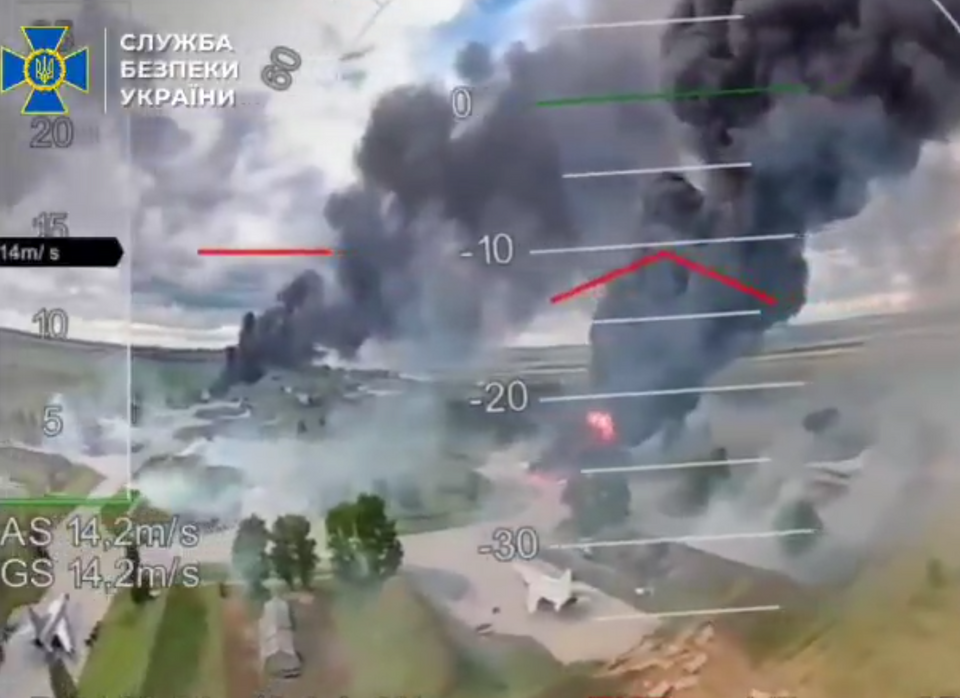
On 1 June 2025 the Security Service of Ukraine (SBU) mounted Operation Spiderweb, launching 117 drones from five covertly modified commercial trucks. These attacked parked aircraft at five Long-Range Aviation branch airfields spread across Russia, from Dyagilevo in the West, to Ukrainka in the Russian Far East. About 20 aircraft were severely damaged or destroyed making up around 20% of Russia’s operational nuclear capable Long-Range Aviation fleet. It has been estimated that two Beriev A-50U airborne early warning (AEW) aircraft, seven Tupolev Tu-95 and four Tu-22M3 strategic bombers were destroyed.
But it isn’t just large scale drone attacks by state forces that pose a threat to an air force’s High Value Assets (HVAs). When a small group of Palestine Action protestors broke into RAF Brize Norton shortly after midnight on 20 June 2025, they put two RAF Voyager tankers out of action with a little red paint and some crowbars thrown into engine nacelles. Police assessed that the act caused damage to the aircraft totalling around GBP 7 million.
On Friday 13 March 2026, it was the USAF’s turn to experience an airfield attack. Five of the 20+ KC-135R Stratotankers deployed to Prince Sultan Air Base (also known as Al Kharj) in Saudi Arabia were damaged in what is believed to have been a missile attack. Four of the five were reportedly already back in service within days, while one suffered slightly more damage, but was still repaired in theatre. The tankers had been deployed to Saudi Arabia in support of Operation Epic Fury – the US/Israeli operation against Iran.
The damaged aircraft were all parked on the packed flight line at the time of the attack, devoid of protection, and not dispersed. Commercial satellite imagery appeared to show one hit on an adjacent hangar, and there was speculation that some of the damaged aircraft may have been inside. The USAF has more than 350 KC-135s in service, and the attack had little effect on tanker availability.
When Prince Sultan Air Base (PSAB) was attacked again, on 27 March, it was clear that some lessons had been learned, though at least one, and perhaps two, large aircraft were damaged beyond repair.
On the by now less congested flight line, one KC-135R seems to have been destroyed in what was a coordinated assault by ballistic missiles and one way attack drones. Ten US service members were wounded in the attack, two of them seriously. But the six E-3G Sentry AWACS aircraft at PSAB had been dispersed, and they sat, well separated, on taxiways, and only one (81-0005) was hit. This aircraft, however, appears to have been damaged beyond repair. The rotodome was toppled, the rear fuselage was destroyed by fire, and the tail section was severed.
Prince Sultan Air Base is located South East of Riyadh, and is a major operating location for USAF aircraft supporting Operation Epic Fury, hosting F-22A Raptors, F-16 Fighting Falcons and E-11A BACN aircraft. The base has repeatedly come under attack, leading some to question why aircraft have not been dispersed more widely, to more local air bases, complicating enemy targeting and decision making.
The loss of a single E-3G is serious for the USAF, taking the in service fleet to just 15 aircraft, two of which are undergoing long-term maintenance. Iran has enjoyed some success in attacking ground-based missile warning radars, damaging the AN/FPS-132 phased array early warning radar at Al Udeid in Qatar, and hitting AN/TPY-2 radars at Muwaffaq Salti Air Base in Jordan, and at Al Ruwais and Al Sader in the UAE. The AN/TPY-2 serves as the primary sensor layer of the THAAD air defence system, so putting these ground-based radars out of action placed even greater importance on the E-3Gs.