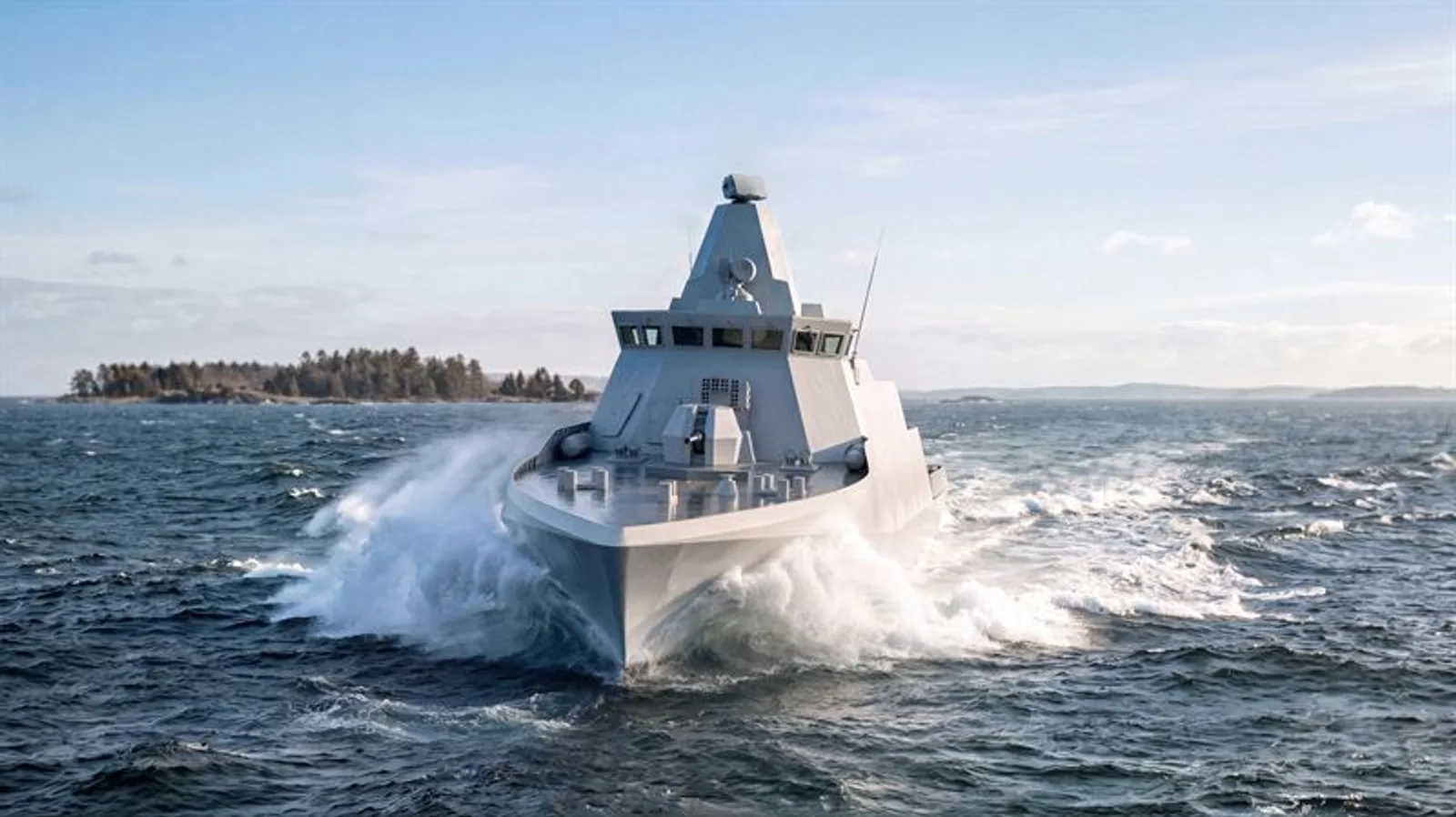
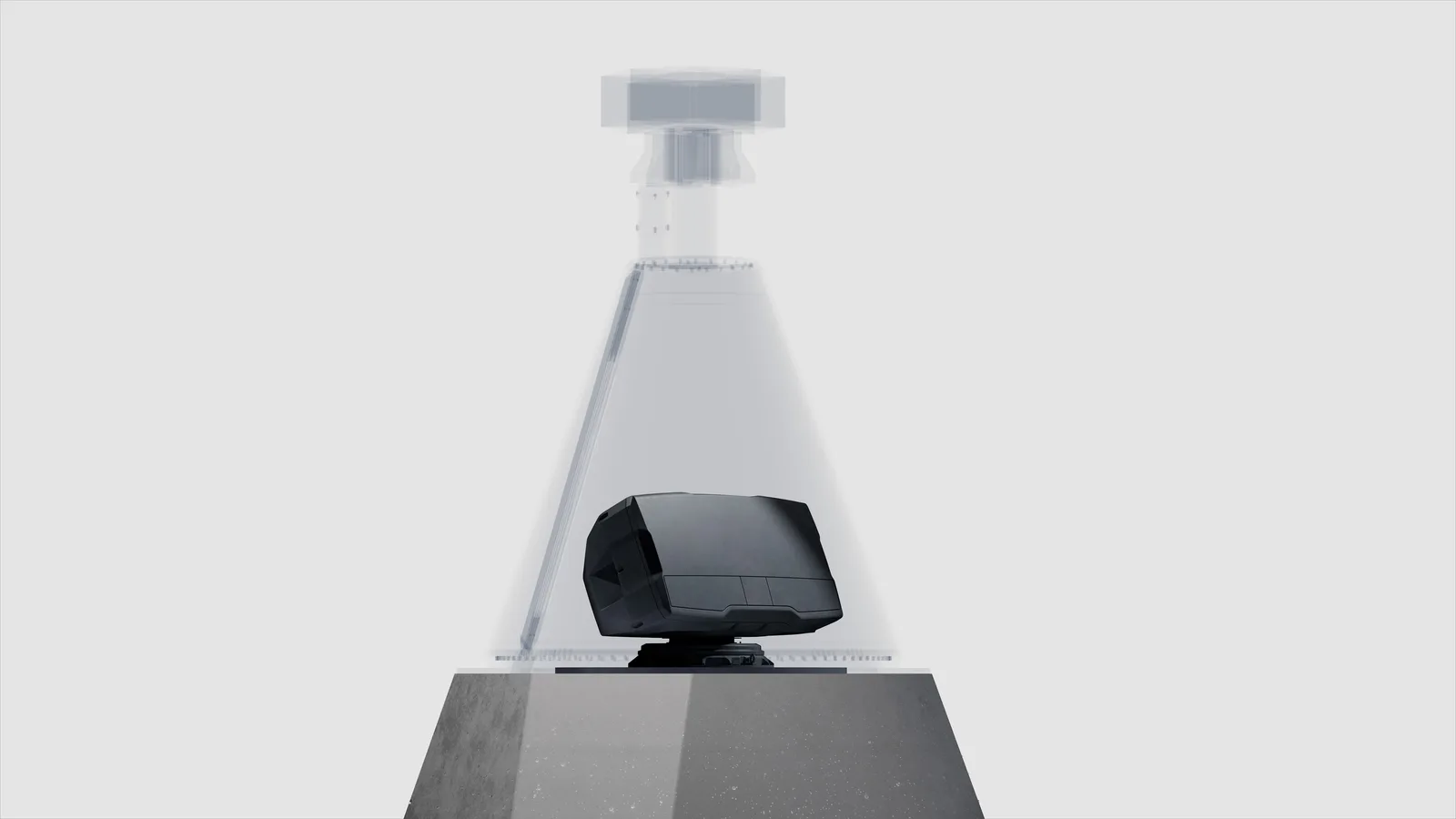
Saab has unveiled its new Sea Giraffe AMB D (Agile Multi-Beam D) radar system – what the Swedish defence and security company called “the latest evolution” of its Giraffe AMB radar.
This new addition to Saab’s collective suite of land-based Giraffe and maritime-based Sea Giraffe systems provides naval forces with “enhanced 3D surveillance and tracking of air and surface targets in increasingly complex maritime environments”, the company said in a 27 October 2026 statement.
“Sea Giraffe AMB D takes a proven naval radar capability to the next level, combining increased performance with a low footprint and an architecture built for continuous development,” Carl-Johan Bergholm, head of Saab’s Surveillance business area, said in the statement. “It is designed to meet the demands of today’s naval forces while giving customers the flexibility to evolve with future threats.”
Against broad customer requirements for building decision-making and wider operational advantage, Saab highlighted the Sea Giraffe AMB D’s ability to give improved early warning by being able to detect, track and classify aircraft, missiles and uncrewed aerial vehicles (UAVs) at ranges up to 250 km, as well as crewed vessels and uncrewed surface vessels (USVs) at ranges up to 50 km. The system’s overall capability is built around active electronically scanned-array (AESA) radar hardware, a new software architecture and accurate target information augmented by modern processing capabilities, the company added.
Complex environment
The evolution and expansion in the nature of naval threats is compounding the increased complexity in the contemporary operating environment. The Sea Giraffe AMB D has been developed to address such shifts in threats, Gustav Klock – naval sales director at the Surface Sensor Solutions unit within Saab’s Surveillance business area – told a media briefing.
In particular, the radar brings capacity to detect, at and from the sea, threats to critical infrastructure at sea and ashore. Such threats are already evident in the Baltic region and elsewhere. For example, in September 2025 UAVs appeared over shore-based civilian and military critical infrastructure sites in several NATO countries across the Baltic and North Sea region. Prior to that, the Baltic Sea had seen several incidents of damage to critical undersea infrastructure, prompting NATO to launch its ‘Baltic Sentry’ presence and surveillance operation to monitor surface vessel activity there.
Sea Giraffe’s niche
In describing the Sea Giraffe AMB D radar’s position within Saab’s radar portfolio, Klock explained that the AMB variant sits between the Sea Giraffe 1X, which is a compact, lightweight system providing short-range self-defence for smaller vessels in the 12-16 m range, and the Sea Giraffe 4A, which provides the power and reach to generate long-range air surveillance for larger ships like frigates.
The Sea Giraffe AMB D, an upgraded and modernised version of the Sea Giraffe AMB, provides particular response to several emerging threats, Klock explained. These include: UAVs and USVs; rocket, artillery and mortar rounds; and air-launched cruise missile (ALCM)-capable fighter aircraft.
The UAVs, USVs, and rocket/artillery/mortar ordnance can threaten naval platforms as well as critical infrastructure assets at sea or ashore. Fighter aircraft are an enduring threat, but their increasing capacity to carry more capable and affordable sea-skimming ALCMs – and even to launch glide bombs (free-fall bombs fitted with wing kits, as Russia has used in its war in Ukraine) – sharpens the edge to this threat.
Klock spelled out the Sea Giraffe AMB D’s contribution in all three cases, explaining that in each instance Saab has been developing the required technology and functionality for several years.
“[UAVs] offer a significant challenge because they fly fairly low, many of them fly fairly slow, and they have a very small radar cross-section,” Klock said, adding that the Sea Giraffe AMB D can separate out these low, small and slow targets.
“From a technical viewpoint, the drone-tracking function operates in the air domain, but we are also able to simultaneously identify and track small vessels on the surface, even during higher sea states,” Klock noted.
Regarding rocket, artillery and mortar threats, “The challenge is to protect critical infrastructure like harbours or maybe small airstrips,” Klock said, with the radar addressing this in different ways. First, through its increased sensing range, “You can either move the ship further away from the coastline and still be able to carry out this force protection task, or you can remain close to shore and cover a larger area inland,” he said. Second, using the radar’s ‘sense and warn’ function, “In a matter of seconds we will be able to calculate the trajectory, point of impact, and time to impact [and] be able to warn those in that area,” he added.
In tackling the fast jet threat, the radar’s enhanced range gives more time to react. “We can now detect [an incoming fighter] at a distance of about 140 km,” said Klock. “[If] the aircraft releases a sea-skimming missile, the missile can be detected either as soon as it reaches the horizon or, if it’s a regular missile [flying] slightly higher up, it will be detected more than 40 km away.”
Klock reiterated that the radar’s instrumented range is 250 km. “That’s not an overstatement,” he said. “We have been able to detect airliners beyond that.”
Klock stressed that many of the improved capability requirements and underpinning technology needs had been identified through close engagement with naval operators. “Throughout these years we have been in ongoing, continuous discussions and collaboration with our customers and end-users to really try to understand what their needs are and how they change,” he said.
Enabling technology
The capacity to tackle these and other threats effectively is facilitated by using the latest AESA technology, which supports improved tracking accuracy, including of high-speed manoeuvring targets; feeding this high-quality track data to an effector via the onboard combat management system; improving the performance-to-weight ratio by enhancing capability while maintaining the same system weight; and having a hardware and software architecture that enables regular updates (with the software updates enabled by the radar being digital).
Illustrating the radar’s tracking capacity, Klock explained that it can maintain simultaneous background tracking on up to 2,000 targets.
“An operator would never like to have a look at 2,000 targets simultaneously,” he said. “When we filter away and just have the targets that are of significance, the system keeps on tracking everything in the air and on the sea in the background, so if something is deemed uninteresting at one point but then starts to act a bit strangely, it pops up for the operator.”
“That’s why an important aspect is this target tracking capacity,” Klock added.
The improved power-to-weight ratio also means the radar can be positioned higher up on a ship’s superstructure, extends its reach and increasing its capacity to detect threats like sea-skimming missiles.