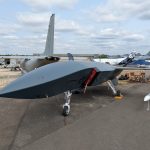

Rheinmetall announced on 10 August 2026 that it is establishing an independent system integration capability for the Boeing Australia MQ-28 Ghost Bat collaborative combat aircraft (CCA) in Germany.
The plan, which would see software development, mission integration and other intellectual property remain within the German industrial ecosystem, is designed to position the MQ-28 as the ideal candidate to fulfil Germany’s CCA requirement, which aims to field a limited initial fleet of CCAs by 2029 to give the Luftwaffe experience with operating them.
Boeing Australia aims to transition the MQ-28 Ghost Bat CCA into operations with the Royal Australian Air Force (RAAF) in 2028 and is currently placing a heavy emphasis on mission systems integration to achieve that goal.
Meanwhile, along with Boeing Australia, Rheinmetall is teamed with Rohde & Schwarz, Diehl Defence and Hensoldt to offer the MQ-28 for German service.
Glen Ferguson, Global Director of the MQ-28 programme for Boeing Defense Australia, was quoted by Rheinmetall as stating that, if the goal is for Germany to achieve a capability with CCAs by 2029, “this work must begin today with the development of tactics, training, definition of force structure and the integration of sovereign technologies”.
Politico reported on 22 July 2026 that “Several confidential ministry papers . . . show [German government] officials divided between purchasing Boeing Australia’s MQ-28 Ghost Bat as a bridge while European projects mature, or holding a competition first that would give German and European designs more time to develop.”
Mike Schmidt, CEO of Rheinmetall’s Business Unit Air, Uncrewed and Space, was quoted by the company as stating, “Germany does not have to choose between speed and independence. We offer a way to achieve both at the same time. The MQ-28 enables us to bypass the lengthy development phase of a new aircraft and go directly to the decisive task: making the capabilities of unmanned combat air systems available to the German Air Force.”
“The MQ-28 Ghost Bat has been designed from the outset as an extremely adaptable platform,” added Ferguson. Experiences gathered in operational use to date show that the MQ-28’s architecture can be quickly adapted to new mission requirements, including air-to-ground capabilities. This is not about a retrofit, but about using a modular design that is conceived from the ground up for continuous adaptations.”
In June 2026 at the ILA Berlin Air Show Boeing and Rheinmetall unveiled the new Block 3 Ghost Bat, which will feature internal weapons carriage, beyond-line-of-sight communications and a 25% larger, increased-span wing, allowing it to carry 2,000 lb (907 kg) more payload, thus taking the aircraft’s maximum take-off weight (MTOW from 10,000 lb to 12,000 lb and its maximum payload up to 4,500 lb (2,041 kg).