Further details of GCAP Combat Air Flying Demonstrator revealed

BAE Systems has shown its Combat Air Flying Demonstrator to a handful of journalists and issued a new CGI illustration of the aircraft. The aircraft is due to fly towards the end of next year and will serve as a flying technology demonstrator tasked with de-risking the main Tempest (GCAP) platform. The demonstrator is not the Tempest prototype, but is instead a pathfinder for industrial, technical and workforce transformation.

GCAP render
BAE Systems released this new CGI of the Combat Air Flying Demonstrator on 27 June 2026, affording a much better look at the aircraft and revealing some new features. (BAE Systems)
Jon Lake
GCAP render
The demonstrator will provide a de-risking bridge to GCAP (seen here), accelerating the development of advanced design approaches and manufacturing techniques and giving UK industry the skills it will need in order to deliver GCAP. (BAE Systems)

The UK government announced the decision to produce a flying technology demonstrator to de-risk the main Tempest programme in July 2022, some five months before the Global Combat Air Programme (GCAP) launch transformed the Tempest effort into a trinational programme.

Richard Berthon, the UK Ministry of Defence’s (MoD’s) Director of Future Combat Air, described the aircraft as being the first flying combat air demonstrator in a generation and said that it would play a key role in proving the technology and design principles behind the Tempest Future Combat Air System (FCAS). He said that the demonstrator would fly within the next five years (ie by July 2027).

The demonstrator’s crew escape system was tested at Langford Lodge in Northern Ireland using two dummies, representative of the anthropomorphic range of pilots, at speeds of 280 kn (518.56 km/h) and 450 kn (833.4 km/h). (BAE Systems)
The CAFD uses a Martin-Baker Mk 16A ejection seat as used in the Typhoon, and the aircrew will wear Typhoon flying gear, including the standard aircrew equipment assemblies and Mk10 helmet. (BAE Systems)
The ejection seat was tested in an accurate and aerodynamically representative facsimile of the CAFD forward fuselage. (Photo: BAE Systems)

Work began some time before the announcement and the escape system (based around an unmodified Martin-Baker Mk16A ejection seat as used in the Eurofighter Typhoon) was tested at Chalgrove and Langford Lodge between December 2021 and June 2022.

The EJ200 powerplant (sourced from the MoD and also from the Typhoon) began TDV3/1 intake integration testing at Filton (in the same TP-14 test cell in which Concorde’s Olympus engine was tested in the 1960s) from early November 2022 to mid-February 2023.

The aircraft’s serpentine engine duct ensures that airflow arrives at the engine face in as clean a state as possible. The aim is to “provide the engine with the ‘quality’ of air that makes the EJ200 think that it’s sitting in a Typhoon,” explained Conrad Banks, chief engineer for Rolls-Royce Defence Future Programmes, as this will enable the powerplant to be operated in the demonstrator using existing flight clearances.

Tempest engine TDV3/1 intake integration testing was undertaken in the TP14 testbed at Rolls-Royce’s facility in Filton, Bristol, using a third duct built specifically for testing. (Rolls Royce)

The serpentine ducting wraps over the weapon bays while blocking the fan blades from enemy radar – which was reportedly a major focus and challenge. BAE Systems platforms delivery director Paul Wilde said that, thanks to the demonstrator’s all-digital design, “We can now do things in seconds that could take months before. We can model how the air looks as it flows through the intake and ducts. Ideally there will be no swirl or distortion, or we at least know what it is.”

The engine performed as expected during testing, without distortion or resonance issues, and there is claimed to be complete confidence that the engine/intake/duct will perform as advertised throughout the whole envelope.

As well as its engines and ejection seat, the demonstrator will include a number of parts sourced from “a number of different aircraft that the that the UK operates”, including the landing gear, which will be modified from a Tornado undercarriage.

Although the design almost certainly has a Warton project designation or ‘P-number’ (one Tempest concept is the P189-17B, for example), this remains unknown and the aircraft has not been formally named. To add to the confusion, the aircraft was initially described as the Tempest Flying Technology Demonstrator in 2022-23, then as the Crewed Combat Air Demonstrator in 2024 and more recently as the Combat Air Flying Demonstrator (CAFD) or Combat Air Demonstrator in 2025.

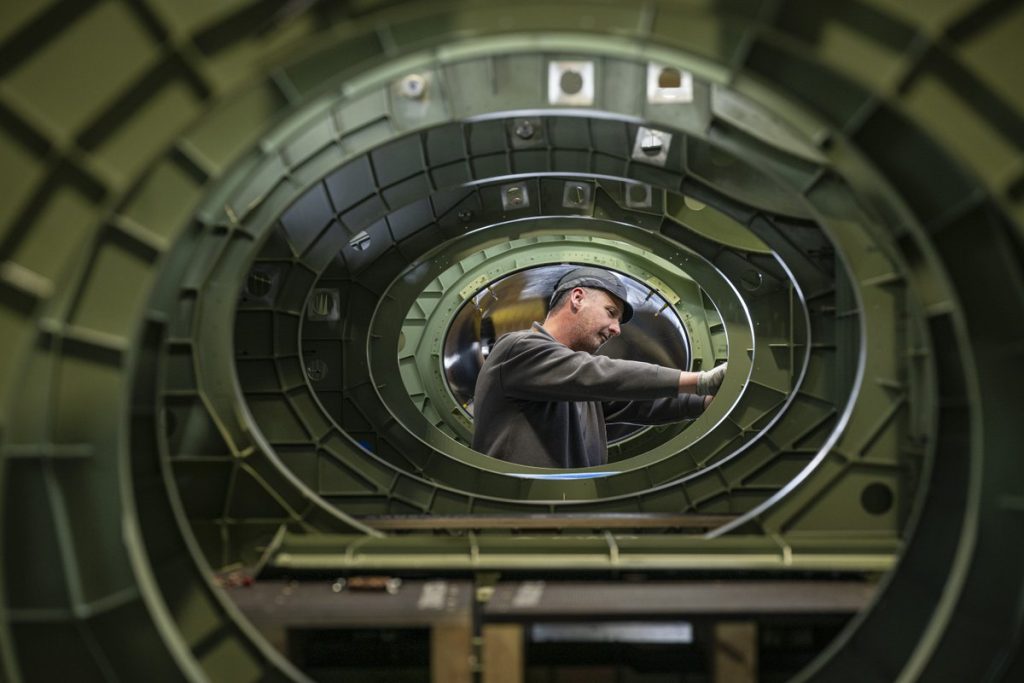
The first images of the CAFD showed the forward fuselage under assembly at Samlesbury. The forward fuselage bears some resemblance to a manufacturing test unit seen previously and shown to visitors at BAE Warton. (BAE Systems)

The demonstrator described

The first images of the demonstrator were photos of the forward fuselage in assembly, which gave little away as to the aircraft’s configuration. On 16 July 2025, with two thirds of its structural weight by then in manufacturing, BAE Systems announced that it was revealing “the design of the UK’s flagship Combat Air Flying Demonstrator,” issuing a CGI rendering of the aircraft. This was a front view and was deliberately unrevealing, with the company giving little away in briefings or in answering questions from journalists.

BAE Systems issued a first CGI render of the aircraft on 16 July 2025, announcing that it was revealing “the design of the UK’s flagship Combat Air Flying Demonstrator”. The angle chosen gave little away. The job of the demonstrator is to get industry “match fit for the main event”. (BAE Systems)

Little has changed in that regard, although a new rendering was released on 26 June 2026.

The intake ducts shown to the press in 2023 had already indicated that the demonstrator aircraft would be large, with BAE Systems pointing out that it had to be “in order to demonstrate some of the technologies… some of that requires a material size, a platform to be able to do so, in terms of the relative scale to GCAP”.

Perhaps unsurprisingly, the demonstrator aircraft has twin fins and twin engines and lacks horizontal tails. Superficially, the aircraft resembles a tailless F-35, with forward-swept intakes and a ‘chined’ forward fuselage. The demonstrator appears to have a ‘boxed in’ rear fuselage section, giving a broad, flat upper fuselage like that of the original Tempest ‘Pregnant Pelican’ model revealed in 2018.

Images of the Combat Air Flying Demonstrator and GCAP allow a comparison of the two aircraft. The tailfins are very different and there are significant differences in leading edge and trailing edge sweep. There are also interesting differences in cockpit and upper fuselage shapes. (BAE Systems)

The aircraft has a slightly cranked inboard leading edge, perhaps a simple leading-edge root extension (LERX), which would seem to be less than ideal from an LO point of view, but no explanation was offered for this. There is modest forward sweep on the trailing edge and the wingtips are parallel to the aircraft centreline. BAE Systems describes the aircraft as having a “cropped delta” configuration. This is unlike the Lambda wing of the original ‘Pregnant Pelican’ Tempest concept and was entirely dissimilar to the unusual planform of the ‘Concept Class 5’ study. It is, however, more similar to the ‘big Delta’ concept unveiled at Farnborough in 2024. This ‘simpler’ shape may have been chosen for cost/structural complexity reasons, although BAE Systems refused to confirm this speculation.

Tony Godbold, FCAS Delivery Director at BAE Systems, noted that the design “follows the legacy and heritage of BAE Systems and British Aerospace of large-tailed and large-finned aircraft”, with the TSR2, Tornado, Experimental Aircraft Programme (EAP) technology demonstrator and Typhoon all having had large tailfins.

The demonstrator’s large vertical tailfins appear more conservative than those seen on Tempest concepts, ‘rectangular’ in shape (or trapezoidal) rather than using the ‘five-sided’ fins seen on previous GCAP/Tempest concepts. They also appear less canted and also less ‘swept’ in side elevation and thus more ‘upright’.

In the CGI the aircraft is shown with a single-piece windscreen and canopy, although it will actually have a separate windscreen and canopy, like the ejection seat test sled.

The aircraft is not, in any sense, a Tempest prototype and certainly not “in terms of shape or size”, according to Air Commodore Martin Lowe, the MoD’s FCAS programme director. The aircraft may not even resemble the definitive production GCAP fighter, the final configuration of which has not been decided, let alone frozen. However, it will be representative of next generation combat air platforms – a crewed, supersonic fighter-type airframe with LO design features.

The demonstrator will act as BAE Systems’ ‘bridge’ to producing a future sixth-generation fighter via the Anglo-Italian-Japanese GCAP effort and will be used to develop both technologies and the suitably qualified and experienced personnel (SQUEP) that the GCAP programme will require.

“The core element of this is left-shifting the risk, looking to learn now, to trip up on things now that we don’t want to when we get into the main programme,” Godbold explained.

The demonstrator will enable BAE Systems to exercise its next-generation combat air design capabilities and to test, evaluate and show key elements of the ‘foundation technology’ planned for the Tempest, but the aircraft will also be used to develop the skills, tools, processes and techniques that will be needed to create the Tempest.

The aircraft incorporates some low observability (LO, or ‘stealth’) shaping techniques similar to those that will be employed on the Tempest platform, thereby exercising BAE Systems’ LO design capabilities.

These capabilities stem from the company’s learning on the secretive Replica project and on the Taranis unmanned combat air vehicle, which is regarded as having been “cutting edge on a global scale”, but GCAP (and the demonstrator) will take stealth much further forward.

Godbold noted, “The low observable requirements were such that we are not sure the physics exist for this yet for what we needed to try and achieve! That’s the level that we are shooting for within this whole programme.”

The demonstrator aircraft is not expected to be fully stealthy, since stealth coatings are unlikely to be applied and engine nozzles will be conventional (though Aviation Week’s Tony Osborne reported that it would have “modified engine nozzles rather than the standard Eurofighter Typhoon installation”. The canopy will also be of conventional construction and will incorporate miniature detonating cord, making it relatively conspicuous to radar.

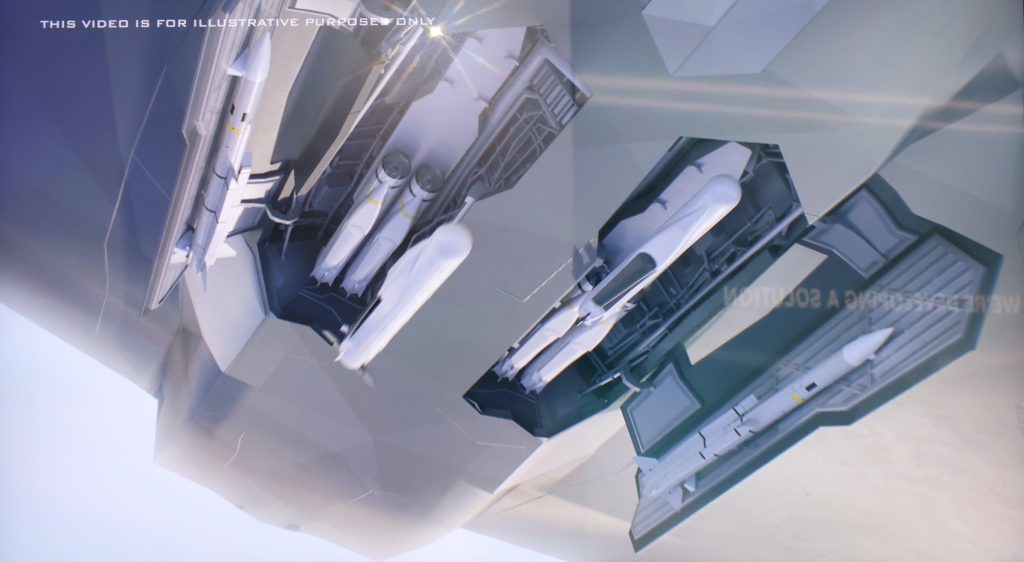
Like GCAP itself, the Combat Air Flying Demonstrator has capacious weapon bays, providing what is claimed to be double the payload of the F-35A. (Jon Lake, MBDA video screengrab)

The aircraft will, however, feature an internal “integrated payload bay”; those journalists who saw the fuselage in build at Samlesbury reported seeing two deep internal weapon bays positioned forward of the main landing gear. Their size was commensurate with claims that GCAP will have about twice the internal weapons payload of the F-35 and will potentially carry larger-diameter and longer effectors. There is some confusion as to whether weapons will be released from the LO-compliant internal weapon bays during testing.

Flying already

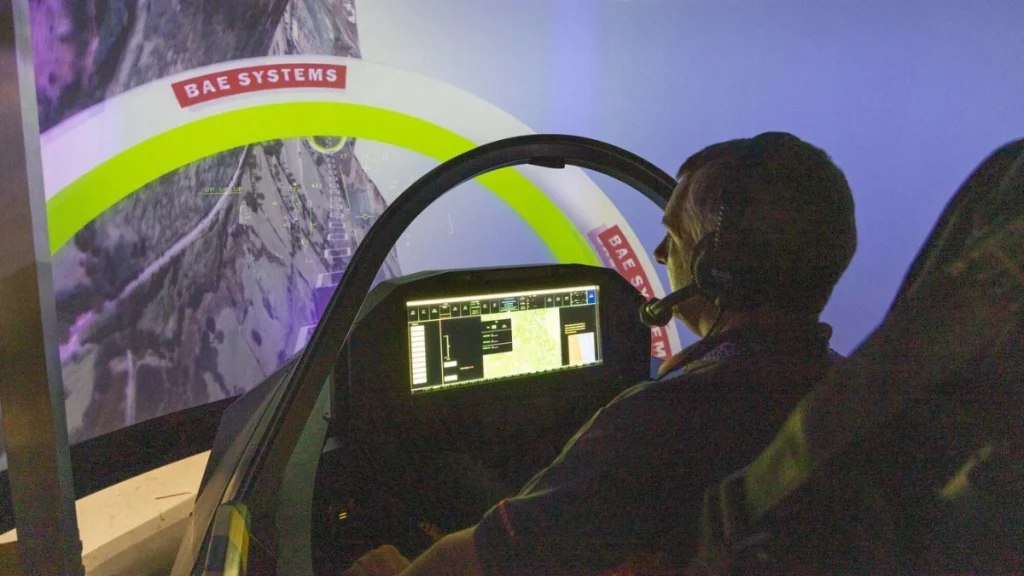
Testing of some elements of the CAFD are already underway. The demonstrator facility at Warton incorporates a so-called hybrid rig, employing a mix of hardware, emulators and digital models, all designed to provide the crucial evidence that will support real-world, live flight trials. This consists of four linked development rigs, with one for the cockpit, one for the flight control system, one for computing and models, and another for the utility management system.

The hybrid rig includes a ‘fixed base’ simulator with a representative CAFD cockpit. This is dominated by a large area display similar to that being developed for future Typhoon upgrades. (BAE Systems)

The cockpit rig is being used to develop, test and evaluate flying controls, flight control laws and displays. It will eventually be used for pilot training prior to first flight. The cockpit rig has a touchscreen large area display (LAD) but does not use the smaller high-integrity panels (HIPs) that are a feature of the similar LAD cockpit being developed for the Typhoon. Largely because of the size of the LAD, the aircraft will use a sidestick rather than a central control column.

The hybrid rig is connected to a physical triplex fly-by-wire (FBW) flight control system. This controls a set of actual hydraulic actuators for the three flaperons on one wing and one for one of the ruddervators, with digital models representing the controls on the other side of the aircraft.

Long before the demonstrator completes assembly and takes to the air, the hybrid rig is being used to facilitate advances in modelling flight control laws. Auto coding of flight control software and software generation techniques, backed up by feedback from the test pilots who have now flown more than 300 hours in the rig, have been used to expedite FBW and handling development.

Godbold said that, with more than 300 virtual test flights in the rig, the aircraft’s flight control system is now far ahead of where it would be following the procedures used in previous projects. “That complete loop has allowed us to mature the design of the flight control system much earlier than we could before and to develop a digital twin to that system,” Godbold noted.

At least 13 pilots have flown the rig, including four Warton-based BAE Systems test pilots (Steve Formoso, Andrew Mallery-Blyth, Luke Gili-Ross and Glyn Gogerty) and a team of six pilots from the Royal Air Force’s (RAF’s) Rapid Capabilities Office (RCO) and the RAF’s No.41 Test and Evaluation Squadron, led by Group Captain Willie Hackett.

Advanced manufacturing

The CAFD programme is not just about producing a manned, supersonic, low-observable fighter-type airframe to derisk Tempest ‘foundation technology’. How the aircraft is manufactured and assembled is also of vital importance. The team will employ innovative design, engineering and manufacturing technologies, including model-based systems engineering and virtual simulation, additive manufacturing, collaborative robotics (cobotics) and digital twins. This will ensure that engineers from BAE Systems and the wider supply chain are at the forefront of the ongoing revolution in aircraft design and manufacturing, providing them with invaluable knowledge, experience and skills.

Godbold believes that the demonstrator programme will enable BAE Systems and the wider UK combat air sector to be fully “match fit” for the GCAP programme and will give “credibility to a UK sovereign industry capability”.

The use of digital design, model-based systems engineering and additive manufacturing “gets us early testing and generating real-world data that we are leveraging in the design process; it is a critical de-risk programme for GCAP,” said Goldbold. He added that the company has learned things by undertaking the demonstrator activity without which there would have been significant problems down the line. “We have probably saved ourselves a number of years of development risk,” he asserted. “We are pushing boundaries, testing new things, trying new things out in engineering and manufacturing to get ready and match fit for the main programme.”

Godbold observed, “We’re pushing the boundaries of not just how we’re designing it, but also how we’re assembling some of these products.”

Among the capabilities, tools and processes being developed and tested that will underpin the GCAP programme are some revolutionary additive manufacturing technologies that allow the manufacture of “parts that traditional techniques just can’t achieve, so you would [otherwise] have to compromise on the requirement, design or performance”, said Godbold.

The titanium intake-fuselage junction, for example, is manufactured as a single component using additive manufacturing. It could not have been produced using conventional manufacturing techniques due to its complex shape.

The demonstrator also incorporates structural parts produced by hot isostatic pressing (HIP). HIP is used to create titanium parts via powder deposition, taking titanium powder and fusing it together using extreme heat and pressure to create parts that could not otherwise be manufactured as a single piece.

Traditional casting and machining methods might require a four-year lead time and produce significant amounts of waste, while HIP can take just six or 12 months. On the demonstrator, actuator cradles for the large trailing-edge control surfaces have been produced using a HIP technique.

Although the demonstrator’s wings are being manufactured at Warton, BAE Systems did not manufacture wings for the Tornado and Typhoon and is having to reach back as far as the Hawk and Harrier programmes to relearn its wing manufacturing competences. The huge carbon wing skins have been “made using a different set of technology than we’re used to”, said Godbold.

The final set of wing skins for the aircraft were delivered to Warton on 14 July 2025.

The aircraft’s centre fuselage skin has been described as the largest-ever carbon composite component to have been produced for a military aircraft in the UK. The use of very large single-piece skins is advantageous from an LO point of view, since surface gaps and discontinuities are very much to be avoided.

BAE Systems has long experience of very tight tolerances and surface ‘quality’ thanks to its work on Typhoon and also on F-35 rear fuselage sections. This will provide a useful stepping-off point for manufacturing and assembling what will be a stealth aircraft requiring extreme standards of external smoothness.

‘Re-brigading’ manpower resources and building the SQUEP

To a surprising degree programme insiders enthusiastically emphasise that the demonstrator programme is as much about developing skills in a cadre of suitably qualified experienced people (SQUEP) as it is about developing, facilitating and demonstrating industrial technologies and capabilities, let alone anything more operationally focused like combat air technologies. This is because BAE Systems has not designed and developed a new combat air platform from scratch for almost half a century, meaning that few of the company’s engineers have any experience of doing so.

Air Commodore Johnny Moreton, a previous UK programme director for the UK Future Combat Air Programme, stated, “One of the life lessons here for a demonstrator programme is: ‘Do we have the suitably qualified experienced people that can actually build an aircraft from scratch, go and certify an aircraft, and go and fly the first one?’ Because that’s not something that the UK has done for a while. And actually, that’s a skill set that’s really quite important. How do we get to that world? It would be useful to have some form of design/methodology in sight that says: ‘Actually, I can learn for the future’. So the demonstrator is very much a ‘Let’s get UK industry and the partners match fit for the future and exploit it downstream as well.’”

Godbold said the programme was “about re-brigading ourselves and the wider UK industry about what it means to design and manufacture an aircraft from first principles again…. It’s been four decades since we’ve done something like this and been at this phase of the programme.”

Working on the programme is equipping BAE Systems’ already experienced and new engineers with the knowledge required to design and build the future operational crewed fighter.

Godbold told journalists, “We have probably had over 200 people now come through Workstream 5 [the company name for the demonstrator programme] who are now employed within GCAP in some shape or form.”

Progress

The CAFD design passed its critical design review (CDR) in May 2024, when BAE Systems said that half of the aircraftʼs weight was by then in manufacturing or assembly. The company now says that more than 75% of parts by volume have now been produced, the vast majority of which have been sourced from the UK supply chain. Most of the demonstrator was manufactured outside Warton, in the wider supply chain across the UK.

More than 75% of parts by volume of the CAFD have now been produced, the vast majority of which have been sourced from the UK supply chain. Major structural sections have been in production for the past 12-18 months. (BAE Systems)

Major structural sections have been in production for the past 12-18 months and rollout is planned before the end of 2027. The rear fuselage section has ‘hardback mounts’ in place for the aircraft’s canted twin tailfins and was starting to have its skin drilled in place in June 2026.

“We really are at the business end of the programme now,” Godbold observed. Final assembly of the front, centre and rear fuselage to form what BAE colloquially calls the ‘cigar’ is underway at the company’s Samlesbury site, in part of the factory producing Typhoon forward fuselage sections. This assembly process is referred to as a ‘wet build’, since the fuel system is being installed at the same time.

The ‘cigar’ will then be moved to Warton, where it will have its wings and tailfins fitted.

Towards a maiden flight

Godbold noted that that work is already underway towards securing military airworthiness certification. “The overall programme is making really good progress and we are on track to get the aircraft ready for the end of next year,” he said. “We are working very hard with the MoD and the CAA [UK Civil Aviation Authority] to get a robust route-to-clearance plan in place.” This will be the first time that BAE Systems has undertaken the full certification process from scratch.

It has been suggested that progress with certification will inform a decision on the timing for the first flight, which is now said to be likely to take place in late 2027 or even during 2028.

To avoid any confusion or suggestion that the programme has been delayed, BAE Systems has stressed that the aircraft will be ready for a first flight by the end of 2027, but that the exact date will be finalised/selected nearer the time, based on a number of factors around the core GCAP programme, regulator etc. There is said to be a degree of “nuance between when the aircraft will be ready to fly versus when the programme will determine is the best date to fly”.

An uncharitable observer might note that BAE Systems is now talking about a first flight by the end of 2027, rather than by the end of July 2027, which would mark the end of the original “within five years” timescale announced in July 2022.

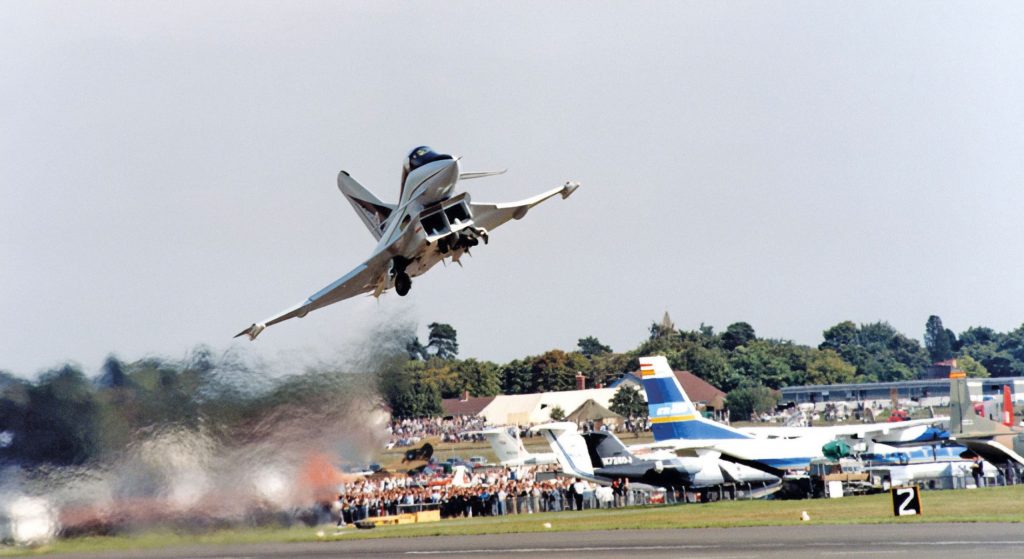
The EAP, which first flew in 1986, casts a long shadow over the CAFD and is frequently referenced by programme managers and senior engineers. It flew supersonically on its maiden flight. (BAE Systems)

It is surprising how often the subject of the original EAP technology demonstrator comes up in discussions about the CAFD. Air Cdre Lowe is given to reminiscing about having had a poster of EAP on his bedroom wall as a boy and finding the project every bit as inspiring as he hopes today’s youngsters will find the new demonstrator.

Godbold remembers growing up “having textbooks with EAP in them and it was one of the inspirations that drew me to the industry and a career in engineering…. It’s one of those moments where you pinch yourself sometimes: you’re part of the team, part of the organisation that is doing this again after a 40-year gap. Sometimes the hair stands on the back of your neck because we’ve got a real aircraft taking shape here!”

The EAP famously broke the sound barrier on its first flight on 8 August 1986 and some suspect that there might be an aspiration for the CAFD to do the same.

“As we mature our design and align this with GCAP, there are other potential emergent experimentation opportunities of what else we could do with a supersonic test aircraft, and these are becoming clearer,” Godbold hinted. “It’s quite an exciting time.”

Wilde believes that the importance of the CAFD cannot be over-stated. “The flying technology demonstrator is a vital initiative for developing national skills and advanced technology, ensuring the UK remains a world leader in the design, production, test and certification of combat aircraft,” he said. “Partnering with around 100 UK suppliers, including our Team Tempest partners, we’re combining engineering expertise with innovative methods to enhance and refresh crucial industrial skills which is so important as we get ready to deliver the Tempest programme. The demonstrator is a ground-breaking initiative that will showcase the best of British engineering, supporting apprentices and graduates who learn from our best engineers, keeping the UK at the forefront of defence and aerospace.”

More assets

As mentioned, the CAFD is not fully representative of the GCAP fighter, lacking many systems and elements. It does not have representative sensors and is powered by existing engines, for example. To make up for this the aircraft is augmented by an array of other rigs, technology demonstrators and testbeds, most of them ground-based but also including some flying hardware.

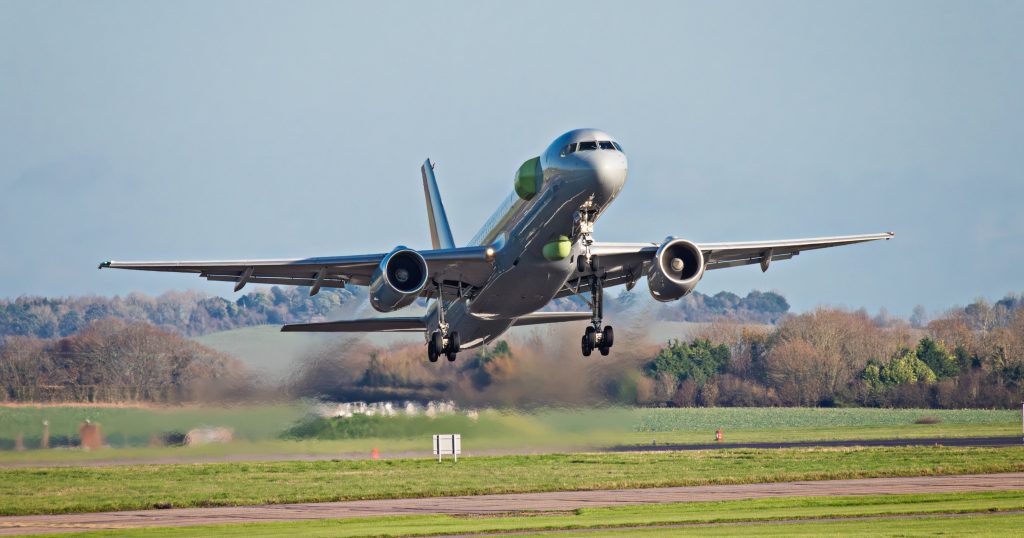
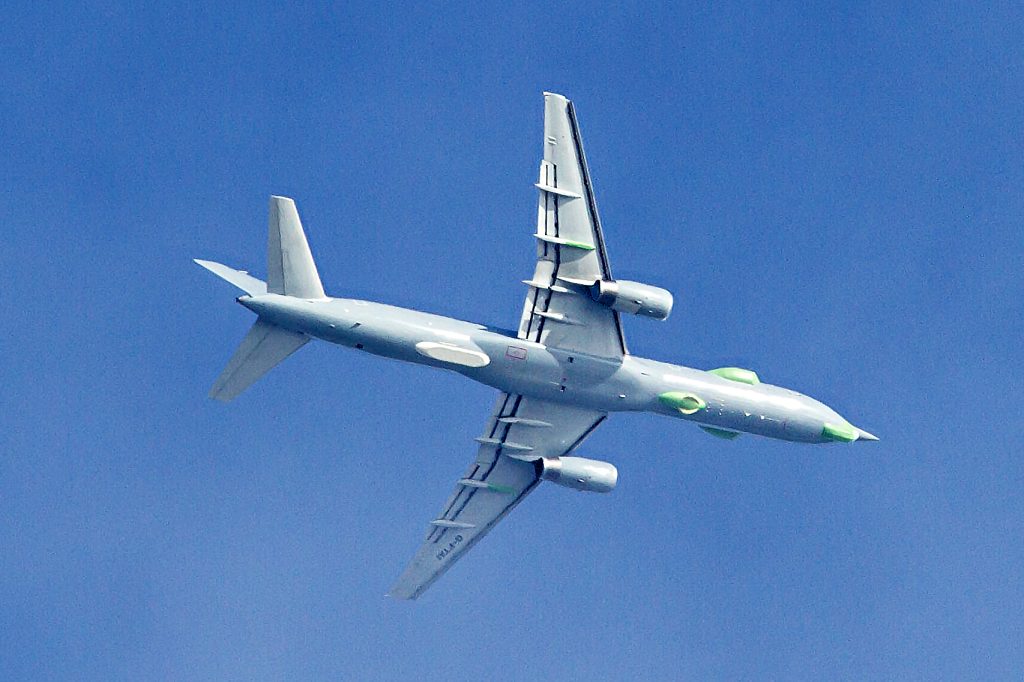
Excalibur is a heavily modified Boeing 757-200 converted and operated by 2Excel Aviation and developed in partnership with Leonardo UK. It is seen here in its original configuration with belly and side (cheek) pods. (2 Excel)
Excalibur is seen here with its pointed nose and chin radome, and with a new canoe radome under the rear fuselage. The aircraft is tasked with the integration and testing of the Tempest’s advanced sensor and communications system payloads. (Ron Smith)

The first of the flying demonstrators is the Excalibur Flight Test Aircraft: a heavily modified Boeing 757-200 converted and operated by 2Excel Aviation and developed in partnership with Leonardo UK. Excalibur has been purpose designed to test the Leonardo Integrated Sensing and Non-Kinetic Effects (ISANKE) and Integrated Communications Systems (ICS) that will equip the production Tempest. The aircraft will be used as a flying laboratory, testing and de-risking some of the next-generation combat air technology being developed for the sixth-generation Tempest, including an array of sensors, datalinks, digital communication systems and electronic warfare/electronic attack systems.

After one redundant Boeing 757 was taken apart for scanning to produce an accurate digital twin, the second airframe was converted at Lasham, Hampshire, in a number of phases.

Belly and side (cheek) pods were added first, along with operator stations in the former airliner’s cabin. The pointed nose radome was added subsequent to initial airworthiness flight testing and preparations are now underway for the integration and testing of the Tempest’s advanced sensor and communications system payloads. The aircraft eventually received 10 operator stations and 16 mission equipment racks.

Flight tests are being undertaken from the MoD flight test centre at Boscombe Down in Wiltshire.

It has been reported that further testbed aircraft supporting the GCAP programme will soon include a modified Gulfstream business in Italy, operating as a dedicated sensor and avionics testbed. In Japan a modified Kawasaki C-2 transport aircraft has also been converted to serve as an airborne laboratory.

Share post

You may be interested in

Categories

All NewsAir

Used tags

BAE SystemsCombat Air Flying DemonstratorFuture Combat Air System (FCAS)Global Combat Air Programme (GCAP)Martin-BakerRoyal Air Force (RAF)Tempest

Similar posts