Integrated delivery
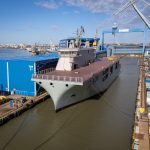
With a scheduled delivery to the navy in early 2027, the ship’s programme is already very busy.
“We are working on developing all the integration processes for the ship,” said Capt Mourinha. This encompasses doctrine, organisation, training, materiel, personnel, leadership, facilities and interoperability; work on each is conducted in parallel, given the overlaps between them.
Training, for example, involves both preparing personnel for their jobs and conducting operational training with the ship, the latter contributing to the development of standards – and, thus, doctrine – for operating what is a new ship type. For example, Capt Mourinha explained, “Training connects with doctrine development because we need to develop the doctrine and the brand-new organisation of the ship to be able to develop training syllabuses we then put in place to train the crew.”
This layered process means pushing hard to get everything in place in time, but also presents an opportunity to consider new ways of operating this new ship type, especially to better reflect current and future naval operational requirements, Capt Mourinha added.
As regards timelines for generating ship operation, the first activity getting underway is commissioning individual pieces of equipment and systems on board. This complex phase, anticipated to last until October, involves running and testing these items with shipbuilder Damen.
Then, harbour acceptance trials will commence. With the ship still alongside, equipment and systems can be tested further in terms of demonstrating their operational capability.
Next, sea acceptance trials are set to take place very early in 2027, in Romanian Black Sea territorial waters. Here, the focus will fall in particular on systems that require the ship to be moving, including engines, power and propulsion, and navigation.
Upon conclusion of these trials, Damen is scheduled to deliver the ship to Portugal.
With the navy now moving through this three-step process, Capt Mourinha said plans currently are on track to meet an April 2027 delivery date.
Post-delivery, the navy will undertake work for a month or so on what the CO called ‘fine tuning’, like adjusting systems to reflect the navy’s doctrine. In addition, final crew training on ship safety and operation will occur, led by the navy’s ‘sea rider’ training staff. From this, the crew and ‘sea riders’ will develop both ship safety and operational training plans. The latter is important, Capt Mourinha explained, because it will enable the crew to prepare to meet the first few mission requirements.
The first mission capabilities likely to be developed are capacity to host scientists and conduct scientific research; to bring on board MUS systems and their teams; and to exploit the ship’s organic and embarked sensors, Capt Mourinha said.
Central to the operational training plans is developing capacity for the ship to accommodate different capabilities – provided in a modular manner by embarked teams, exploiting the ship’s space and flexibility – to meet the multi-role output.
The operational training plans will then be performed at sea to demonstrate the ability to operationally integrate the embarked capabilities and teams. “This is like building up a large mosaic, where several pieces are being added. The pieces require at least four important things: people, equipment, doctrine and training,” said Capt Mourinha. “The training together of these teams with the ship will be formalising the addition of a new capability to its portfolio.”
Regarding embarking new capability, “When we talk about MUS systems, we need to take into account that each single one is like a new addition too because it needs to be integrated and operated on board and to have doctrine designed for how we operate it,” the CO explained.
Initial to full
In early 2027 the navy is also aiming to achieve initial operational capability (IOC) with Dom João Segundo.
“Because of our IOC concept, this will be fulfilled before the ship sails for its first mission,” Capt Mourinha said. “As soon as we have a mission and we are trained and set to do it, we consider that we have fulfilled IOC.”
Beyond this, the navy plans to push ship capabilities forward with a view to meeting a longer-term aim for full operational capability (FOC) delivery in 2028. However, this timeframe is far enough away that it is not set firm. “FOC is a lengthier process because it requires adding these pieces that build the full mosaic of ship capabilities,” said Capt Mourinha. “We would like to have FOC in 2028 …. [However], a lot of things in the ship and a lot of stuff that is being done on board are quite new, so we need first to assess how long it will all take to be implemented.”
The complexity of a phase like FOC underlines the navy’s broader challenge of delivering a lot of work in a short timeframe to bring a new ship and a new concept to operational life. The navy is very focused on this challenge, however. “Integrating all this into a ship, into a single piece, is … complex and requires a lot of work. That is my main challenge now: to link all this together and put it into the ship,” said Capt Mourinha.
Alongside linking the new systems and capabilities, a particular layer of complexity is the C2 architectural framework to integrate, manage and operate these capabilities.
“The C2 is complex for a couple of reasons,” said Capt Mourinha. First, not only will the ship have more organic assets on board compared to other ships before (with the exception of an aircraft carrier), but these organic assets will be mostly, if not all, uncrewed. The concept is that many of these MUS will be operated simultaneously too, he added.
Second, the ship and its complex MUS operations will occur in waters where many other ships will be present, including from naval allies with some operating their own MUS. Many of these MUS systems, and the ships embarking them, will be connecting to maritime operational centres (MOCs) ashore as well. “So we need to have a common operational picture [COP] where we see each other and where we co-ordinate our operations,” said Capt Mourinha. To help unpick this C2 complexity, the navy has developed a modular C2 architecture platform bespoke to Dom João Segundo. Called Tróia, it was developed by CEOV (Célula de Experimentação Operacional de Veículos Não Tripulados): the navy’s MUS technology innovation and development cell, headquartered in Almada.
Offboard capability on board
The IOC timeframe is also a framework within which the navy will have embarked on board Dom João Segundo an initial set of MUS capabilities, Capt Mourinha explained. While only an initial ‘load-out’, it will still demonstrate the multi-domain operational requirement the MUS capability must meet.
The initial fit will include four types of UAV systems: the Heifu Pro/BHV616 advanced tactical hexacopter; the VTOne fixed-wing UAV; the Uavision Ogassa; and the Tekever AR3-EVO.
Four USV types could be embarked: the navy’s own Barracuda, developed under CEOV’s Sea Tractor programme; two small, short-range USVs for hydrographic purposes (and in use with the hydrographic office); and possibly a multi-purpose version of the Portuguese-made MV7 (itself evolved from the Ukrainian Magura USV).
UUVs number two types: the Teledyne Gavia autonomous underwater vehicle (AUV); and the indigenous (navy/Porto University) SeaCON AUV.
The presence on board of MUS from all domains underscores the operational need to deliver MUS effect in all domains.
“These are the MUS we are planning to have at the very beginning,” said Capt Mourinha. “Then, we’ll be integrating new MUS as soon as they become navy capabilities. Meanwhile, we will be experimenting with others that might come from the navy and CEOV, or from industry.”
MUS capability will be embarked under X31 squadron: the navy’s in-house, all-domain MUS acquisition, experimentation, integration, and operation unit. X31 sits administratively under CEOM in Tróia and operationally under the Fleet Commander. Its task of accelerating delivery to the operational commander mirrors Dom João Segundo’s own concept of bringing new MUS capability into operational service quickly.