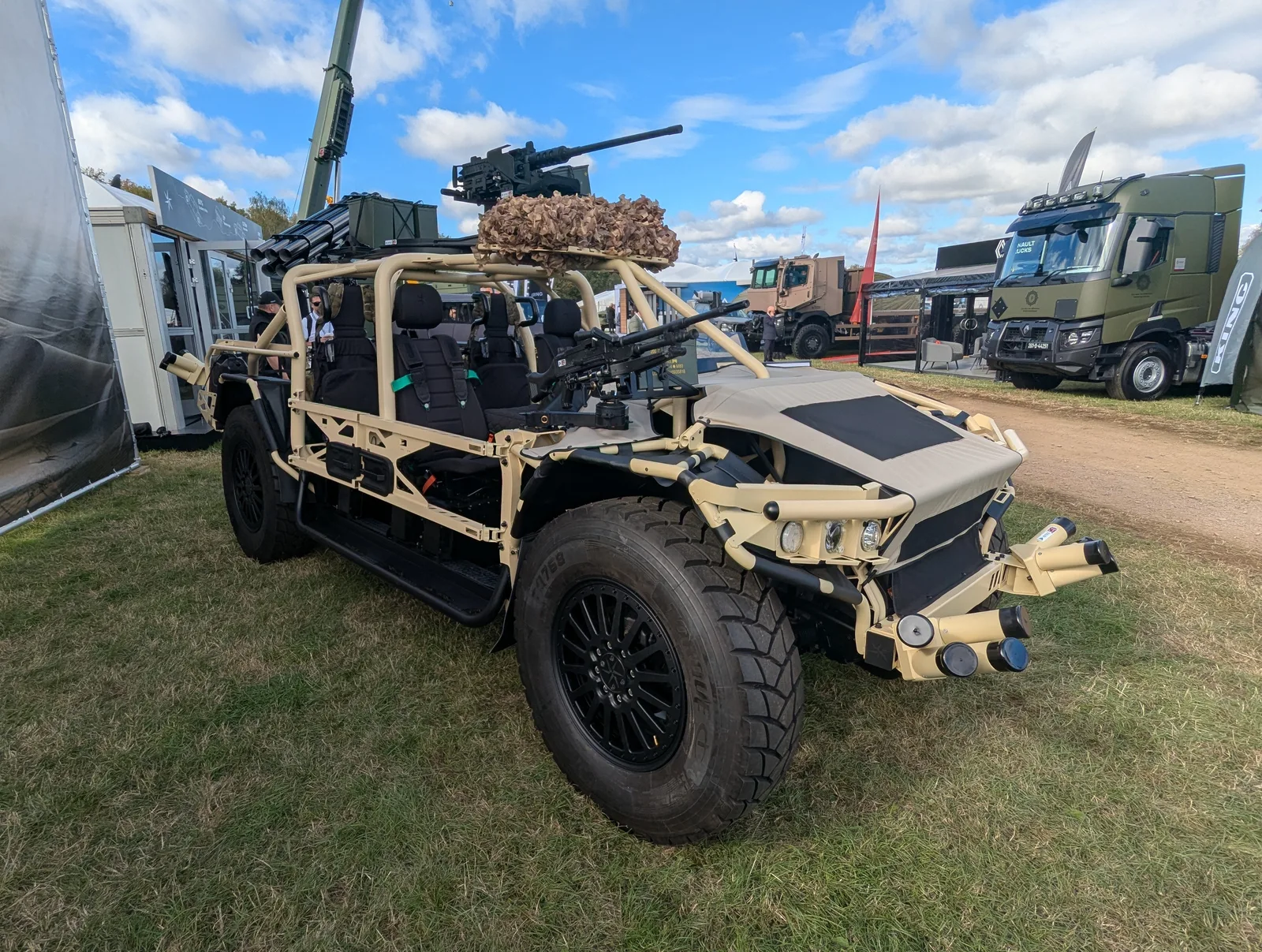
London-based Fering Technologies brought its Pioneer X ultra-long-range 4×4 mobility platform to the Defence Vehicle Dynamics (DVD) 2026 event, held at UTAC Millbrook Proving Ground in Bedfordshire on 16/17 September, promoting the vehicle’s unique capabilities. The Fering Pioneer X is a militarised variant of the original Fering Pioneer introduced in 2021.
Initially designed as an expedition vehicle that could circumnavigate the globe with as few fuel stops as possible, the Pioneer is driven by a hybrid electric powertrain featuring dual electric motors that deliver 490 Nm of torque per axle, four small lithium-titanium-oxide batteries and currently a relatively modest 1.1-litre diesel generator that keeps those batteries topped up. With a 470-litre fuel tank integrated into the vehicle’s central spine, this means that the Pioneer can achieve an astonishing range of 7,000 km on just one fuel tank.
As Gareth Reece, Fering’s chief commercial officer, explained to Warsight at DVD 2026 on 16 September, “Unlike a Tesla, where the entire lower chassis is just one large battery, we just use four small batteries, which are benign. They’re not particularly smart batteries because they don’t need to be. We’re not charging all the battery up try and get the range and push it all the way out like a Tesla would do; we’re just maintaining a charge on the battery, so we’re constantly topping the battery up to around about 80% because we have regen braking as well, so we’ve got to store that regen somewhere.”
The Pioneer’s hybrid electric powertrain means that the vehicle can also run completely silently out to a range of 80 km.
“And obviously, because it’s such a modular system, if we need more silent running, we just put an extra set of batteries in there,” Reece added.
Built around a modular frame that combines carbon fibre and aluminium, the Pioneer weighs just 1.8 tonnes but can carry a payload of 1,750 kg, so pretty much its own weight.
“Everything is built off a carbon tub. Because we don’t have a traditional mechanical transmission system, we use that space for fuel storage,” Reece explained. “We have a motor at the front, motor at the back, and then we have universal axles that plug into the actual carbon frame. Effectively that design enables us to get the range and also produce the power.”
Developed to handle extreme terrain, the Pioneer features a four-wheel internal independent air spring variable ride, with 18 bar active suspension, central tyre inflation system and on/offroad operating modes. With its powertrain delivering 480 Nm of power to each axle, the Pioneer can handle a 60% gradient climb, a 51° traverse angle and 0.75 m step climb. It is also fully submersible to IP67 standards.
Noting that the Pioneer would also be airdroppable, Reece said, “I think we sit very firmly in that niche of force projection, because once you’ve got the capability in theatre, we don’t really need a logistics resupply, in terms of fuel anyway, for potentially 7,000 km, which is the equivalent of driving from London to Istanbul and back,” thus making the vehicle an ideal platform for elite forces.
The Pioneer can also offload power in the field, acting as a battlefield power station and typically offloading 60 kWh of energy to power-hungry mission payloads such as counter-unmanned aerial vehicle systems.
“Just in terms of power provision, we can we can kick out around about 240 kW burst energy, so when you talk about directed-energy weapons, we are capable of delivering that,” Reece added.
The company has already worked with Sweden’s Saab regarding the feasibility of mounting a Saab Giraffe 1X 3D multi-mission radar on the Pioneer.
Asked by Warsight if Fering already has clients for the Pioneer X, Reece said, “Yes, we’re taking orders.” Warsight understands, although this was not overtly confirmed by Reece, that Fering has supplied Pioneer vehicles to the militaries of the United Arab Emirates as well as Canada, where the company is conducting trials with an autonomous variant that are due to be concluded by March 2027.
Pioneer: a supplement to LMV?
On 9 September 2026 Fering announced that it had entered a bid with the UK Ministry of Defence (MoD) to compete for its upcoming Light Mobility Vehicle (LMV) programme, which received initial funding in the MoD’s Defence Investment Plan (DIP), published on 30 June 2026.
Citing reports from Powersize.tech, the independent mission-based benchmarking platform for government R&D and procurement teams, Fering has demonstrated that, when analysed alongside numerous LMV competitor vehicles, the Pioneer – despite a ‘worst case’ unit cost of USD 1.2 million (EUR 1.05 million) unit cost that is higher than its rivals – would pay for itself in operating costs during a single 2,039 km mission, and considerably so.
While casting no doubt on those figures whatsoever, to this Warsight author Fering’s tilt at the LMV programme looks like something of a stretch for the Pioneer. The LMV programme, which is essentially to replace the British Army’s fleet of Land Rover- and Pinzgauer-based fleets, stipulates nine LMV variants, all to be derived from a common base platform, including an armoured Enhanced Protection Vehicle (EPV). It is difficult to see how the Pioneer X could address all of these requirements without compromising the very qualities that make it such a unique vehicle, especially when quite heavily armoured.
However, it is worth noting that – so far at least – the UK MoD has made no LMV stipulation with regard to the adoption of hybrid electric drive, despite its experimentation with such technology in recent years with efforts such as the Technology Demonstrator 6 (TD6) programme. This appears to be a very short-sighted approach when addressing vehicle fleets that will serve several decades into the future.
Perhaps, then, there could still be a place for the Pioneer X in UK service, even with no directly relevant requirement having yet been issued.
Reece appeared to acknowledge Fering’s LMV pitch is something of a long shot when he noted that “Perhaps our vehicles will supplement the LMV fleet.”
He also expressed some degree of vexation with the MoD’s apparent reticence to try something new.
“This is one thing that frustrates us as a small, growing business: the lack of appetite to trial experimental vehicles and to invest in our own economy,” he said. Yeah. “Even if it was a small fleet of five or 10 vehicles, that would sustain us for quite a lengthy period of time and give us runway.”
If some place can’t be found for the unique qualities of the Pioneer X – with UK special forces, for example – the UK MoD would seem to be missing a trick.