Since being announced in 2024, Türkiye’s Steel Dome integrated air and missile defence system has progressed remarkably quickly, and available production capacity for it may soon double.

Since being announced in 2024, Türkiye’s Steel Dome integrated air and missile defence system has progressed remarkably quickly, and available production capacity for it may soon double.

Standing before NATO leaders at the Alliance’s July 2026 summit in Ankara, President Recep Tayyip Erdoğan made an important announcement that few in the room had expected: Türkiye would allocate USD 24 billion for Çelik Kubbe (Steel Dome), its domestic multi-layered ground-based air defence (GBAD) architecture. The figure was striking not just for its size, but for what it signalled. Two years after the programme had been formally approved, Türkiye was no longer talking about a concept, it was writing cheques.
The USD 24 billion pledge is the latest and largest in a series of financial commitments that have come in rapid succession. Since Steel Dome was approved in August 2024, Türkiye has signed procurement packages totalling USD 6.5 billion and staged a succession of high-profile handover ceremonies. Hardware is already in the field, and more is coming.
What makes the programme unusual is its structure. There is no single Steel Dome contract. “There are a lot of contracts since the beginning,” says a Turkish defence industry professional speaking to Warsight on condition of anonymity. “But there is no single Steel Dome contract as far as I know. SSB [Türkiye’s Secretariat of Defence Industries] is signing contracts piece by piece – for radars, missile systems, EW [electronic warfare] systems, gun systems, and so on – but it is known they are all for Steel Dome. How many systems will be acquired is not fully known. The quantity is somewhat open-ended, but it is known that very substantial investment will be made.”
Steel Dome was formally approved at a meeting of the Defence Industry Executive Committee (SSİK) on 6 August 2024, and announced to the public shortly after. The concept had previously circulated internally under the name ‘Gökkubbe’ (ENG: ‘Celestial Dome’) before being renamed and officially sanctioned. From the outset, it was framed not as a new weapon but as a national architecture, a network connecting existing and future Turkish air defence systems under a single AI-driven command layer.
Exactly one year later, on 27 August 2025, the programme reached its first major public milestone. At Aselsan’s Gölbaşı campus near Ankara, Erdoğan presided over three events on the same day: the first large-scale Steel Dome delivery, the opening of 14 new Aselsan production facilities, and a groundbreaking ceremony for the Oğulbey Technology Base. “With Steel Dome, we will move into a different league in air defence,” he said.

The 27 August delivery package was valued at USD 460 million, and comprised 47 vehicles:
The 14 new Aselsan facilities, worth USD 280 million, were built specifically to support the higher production rates that Steel Dome requires. The USD 1.5 billion Oğulbey Technology Base, described as Europe’s largest integrated air defence production complex, is expected to more than double Aselsan’s manufacturing capacity when its first halls open, slated for 2026.
The August 2025 ceremony was not a one-off. In November 2025, SSB held a formal signing event with Aselsan, Roketsan, and Havelsan, locking in USD 6.5 billion in contracts for serial production and further system development across the Steel Dome family.
Deliveries continued through the end of the year. In December 2025, Aselsan handed over additional ALP-series radars, more Hisar-A batteries, a further Siper battery, and a batch of 35mm towed anti-aircraft guns. In January 2026, SSB President Haluk Görgün confirmed that another Siper system had passed its autonomous acceptance test and entered inventory. In April 2026, Roketsan staged a large handover at its newly opened Lalahan missile integration facility, delivering Siper, Hisar-A, Hisar-O, and Sungur man-portable air defence missiles, among other munitions.
Aselsan CEO Ahmet Akyol has set a target of more than 100 system component deliveries in 2026 alone, more than double the August 2025 package. The new Gölbaşı facilities and the ongoing Oğulbey construction are meant to make that possible. Table 1 summarises the procurement activity and contract values revealed thus far.
| Table 1: Steel Dome procurement activity | ||
| Date | Event | Value |
| 6 Aug 2024 | Programme approved at Defence Industry Executive Comitee (SSİK); renamed from Gökkubbe to Çelik Kubbe (Steel Dome) | – |
| 27 Aug 2025 | 47 vehicles delivered: 10× Siper (1 battery); 21× Hisar-O+ (3 batteries); 2× Korkut 150 vehicles; 3× Korkut 130 towed platforms; 7× Puhu 3-LT ESM EW System+; 2× Redet EW; 2× ALP 300-G radars |
USD 460 million |
| 25 Nov 2025 | Contracts signed with Aselsan, Roketsan, Havelsan for serial production of Siper, HISAR, radar and C2 systems | USD 6.5 billion |
| Dec 2025 | 1× Siper SAM battery, multiple Hisar-A Short-range SAM, ALP-series radars, 35mm towed guns | n.k. |
| Apr 2026 | Multiple Siper, Hisar-A, Hisar-O, Sungur (Very short range SAM) (Roketsan Lalahan facility handover) | n.k. |
| Jun 2026 | Aselsan contract for comms, satellite and C2 components | ~USD 900 million |
| Jul 2026 | USD 24 billion in funding announced by Erdoğan at NATO Summit, Ankara | USD 24 billion (planned) |
| Note: Quantities for December 2025, January 2026 and April 2026 deliveries are listed as “multiple” in official statements; specific unit numbers have not been publicly confirmed. | ||
Steel Dome is not a single weapon, it is a networked system of multiple different systems. At its core is an automated, artificial intelligence (AI)-driven C2 software layer built by Aselsan, which connects all platforms over a military digital communications backbone. The industrial team behind it includes Aselsan for integration and C2, Roketsan for missiles and propulsion, Tübitak Sage for guidance systems, and MKE for munitions.

The system covers multiple engagement layers. At the close-in layer are the Şahin counter-unmanned aerial vehicle (C-UAV) system armed with a 40 mm automatic grenade launcher with ATOM air-bursting munitions, the Gökberk high-energy laser (HEL) system, and the Ihtar drone jamming system.
Slightly above this, at the very short-range air defence (VSHORAD) layer are Korkut SPAAGs/towed 35 mm anti-aircraft guns, and Sungur man-portable air defence system (MANPADS) missiles. Slightly above this, the Gürz self-propelled anti-aircraft gun and missile (SPAAGM) system straddles the very-short/short-range air defence (V/SHORAD) layer.
Slightly above this, straddling the short to medium-range air defence (MRAD) layer is the Hisar-A+, able to intercept targets at ranges of approximately 15 km and to altitudes up 10 km. Above this is the Hisar-O+ forming the main defence for the MRAD layer. Ranges vary depending on the missile used – infrared (IR) or radio frequency (RF) – but the longer-range RF active seeker-equipped missile is able to engage targets at ranges of over 25 km, and to altitudes of around 15 km.
Siper provides the long-range air defence (LRAD) and missile defence against short-range ballistic threats. The Siper Block 1 missile’s performance has previously been disclosed as at being over 100 km in range, and 20 km in altitude. This has been validated in testing. The follow-on Siper Block 2 is slated to provide a substantial performance gain, with over 150 km range and 30 km altitude.
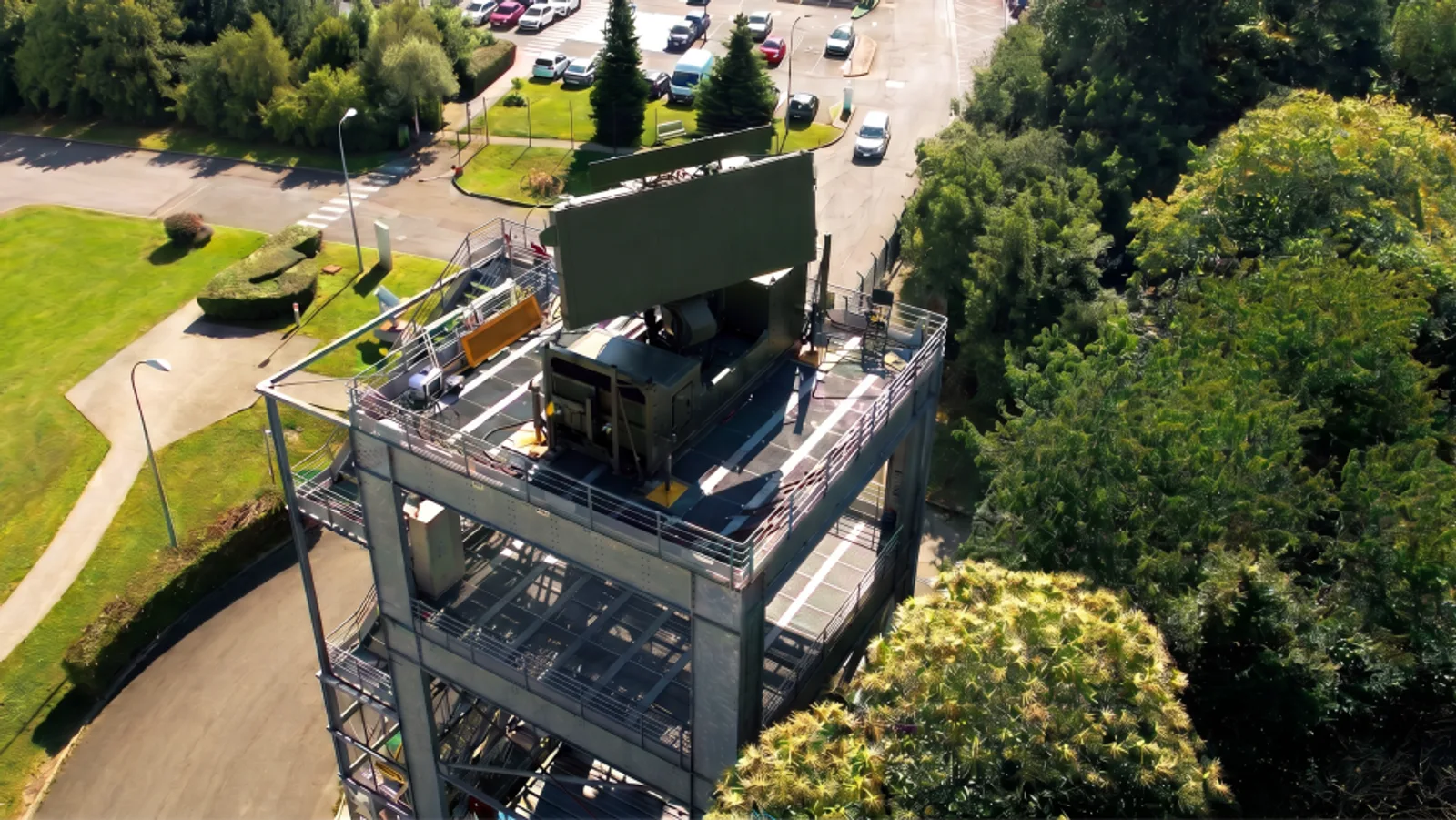
A network of ALP-series radars and Puhu and Redet ESM/EW platforms feed data into the system, allowing it to identify threats and assign the right interceptor automatically.
On interoperability with allied systems, the answer appears to be yes, but the details are not public. The same Turkish industry source said Steel Dome’s C2 infrastructure is already linked to Turkish military digital networks, and that allied air defence systems operating in Türkiye connect through the same framework. “It will certainly be compatible,” the source said, adding, “when the PATRIOTs came here, they connected through that network.”
On the broader NATO angle, including the USD 26.3 billion air and missile defence framework agreement signed at the July 2026 Ankara Summit, which is reported to cover Steel Dome interoperability and potentially technology transfer, the source was direct about the limits of available information. “There is integration. We don’t fully know the content. What NATO will do, what we signed, whether we will acquire [additional systems] ourselves – those parts are unknown, because the contents of the agreements were not announced.”

The financial trajectory tells the story clearly. The programme was approved in August 2024 with no single announced budget. The first large delivery batch in August 2025 was valued at USD 460 million. The November 2025 contracts added USD 6.5 billion for serial production and development. The Oğulbey facility alone carries a USD 1.5 billion price tag. The NATO Summit announcement put the total planned allocation at USD 24 billion over multiple years, covering not just procurement but a long-term industrial build-up intended to make Türkiye a net exporter, not just a buyer, in the air defence market.
In the roughly two years since Steel Dome was approved, Türkiye has moved from a formal concept to a programme with hardware in the field, a production infrastructure taking shape, and a financial commitment that few European nations can match. Whether Aselsan hits its 100-plus system component delivery target for 2026, and how quickly Oğulbey comes online, will determine whether Steel Dome grows from a credible national project into a fully operational strategic shield.