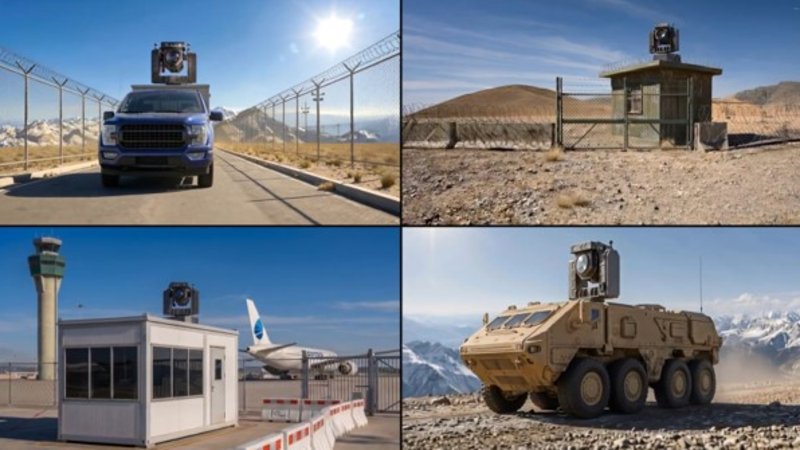

Israeli defence start-up Esh-Tech announced the development of its new DroneLight laser-based short-range counter-unmanned aerial vehicle (C-UAV) system at Eurosatory 2026, held in Paris from 15 to 19 June.
Unlike other laser-based C-UAV systems, which typically use continuous-wave lasers with an energy consumption of at least 20 kW and can take 15 seconds or more – focusing on a specific point on a drone – to kill it, DroneLight uses a pulsed laser that requires just 4 kW and can bring down a drone in a couple of seconds.
Since Dronelight only has to perform milliseconds of active firing to be effective, it has a low power requirement that gives the system what Esh-Tech asserts are best-in-class size, weight, power and cost (SWaP-C) characteristics, meaning that the system can be mounted on tactical vehicles and only have to draw power from those vehicles rather than having to rely on a sizeable separate power unit.
Explaining how the system works, Erez Riahi, CEO and co-founder of Esh-Tech, told Warsight at Eurosatory 2026 on 15 June that DroneLight uses a high-energy pulsed laser operating at a pulse repetition frequency greater than 5 Hz (ie more than five pulses per second). Its precision comes through the use of a co-boresighted 300 mm optical and laser aperture.
“To make a hole [in the targeted UAV] what we are doing, instead of trying to burn it, we have very high energy, very high power, but very short, and it’s like a bullet, and we are doing five holes per second,” said Riahi. “We are making a lot of holes into the target. What happens, at one or two of the holes, we hit a vital place like the electronics, or camera, or communication system, or any sensor or battery, even we can also kill the battery.
“According to our test that we made in real conditions,” Riahi added, “it will take on average between five and 10 hits to kill a drone. It can be the first one, it can be the 15th one, but on average five to 10. So that says that we need between one and two seconds to kill a single drone.”
Dronelight’s effectiveness is also enhanced by a system that optimises its performance in light of the prevailing atmospheric conditions. “The atmosphere is changing all the time,” said Riahi, “so we developed a specific algorithm based on AI etc that monitors the atmosphere at 1,000 times per second.” He explained that this can improve the performance of the system by 50-70% “because you know exactly when to send your laser”.
The initial DroneLight system, said Riahi, has a range of around 500 m, but a subsequent iteration of the system will extend this range out to 1 km. The system also has high-slew kinematics that offer a 360° field of fire with a 120° /s slew rate and acceleration of 60°/sec².
Asked by Warsight why no one else had developed a similar system for the C-UAV mission before, Riahi replied, “Because developing such a laser is a very complicated issue at a normal price.” He explained that Esh-Tech has taken years to develop a laser system that can handle a high power output without destroying its optics, adding, “I cannot elaborate more because of the IP that we have, but believe me: to do that is very complicated. Most of the companies that are making lasers are buying lasers from another company and then doing the integration, the optics and things like that, but here we are developing the laser by ourselves.”