The appearance of a Typhoon test aircraft over Wales carrying APKWS rockets in March 2026 was a telling sign of the times. Across NATO, air forces that have more typically prepared to fight peer adversaries are now rethinking their arsenals for a world of mass-produced disposable drones.
Sledgehammers for cracking nuts: UK air defence against Iranian drones

Eight F-35Bs of No.617 Squadron were deployed to Akrotiri to bolster the Station’s air power. (Crown Copyright/Royal Air Force, 2026)
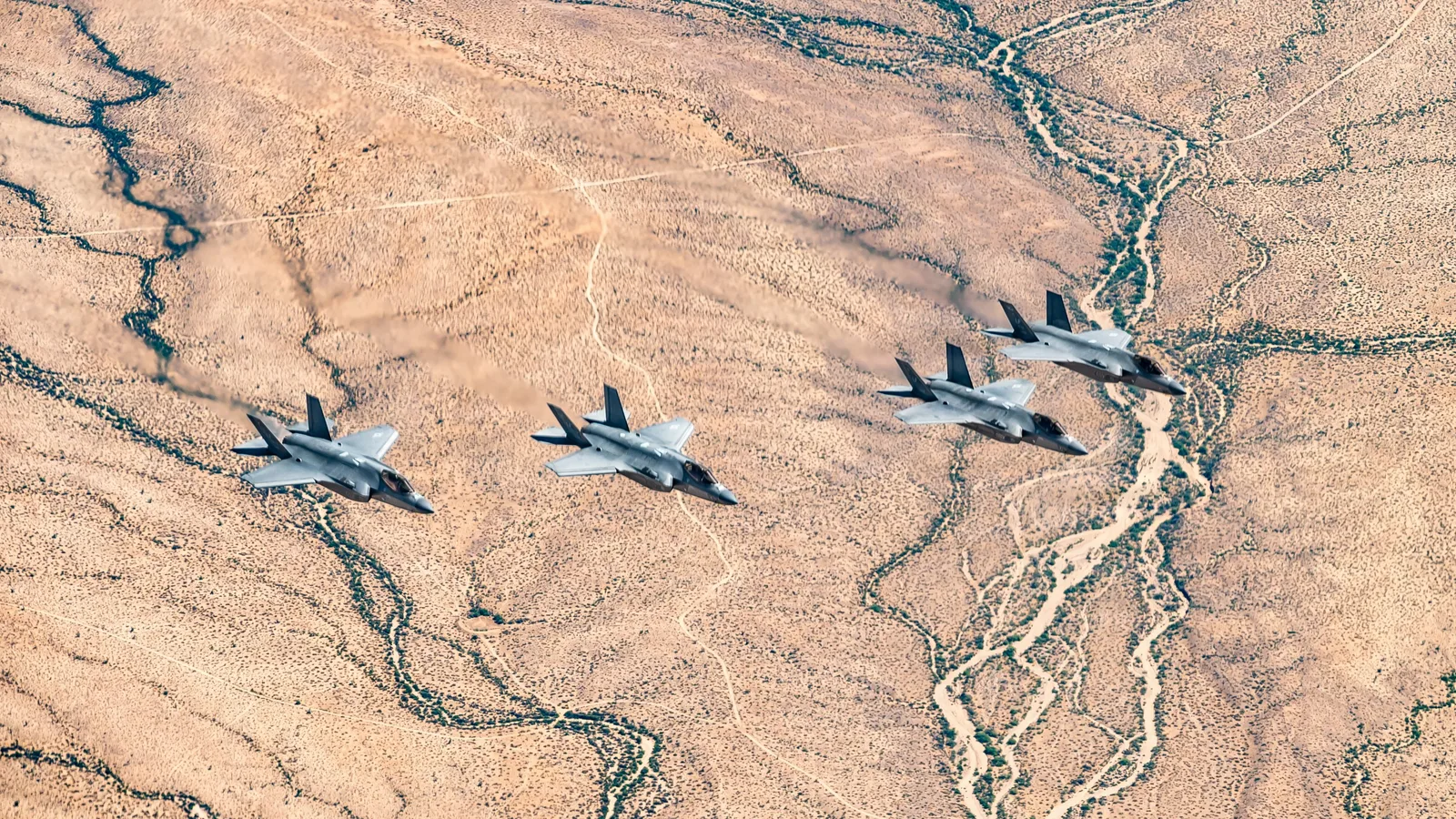
During recent operations in the Middle East, the UK deployed a range of air defence assets to protect its bases on the island of Cyprus, and to support and defend regional allies against a wide spectrum of threats, but especially performing C-UAV (counter unmanned aerial vehicle) missions against Iranian Shahed one-way attack (OWA) drones. The UK deployed its Rapid Sentry short-range air defence (SHORAD) system, Leonardo Helicopters AW159 Wildcat helicopters armed with Martlet Lightweight Multirole Missiles (LMMs), as well as Lockheed Martin F-35B Lightning II and Eurofighter Typhoon manned fighters.
Manned fighter aircraft can be regarded as representing ‘traditional air defence’, and still provide one of the most important ‘layers’ in defending against air threats. Fighter aircraft offer greater flexibility and longer range than ground-based air defence (GBAD) effectors, often allowing a threat to be intercepted and destroyed further out, and for the fighter to reposition rapidly to deal with new threats. Compared to GBAD, fast jet fighters can cover much greater distances at higher speeds, and thereby protect larger areas, while also being more ‘reactive’ in the face of multi access threats. Manned fighters typically carry a range of weapons, giving them impressive capability against a wide spectrum of targets, and also carry their own sensors – principally radar and infrared (IR). This has proved pivotal in recent operations, with Typhoon proving able to detect low radar cross section (RCS) drone targets, and to give its pilots good situational awareness even in congested airspace, with many other players nearby.
Against unmanned threats – and particularly against cheap, relatively slow-moving OWA drones, manned fast jet fighters may not be ideally suited – with performance characteristics that may not match those of the target very well. Up to now, RAF fighters have not carried the best weapons for the task, lacking persistence, while also missing optimised low-cost effectors.
This has not prevented RAF Typhoons and F-35Bs from downing Iranian Shahed drones, with the Typhoon opening the RAF’s scoring on 14 December 2021 above the Al Tanf Coalition base in Syria. The importance of countering unmanned platforms was underlined on 1 March 2026, when a Shahed drone slammed into the side of a hangar at RAF Akrotiri, a UK Sovereign Base Area on the island of Cyprus. Though Akrotiri hosts a detachment of Typhoons used to support Operation Shader, the Iranian OWA drone is understood to have hit a hangar used by the ‘Olive Harvest’ U-2S detachment.

A No.12 Squadron Typhoon scored the RAF’s first kill of the present campaign later that same day (1 March), shooting down a Shahed drone that was approaching Qatar. The Typhoon pilot used a single MBDA ASRAAM IR-homing air-to-air missile (AAM) to down the enemy aircraft. A Royal Navy F-35B pilot serving with the RAF’s No.617 Squadron then ‘splashed’ two enemy drones in Jordanian airspace on 2 March, again using ASRAAM missiles. Interestingly, the F-35B was reported to have been flying alongside two Typhoons from RAF Akrotiri.
But there are concerns about the RAF’s missile stocks, which are running low (the French Armée de l’Air is experiencing much the same with MICA missile stocks). There is also a concern as to the cost effectiveness of expending a GBP 200,000 ASRAAM (or a EUR 1.2-2 million MICA) against a USD 20,000 drone. In Ukraine, the need to conserve AIM-9 Sidewinder stocks has led F-16 pilots to shoot down Shahed drones using their M61A1 20 mm cannon. Subsequently, Ukraine obtained BAE Systems Inc. AGR-20F APKWS (Advanced Precision Kill Weapon System) rockets, also known as the FALCO (Fixed Wing, Air Launched, Counter-Unmanned Aircraft Systems Ordnance). These take Hydra 70 Mk 66 rockets, and add Distributed Aperture Semi-Active Laser Seeker (DASALS) guidance and a proximity fuse, as well as air-to-air optimised guidance and sensing algorithms. An IR homing capability is reportedly set to be integrated in future.
The United States has already integrated these missiles onto the F-16C Fighting Falcon and the F-15E Strike Eagle, and were first used against Houthi UAVs. The F-15E to carry up to 42 precision-guided APKWS rockets in six seven-round pods, providing a volume of fire that is unmatched using conventional air-to-air missile loadouts.
And while an AIM-9X costs more than USD 450,000, and an AIM-120 AMRAAM double that, or more, the APKWS costs much less, with some estimates as low as USD 15,000-20,000. This makes it a cost-effective tool for engaging cheap drones. For comparison, cost estimates for select NATO munitions used to engage drones in the air-to-air role are summarised in Table 1.
| Table 1: Cost summary for select NATO munitions used in air-to-air drone engagements | |
| Munition | Cost per round (USD) |
| M789 HEDP munition for M230LF chain gun | 100 |
| XM1211 HEP munition for M230LF chain gun | 275 |
| APKWS | 20,000 – 41,000* |
| Thales 68 mm Induction Rocket System (IRS) | 10,000 (est.) |
| LMM (Martlet) | 66,000 – 93,000 |
| ASRAAM | 264,000 |
| AIM-9X | 400,000 – 500,000** |
| MICA (RF and IR) | 1,380,000 – 2,520,000 |
| Notes:
*768 APKWS-II rocket kits were sold to the UK for the AH-64E at an estimated cost of USD 31.2 million. This brought the cost to USD 40,625 per unit, covering the rockets, support equipment, and technical services. **340 AIM-9X missiles for Denmark cost USD 318.4 million in 2025. This would represent a cost of USD 935,294 per unit, but this figure also included tactical guidance units, training, support, and spares. |
|
At the DSEI exhibition in September 2025, BAE Systems said that it was assessing the APKWS guided rocket as one of a range of potential counter-drone weapons for the Typhoon, though the RAF had previously stated that it had no requirement to integrate the weapon on the Typhoon. The day after the F-35B scored its first drone kills, on 3 March 2026, spotters outside BAE’s Warton factory aerodrome photographed a Typhoon test aircraft carrying (apparently empty) seven-round rocket pods under each wing.
The following day the same aircraft flew again, this time with what appeared to be a single APKWS round in the centre position of the starboard pod, landing later with the pod empty. The aircraft was said to have flown out over Wales, presumably to the Aberporth range.


BAE Systems refused to comment, beyond saying that: “Warton Aerodrome is regularly used for flight testing by BAE Systems using our fleet of test-and-evaluation Typhoon aircraft in support of the UK and our international customers. This activity is part of our scheduled programme and we do not comment on the nature of these flights.”
Warsight understands, however, that this firing was made in support of an RAF Urgent Operational Requirement (UOR) to integrate the weapon on Typhoon.
To augment UK C-UAV capabilities in the region, on 3 March 2026, the Royal Navy announced that it was “sending two Wildcat helicopters to Cyprus to bolster drone defence for our Cypriot partners.” By mid-March, three Leonardo AW159 Wildcats from No.815 Squadron were in place, all carrying up to ten Martlet Lightweight Multirole Missiles (LMMs), optimised for the C-UAV role. There have been no reports of successful interceptions by the Wildcats, but the LMM missile has enjoyed success in the ground-launched role, as part of the RAF Regiment’s ‘Rapid Sentry’ C-UAV system.

Any helicopter C-UAV platform has to be in the right place at the right time, and must get its intercept geometry right first time, as it will have minimal ‘overtake’ compared to a fixed wing UAV, especially ‘post merge’ or once behind the target’s 3-9 line. This tends to make it more useful for relatively short range, local air defence closer to the anticipated target.
Some have expressed surprise that the UK has not deployed AH-64E Apaches to the region for drone hunting. Israel and the UAE have employed the Apache in the C-UAV role, demonstrating the effectiveness of the M230LF 30 mm chain gun and its XM1211 high explosive proximity (HEP) ammunition – 70-150 rounds can be fired for the price of a single APKWS rocket.

Share post